Vogue
“The New York society weekly of 1892 that Condé Nast bought in 1909 and made the world's most influential fashion magazine, still published today in editions around the world.”
Vogue is the fashion magazine that, for more than a century, has decided what the world should wear, who should be photographed and what a magazine can look like. It began in New York on 17 December 1892 as a ten-cent weekly for the city's high society, made by the businessman Arthur Baldwin Turnure. In 1909 Condé Nast bought it and turned it into a fashion magazine for women. Today it is published in New York and, in many languages, around the world, by Condé Nast, which belongs to the Newhouse family's Advance Publications.
Turnure's first issue, on a Saturday, promised in its own words 'a dignified authentic journal of society, fashion and the ceremonial side of life', 'mainly pictorial', with Josephine Redding as editor and over two hundred and fifty shareholders. After Turnure's death in 1906 it was Condé Nast, an advertising man, who saw what it could be: by July 1909 he was its president, in 1910 it became a fortnightly at fifteen cents, and he sold advertisers what he called the 'elimination of waste circulation', the small number of rich readers who could buy their goods. Vogue was not the first fashion magazine: Godey's Lady's Book dates from 1830 and Harper's Bazar from 1867. It became one under Nast.
Edna Woolman Chase, editor from 1914 to 1952, ran the magazine for Nast through two wars. In November 1914, with Paris closed to buyers, she and Vogue staged a Fashion Fête in New York for American dressmakers. Nast then took Vogue abroad: British Vogue in 1916, the first overseas edition, and Vogue Paris in 1920, with Lucien Vogel and artists from his Gazette du Bon Ton. Vogue also sold dress patterns, a business it handed to Butterick in 1961. Nast's other great idea was to hire the best picture-makers: the illustrators Helen Dryden and Georges Lepape, then the photographers Baron de Meyer (from 1914), Edward Steichen (chief photographer from 1923, with the first colour photograph on a cover, 1 July 1932), Horst, Cecil Beaton and, from 1943, Irving Penn.
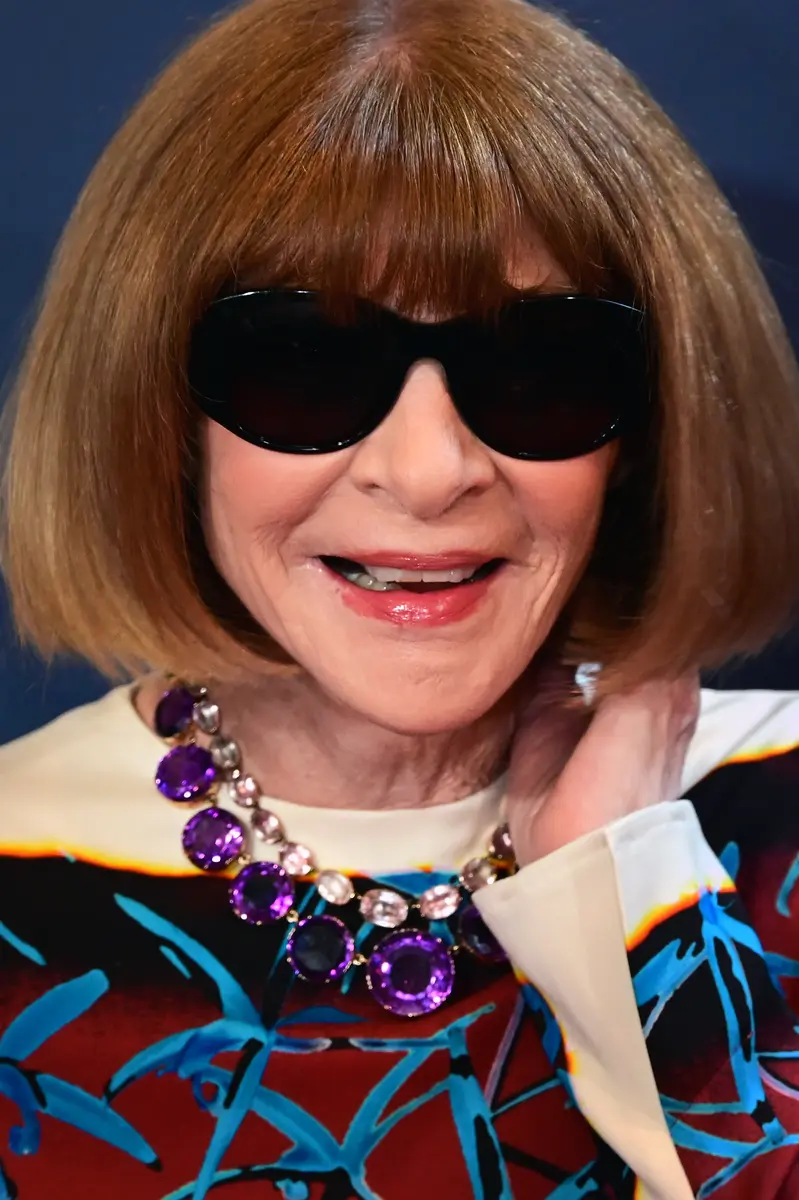
The look of Vogue is the look of its editors and photographers. Lee Miller sent war reports from Normandy in 1944. Diana Vreeland (1963–71) filled it with youth, the 'Youthquake' and Richard Avedon's pictures; Grace Mirabella (1971–88) made it a guide for working women, and put Beverly Johnson on the August 1974 cover, the first Black woman on American Vogue. Anna Wintour (1988–2025, told in her own entry) brought the celebrity cover, couture with jeans and the Met Gala. Abroad, Franca Sozzani's Vogue Italia (1988–2016) was the most daring edition; Vogue China began in 2005 and Vogue Arabia in 2017. A film, 'The September Issue' (2009), and the live Vogue World shows, begun in 2022, made the magazine itself a spectacle.
In June 2025 Wintour said she would step down as American Vogue's editor in chief after 37 years, and in September Vogue named Chloe Malle its 'head of editorial content', ending the title of editor in chief. Wintour stays as Vogue's global editorial director and as Condé Nast's chief content officer. Its name is the French word for fashion.
What happened
- 1892
A new weekly, Vogue, appears in New York on a Saturday, price ten cents. Its publisher Arthur B. Turnure says it is to be 'a dignified authentic journal of society, fashion and the ceremonial side of life', 'mainly pictorial'; over two hundred and fifty shareholders have bought stock; Mrs Josephine Redding is editor and Harry W. McVickar art director. The cover shows a debutante.
Union Square, New York: Vogue's first office, at 61 Union Place, the southwest corner of East 18th Street and Fourth Avenue, 'Head Office' in the Publisher's Notices of the first issue (17 December 1892)- 1893
The cover is an oval portrait of the Comtesse Divonne, 'née Miss Florence Audenried', which looks like a halftone of a photograph: the likeliest candidate for Vogue's first photographed cover, though no authority names it so.
- 1906
Arthur Turnure dies of pneumonia, aged 49 (13 April, according to Wikipedia). Wikipedia says Marie Harrison becomes the majority shareholder of The Vogue Company; by July 1909 the company's vice president is M. L. Harrison and its secretary W. O. Harrison.
- 1909
Condé Nast, a former advertising manager of Collier's Weekly, buys the weekly society paper Vogue, then selling about 14,000 copies, and decides to make it 'the technical adviser' of the woman of fashion in her clothes. By the issue of 1 July 1909 he is the company's president, in offices at 11-15 East 24th Street.
Madison Square, New York: The Vogue Company's offices at 11-15 East 24th Street, where Condé Nast was president by July 1909 and Vogue became a fortnightly in 1910 - 1910
'First issue of Vogue as a fortnightly', says the cover, with a 'Special Fashion Number', price fifteen cents instead of ten: Nast has doubled the number of issues a month and raised the price.
- 1912
A colour cover by Helen Dryden, one of the artists Nast pays to make his covers, shows the winter fashions. By now each issue carries named cover artists, more advertising pages and more patterns, which the magazine has sold from a home-sewing department since about 1899.
- 1914
Edna Woolman Chase, who joined the circulation department in 1895 at eighteen, becomes Vogue's editor, an office she holds until 1952. In the same year Baron Adolph de Meyer, whose first photograph for Vogue appeared in 1913, becomes its first full-time fashion photographer.
With the war closing Paris to American buyers, Chase and Vogue stage a 'Fashion Fête' in the ballroom of the Ritz-Carlton Hotel in New York, showing clothes made by New York dressmakers, with the profit going through the Committee of Mercy to women and children left destitute by the war. Vogue gives the opening as 'the evening of November 4'.
- 1916
British Vogue, the first overseas edition, is launched in London, after the war made it impossible to ship American copies to Europe; its first editor is Elspeth Champcommunal. Britannica gives only the year 1916; Wikipedia gives September.
Vogue House, Hanover Square, London: the home of British Vogue (1916), Vogue's first overseas edition, in a building completed in 1958- 1920
Vogue Paris is founded by Condé Nast, the oldest French fashion magazine still published. Lucien Vogel, founder of the Gazette du Bon Ton, whose artists Nast had already used for Vogue covers, becomes its first art director, and his wife Cosette de Brunhoff its first editor.
Place Vendôme, Paris: Vogue Paris, founded by Condé Nast in 1920, the oldest French fashion magazine still published; the point is the square where Vogue World: Paris was staged on 23 June 2024, no Vogue Paris office of 1920 having been found - 1923
Edward Steichen, back in New York, reads in Vanity Fair that he has given up photography and goes to see Nast to set the record straight; Nast, who has just lost de Meyer to a rival, offers him the job of chief photographer of Vogue and Vanity Fair. He keeps it until 1937 (or 1938: qa.uncertain) and gives Vogue sharp, modern pictures in place of de Meyer's soft focus.
- 1927
Georges Lepape, the Gazette du Bon Ton artist whom Lucien Vogel met in 1911 and whom Nast had put on Vogue covers during the war, draws the cover of Vogue's Paris edition for spring hats and fabrics.
Place Vendôme, Paris: Vogue Paris, founded by Condé Nast in 1920, the oldest French fashion magazine still published; the point is the square where Vogue World: Paris was staged on 23 June 2024, no Vogue Paris office of 1920 having been found- 1932
Vogue's first cover in colour photography: Edward Steichen's swimmer holding a beach ball, made in the studio, for the Beauty Number. Britannica calls Vogue 'one of the first' magazines to print a colour photograph on its cover.
- 1936
Vanity Fair, Nast's other glossy, is folded into Vogue, which carries 'incorporating Vanity Fair' on its masthead for years afterwards.
- 1939
Horst P. Horst's photograph of Madame Bernon seen from behind in a laced corset by Detolle for Mainbocher is printed full-page in the Paris Openings number, in the days before the war: the V&A calls it Horst's most iconic image.
- 1942
Condé Nast dies. Vogue's notice, printed with his portrait in the issue of 15 October, says his associates 'now receive, in his passing, the heritage of his principles and purposes'.
- 1943
Irving Penn, hired that year by art director Alexander Liberman to suggest cover ideas, takes his first colour photograph, a still life of accessories, which becomes the cover of the 1 October issue and the start of his Vogue career.
- 1944
American Vogue prints Lee Miller's six-page report from a U.S. Army tent hospital in Normandy, which she has photographed and written as Vogue's War Correspondent; the cover of the issue announces it.
- 1946
British Pathé's film 'Vogue (1946)' follows the making of British Vogue: editor Audrey Withers at an editorial meeting, Clifford Coffin taking a fashion photograph, Carl Erickson sketching, Lee Miller choosing pictures from the Balkans, then the printing and a woman buying the magazine at a newsagent's.
- 1949
Penn's 'The Tarot Reader' opens 'Vogue's Eye View of Diablerie': a fortune told in huge black hats, one of the pictures that made him, in the V&A's words, one of Vogue's most significant fashion photographers.
- 1951
Cecil Beaton photographs the 'New Soft Look' in front of Jackson Pollock's drip paintings at the Betty Parsons Gallery, the best-known fashion shoot of the New York School; Beaton had joined Vogue's pages after a 1926 London exhibition won him a contract, and worked for it for thirty years (V&A).
- 1952
Chase retires after 38 years as editor; Jessica Daves succeeds her, remembered for strengthening Vogue's arts and literary pages in the 1950s.
- 1959
Samuel I. Newhouse buys control of Condé Nast Publications, for about $5 million according to Wikipedia; his company Advance Publications has owned Vogue ever since, and his son S. I. 'Si' Newhouse became chairman in 1975.
- 1961
Condé Nast sells its pattern business, the Vogue Pattern Service, to the Butterick company, which licenses the Vogue name for patterns from then on; the magazine itself stays with Condé Nast.
- 1963
Diana Vreeland, who came from Harper's Bazaar in 1962, becomes Vogue's editor in chief, until 1971. She turns it to 'the novel, the bizarre and the outrageous', youth, rock and 'the Beautiful People' (Britannica).
- 1965
The issue of 1 January 1965 prints 'Youthquake', the feature on the 'bright young people', under Vreeland's editorship; the Getty Museum credits her with coining the word in 1965 for the youth-led fashion of the decade.
- 1967
Richard Avedon's picture of the seventeen-year-old Penelope Tree and a great diamond opens 'The Penelope Tree' by Polly Devlin, one of the girls Vreeland made famous.
- 1971
Vreeland is removed; Grace Mirabella, her associate, is named editor in chief, to give the magazine a practical voice for the working women of the seventies. Mirabella remains until 1988.
- 1972
Eighteen pages of 'this year's sun dressing' are shot by Helmut Newton on the island of Maui; he works for Vogue from 1971, one of several photographers (with Avedon, Demarchelier, Elgort) of Mirabella's years.
- 1974
Beverly Johnson is on the cover of August 1974, the first Black woman on the cover of American Vogue (Donyale Luna had been on British Vogue in 1966).
- 1988
Franca Sozzani becomes editor in chief of Vogue Italia, which she leads until her death in 2016, making it the edition known for ground-breaking photography, with Steven Meisel as her longtime collaborator.
Galleria Vittorio Emanuele II, Milan: Vogue Italia, edited by Franca Sozzani from 1988 to 2016; the point is the arcade where Vogue World: Milano was held on 22 September 2026, no Vogue Italia address having been checkedCondé Nast's owner S. I. Newhouse replaces Mirabella, who is said to have learned of it from the news, with Anna Wintour, 38, from British Vogue and House & Garden, because Vogue is losing ground to Elle. Wintour's own work at Vogue is told in her entry.
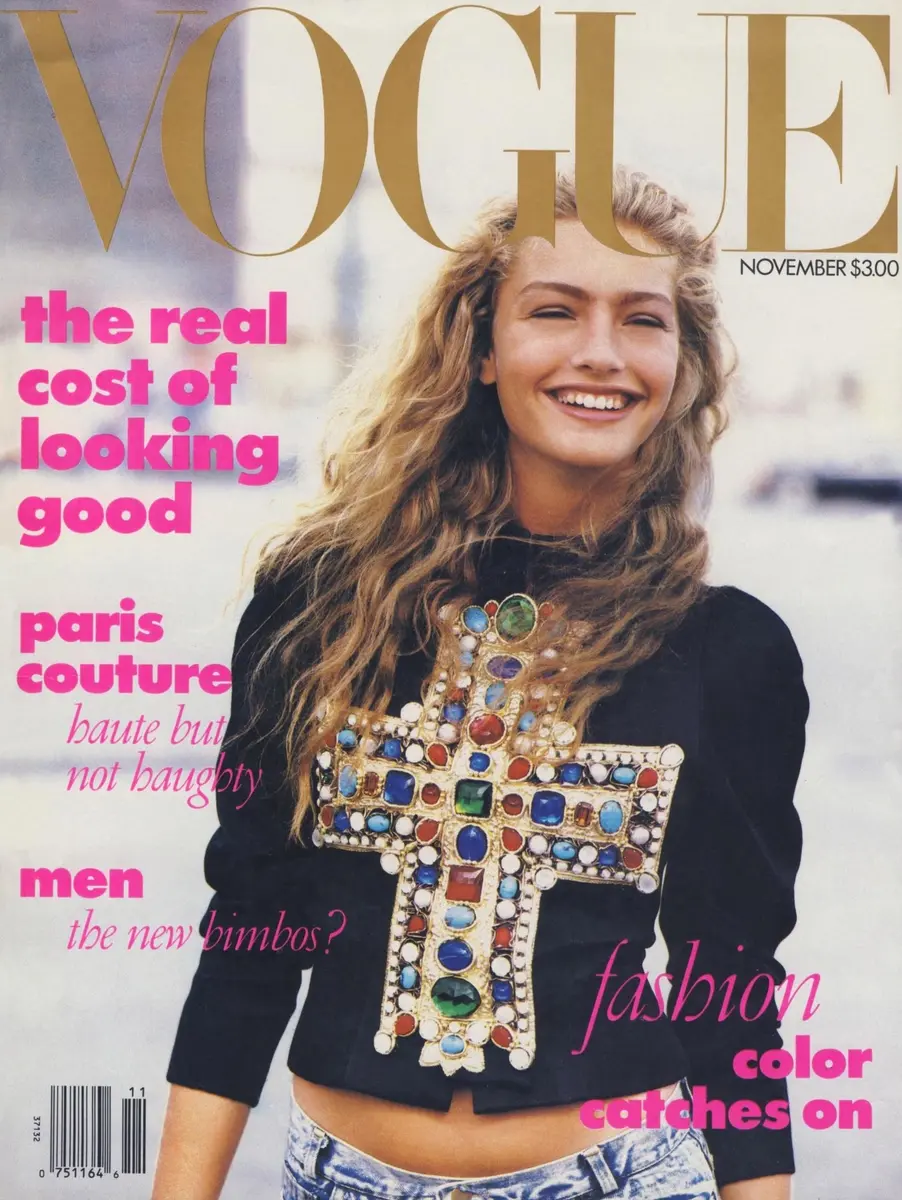
Wintour's first cover, November 1988: a laughing model in a jewelled couture jacket over jeans, shot outdoors. The look, with celebrities rather than only models on later covers, is imitated worldwide.
- 2005
Vogue China, the sixteenth edition of Vogue, is launched, made by Condé Nast with the state-owned China Pictorial Publishing House; Angelica Cheung is its first editor in chief and its first print run is said to have sold out.
- 2009
The cover of the March 2009 issue, with Michelle Obama photographed by Annie Leibovitz, is released; Hillary Clinton, in December 1998, was the first First Lady on the cover (Wikipedia), and André Leon Talley writes Obama's cover story.
R. J. Cutler's film 'The September Issue', about the making of the record 840-page September 2007 issue and about Wintour and her creative director Grace Coddington, opens in the United States, after its first showing at Sundance on 16 January 2009.
- 2014
Condé Nast, the first tenant to open for business in One World Trade Center, moves the first 175 of its 3,400 staff from Times Square; Wintour's Vogue is to take the 25th floor.
One World Trade Center, Lower Manhattan: the headquarters of Condé Nast and of American Vogue since November 2014- 2016
Franca Sozzani dies in Milan, aged 66, after a year-long illness; Anna Wintour calls her 'warm, clever, funny' and 'the hardest-working person I have known'.
Galleria Vittorio Emanuele II, Milan: Vogue Italia, edited by Franca Sozzani from 1988 to 2016; the point is the arcade where Vogue World: Milano was held on 22 September 2026, no Vogue Italia address having been checked- 2017
Vogue Arabia, the 22nd edition, goes on sale in print, with Gigi Hadid on the cover (photographed by Inez and Vinoodh, per Wikipedia); it had started online in 2016 under licence with Nervora of Dubai.
- 2022
The first Vogue World, a fashion show and street fair for Vogue's 130th anniversary, takes over a block in the Meatpacking District in New York during Fashion Week; London follows on 14 September 2023 (Theatre Royal Drury Lane) and Paris on 23 June 2024 (Place Vendôme).
Place Vendôme, Paris: Vogue Paris, founded by Condé Nast in 1920, the oldest French fashion magazine still published; the point is the square where Vogue World: Paris was staged on 23 June 2024, no Vogue Paris office of 1920 having been found- 2024
The May 2024 cover, with Zendaya in a red rose-shaped Dolce & Gabbana dress photographed by Annie Leibovitz, is revealed ahead of the Met Gala.
- 2025
Anna Wintour tells staff that she will step down as editor in chief of American Vogue after 37 years; she stays Vogue's global editorial director and Condé Nast's chief content officer, and the editor-in-chief title is to be replaced by 'head of editorial content'.
Vogue names Chloe Malle, editor of Vogue.com, as its first head of editorial content, reporting to Wintour; the title of editor in chief of American Vogue ends after 133 years.
Vogue World: Hollywood, the fourth Vogue World, is held on the Paramount Pictures lot, with costume designers and fashion houses; Vogue World: Milano follows on 22 September 2026 in the Galleria Vittorio Emanuele II.
Galleria Vittorio Emanuele II, Milan: Vogue Italia, edited by Franca Sozzani from 1988 to 2016; the point is the arcade where Vogue World: Milano was held on 22 September 2026, no Vogue Italia address having been checked