The luxury slowdown
“After years of price rises, luxury stopped growing in 2024: Bain counts about 340 million buyers in 2025, down from 400 million in 2022. Hermès and jewellers grew; Gucci and Burberry shrank.”
After the post-Covid rush of 2021 to 2023, the world's luxury business stopped growing. Bain & Company and the Italian industry group Altagamma count the market every year. They put sales of personal luxury goods (bags, clothes, shoes, watches, jewellery, beauty) at about €369 billion in 2023, €364 billion in 2024 and €358 billion in 2025. Bain's autumn 2024 study called 2024 the first slowdown in 15 years outside the Covid year. The number of buyers fell faster than sales: Bain counted about 400 million luxury consumers in 2022 and about 340 million in 2025 (its longer December report says around 330 million), as shoppers bought less often or stopped.
No single cause explains it. Houses had raised prices again and again since 2019. Bain says like-for-like iconic bags cost 50 to 70 per cent more in 2025 than in 2019, and that many shoppers felt the 'price-to-value equation has broken'. The first to leave were the 'aspirational' shoppers, who stretch to buy one bag; the richest customers kept spending, and by 2024 the top 2 per cent of buyers made about 45 per cent of sales. China, which had powered the boom, fell about 20 per cent in 2024 and fell again in 2025. Cheaper routes grew: look-alike 'dupes', such as Walmart's $78 'Wirkin' in December 2024, and second-hand luxury, which Bain sized at about €50 billion in 2025. From April 2025 US tariffs added a new cost, and in 2026 a conflict in the Middle East hurt sales there, according to LVMH and Richemont.
It was not a slump for everyone. Hermès grew 15 per cent in 2024 and 9 per cent in 2025 at constant exchange rates, and Richemont's jewellers (Cartier, Van Cleef & Arpels) grew 14 per cent in the year to March 2026. LVMH's fashion and leather division, its biggest, fell 5 per cent in 2025 on an organic basis. At Kering, Gucci's sales dropped from €9.9 billion in 2023 to €6.0 billion in 2025, and Burberry's comparable store sales fell 12 per cent in the year to March 2025. The weak houses changed their leaders: Burberry's chief executive in July 2024, Gucci's designer in February 2025, Kering's chief executive in June 2025, and a wave of creative directors in Paris and Milan (see the designer reshuffle of 2024 and 2025).
There was no single peak and there is no clean end. By 2025 and 2026 the signs were mixed. LVMH's sales grew again from the third quarter of 2025 (about 1 per cent), and its fashion and leather division returned to organic growth in the second quarter of 2026. Kering's comparable sales rose 1 per cent in the first half of 2026 and Gucci's fall narrowed to 2 per cent in the second quarter. Burberry's comparable sales rose 2 per cent in the year to March 2026. Bain's June 2026 update forecast 2 to 4 per cent growth for personal luxury goods in 2026, led by jewellery, with leather goods still weak. Yet on 3 September 2026 LVMH's shares touched their lowest since 2020, and Bank of America data pointed to slower demand in the third quarter. This entry ends in 2026 by convention, not because anything ended it; the last data checked for it date from early September 2026.
What it has changed so far: Bain tells houses to restore 'price integrity' and win back customers with creativity; Gucci is cutting its number of shops in favour of fewer, larger ones; and the industry leans on experiences (such as Louis Vuitton's 'The Louis' in Shanghai), jewellery and watches rather than handbags. More than 70 per cent of the shoppers who cut back say they intend to return, but not necessarily to the same brands. Whether the slowdown ends in a recovery or in a lower, steadier normal is not yet known.
What happened
- 2024
Burberry names Joshua Schulman, who had run Michael Kors and, before that, been brand president of Coach, its chief executive from 17 July and lets Jonathan Akeroyd go at once. The same day it reports first-quarter comparable store sales down 21%, suspends its dividend and warns of a first-half operating loss.
FTSE Russell announces that Burberry will leave the FTSE 100 after 15 years (from 23 September), its shares down about 70% in a year to a value of about £2.3bn; Hiscox takes its place.
LVMH reports third-quarter sales: group revenue down 3% organically and Fashion & Leather Goods down 5% (first nine months: -1%). The group blames mainly Japan and the stronger yen; trade press adds weak demand in China.
Kering reports third-quarter revenue down 16% on a comparable basis to about €3.8bn, with Gucci down 25% on a comparable basis, and cuts its 2024 profit forecast to about €2.5bn, 47% less than in 2023: its third profit warning of the year.
Hôpital Laennec, rue de Sèvres, Paris: headquarters of Kering (Gucci, Saint Laurent, Bottega Veneta)In Milan, Bain and Altagamma present their autumn study: personal luxury goods fall about 2% to €363bn at current rates (flat at constant rates), the first slowdown in 15 years outside Covid; about 50 million customers have gone in two years; the top 2% of clients now make about 45% of sales; mainland China is down 20% to 22%.
Burberry reports a half-year operating loss and no interim dividend, with sales down 20% at constant exchange rates, and launches 'Burberry Forward': a return to outerwear, scarves and the 'Timeless British Luxury' idea, with £40m of cost cuts. Its shares rise by up to 16%.
Walmart's $78 'Wirkin', a leather bag that copies the Hermès Birkin (which costs $10,000 to $40,000 new), goes viral on TikTok and appears to sell out by the end of December: the year's emblem of the dupe.
- 2025
Gucci announces that its creative director Sabato De Sarno has left after under two years, two and a half weeks before his next show; the design office finishes the collection for 25 February.
Kering reports 2024 revenue of €17.2bn, down 12%; Gucci falls 21% on a comparable basis to €7.65bn (from €9.87bn in 2023); recurring operating income drops 46% to €2.55bn.
Hôpital Laennec, rue de Sèvres, Paris: headquarters of Kering (Gucci, Saint Laurent, Bottega Veneta)President Trump signs Executive Order 14257 in the Rose Garden: a 10% duty on all imports from 5 April and higher country rates from 9 April, justified by a national emergency under IEEPA. Luxury houses with US sales and European or Swiss production face a new cost.
White House Rose Garden, Washington: where the 'reciprocal' tariffs were announced on 2 April 2025LVMH reports first-quarter revenue of €20.3bn; Fashion & Leather Goods is down 5% organically and the US 'a slight decline'.
Hermès says it will 'fully offset' the new US tariff by raising its US prices from 1 May across all its lines,; first-quarter sales are up 7% at constant rates, below the 9.8% expected.
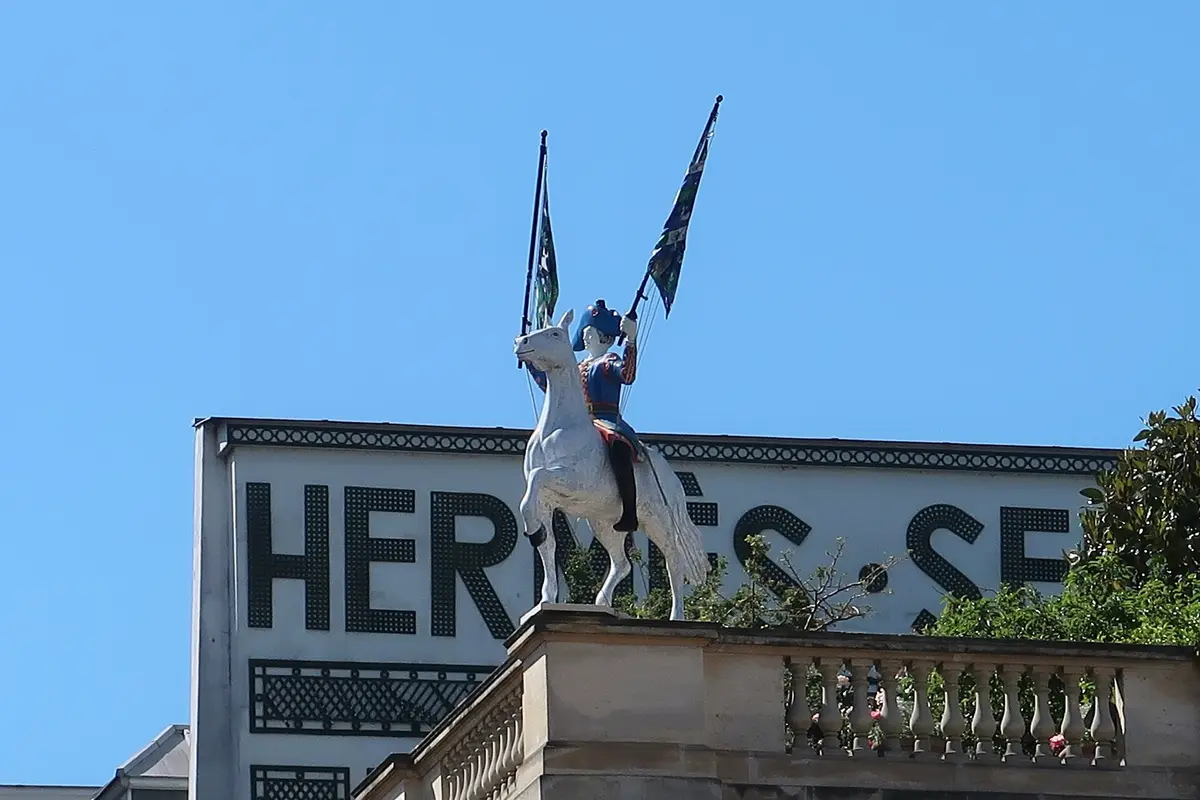
Rue du Faubourg Saint-Honoré, Paris: Hermès has its flagship shop at no. 24Burberry reports a bad year to March 2025: sales down 17% to about £2.5bn, comparable store sales down 12%, an operating loss, a savings target of £100m a year and up to 1,700 jobs to go by 2027.
Castleford, West Yorkshire: Burberry's trench-coat factoryKering names Luca de Meo, who had just announced his departure as head of Renault, its chief executive; François-Henri Pinault stays chairman. De Meo is due to take office on 15 September, after a shareholder meeting on 9 September.
Louis Vuitton unveils 'The Louis' in Shanghai, a ship-shaped space of shop, café and exhibition, 114.5 m long, open to the public from 28 June: LVMH's answer to cautious Chinese shoppers is an experience.
HKRI Taikoo Hui, West Nanjing Road, Shanghai: where Louis Vuitton unveiled 'The Louis' on 25 June 2025A 39% US tariff on Swiss goods takes effect at midnight. The US took 16.8% of Swiss watch exports in 2024, and Rolex, Omega and others had already raised prices by 3% to 10%.
LVMH reports 1% organic growth in the third quarter, with 'improvement across all business groups'; Fashion & Leather Goods is still down 2% in the quarter and 6% over nine months.
The US, Switzerland and Liechtenstein sign a memorandum cutting the US tariff on Swiss goods from 39% to 15%, retroactive to this date (the Swiss government confirms it on 10 December).
Bain and Altagamma publish their autumn 2025 study: personal luxury goods fall 2% to €358bn at current rates (flat at constant rates); the number of luxury consumers has dropped from 400 million in 2022 to around 340 million.
Bain's full report says about 20 million consumers left the market in 2025 (to around 330 million), mostly aspirational ones; iconic bags cost 50% to 70% more than in 2019 and 'the price-to-value equation has broken'; second-hand luxury has grown to about €50bn.
- 2026
LVMH reports 2025 revenue of €80.8bn, down 1% organically and 5% as reported, with Fashion & Leather Goods down 5% organically; growth returned in the second half (+1%).
Bain says mainland China's luxury market fell 3% to 5% in 2025, 'a significant moderation' after the sharp fall of 2024, and that 35% of Chinese luxury spending now happens outside the mainland.
Beijing Daxing International Airport: travel-retail shops, where Chinese luxury spending is also won or lostKering reports 2025 revenue of €14.7bn, down 10% comparable, with Gucci down 19% to €5.99bn and recurring operating income down 33%; de Meo says the year 'does not reflect the Group's true potential'.
Hôpital Laennec, rue de Sèvres, Paris: headquarters of Kering (Gucci, Saint Laurent, Bottega Veneta)Hermès reports 2025 revenue of €16.0bn, up 9% at constant rates, with leather goods up 13% and a 41% operating margin.
Rue du Faubourg Saint-Honoré, Paris: Hermès has its flagship shop at no. 24The US Supreme Court rules in Learning Resources v. Trump that the IEEPA does not authorise the President to impose tariffs, striking down the 'reciprocal' tariffs of April 2025.
United States Supreme Court, Washington: Learning Resources v. Trump, decided 20 February 2026Kering's first-quarter sales are stable on a comparable basis, with Gucci down 8%; de Meo calls it 'an important first step'. Kering's Capital Markets Day follows on 16 April in Florence, where de Meo was due to present the turnaround plan.
Burberry reports its first year of comparable sales growth under Schulman (+2%, after -12%) and adjusted operating profit of £160m, up from £26m; the company calls it an inflection point.
Castleford, West Yorkshire: Burberry's trench-coat factoryRichemont reports sales of €22.4bn for the year to March 2026, up 11% at constant rates, driven by its jewellery houses (+14%), while its watchmakers are up 1% after 'a challenging 24-month period'.
Cartier Building, Fifth Avenue, New York: Cartier's flagship, part of Richemont's growing Jewellery MaisonsBain and Altagamma's spring update forecasts personal luxury goods growth of 2% to 4% for 2026 (€365 to €373bn), led by jewellery, with leather goods still under pressure, the Americas leading and Europe the weakest region.
LVMH reports first-half revenue of €38.6bn (+2% organic, +3% in the second quarter); Fashion & Leather Goods returns to organic growth in the second quarter (+1%), which the group credits to Jonathan Anderson's first designs for Dior and Louis Vuitton's new stores in Beijing and Seoul.
Avenue Montaigne, Paris: Dior's house at no. 30, credited by LVMH for its recovery in 2026Kering reports first-half revenue of €7.22bn, up 1% comparable (+2% in the second quarter); Gucci is down 5% in the half and 2% in the second quarter, its smallest fall among the figures in this entry.
Hôpital Laennec, rue de Sèvres, Paris: headquarters of Kering (Gucci, Saint Laurent, Bottega Veneta)Hermès reports first-half revenue of €8.16bn, up 6% at constant rates (+6.7% in the second quarter) with a 41% margin; the Americas are up 15%.
LVMH's shares fall 2.3% to their lowest price since 2020 and the STOXX Europe Luxury 10 index is about 19% down for the year; Bank of America data show third-quarter demand about 3 points slower than the second. The latest day checked for this entry.