New Horizons flies past Pluto
“New Horizons, launched in 2006, flew past Pluto on July 14, 2015, and found a living world with a heart of nitrogen ice; Clyde Tombaugh had discovered Pluto 85 years earlier.”
Pluto was found in 1930 by Clyde Tombaugh, a 24-year-old farm boy from Kansas working at Lowell Observatory in Flagstaff, Arizona. He spotted a faint dot that had moved between two photographic plates exposed on January 23 and 29, and the discovery was announced on March 13. For the next 85 years Pluto stayed a dot. A 1991 US stamp showed it with the words 'Not yet explored', and the planetary scientist Alan Stern, who had been pressing NASA for a mission since 1989, later held up that stamp with 'Not yet' crossed out. His first plan, Pluto Kuiper Express, was cancelled in 2000 because of its cost. The mission that finally flew was proposed in 2001 by a team led by Stern, with the Johns Hopkins Applied Physics Laboratory (APL) building the spacecraft, and NASA chose it on November 29, 2001.
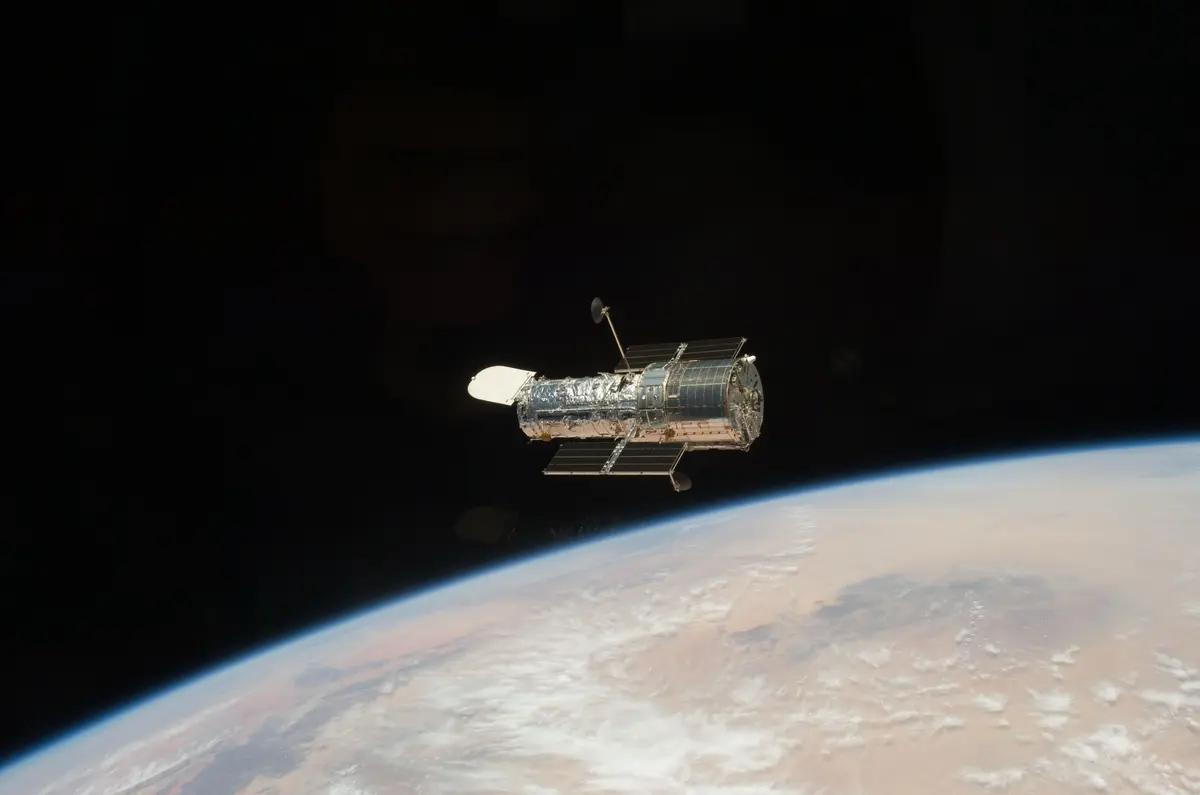
New Horizons lifted off on an Atlas V rocket from Cape Canaveral at 2:00 pm Florida time (19:00 UTC) on January 19, 2006, on the third try in three days. It was the fastest spacecraft ever launched, passing the Moon's orbit in about nine hours, and it was only the size of a baby grand piano. It carried seven instruments and a small canister with some of Tombaugh's ashes. Seven months later, on August 24, 2006, the International Astronomical Union voted that Pluto was a 'dwarf planet', so the probe was now heading for a different kind of world than the one it had been built for. It kept flying, and the goal did not change.
A close pass of Jupiter on February 28, 2007, gave New Horizons a gravity boost that cut the trip from fourteen years to under ten. Then came eight quiet years: the probe slept most of the time to save wear, was woken once a year for checks, and crossed the orbits of Saturn (2008), Uranus (2011) and Neptune (August 25, 2014, exactly 25 years after Voyager 2's flyby of Neptune). It woke for good on December 6, 2014, and began looking at Pluto on January 15, 2015. On July 4, ten days before the flyby, the main computer overloaded and the craft went into safe mode; the engineers had it working again within days, and the flyby plan, loaded by July 7, was untouched.
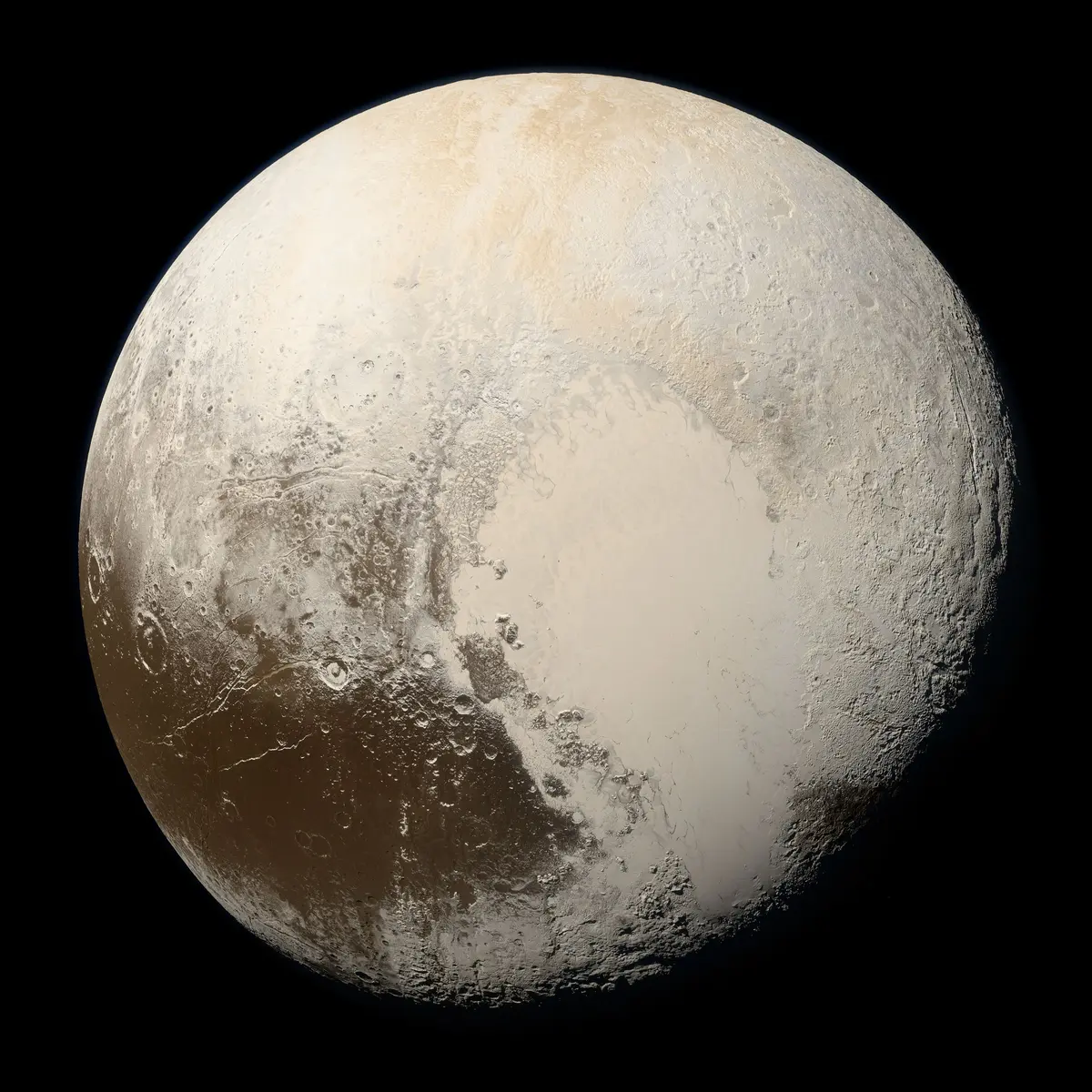
At 11:49 UTC on July 14, 2015, New Horizons passed about 12,500 kilometres above Pluto at about 14 kilometres a second, almost exactly when it was predicted nine years earlier, and then passed Charon, Pluto's largest moon. It flew the encounter alone and out of contact, taking 236 observations of all six bodies of the Pluto system, so nobody on Earth knew whether it had survived until its preprogrammed 'phone call' arrived at 00:52 UTC on July 15, after a wait of 21 hours. The first close pictures came the next day and showed a living world: a huge, young, crater-free plain of nitrogen ice shaped like a heart (Sputnik Planitia), mountains of water ice up to 3.5 kilometres high, layers of blue haze and a red cap on Charon's pole.
The probe could send only about 2,000 bits a second from so far away, so the data took 16 months to arrive. The last piece, from the Ralph/LEISA infrared instrument, reached APL at 5:48 am Maryland time on October 25, 2016, which is where this entry ends. New Horizons flew on and passed the small Kuiper Belt object Arrokoth on January 1, 2019, which is a separate target and not part of the Pluto story. The flyby finished the first survey of the planets by spacecraft, begun by Mariner 2 at Venus in 1962. Pluto cannot be shown on the map of the Earth, so the places on the map are the Earth-side ones: the launch pad, the control room, the science base, the antenna that received the last data and Tombaugh's observatory.
What happened
- 2006
- 7:00 p.m.
After two scrubs, for wind on January 17 and a power cut at APL on January 18, New Horizons lifts off on an Atlas V from Launch Complex 41 at 2:00 pm Florida time (19:00 UTC): the fastest spacecraft ever launched, at 36,000 miles an hour, past the Moon's orbit in about nine hours.
Space Launch Complex 41, Cape Canaveral: the pad from which New Horizons lifted off at 19:00 UTC on January 19, 2006 On the 100th anniversary of Clyde Tombaugh's birth, APL announces that the probe, two weeks out, is carrying a small amount of the discoverer's ashes to the planet he found.
Lowell Observatory, Flagstaff, Arizona: where Clyde Tombaugh found Pluto on February 18, 1930- 4:05 a.m.
New Horizons passes the small asteroid 132524 APL, later named for the laboratory, at about 100,000 km, a first close pass of a solar-system body on the way out.
In Prague the International Astronomical Union defines a 'planet' and decides that Pluto, which fails the rule of having cleared its orbit, is a 'dwarf planet'; the probe, seven months into its flight, is now bound for a dwarf planet, and keeps going.
APL releases the first sighting of Pluto by the probe: six exposures of September 21 and 24, 2006 from 4.2 billion km away, in which a faint dot moves against the stars, found the same way Tombaugh found it.
- 2007
- 5:43 a.m.
At 05:43 UTC New Horizons passes Jupiter at 2.3 million km, at about 21 km a second; the planet's gravity speeds it on and cuts the trip to Pluto from fourteen years to under ten. Its cameras watch a volcano on Io erupt.
- 2008
The probe crosses the orbit of Saturn, 9.5 AU from Earth, with seven years still to go; for most of the long cruise it will sleep, woken once a year for checks.
- 2014
New Horizons crosses the orbit of Neptune, exactly 25 years after Voyager 2's flyby of Neptune; at NASA Headquarters Voyager veterans and Alan Stern mark the day.
- 2:53 a.m.
At 3 pm on December 6 Florida time the probe's timer ends its last hibernation and it wakes; at 9:53 pm Eastern (02:53 UTC on December 7) the Mission Operations Center at APL sees the signal, which took 4 hours 26 minutes, via the Canberra station, saying it is awake and healthy.
Johns Hopkins Applied Physics Laboratory, Laurel, Maryland: where New Horizons was built and flown, and its Mission Operations Center heard the 'phone call' on July 14, 2015 - 2015
New Horizons begins its approach to Pluto, still about 200 million miles away; over the next months Pluto grows from a dot to a disc.
After seven weeks of searching for dust and rings, the team decides to keep the probe on its original path through the Pluto system, rather than detour; at 50,000 km an hour a grain of rice could be lethal.
The main computer, busy with new commands and compressing old data at once, overloads and the probe switches to its backup computer and enters safe mode; contact is re-established within two hours, and the flyby commands are reloaded by July 7.
- 7:38 a.m.
At 3:38 am Eastern (07:38 UTC), a day out, the Ralph camera makes its last colour scan of both worlds, and at 768,000 km LORRI takes the last and sharpest picture sent home before closest approach, showing the heart.
- 11:49 a.m.
At 11:49 UTC (7:49 am Eastern) New Horizons passes Pluto at about 12,500 km and about 14 km a second, within a minute of the time worked out nine years before, through a window 60 by 90 km wide. It is out of contact; at APL a crowd counts down.
- 12:03 p.m.
About fourteen minutes after Pluto the probe passes Charon, Pluto's largest moon, at about 28,800 km.
- 12:04 p.m.
Fifteen minutes after its closest pass, the probe looks back toward the Sun and records the sunset glow on Pluto's mountains and haze layers.
The first close-up pictures arrive: a world with mountains of ice, plains of flowing nitrogen and a heart-shaped glacier, with almost no craters.
- 12:52 a.m.
The preprogrammed 'phone call' arrives at 00:52:37 UTC (8:52 pm Eastern on July 14) after a 21-hour silence: no pictures, only health data showing the flyby went to plan; flight controllers cheer at APL.
Johns Hopkins Applied Physics Laboratory, Laurel, Maryland: where New Horizons was built and flown, and its Mission Operations Center heard the 'phone call' on July 14, 2015 The team chooses a small Kuiper Belt object, 2014 MU69 (later named Arrokoth), about a billion miles beyond Pluto, as the probe's next target.
The slow return of the flyby data begins in earnest: the first compressed 'browse' set arrives from September 5, among it the big mosaic of Sputnik Planum taken on July 14 at 80,000 km.
A series of four engine burns, each of 22 minutes, begins to steer the probe from October 22 toward Arrokoth for its January 2019 flyby.
- 2016
- 9:48 a.m.
At 5:48 am Eastern (09:48 UTC), after 16 months, the last bits of Pluto data, a piece of a Pluto-Charon sequence from the Ralph/LEISA instrument, arrive at APL via the Canberra station: over 50 gigabits, 400-odd observations, sent at about 2,000 bits a second.
Canberra Deep Space Communication Complex, Tidbinbilla: the NASA station through which the last Pluto data arrived on October 25, 2016