The Hubble Space Telescope launches
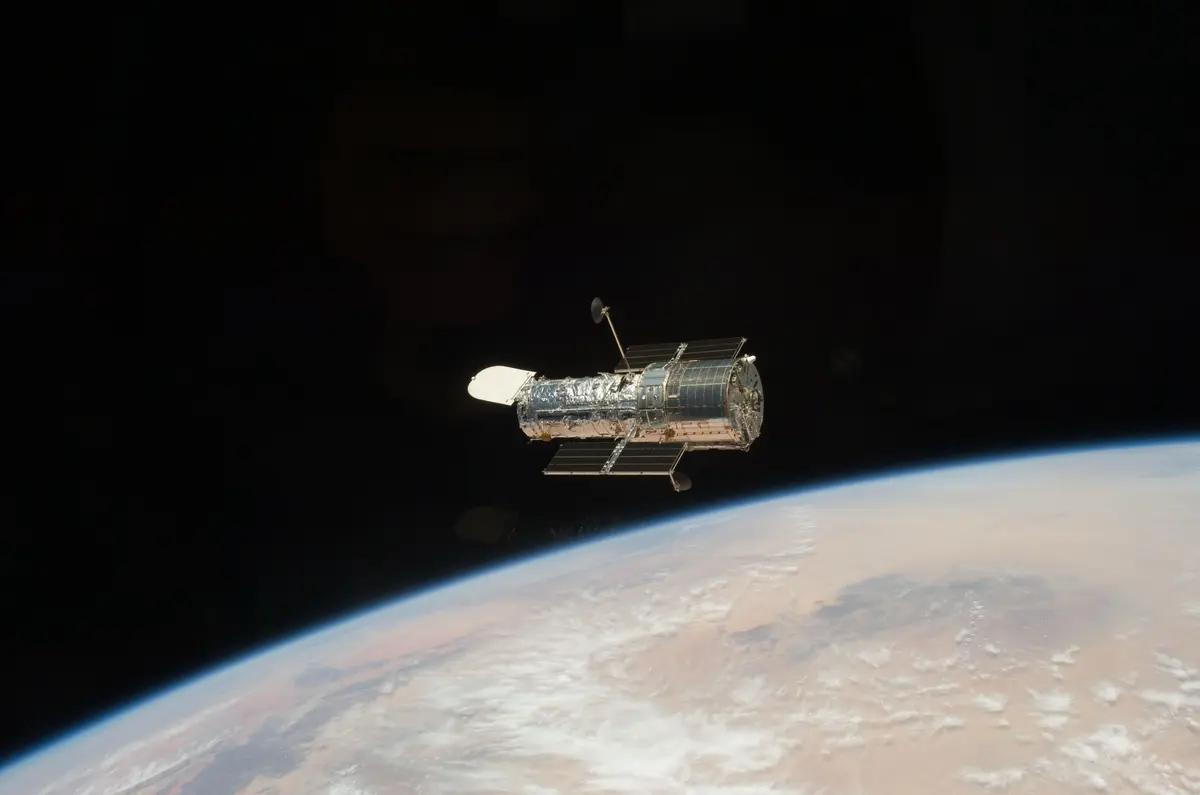
“Hubble: launched on 24 April 1990 with a mirror ground two microns too flat, it was fixed by spacewalking astronauts in December 1993 and went on to take the Deep Field and the Pillars of Creation.”
The Hubble Space Telescope began as an argument. In 1946, before anyone had put a satellite into orbit, the American astronomer Lyman Spitzer wrote that a telescope above the air would see far sharper than any on the ground, and in colours the air blocks. It took more than thirty years of lobbying. In 1975 the European Space Agency joined the project, in 1977 Congress approved the money, and the planned 3-metre mirror was cut to 2.4 metres to save cost. The mirror was ground at the Perkin-Elmer company in Danbury, Connecticut, the spacecraft was built and tested by Lockheed in Sunnyvale, California, and in 1983 the telescope was named for Edwin Hubble. It was due to fly in 1986. Then the shuttle Challenger exploded on 28 January 1986, and the shuttle fleet stayed on the ground for 32 months.
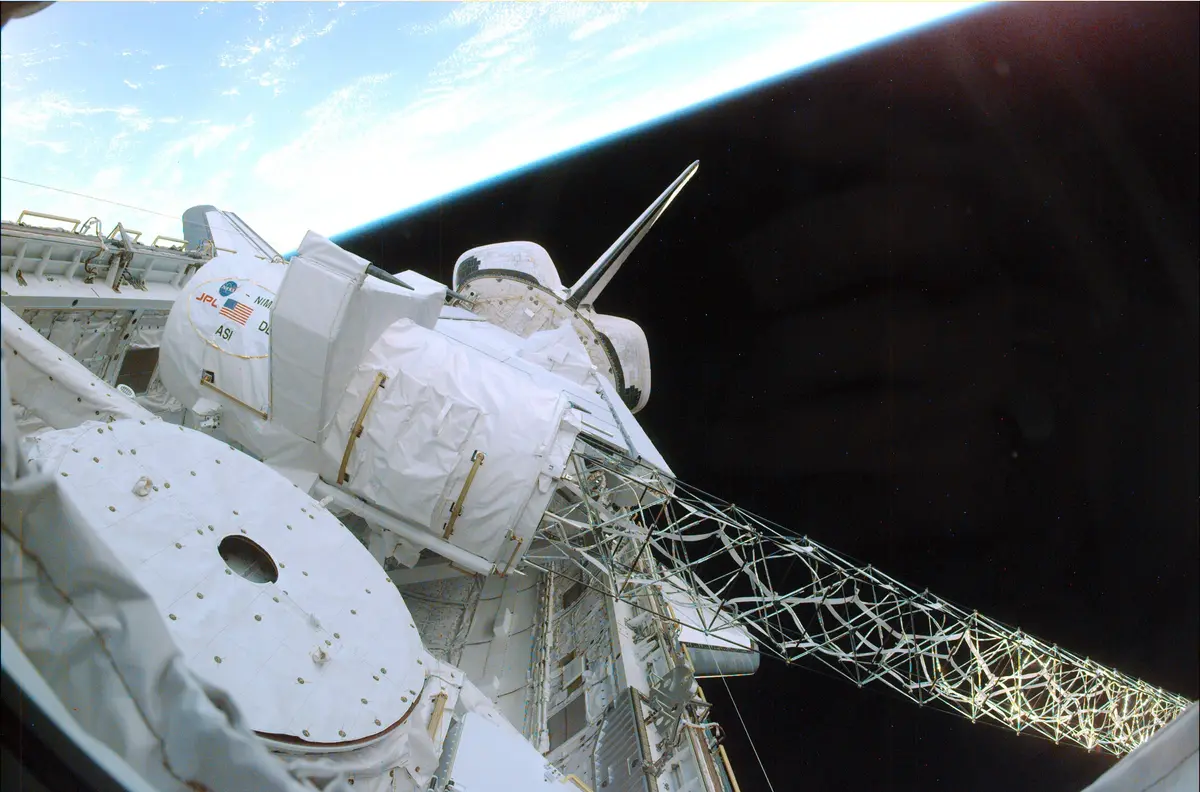
Discovery lifted off from Kennedy Space Center at 8:33 in the morning, Florida time, on 24 April 1990, with Hubble in its payload bay and five astronauts: Loren Shriver, Charles Bolden, Steven Hawley, Bruce McCandless and Kathryn Sullivan. The next day the crew lifted the telescope on the robot arm and let it go, about 610 kilometres above the Earth, the highest a shuttle had ever flown. The first picture, a star cluster, came on 20 May. Within weeks it was clear that something was badly wrong. Stars were not sharp points but fuzzy blobs surrounded by haloes. On 27 June NASA admitted the mirror had a flaw called spherical aberration: its edge was ground too flat by about two microns, a fiftieth of the width of a human hair.
A board led by Lew Allen, the director of the Jet Propulsion Laboratory, reported in November 1990. A test instrument used to check the mirror's shape, the reflective null corrector, had been put together with one lens 1.3 millimetres out of place. The mirror had been ground with great care, but to the wrong shape, and other tests that hinted at the error had been dismissed. Hubble was built to be visited, so it could be repaired. On 2 December 1993 the shuttle Endeavour carried seven astronauts to it, among them the European astronaut Claude Nicollier. In five spacewalks they fitted a new camera with its own corrective mirrors, and COSTAR, a refrigerator-sized set of small mirrors that worked like spectacles for three older instruments. On 13 January 1994 NASA showed the galaxy M100 before and after. The blur was gone.
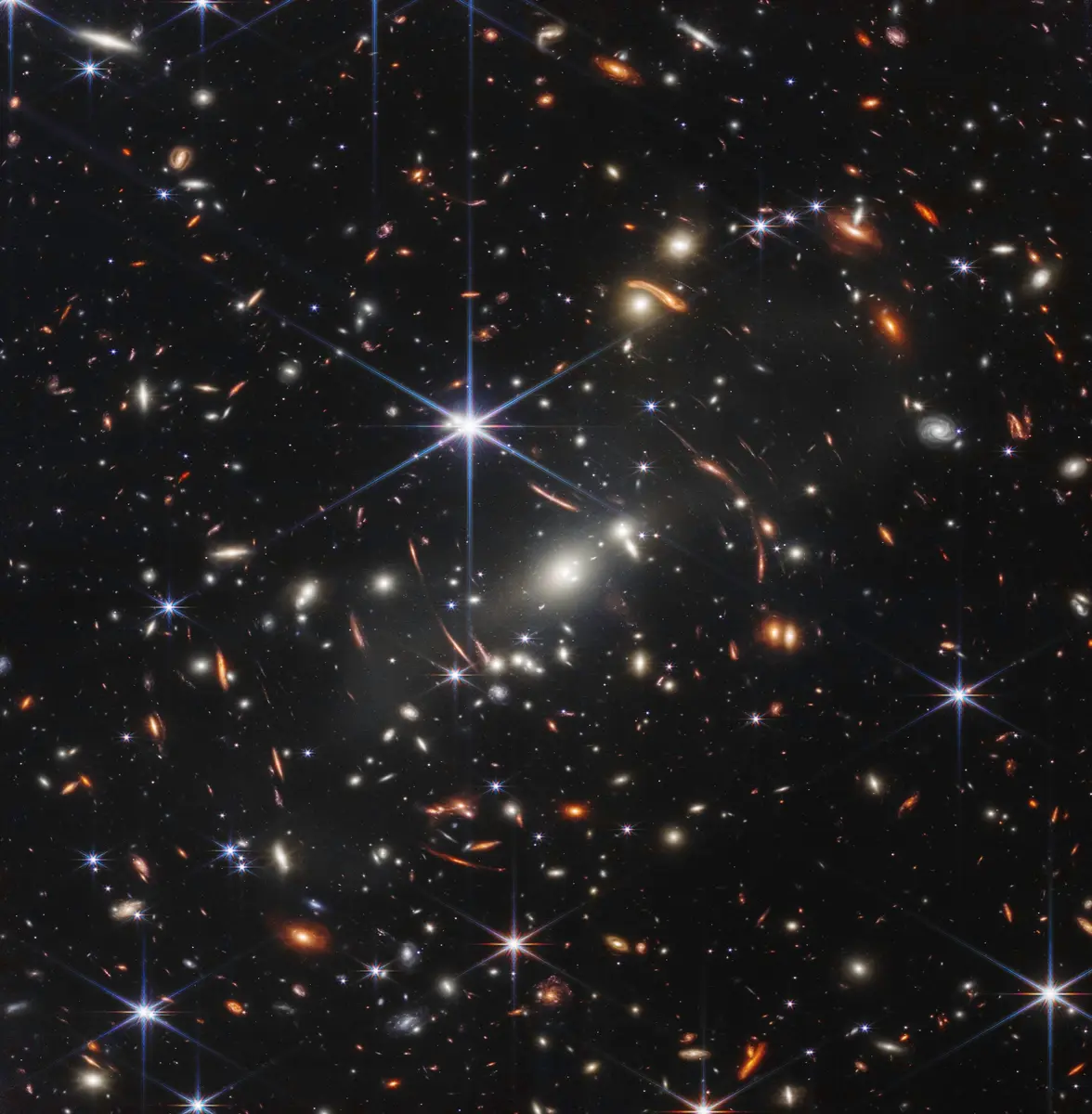
What followed changed how people see the universe. The 'Pillars of Creation' in the Eagle Nebula were shown in November 1995. In December 1995 Hubble stared at one empty patch of sky for ten days, and the Deep Field showed at least 1,500 galaxies in a spot as small as a dime held 75 feet away. Astronauts came back in 1997, 1999 (to replace failed gyroscopes) and 2002. After the loss of Columbia in 2003 the last visit was cancelled, then restored in 2006, then delayed again in 2008 by a failure in the telescope's data unit. In May 2009 the shuttle Atlantis carried the final crew. In five spacewalks they installed a new wide-field camera and a new ultraviolet spectrograph, and repaired two instruments that were never meant to be repaired in space. Atlantis landed on 24 May 2009, and this entry ends there.
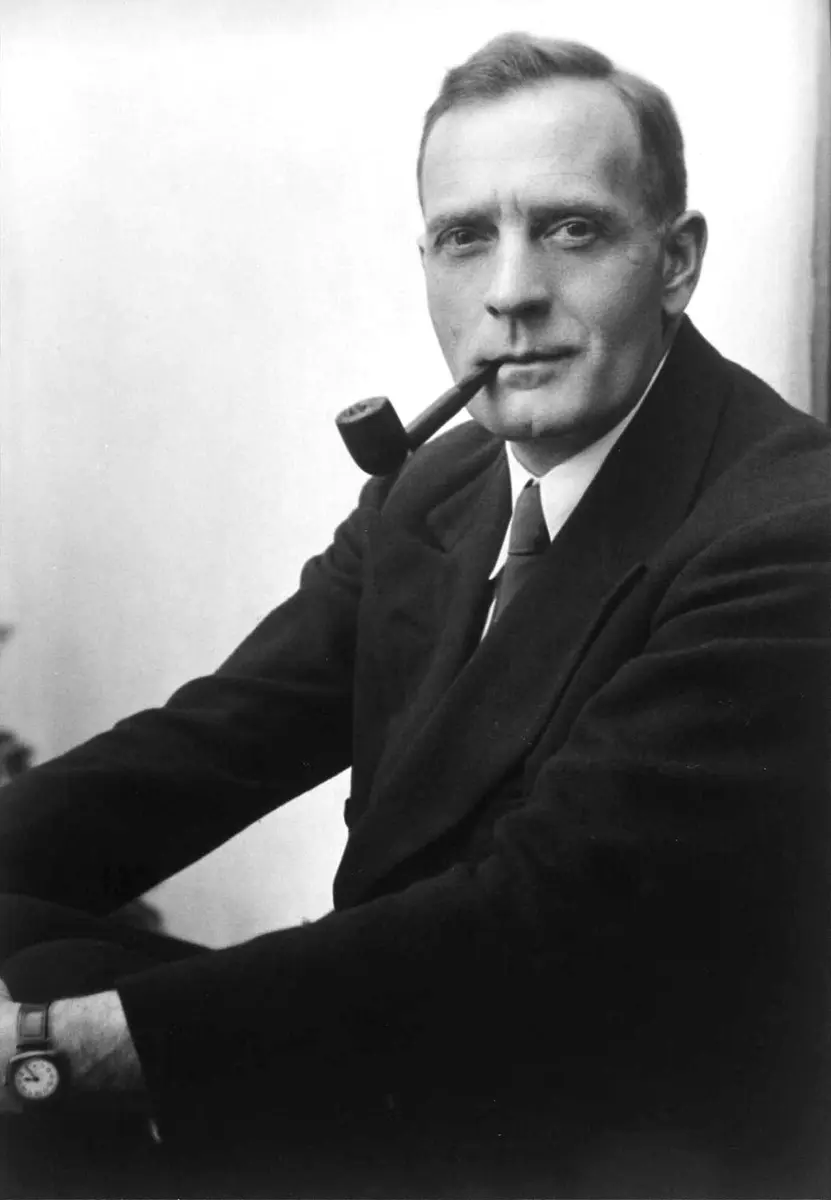
No one will visit Hubble again, but it is still working. It measured the pace of the universe's expansion more accurately than ever before, helped to show that the expansion is speeding up, and taught astronomers that galaxies were already forming very early in cosmic history. The telescope is named for the man who showed in the 1920s that other galaxies lie beyond our own and that the universe is expanding. Its successor, the infrared James Webb Space Telescope, launched on Christmas Day 2021 and sees even further back in time. The story of the flaw and the rescue is also a story about trust: a famous failure turned into one of the most loved machines in the history of science.
What happened
- 1946
Lyman Spitzer, then teaching at Yale, writes 'Astronomical advantages of an extra-terrestrial observatory'. Above the air, he says, a telescope would see sharper and would see ultraviolet and infrared light that the atmosphere blocks. No satellite exists yet. His report first appears in an appendix to a document written for Douglas Aircraft.
Yale University, New Haven: where Lyman Spitzer taught and wrote 'Astronomical advantages of an extra-terrestrial observatory' in 1946, before he moved to Princeton in 1947 - 1975
The European Space Agency joins the project. It will pay 15 percent of the cost, through the Faint Object Camera and the solar arrays, and in return European astronomers are promised at least 15 percent of the observing time.
- 1977
The money starts to flow. Congress approved funding for the Large Space Telescope earlier in 1977, and it takes effect today, the first day of the new financial year. To save cost the mirror has already been cut from 120 inches (3 metres) to 94 inches (2.4 metres).
- 1978
Preliminary grinding begins on the 2.4-metre primary mirror at the Perkin-Elmer Corporation's optics plant in Danbury, Connecticut. A photograph of March 1979 shows the glass on the grinding table.
Danbury, Connecticut: the Perkin-Elmer Corporation's optics plant, where the 2.4-metre primary mirror was ground and polished from 1978- 1981
The precision-ground mirror is finished, after more than two years of work. Perkin-Elmer checked its shape with a special test device, the reflective null corrector, that will turn out to hold the error.
Danbury, Connecticut: the Perkin-Elmer Corporation's optics plant, where the 2.4-metre primary mirror was ground and polished from 1978The Space Telescope Science Institute is set up to run Hubble's science. NASA chooses the Association of Universities for Research in Astronomy, which puts the institute on the Homewood campus of Johns Hopkins University in Baltimore, with Riccardo Giacconi as its first director.
Space Telescope Science Institute, Baltimore: Hubble's science headquarters since 1981, on Johns Hopkins University's Homewood campus; it released the Deep Field and plans the telescope's observations- 1983
The Large Space Telescope is renamed the Hubble Space Telescope, after the astronomer Edwin Hubble, who showed that other galaxies lie far beyond the Milky Way and are moving away from it.
- 1985
The whole spacecraft is finished. Lockheed in Sunnyvale, California, which built the shroud and spacecraft systems, has now assembled and tested the telescope. A launch on the shuttle is planned for 1986.
Sunnyvale, California: the Lockheed Missiles and Space Company built the telescope's shroud and spacecraft systems here and assembled and tested the finished Hubble - 1986
The shuttle Challenger breaks apart 73 seconds after launch and all seven crew members die. The shuttle fleet is grounded for 32 months, and Hubble, finished and waiting, cannot fly.
- 1990
Hubble is fitted into the payload bay of the shuttle Discovery at Kennedy Space Center, three weeks before the launch date.
Kennedy Space Center, Florida: where Hubble was fitted into Discovery's payload bay in April 1990 and where Endeavour landed on 13 December 1993 at the end of the first repairThe first launch attempt stops at four minutes before lift-off because of a faulty valve in one of Discovery's auxiliary power units. The valve is replaced and the batteries are recharged.
Kennedy Space Center Launch Complex 39B: Discovery lifted off from this pad with Hubble on 24 April 1990, and Endeavour with the first repair crew on 2 December 1993- 12:33 p.m.
Discovery lifts off from pad 39B at 8:33:51 in the morning, Florida time, with Shriver, Bolden, Hawley, McCandless and Sullivan aboard. A hold at 31 seconds before lift-off, caused by a computer failing to close a fuel valve on the ground, is cleared. Columbia waits on the neighbouring pad, the first time since Challenger that an orbiter stands on each pad.
Kennedy Space Center Launch Complex 39B: Discovery lifted off from this pad with Hubble on 24 April 1990, and Endeavour with the first repair crew on 2 December 1993 The crew lift Hubble out of the bay on the robot arm; its antennas and solar arrays are opened and the crew release it into an orbit 330 nautical miles (about 610 km) up, the highest a shuttle has flown. One solar array stops part-way as it unrolls, and McCandless and Sullivan start preparing a spacewalk to open it by hand; ground controllers free it first.
Discovery lands at Edwards Air Force Base in California at 6:49:57 in the morning, Pacific time, after five days, one hour and sixteen minutes in space.
Edwards Air Force Base, California: Discovery landed here on 29 April 1990 and Atlantis, ending the final servicing mission, on 24 May 2009Hubble takes its first picture, a test of the Wide Field and Planetary Camera that shows a star cluster, NGC 3532. It is about 50 percent sharper than the best ground-based picture, and the flaw has not yet been found.
NASA announces that the main mirror has spherical aberration. Its curve is off by about 2 microns, a fiftieth of the width of a human hair, and the images are blurred.
The board of investigation, led by Lew Allen, director of the Jet Propulsion Laboratory, reports. The field lens of the reflective null corrector, the test device used to shape the mirror, was about 1.3 millimetres too far from the lower mirror. The mirror was made very accurately, but to the wrong curve, and other tests that showed the fault had been set aside.
- 1993
- 9:27 a.m.
Endeavour lifts off from pad 39B at 4:27 in the morning, Eastern time, on the first servicing mission, STS-61, with seven astronauts. Covey commands, Bowersox is the pilot, and Musgrave, Hoffman, Thornton, Akers and the European astronaut Claude Nicollier are the mission specialists.
Kennedy Space Center Launch Complex 39B: Discovery lifted off from this pad with Hubble on 24 April 1990, and Endeavour with the first repair crew on 2 December 1993 Nicollier catches Hubble with the robot arm and sets it upright in the payload bay. Story Musgrave and Jeffrey Hoffman start the first of five spacewalks and replace some of the gyroscopes that point the telescope.
On the second spacewalk Tom Akers and Kathy Thornton replace the solar arrays with a new set that copes better with the heating and cooling of each orbit. Thornton lets go of one of the old, bent panels, which later burns up in the atmosphere.
Musgrave and Hoffman take out Hubble's main camera and put in the Wide Field and Planetary Camera 2, whose small mirrors are shaped to cancel the flaw in the main mirror.
Thornton and Akers fit COSTAR, a unit of five pairs of small mirrors, in front of the telescope's three other instruments. Its job is to be a pair of spectacles for them.
Pilot Kenneth Bowersox fires Endeavour's engines to lift the shuttle and Hubble into a higher orbit. Musgrave and Hoffman make the fifth and last spacewalk: they fit new solar-array electronics, a connection box and covers on the magnetometers.
Nicollier opens the arm and lets Hubble go again, this time with clear sight.
- 5:25 a.m.
Endeavour lands at Kennedy Space Center at 12:25 in the morning, Eastern time, after almost eleven days.
Kennedy Space Center, Florida: where Hubble was fitted into Discovery's payload bay in April 1990 and where Endeavour landed on 13 December 1993 at the end of the first repair - 1994
NASA shows the first pictures made with the new optics. The core of the galaxy M100 is a fuzzy blob in the old camera and full of points of light in the new one.
Fragments of Comet Shoemaker-Levy 9 begin to hit Jupiter. Hubble watches for a week; NASA calls it the first time astronomers witnessed two astronomical objects collide.
- 1995
NASA releases the 'Pillars of Creation', towers of gas and dust in the Eagle Nebula where new stars are being born. The picture was taken in April.
Hubble starts to stare at one patch of sky near the Big Dipper. Over ten days, until 28 December, it makes 342 exposures with the new camera.
- 1996
The Hubble Deep Field is shown to astronomers at the American Astronomical Society's meeting in San Antonio. The tiny patch holds at least 1,500 galaxies, some seen as they were more than ten billion years ago.
- 1997
- 8:35 a.m.
Discovery lifts off at 3:35 in the morning, Eastern time, on the second servicing mission. On 14 February the astronauts install two new instruments, the Space Telescope Imaging Spectrograph and the Near Infrared Camera and Multi-Object Spectrometer.
- 1998
A paper reports the first evidence that the expansion of the universe is not slowing down, as expected, but speeding up; measurements of distant exploding stars, among them Hubble's, are part of the evidence.
- 1999
The fourth of Hubble's six gyroscopes fails. It needs three to point accurately, so it goes into 'safe mode' and stops observing until it is repaired. NASA splits the next servicing mission in two to hurry.
Three days after Discovery's launch on the third servicing mission, Steven Smith and John Grunsfeld replace all three units that hold Hubble's gyroscopes. In the control center at Goddard, controllers send commands and watch the telescope's health while the repair goes on. Discovery lands on 27 December.
Goddard Space Flight Center, Greenbelt, Maryland: home of the Space Telescope Operations Control Center, which commands the telescope day and night; Mike Griffin announced the return of the last repair mission here on 31 October 2006- 2002
On the fourth spacewalk of the fourth visit, flown by Columbia, James Newman and Michael Massimino install the Advanced Camera for Surveys, which replaces the last of Hubble's original instruments.
- 2004
NASA's administrator, Sean O'Keefe, cancels the last servicing mission because of the risk to a crew after the loss of Columbia in February 2003.
NASA releases the Hubble Ultra Deep Field, made of exposures that add up to a million seconds, which shows about 10,000 galaxies in a tiny patch of sky.
- 2006
Mike Griffin, NASA's new administrator, announces at Goddard that the last servicing mission is back on.
Goddard Space Flight Center, Greenbelt, Maryland: home of the Space Telescope Operations Control Center, which commands the telescope day and night; Mike Griffin announced the return of the last repair mission here on 31 October 2006- 2008
A unit that handles the telescope's data fails and controllers switch to the backup, which has no spare. The last servicing mission is put back to May 2009 so that a replacement can go up.
- 2009
- 6:01 p.m.
Atlantis lifts off at 2:01 in the afternoon, Eastern time, with seven astronauts for the fifth and final servicing mission, STS-125.
On the first spacewalk John Grunsfeld and Andrew Feustel take out Wide Field Planetary Camera 2, the camera of 1993, and put in the Wide Field Camera 3. They also install a new computer for the instruments' commands and data.
On the third spacewalk Grunsfeld and Feustel install the Cosmic Origins Spectrograph, in the bay COSTAR no longer needs because all the new instruments have their own corrective optics, and repair the Advanced Camera for Surveys. COSTAR comes home with the crew.
National Air and Space Museum, Washington: shows Hubble's backup mirror, made by Kodak, and COSTAR, the corrective optics fitted in 1993 and brought home in 2009Michael Massimino and Michael Good replace an electronics card in the Space Telescope Imaging Spectrograph to bring it back to life, a repair no one had planned to make in space.
Feustel and Grunsfeld make the last spacewalk at Hubble. They fit the second battery module, a refurbished guidance sensor and new insulation blankets.
Atlantis lets Hubble go, in the best shape it has ever been in.
Atlantis lands at Edwards Air Force Base in California, ending the last servicing mission. Hubble is left at its scientific peak.
Edwards Air Force Base, California: Discovery landed here on 29 April 1990 and Atlantis, ending the final servicing mission, on 24 May 2009