Edwin Hubble
“The Mount Wilson astronomer who showed in 1924 that Andromeda lies far beyond the Milky Way, and in 1929 that galaxies recede faster the farther they are: first evidence that the universe is expanding.”
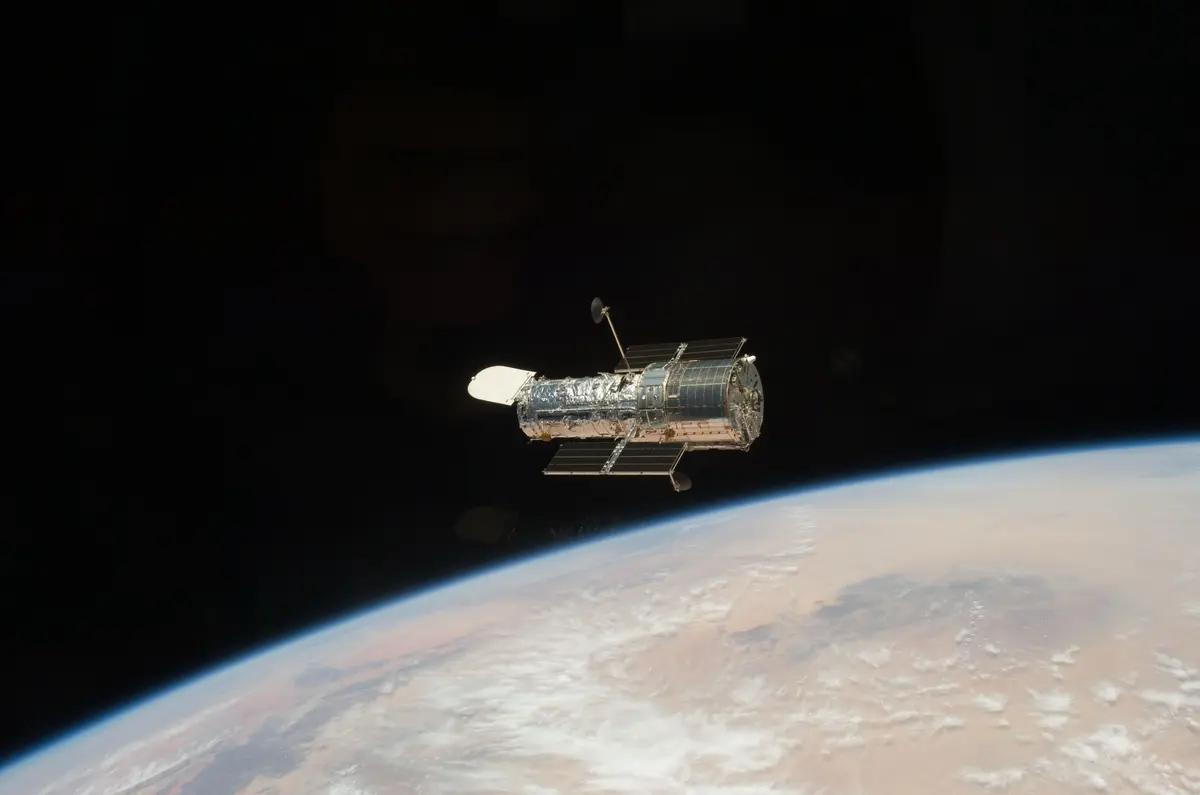
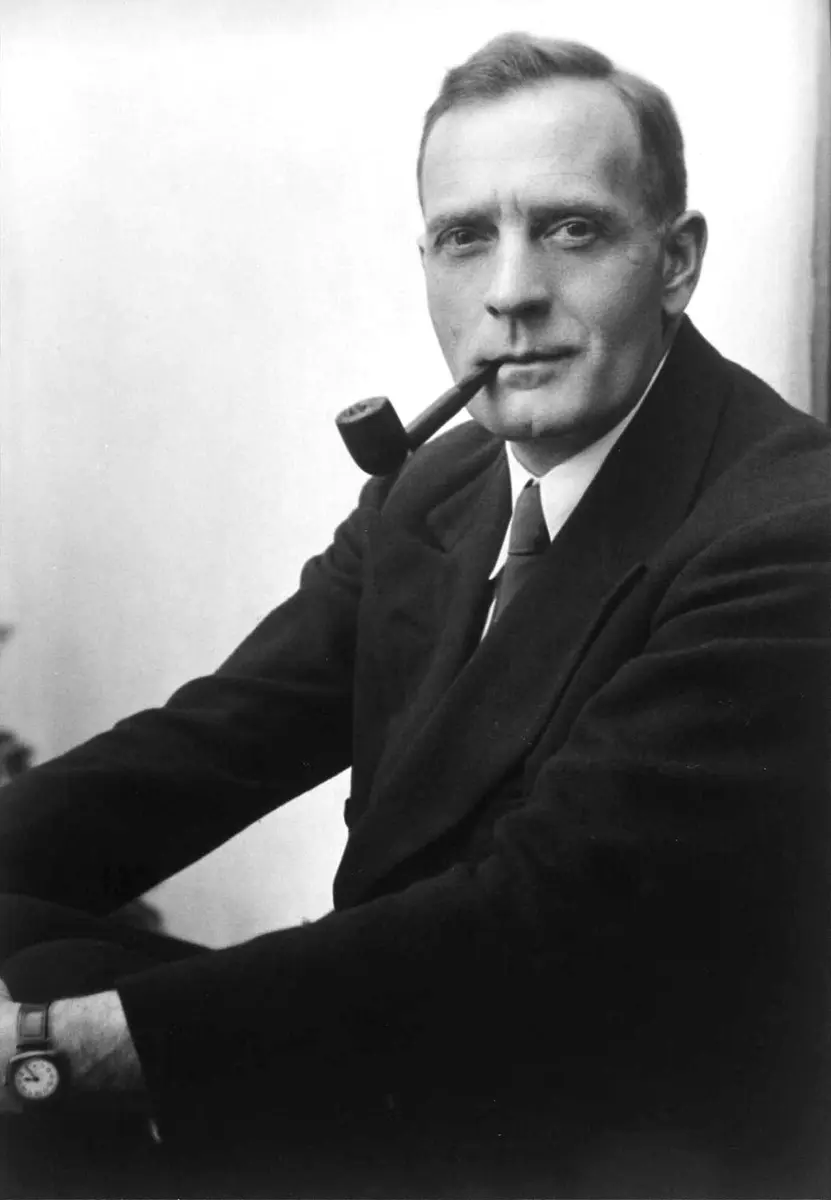
Edwin Hubble was the American astronomer who, working at Mount Wilson Observatory in California, showed that the Milky Way is only one galaxy among countless others, and then showed how those galaxies move. In 1924 he proved that the Andromeda Nebula lies far outside our own galaxy. In 1929 he published the evidence that the farther away a galaxy is, the faster it moves away from us. That observation became the first support for the idea of an expanding universe. The space telescope launched in 1990 carries his name; it has its own entry.
He was born in Marshfield, Missouri, on 20 November 1889 and grew up in Illinois, a tall athlete with a school high-jump record. After the University of Chicago he went to Oxford as a Rhodes Scholar and studied law to please his father. When his father died in 1913 he taught school for a year, then returned to Chicago to study astronomy at Yerkes Observatory. He finished his doctorate on faint nebulae in spring 1917 and went straight into the army, serving in France as a major. In 1919 he joined the staff of Mount Wilson, where its director George Ellery Hale had held a post open for him.
At Mount Wilson stood the 100-inch Hooker telescope, then the largest in the world. Astronomers argued whether the 'spiral nebulae' were small clouds inside the Milky Way or whole 'island universes' far away. On the night of 5 to 6 October 1923 Hubble photographed Andromeda, found a star he took for a nova, and crossed out his 'N' to write 'VAR!': it was a Cepheid, a star whose pulse tells its true brightness, the yardstick Henrietta Leavitt had discovered at Harvard. Comparing true and apparent brightness gave a distance of about 900,000 light-years (today's figure is about 2.5 million), far beyond the Milky Way. The result was read to the American Astronomical Society on 1 January 1925.
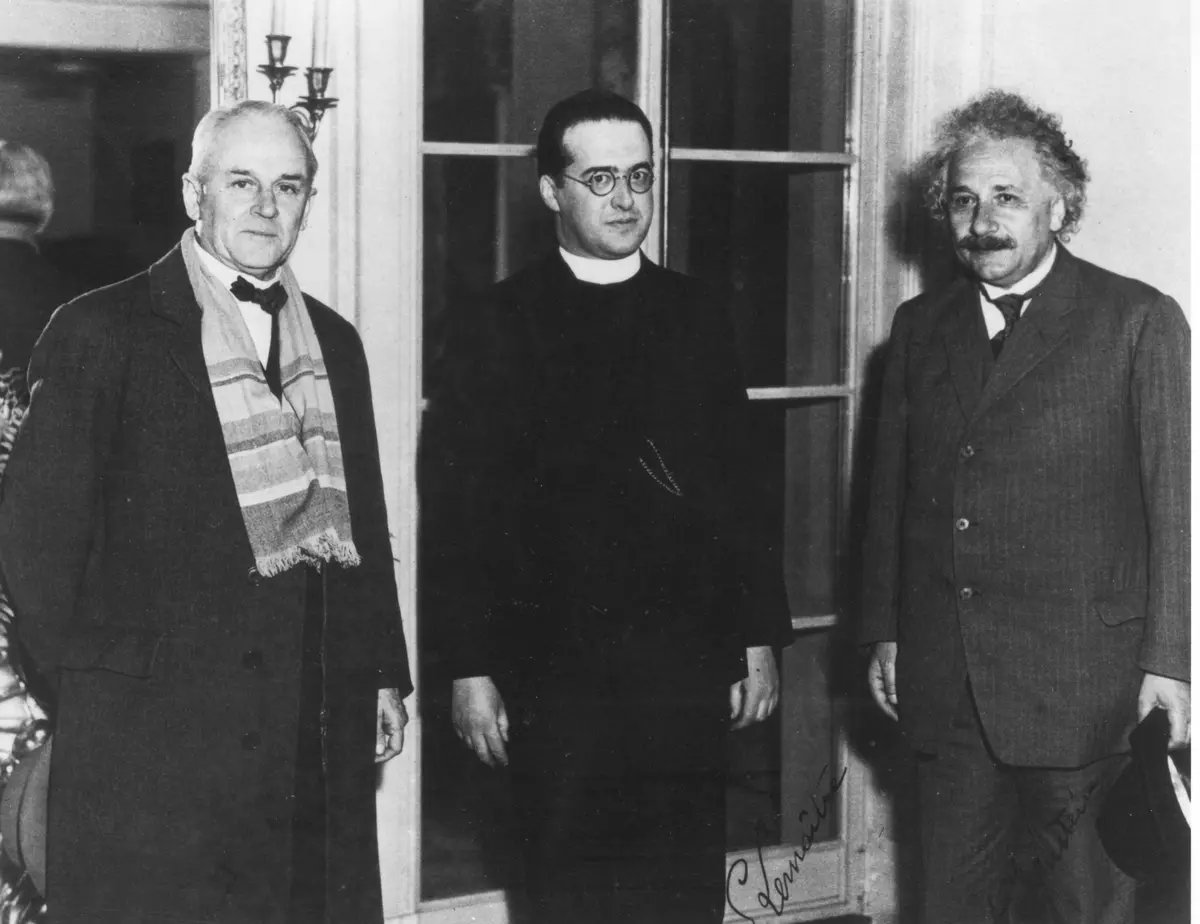
The expanding universe has more than one author. From 1912 Vesto Slipher at Lowell Observatory measured the Doppler shifts of spiral nebulae and found most rushing away. In 1927 the Belgian priest and physicist Georges Lemaitre derived from Einstein's equations a growing universe and a straight-line link between distance and speed, and put a number on it, about 625 kilometres a second per megaparsec, using Slipher's speeds and Hubble's distances; but he published in French, in a Belgian journal. In 1929 Hubble, with his own distances to 24 galaxies and mostly Slipher's speeds, found the same rough proportion, about 500. He did not name Slipher and wrote nothing about expansion, only that it might be a 'de Sitter effect'. With Milton Humason's speeds, the Hubble and Humason paper of 1931 made the case.
Hubble also sorted the galaxies into ellipticals, spirals and barred spirals (1926) and wrote The Realm of the Nebulae (1936), but he never fully accepted that the redshifts were real motion. In the Second World War he directed ballistics research at Aberdeen Proving Ground. In January 1949 he took the first official photographs with the 200-inch Hale telescope on Palomar Mountain. He died of a cerebral thrombosis at his home in San Marino, California, on 28 September 1953. Note: in 2018 the International Astronomical Union recommended, by a vote of 78 per cent of those voting, calling the law the Hubble-Lemaitre law.
What happened
- 1889
Edwin Powell Hubble is born in Marshfield, Missouri, one of eight children of John Powell Hubble, an insurance man, and Virginia Lee James. The family later moves to Wheaton, Illinois.
Marshfield, Missouri: Hubble was born here on 20 November 1889- 1906
He enters the University of Chicago on a scholarship, studies physics, astronomy and mathematics, works as a laboratory assistant to Robert Millikan, and becomes a star of the track and sports field.
- 1910
After graduating he is chosen as a Rhodes Scholar and goes to Queen's College, Oxford, to read law, as his father wanted; he takes his BA in jurisprudence in 1912.
- 1912
At Harvard College Observatory, Henrietta Leavitt shows that the longer a Cepheid variable star takes to pulse, the brighter it truly is. This yardstick for distance is the one Hubble will use.
At Lowell Observatory in Arizona, Vesto Slipher takes his first clear spectrum of the Andromeda Nebula and finds it approaching at about 300 km/s, the first speed ever measured for a spiral nebula. By 1917 he has 25 spirals, most of them moving away.
- 1913
His father dies. Hubble comes home from Oxford and teaches physics and mathematics for a year at the high school in New Albany, Indiana.
- 1914
He returns to the University of Chicago for graduate work in astronomy under Edwin Frost, observing at Yerkes Observatory on the shore of Lake Geneva with its 24-inch reflector and photographing faint nebulae, among them the one now called Hubble's Variable Nebula.
Yerkes Observatory, Williams Bay, Wisconsin: where he did his doctoral research from 1914 to 1917- 1917
He finishes his dissertation on faint nebulae in the spring and, having passed his oral examination, joins the army instead of taking the Mount Wilson post Hale has offered. He serves in France and rises to major.
- 1919
Back from France, he joins the staff of Mount Wilson Observatory near Pasadena, where the 100-inch Hooker telescope, finished in 1917, is the largest in the world.
Mount Wilson Observatory, near Pasadena, California: his observatory from 1919, home of the 100-inch Hooker telescope - 1920
At the Smithsonian's natural history museum in Washington, Harlow Shapley and Heber Curtis debate 'the scale of the universe': are the spiral nebulae inside the Milky Way or far outside it? Nothing is settled. Hubble is at Mount Wilson, not on the stage.
- 1923
On the night of 5 to 6 October, Hubble takes a 45-minute plate of the Andromeda Nebula with the Hooker telescope. He marks a star with 'N' for nova, then sees that it varies like a Cepheid, crosses the letter out and writes 'VAR!'. It is the first Cepheid found in Andromeda.
Mount Wilson Observatory, near Pasadena, California: his observatory from 1919, home of the 100-inch Hooker telescope- 1924
Hubble writes to Harlow Shapley, now director of Harvard College Observatory, about the Andromeda Cepheid. The letter undercuts Shapley's view that the Milky Way is the whole universe. Through the year Hubble finds about a dozen Cepheids in the nebula; all give a distance of about a million light-years.
He marries Grace Burke, a Stanford graduate.
- 1925
His paper 'Cepheids in Spiral Nebulae' is read for him at the meeting of the American Astronomical Society in Washington: Andromeda is about 900,000 light-years away, far beyond the Milky Way. Astronomers quickly accept that the universe holds many galaxies.
- 1926
He publishes his classification of the galaxies by shape: ellipticals, spirals, barred spirals and irregulars. A form of it is still in use.
- 1927
In Belgium the priest and physicist Georges Lemaitre derives from Einstein's equations a universe of growing size and a straight-line link between a galaxy's distance and its speed of recession. From Hubble's distances and Strömberg's list of speeds (mostly Slipher's) he estimates 625 km/s per megaparsec. He publishes in French in a Brussels journal; few astronomers see it.
- 1929
Hubble's paper 'A relation between distance and radial velocity among extra-galactic nebulae' is communicated to the Proceedings of the National Academy of Sciences.
The paper appears in the Proceedings of the National Academy of Sciences (vol. 15, pp. 168-173). From his own distances to 24 galaxies and their speeds (nearly all Slipher's, four Humason's), Hubble finds that speed rises roughly in step with distance, about 500 km/s per megaparsec. He is careful: he calls it a first approximation, suggests it may be the 'de Sitter effect', and says nothing of an expanding universe. He does not credit Slipher in the paper. Humason's report of a galaxy receding at 3779 km/s appears in the same issue. The finding is later read as the first observational support for an expanding universe.
Mount Wilson Observatory, near Pasadena, California: his observatory from 1919, home of the 100-inch Hooker telescope- 1930
At a meeting of the Royal Astronomical Society in London, Willem de Sitter admits that neither his model nor Einstein's explains a straight-line relation between distance and speed, and Arthur Eddington says a new model is needed. Lemaitre reads the report and writes to Eddington to point to his paper of 1927.
- 1931
Hubble and Humason measure about forty more galaxies, out to eighteen times the distance of the 1929 diagram, and show that speed is proportional to distance. Hubble himself, throughout his career, will not say flatly that the redshifts are real motion.
Einstein visits Mount Wilson and looks through the 100-inch telescope. He accepts the expanding model during this trip to the United States, which draws the world's attention to the work of Hubble, Humason, Lemaitre and Tolman.
Mount Wilson Observatory, near Pasadena, California: his observatory from 1919, home of the 100-inch Hooker telescopeLemaitre, asked by the Royal Astronomical Society for an English version of his 1927 paper, agrees but leaves out his estimate of the expansion rate and the discussion of the speeds, calling it provisional. The translation appears in the Monthly Notices in 1931, and readers of the English version are left thinking Hubble was first to give the number.
- 1936
He publishes The Realm of the Nebulae, his account of his methods and of the study of the galaxies. After it he publishes little original research.
- 1942
The United States at war, he becomes chief of ballistics and director of the supersonic wind tunnels at the Ballistic Research Laboratories at Aberdeen Proving Ground, Maryland, until 1946, and is awarded the Medal of Merit.
- 1949
Hubble climbs into the prime-focus cage of the new 200-inch Hale telescope on Palomar Mountain and takes the first official photographs with it, of the nebula NGC 2261, which he had studied as a student and which now bears his name.
Palomar Observatory, California: the 200-inch Hale telescope he was the first to use, in 1949After four runs on the telescope in the spring, he suffers a heart attack. The 200-inch's first scheduled run, in November, goes to another astronomer.
- 1953
Edwin Hubble dies of a cerebral thrombosis at his home in San Marino, California, aged 63. He had been nominated for the Nobel Prize that year; he died shortly before the winners were chosen.
San Marino, California: his home from the 1920s and the place of his death on 28 September 1953