Georges Lemaitre
“The Belgian priest and physicist who showed in 1927 that the universe is expanding and proposed in 1931 that it began as a 'primeval atom': the idea behind the Big Bang.”
Georges Lemaître was a Belgian priest and physicist, and one of the few people in history who was both at once. In 1927 he showed that Einstein's equations allow a universe that grows, and that the light of distant galaxies fits such a universe. In 1931 he went one step further: if the universe is growing now, it must once have been tiny and dense. He called that start the 'primeval atom'. It was the first form of what we now call the Big Bang.
He was born in Charleroi on 17 July 1894 and studied engineering at the Catholic University of Louvain. The First World War interrupted his studies: he volunteered in August 1914 and served in the Belgian army, later in the artillery. After the war he turned to mathematics and physics, took his doctorate in 1920, entered the seminary at Mechelen and was ordained a priest in September 1923. He then studied with Arthur Eddington at Cambridge, worked at the Harvard College Observatory and took a second doctorate at MIT. In 1927 he became a professor at Louvain, where he stayed until he retired in 1964.
The 1927 paper is the heart of his fame. He printed it in French, in the small Annales de la Société scientifique de Bruxelles, under the title 'A homogeneous universe of constant mass and increasing radius accounting for the radial velocity of extragalactic nebulae'. Using 42 galaxies, he derived that the speed at which a galaxy moves away grows with its distance, and gave a first value of about 625 kilometres per second for each million parsecs. Einstein, who met him at the Solvay Conference that October, told him the mathematics was correct but the physics 'abominable'. Edwin Hubble found the same relation from better data in 1929. In January 1930 Eddington and Willem de Sitter said in London that no model explained the data, and Lemaître wrote to remind Eddington of his paper. An English version appeared in the Monthly Notices of the Royal Astronomical Society in March 1931. It leaves out the paragraph with the number, and a letter found in 2011 shows that Lemaître himself asked for the cut. For decades the rule was called Hubble's law. In 2018 the International Astronomical Union recommended the name Hubble–Lemaître law, by 78 per cent of the 4060 votes cast.
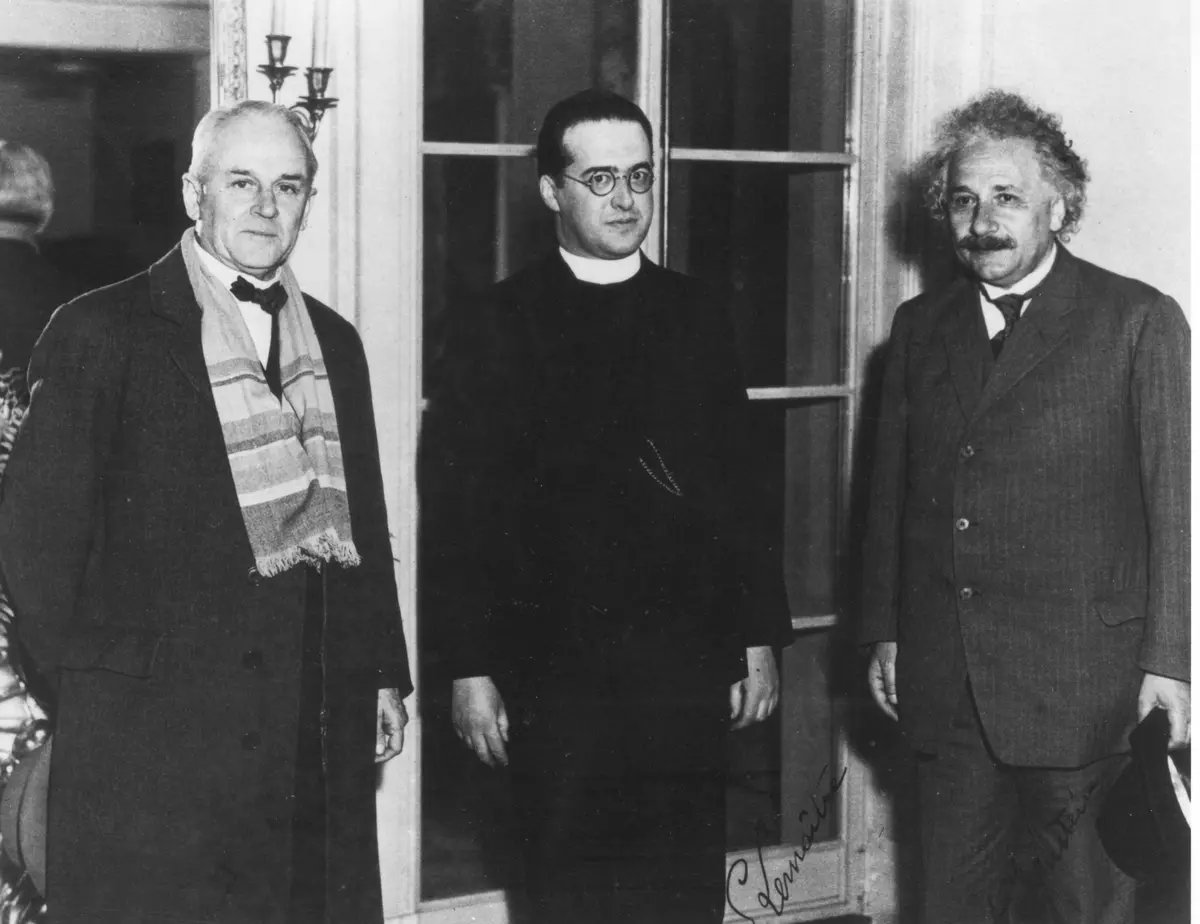
In 1931, in a note of 457 words in Nature, he said that the world may have begun from a single quantum, before space and time had a meaning. At the British Association in London that September he called it a 'fireworks' theory and used the phrase 'primeval atom'. Eddington found a beginning 'repugnant'. Lemaître kept science and faith apart: he did not want his physics read as a proof of Genesis, and in 1951 he was uneasy when Pope Pius XII spoke as if cosmology had confirmed creation. In January 1933 he lectured at Caltech with Einstein in the audience; the newspapers made him a celebrity, a priest who was also one of the leading cosmologists.
He was much more than the Big Bang. With Manuel Vallarta he calculated how cosmic rays bend in the Earth's magnetic field on Vannevar Bush's differential analyzer at MIT, and in 1958 he brought the university's first electronic computer to Louvain. In 1960 Pope John XXIII named him president of the Pontifical Academy of Sciences. He died in Leuven on 20 June 1966, a year after the discovery of the cosmic microwave background, the afterglow that gave strong support to the picture he had sketched.
What happened
- 1894
Georges Lemaître is born in Charleroi, the eldest of four children of Joseph Lemaître and Marguerite Lannoy.
Charleroi: Lemaître was born here on 17 July 1894- 1904
At the Jesuit Collège du Sacré-Cœur in Charleroi, the priest and scientist Ernest Verreux teaches him; the wish for a double vocation, as priest and as scientist, begins to take form. He later said he felt both from the age of nine.
Collège du Sacré-Cœur, Charleroi: the Jesuit school of his boyhood, where a science teacher, Ernest Verreux, first showed him that science and faith could be joined - 1910
The family leaves Charleroi for Brussels (a fire had destroyed the father's works), and Georges finishes school at the Jesuit Collège Saint-Michel, with a mathematics course for university entry.
- 1911
He enters the Catholic University of Louvain to read engineering, as his father wished. Britannica and MacTutor give 1911; UCLouvain's exhibition says 1913.
Leuven, Naamsestraat 40 (Heilige-Geestcollege, the Collège du Saint-Esprit): the address he signed his 1931 Nature note from, in the old university town where he studied, taught for forty years and died - 1914
The German army invades Belgium and Georges and his brother Jacques enlist as volunteers in the Belgian army.
He takes part in the defence of Antwerp and in the battle of the Yser, where the Belgian army holds the last corner of its country.
Diksmuide, on the Yser: the Belgian front of October 1914, where Lemaître fought as a volunteer- 1915
He is transferred to the 38th artillery battery; at the front he reads Poincaré's 'Electricity and Optics'. His war ends with the Military Cross (1918) and the palms to it (1921).
- 1919
Back in civil life, he returns to Louvain and resumes his studies, turning from engineering to mathematics and physics and completing Cardinal Mercier's course in the philosophy of Thomas Aquinas.
Leuven, Naamsestraat 40 (Heilige-Geestcollege, the Collège du Saint-Esprit): the address he signed his 1931 Nature note from, in the old university town where he studied, taught for forty years and died- 1920
He takes his doctorate in science at Louvain with a thesis on the approximation of functions of several real variables, under Charles de la Vallée Poussin, and enters the Maison Saint-Rombaut, the seminary of the Archdiocese of Mechelen for later vocations.
St Rumbold's Cathedral, Mechelen: the seat of Cardinal Mercier and of the archdiocese; Lemaître studied for the priesthood here at the Maison Saint-Rombaut seminary, 1920-23 - 1921
He finishes 'The first three words of God', an essay trying to reconcile Genesis with science, at the Maison Saint-Rombaut. He later gave up this kind of 'concordism' and kept science and religion apart.
St Rumbold's Cathedral, Mechelen: the seat of Cardinal Mercier and of the archdiocese; Lemaître studied for the priesthood here at the Maison Saint-Rombaut seminary, 1920-23- 1923
Cardinal Mercier ordains him a priest; from then on he is Abbé Lemaître. Wikipedia gives 22 September 1923; other accounts say 23 September.
St Rumbold's Cathedral, Mechelen: the seat of Cardinal Mercier and of the archdiocese; Lemaître studied for the priesthood here at the Maison Saint-Rombaut seminary, 1920-23About ten days after his ordination he arrives at St Edmund's House, Cambridge. For a year he studies with Arthur Eddington, who introduces him to modern cosmology, stellar astronomy and numerical methods.
St Edmund's College, Cambridge: where he lived in 1923-24 while he studied with Eddington- 1924
He crosses to the United States: a year at the Harvard College Observatory with Harlow Shapley, who knew the 'spiral nebulae' best, and a place in the doctoral programme at MIT.
Harvard College Observatory, Cambridge, Massachusetts: where he worked with Harlow Shapley in 1924-25 - 1925
He returns to Belgium and becomes a part-time lecturer at the University of Louvain.
Leuven, Naamsestraat 40 (Heilige-Geestcollege, the Collège du Saint-Esprit): the address he signed his 1931 Nature note from, in the old university town where he studied, taught for forty years and died - 1927
He publishes 'Un univers homogène de masse constante et de rayon croissant' in the Annales de la Société scientifique de Bruxelles. From Einstein's equations he derives an expanding universe, links it to the redshifts of 42 galaxies, shows that speed should grow with distance, and gives a first value of about 625 kilometres per second per million parsecs.
Leuven, Naamsestraat 40 (Heilige-Geestcollege, the Collège du Saint-Esprit): the address he signed his 1931 Nature note from, in the old university town where he studied, taught for forty years and diedBack at MIT he defends his doctoral thesis on the gravitational field in a fluid sphere, takes his degree, and is made a full professor at Louvain.
Massachusetts Institute of Technology, Cambridge: his second doctorate (1927) and the differential analyzer used in his cosmic-ray work with VallartaAt the fifth Solvay Conference in Brussels, Einstein speaks to him about the paper: in Lemaître's later words, the calculations are correct, but the physics 'abominable'.
Leopold Park, Brussels: the site of the Solvay Institutes, where the fifth Solvay Conference met in October 1927 and Einstein spoke to him- 1929
Edwin Hubble publishes, in the Proceedings of the National Academy of Sciences, his own velocity-distance relation from his better distances, without an expanding universe and without a reference to Lemaître's French paper.
- 1930
Having read the February Observatory's report of the January meeting at which Eddington and de Sitter said no model fits the redshifts, Lemaître writes to Eddington that he solved this two years ago, and sends copies of his paper. Eddington, who had seen it in 1927 and forgotten it, is 'shamefaced'.
De Sitter, who has now been sent the paper, answers Lemaître very favourably in a letter dated 25 March.
Eddington reads a paper to the Royal Astronomical Society showing that Einstein's static world is unstable, and adopts Lemaître's expanding model, which is called the Eddington-Lemaître model.
- 1931
The Royal Astronomical Society's secretary, W. M. Smart, asks Lemaître for his paper in English; Lemaître, who does the translation himself, cuts the provisional discussion of the data and the number from it. The two letters are dated 13 February (Nussbaumer and Bieri) and 9 March (Block, O'Raifeartaigh).
The English version, 'A homogeneous universe of constant mass and increasing radius accounting for the radial velocity of extra-galactic nebulae', appears in the Monthly Notices (volume 91, pages 483-490). It leaves out the paragraph with the number, so for decades readers took Hubble's number for the first.
In Nature, signing from 40 rue de Namur, Louvain, he writes in 457 words that if the world began with a single quantum, space and time had no meaning at first: the beginning would be 'a little before' them. He wrote it partly in answer to Eddington, who had called a beginning 'repugnant'.
Leuven, Naamsestraat 40 (Heilige-Geestcollege, the Collège du Saint-Esprit): the address he signed his 1931 Nature note from, in the old university town where he studied, taught for forty years and diedAt the British Association's centenary meeting in London, in a session on the evolution of the universe, he proposes a 'fireworks' theory and speaks of a 'primeval atom' from which the whole universe came by disintegration.
- 1933
In Pasadena at the invitation of Robert Millikan, he is photographed with Millikan and Einstein at Caltech, and gives seminars with Einstein in the audience. The newspapers report Einstein calling his account of creation 'the most beautiful' he had heard; the report may refer only to his cosmic-ray idea.
California Institute of Technology, Pasadena: the seminars of January 1933, with Einstein and Millikan- 1934
He receives the Francqui Prize, Belgium's highest scientific honour, from King Leopold III; Einstein is among those who proposed him and Eddington sits on the jury.
- 1936
He is elected to the Pontifical Academy of Sciences, which Pope Pius XI had refounded that year.
Casina Pio IV, Vatican Gardens: the seat of the Pontifical Academy of Sciences, of which he was a member from 1936 and president from 1960The Lemaître-Vallarta papers on cosmic rays show that these particles are charged, because the Earth's magnetic field bends them, and that they come from far away.
Massachusetts Institute of Technology, Cambridge: his second doctorate (1927) and the differential analyzer used in his cosmic-ray work with Vallarta- 1938
Sailing home from the IAU General Assembly in Stockholm, he talks with Eddington on deck, seven years after their dispute about a beginning.
- 1941
He is elected a member of the Royal Academy of Sciences and Arts of Belgium.
- 1946
He publishes 'L'Hypothèse de l'atome primitif', the book on the primeval atom, prefaced by the philosopher Ferdinand Gonseth; it is translated into Spanish the same year and into English in 1950.
Leuven, Naamsestraat 40 (Heilige-Geestcollege, the Collège du Saint-Esprit): the address he signed his 1931 Nature note from, in the old university town where he studied, taught for forty years and died - 1951
Pope Pius XII, in his address 'Un'Ora' to the Pontifical Academy, speaks as if the new cosmology confirms a creation 'out of nothing'. He does not name Lemaître, but it is plain to whom he alludes, and Lemaître is displeased. Wikipedia places him in the audience; Tanzella-Nitti says he was away.
Casina Pio IV, Vatican Gardens: the seat of the Pontifical Academy of Sciences, of which he was a member from 1936 and president from 1960- 1953
He receives the first Eddington Medal of the Royal Astronomical Society, for his work on the expansion of the universe.
- 1958
He brings the university's first electronic computer, a Burroughs E101, to Louvain and spends more and more of his time on programming and numerical calculation.
Leuven, Naamsestraat 40 (Heilige-Geestcollege, the Collège du Saint-Esprit): the address he signed his 1931 Nature note from, in the old university town where he studied, taught for forty years and died - 1960
Pope John XXIII names him a domestic prelate, with the title Monsignor, and president of the Pontifical Academy of Sciences, in succession to Agostino Gemelli. He holds the post until his death.
Casina Pio IV, Vatican Gardens: the seat of the Pontifical Academy of Sciences, of which he was a member from 1936 and president from 1960- 1964
He retires from teaching and becomes professor emeritus at Louvain.
Leuven, Naamsestraat 40 (Heilige-Geestcollege, the Collège du Saint-Esprit): the address he signed his 1931 Nature note from, in the old university town where he studied, taught for forty years and died - 1965
Penzias and Wilson announce the cosmic microwave background, the 'fossil' radiation that his picture implied (he had guessed that the fossils might be cosmic rays); Wikipedia says his assistant Odon Godart told him of it.
- 1966
Lemaître dies in Leuven at the age of 71, a year after the discovery of the cosmic microwave background.
Leuven, Naamsestraat 40 (Heilige-Geestcollege, the Collège du Saint-Esprit): the address he signed his 1931 Nature note from, in the old university town where he studied, taught for forty years and died