Albert Einstein
“The patent clerk who rewrote space, time and gravity, and became the face of genius itself.”
Albert Einstein was born on March 14, 1879, in Ulm, in southern Germany, to a secular Jewish family; six weeks later they moved to Munich, where his father ran an electrical business. He disliked the rote learning of his Munich school, but at sixteen a family friend, the medical student Max Talmud, was already feeding him higher mathematics and philosophy. When the family business failed and moved to Italy he finished school in Switzerland, and in 1896 he entered the Federal Polytechnic in Zurich to train as a teacher of physics and mathematics. No university would hire him when he graduated, so he took a job as a technical expert at the Swiss patent office in Bern, became a Swiss citizen in 1901, and in 1903 married his fellow student Mileva Marić.
In 1905, working at the patent office and doing physics in his spare time, the twenty-six-year-old published the papers that changed the subject: light comes in packets of energy, which explains the photoelectric effect; the jittering of pollen grains in water proves that atoms are real; space and time are relative to the observer, the special theory of relativity; and mass and energy are the same thing, E = mc². The same year he got his doctorate. Professorships followed in Zurich, Prague and Zurich again, and in 1914 Berlin made him director of the Kaiser Wilhelm Institute for Physics. In 1915 he completed the general theory of relativity: gravity is not a force acting at a distance but the bending of space and time by mass.
The theory predicted that starlight passing the Sun would bend by a measurable amount. On May 29, 1919, two British expeditions, one to an island off West Africa and one to Brazil, photographed stars beside the eclipsed Sun, and the starlight had shifted as Einstein said it would. The announcement of the result in London late that year made him, overnight, the most famous scientist alive. He was given the Nobel Prize in Physics for 1921, not for relativity but for the photoelectric effect, toured the world, and spent the rest of the 1920s resisting the new quantum mechanics that his own light-packets had helped to start: 'He does not play dice', he wrote to Max Born in 1926.
He was abroad when Hitler took power in January 1933, renounced his German citizenship in March, and never went back. In October 1933 he joined the new Institute for Advanced Study in Princeton, New Jersey, and lived at 112 Mercer Street for the rest of his life. On August 2, 1939, he signed the letter drafted with the physicist Leo Szilard that warned President Roosevelt that Germany might build an atomic bomb; it set the United States on the road to the Manhattan Project, and after the war he campaigned against the weapons it produced. He became an American citizen in 1940, retired from the Institute in 1945 but kept working there on a theory that would unite gravity and electromagnetism, and died in Princeton Hospital on April 18, 1955, of a burst aneurysm.
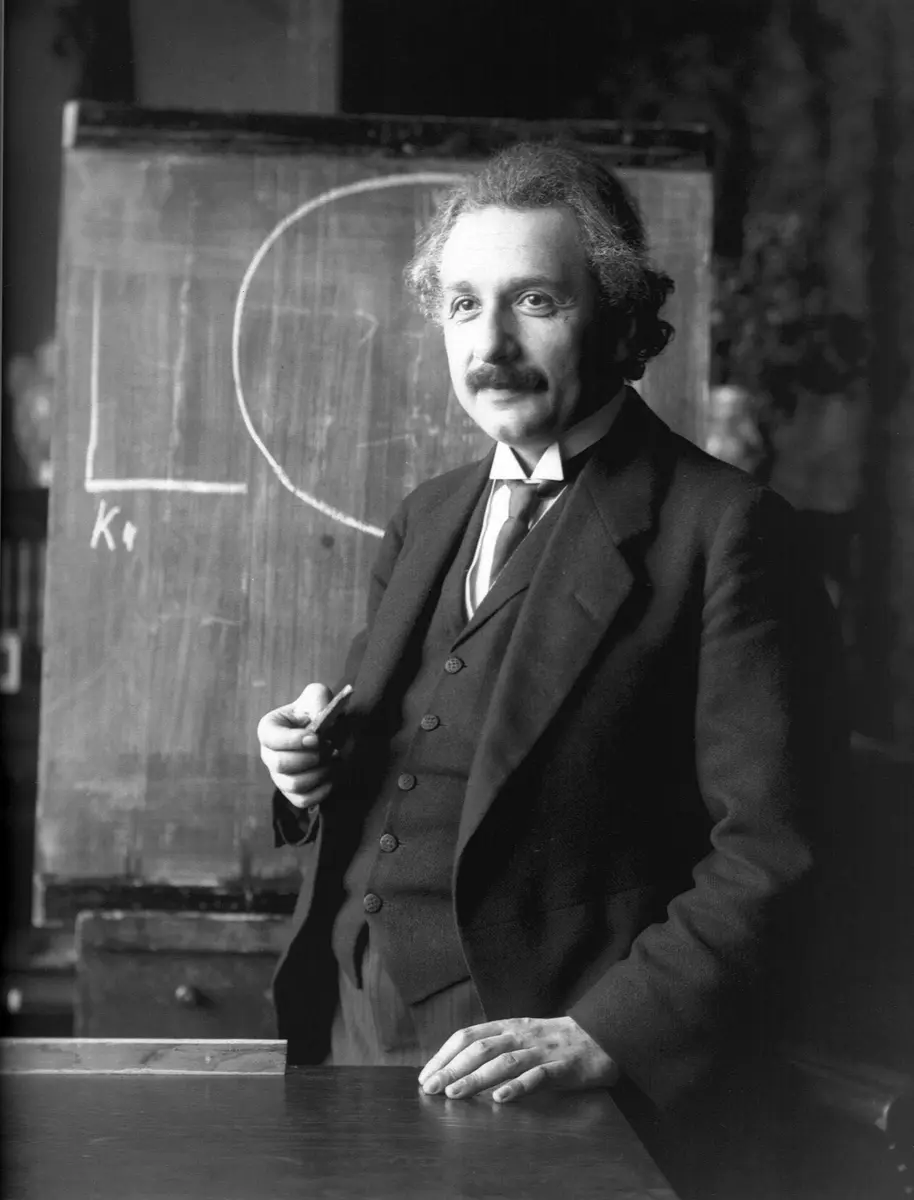
Einstein's world ran from the horse-drawn Germany of Bismarck to the hydrogen bomb, and his face, with its wild white hair, became the picture of genius itself. His ideas are not antiques: satellite navigation must correct for both his relativities to stay accurate, the photoelectric effect is at work in every solar panel, and the gravitational waves his equations predicted were finally detected a century later, in 2015. He was a pacifist who signed the letter that led to the bomb, a German who became Swiss, then German again, then American, and a scientist who spent his fame speaking against war and racism.
What happened
- 1879
Born in Ulm, Württemberg, to Hermann and Pauline Einstein; the family moves to Munich six weeks later.
Ulm: born March 14, 1879- 1896
Enters the Federal Polytechnic in Zurich to train as a teacher of physics and mathematics.
- 1902
Starts work as a technical expert at the Swiss patent office in Bern, having found no university post.
Einstein House, Kramgasse 49, Bern: his flat in the patent-office years, where the 1905 papers were written - 1903
Marries Mileva Marić; the couple's flat at Kramgasse 49 is now the Einstein House.
Einstein House, Kramgasse 49, Bern: his flat in the patent-office years, where the 1905 papers were written - 1905
The miracle year: the papers on light quanta, Brownian motion, special relativity and E = mc², and his doctorate.
Einstein House, Kramgasse 49, Bern: his flat in the patent-office years, where the 1905 papers were written - 1914
Moves to Berlin as director of the Kaiser Wilhelm Institute for Physics and professor at the university, and becomes a German citizen again.
Berlin, 1914–1933: the Prussian Academy of Sciences, where general relativity was presented in 1915 - 1915
Presents the completed general theory of relativity in Berlin: gravity as the curvature of space and time.
Berlin, 1914–1933: the Prussian Academy of Sciences, where general relativity was presented in 1915- 1919
Two British expeditions photograph stars beside the eclipsed Sun, from an island off West Africa and from Sobral in Brazil; the starlight bends as he predicted.
The eclipse results are announced in London; he becomes the most famous scientist in the world overnight.
- 1922
Receives the Nobel Prize in Physics for 1921, held over a year, for the law of the photoelectric effect rather than for relativity.
- 1927
The fifth Solvay Conference in Brussels, and the group photograph with Planck, Curie, Bohr and Heisenberg; his argument with Bohr over quantum mechanics is at its height.
- 1933
Abroad when Hitler takes power, he renounces his German citizenship for the second time and never returns to Germany.
Arrives in the United States and joins the new Institute for Advanced Study in Princeton.
Institute for Advanced Study, Princeton: 1933 until his death- 1939
Signs the letter to President Roosevelt, drafted with Leo Szilard, warning that Germany might build an atomic bomb.
- 1940
Becomes a citizen of the United States.
- 1947
Photographed in Princeton by Orren Jack Turner: the portrait of his old age.
112 Mercer Street, Princeton: his home until he died in the town's hospital in 1955 - 1955
Dies in Princeton Hospital, aged 76, of a ruptured aneurysm, a short walk from his home on Mercer Street.
112 Mercer Street, Princeton: his home until he died in the town's hospital in 1955