Nuclear fission is discovered
“In December 1938 Hahn and Strassmann found barium in uranium hit by neutrons; Meitner and Frisch explained it: the nucleus had split, 'fission', freeing enormous energy, the root of reactors and the bomb.”
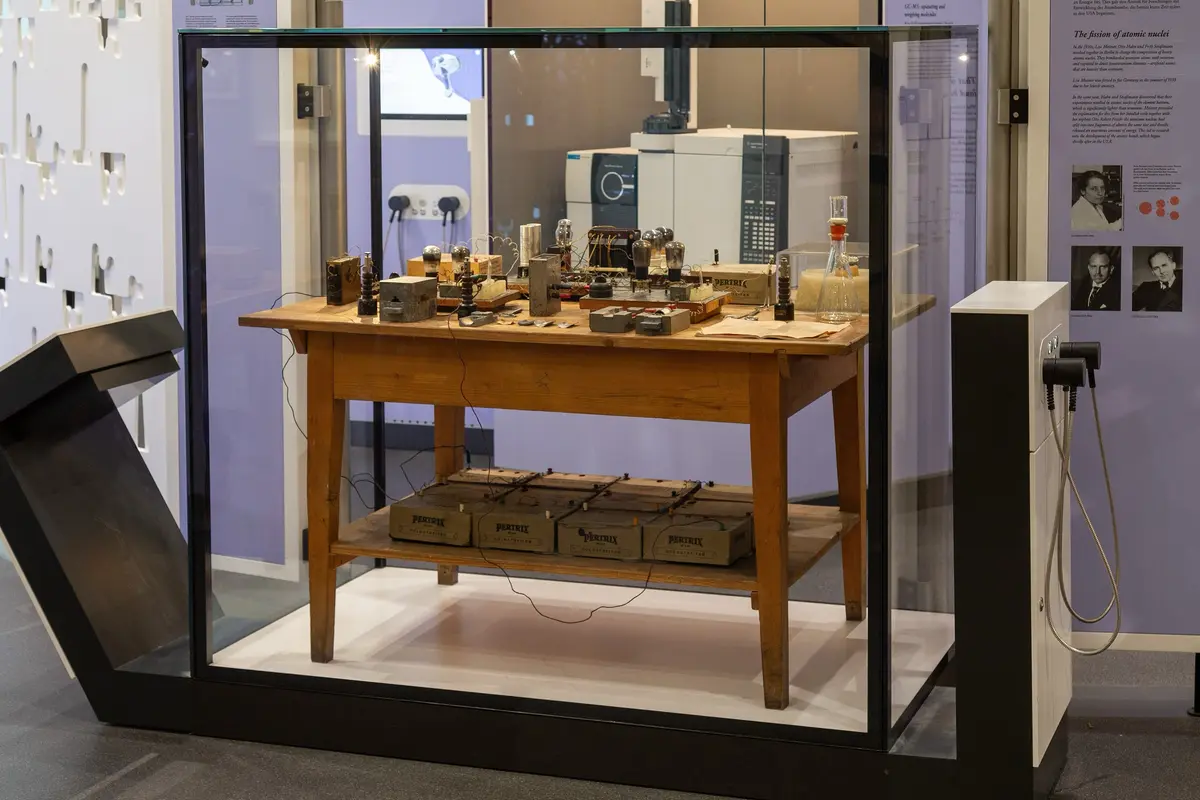
In December 1938, in a laboratory in the Berlin suburb of Dahlem, the chemists Otto Hahn and Fritz Strassmann found something that should not have been there. They had been firing neutrons at uranium, the heaviest element then known, in the hope of making new elements heavier still. Instead their careful chemistry showed barium, an element only a little more than half as heavy. A few weeks later their colleague of thirty years, Lise Meitner, who had fled Nazi Germany that summer, and her nephew Otto Frisch explained what it meant: the uranium nucleus had split into two roughly equal halves, which flew apart with far more energy, atom for atom, than any process known until then. Frisch called it fission, after the way a living cell divides in two.
The road there began with the neutron, found in 1932: having no electric charge, it can slip into an atomic nucleus. In Rome in 1934 Enrico Fermi's group bombarded element after element with neutrons, and when they reached uranium they believed they had made the first elements beyond it. The German chemist Ida Noddack replied that the nucleus might instead have broken into large pieces, but no one followed her up. In Berlin, Hahn, Meitner and Strassmann spent four years chasing Fermi's 'transuranic' elements. Meitner, an Austrian of Jewish descent, had to leave in July 1938 with two small suitcases and found a post at the Nobel Institute in Stockholm. Hahn and Strassmann went on, with her advice by letter, and in December proved that the 'radium' they thought they had made was in fact barium. They published on 6 January 1939, but as chemists they did not yet dare to say that the nucleus had burst.
Meitner and Frisch, walking in the snow at Kungälv in western Sweden over Christmas, pictured the nucleus as Niels Bohr did, as a drop of liquid. A uranium nucleus carries so much electric charge that it is barely held together; hit by a neutron it could stretch, pinch in the middle and divide, and the two charged halves would push each other apart with about 200 million electronvolts. Meitner worked out that the two halves weigh about a fifth of a proton less than the uranium nucleus, and by Einstein's E = mc² that missing mass is just that energy. Back in Copenhagen Frisch caught the huge pulses of the flying fragments in an ionisation chamber, and their letter appeared in Nature on 11 February 1939. Bohr had already carried the news to America: on 26 January it was announced at a physics conference in Washington, and within weeks the splitting had been seen in New York, Paris and elsewhere.
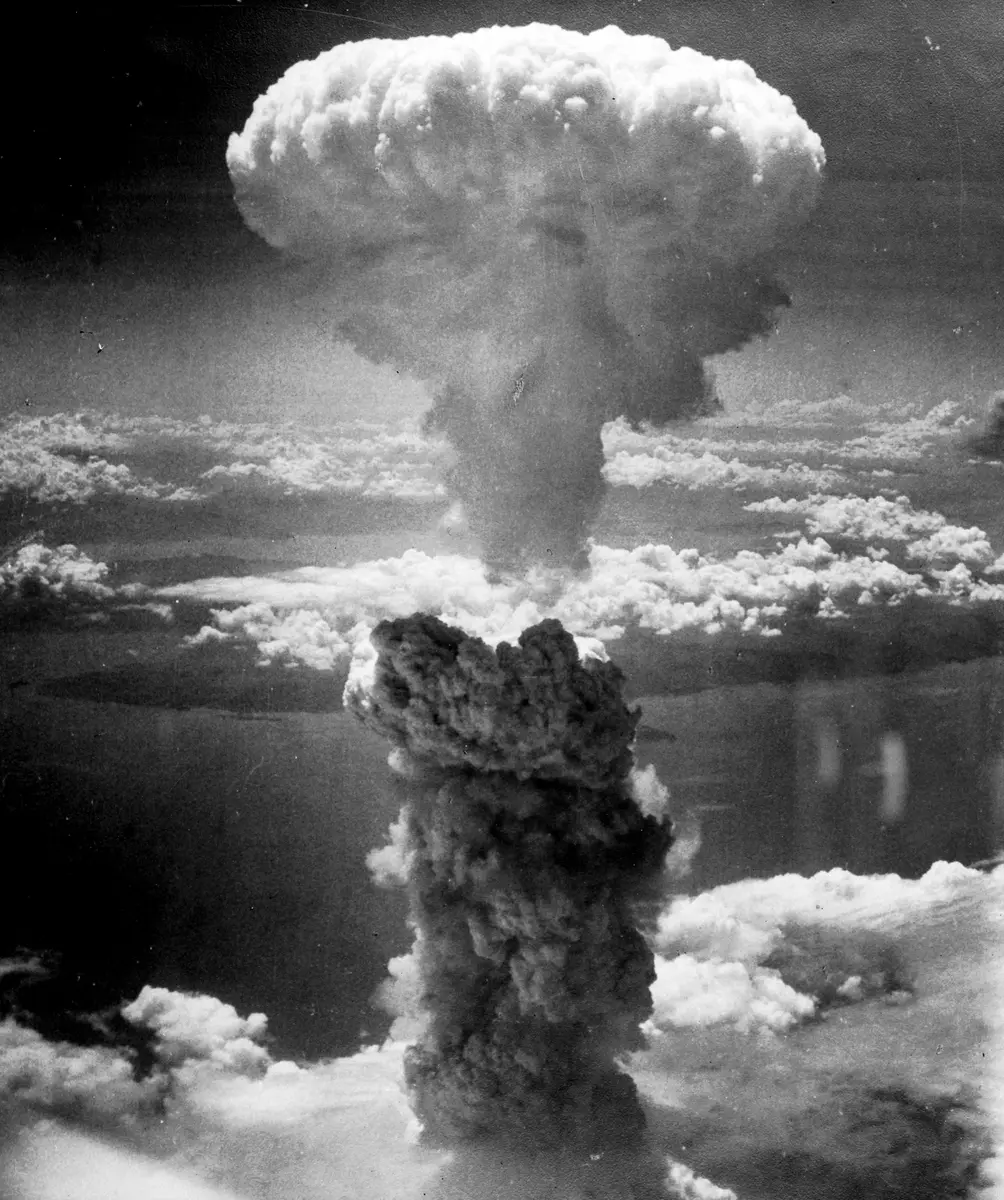
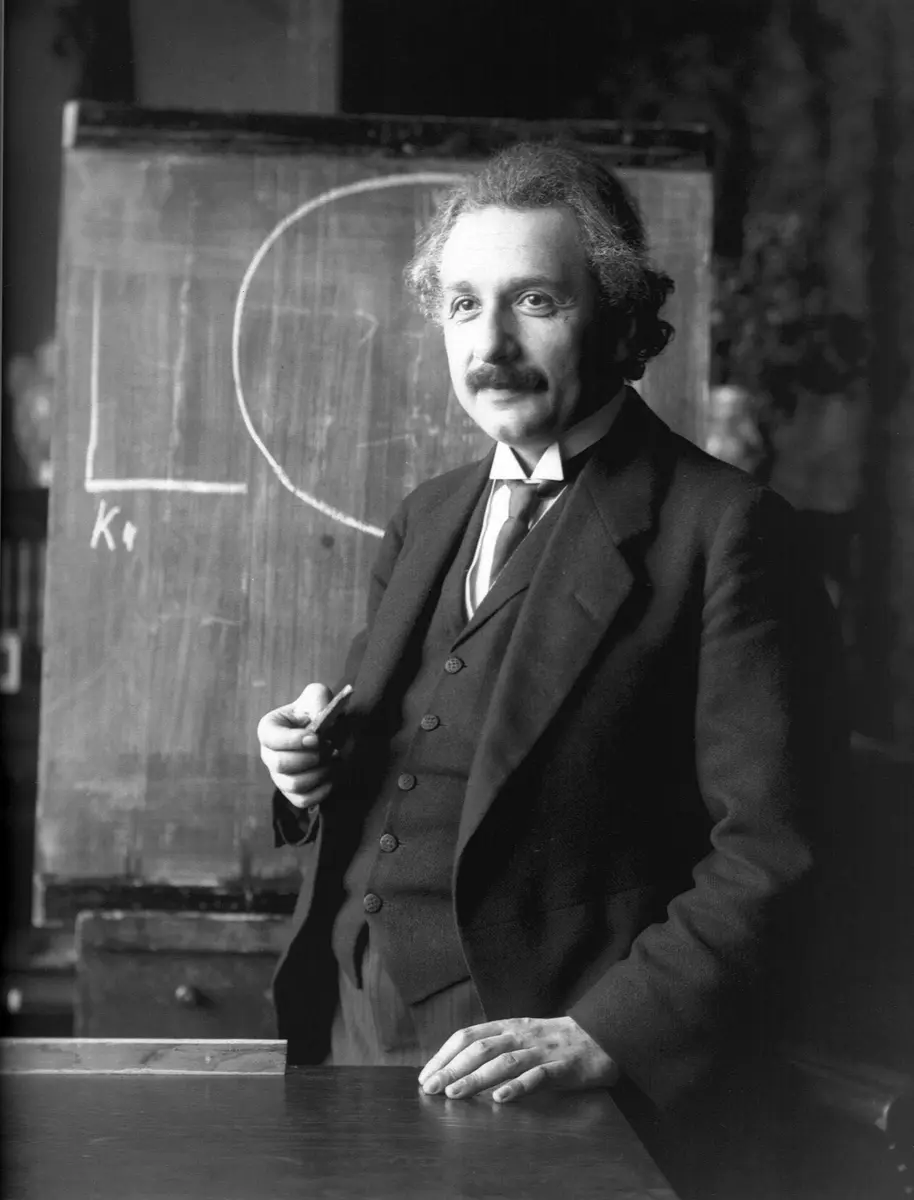
The discovery soon changed the world. In March 1939 Frédéric Joliot's team in Paris showed that each fission sets free further neutrons, so a self-sustaining chain reaction became thinkable: in a controlled form a source of heat and power, unchecked an explosion of enormous force. Bohr saw that it is the rare uranium-235 that splits with slow neutrons, and with John Wheeler published the full theory on 1 September 1939, the day Germany invaded Poland. A month earlier Albert Einstein had signed a letter, drafted by the refugee physicist Leo Szilárd, warning President Roosevelt that Germany might build such a bomb. Six years later two atomic bombs destroyed Hiroshima and Nagasaki.
Credit was shared unequally. Hahn alone received the Nobel Prize in Chemistry for 1944, which he learned of while interned in England after the war and collected in Stockholm in December 1946. Meitner, nominated 48 times for physics and chemistry, never won, and Strassmann and Frisch were barely mentioned. Historians now see the discovery as the work of a team of chemists and physicists that exile and the Nazi state had split apart. Meitner refused to work on the bomb; the element meitnerium, number 109, carries her name, and every nuclear reactor runs on the reaction that she and Frisch explained.
What happened
- 1934
In Nature, Enrico Fermi reports from Rome that bombarding elements with neutrons makes most of them radioactive, and that uranium seems to yield a new element beyond it, number 93. His group had been bombarding uranium since the spring; the new 'transuranic' elements will be sought for four years.
The Royal Physics Institute, Via Panisperna 89a, Rome: Fermi's laboratory, where his group bombarded uranium with neutrons in 1934 and found the power of slow neutronsThe German chemist Ida Noddack, in a paper 'On element 93', objects that Fermi has not ruled out other possibilities: the uranium nucleus might have broken into several large fragments. No one follows her up, not even herself.
Fermi puts a block of paraffin between the neutron source and the target and the radioactivity jumps; water does the same. Neutrons slowed down by hydrogen are captured far more easily, the discovery that will win him the Nobel Prize.
The Royal Physics Institute, Via Panisperna 89a, Rome: Fermi's laboratory, where his group bombarded uranium with neutrons in 1934 and found the power of slow neutrons- 1938
Lise Meitner, Austrian, of Jewish descent and no longer safe in Nazi Germany, leaves Berlin in haste with two small suitcases after thirty years with Hahn. She finds a post at the Nobel Institute for Physics in Stockholm, and keeps advising Hahn and Strassmann by letter.
The Kaiser Wilhelm Institute for Chemistry, Thielallee 63, Berlin-Dahlem: where Hahn, Meitner and Strassmann worked on uranium from 1934 and barium was found in December 1938; today the Free University's Hahn-Meitner-BauIn Stockholm Fermi receives the Nobel Prize in Physics, partly for the 'new radioactive elements' made by neutrons. He does not go home: his wife Laura is Jewish, and Italy's new racial laws threaten her family, so they sail on to New York, where Columbia University gives him a post.
After a night's irradiation of 15.5 grams of uranium, Hahn and Strassmann run their 'indicator experiment': known radium added as a marker separates from barium as usual, but their supposed radium will not. Pressed by Meitner to test it again, they now have to accept that it is barium. Hahn describes the 'strange results' to her in a letter that December.
The Kaiser Wilhelm Institute for Chemistry, Thielallee 63, Berlin-Dahlem: where Hahn, Meitner and Strassmann worked on uranium from 1934 and barium was found in December 1938; today the Free University's Hahn-Meitner-BauTheir paper reaches Die Naturwissenschaften; the day before, Hahn's diary noted 'Strassmann and I are writing our exciting paper'. As chemists they must say the product is barium, yet as 'nuclear chemists' they do not dare to break with everything physics says; they only hint that the nucleus may have burst.
The Kaiser Wilhelm Institute for Chemistry, Thielallee 63, Berlin-Dahlem: where Hahn, Meitner and Strassmann worked on uranium from 1934 and barium was found in December 1938; today the Free University's Hahn-Meitner-BauIn Kungälv near Göteborg, where Meitner is spending Christmas, her nephew Otto Frisch finds her brooding over Hahn's letter. On a walk in the snow, he on skis, she on foot, they sit down on a tree stump and calculate: the uranium nucleus is a wobbly charged drop that a single neutron can split in two; the halves fly apart with about 200 MeV, and the mass they lose, a fifth of a proton, is exactly that energy by E = mc².
Kungälv, Sweden: the house on Västra gatan whose plaque says that Meitner and Frisch formulated their explanation of the splitting of uranium here at the end of 1938- 1939
Hahn and Strassmann's paper appears in Die Naturwissenschaften. Ten days later it reaches Frédéric Joliot's laboratory in Paris, where it is read as a bombshell.
The Kaiser Wilhelm Institute for Chemistry, Thielallee 63, Berlin-Dahlem: where Hahn, Meitner and Strassmann worked on uranium from 1934 and barium was found in December 1938; today the Free University's Hahn-Meitner-BauIn Copenhagen Frisch has rigged up an ionisation chamber and amplifier in two days and, working through the night, caught the huge pulses of the flying fragments by three in the morning. He mails two letters to Nature: the joint explanation with Meitner, drafted over the telephone, which names the process 'fission', a word he took from an American biologist, William Arnold; and his own proof.
Niels Bohr's Institute of Theoretical Physics, Blegdamsvej, Copenhagen: Frisch's laboratory, where he measured the fission fragments in January 1939Bohr, told the news by Frisch just before he sailed, lands in New York, where Fermi meets him at the pier. On the voyage he and Léon Rosenfeld had worked out more of the theory; the news is soon all over Princeton and Columbia.
At Columbia University, John Dunning and Herbert Anderson put uranium in an ionisation chamber next to a neutron source by the cyclotron in Pupin Hall's basement and see the huge pulses, the first fission experiment in America. Dunning writes in his notebook: 'Believe we have observed new phenomenon of far reaching consequences.'
Pupin Hall, Columbia University, New York: where Dunning and Anderson saw the first fission pulses in America on 25 January 1939At the annual Washington conference on theoretical physics, held at George Washington University, Bohr with Fermi beside him tells American and émigré physicists about fission. Several leave for their laboratories; newspapers carry the story across the country.
George Washington University, Washington: where Bohr announced the discovery at the theoretical physics conference on 26 January 1939Hahn and Strassmann's second paper proves barium beyond doubt, finds further fragments, and now speaks of 'Uranspaltung', the splitting of uranium.
The Kaiser Wilhelm Institute for Chemistry, Thielallee 63, Berlin-Dahlem: where Hahn, Meitner and Strassmann worked on uranium from 1934 and barium was found in December 1938; today the Free University's Hahn-Meitner-BauMeitner and Frisch's letter, 'Disintegration of Uranium by Neutrons: a New Type of Nuclear Reaction', appears in Nature, signed from Stockholm and Copenhagen; Frisch's physical evidence follows a week later.
In Nature, Hans von Halban, Frédéric Joliot and Lew Kowarski show from Paris that fission sets free fresh neutrons. If each split frees more than one, a chain reaction is possible, the question Leo Szilárd had been asking for years; Fermi and Anderson at Columbia, always a little behind the Paris team, find the same.
At Peconic on Long Island, Albert Einstein signs a letter to President Roosevelt, drafted with Szilárd, warning that a chain reaction in uranium could make 'extremely powerful bombs' and that Germany may be working on them.
Bohr and John Wheeler's 'The Mechanism of Nuclear Fission' appears in Physical Review: the full liquid-drop theory of fission. Early in the year Bohr had seen that it is the rare uranium-235 that splits with slow neutrons. The same day Germany invades Poland, and the Second World War begins.