Galileo
“The Tuscan scientist who turned the telescope on the sky, found Jupiter's moons, founded the science of motion, and was condemned by the Inquisition in 1633 for teaching that the Earth moves.”
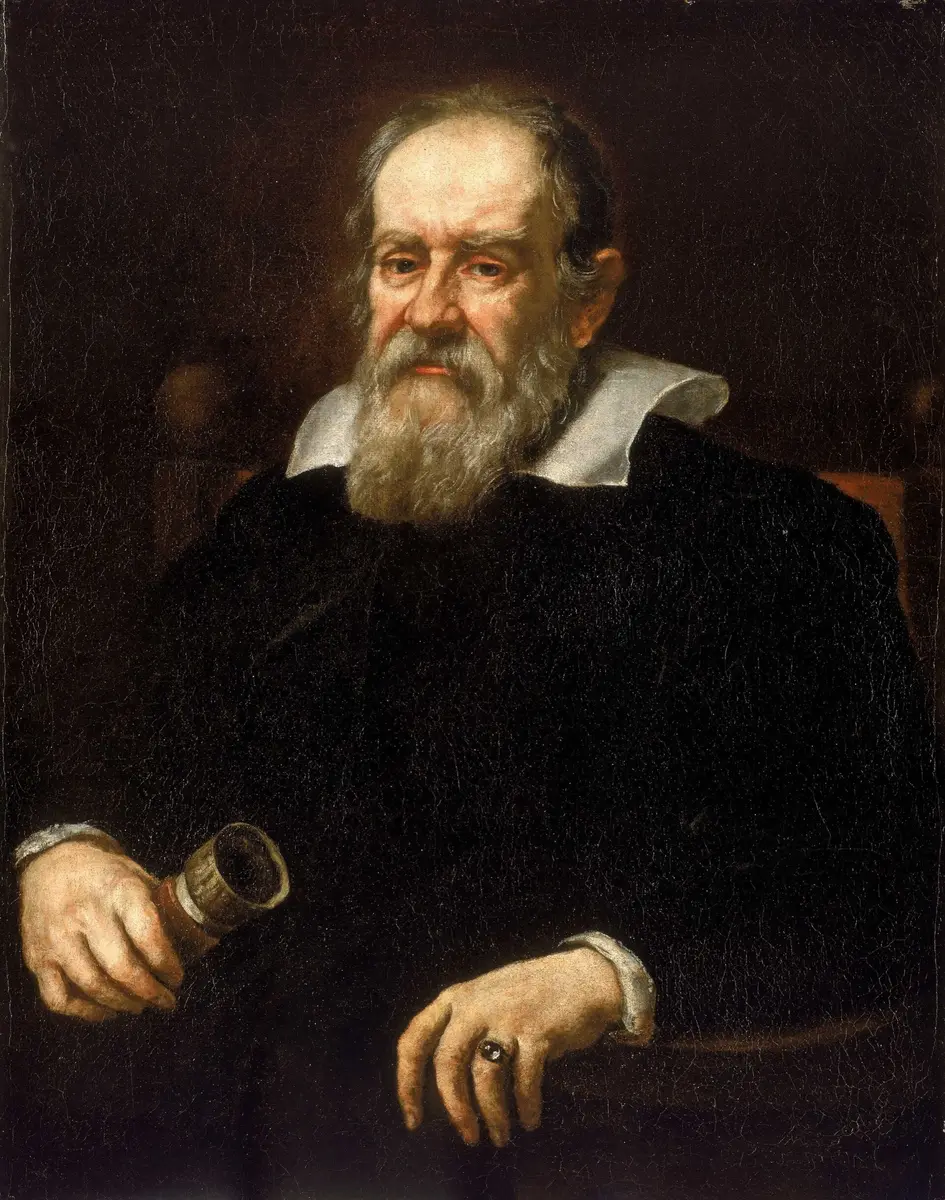
Galileo Galilei was the Tuscan mathematician, astronomer and physicist who turned a Dutch spyglass into a scientific instrument, saw mountains on the Moon and four moons circling Jupiter, and became the best-known champion of Copernicus's Sun-centred universe. He also founded the modern science of motion: by timing balls rolling down gentle slopes he found that a falling body gains speed steadily, so that the distance it covers grows with the square of the time, and that a thrown object follows a parabola. His insistence that the book of nature is written in the language of mathematics, and his habit of testing ideas against experiment, have made him for many the father of modern science. His trial by the Roman Inquisition in 1633 made him the lasting symbol of a clash between science and the Church.
He was born in Pisa on 15 February 1564, the eldest son of Vincenzo Galilei, a Florentine lute player and writer on music, and grew up in Florence. His father sent him back to the University of Pisa to become a doctor, but he preferred Euclid and Archimedes and left in 1585 without a degree. After some years of private teaching he became lecturer in mathematics at Pisa in 1589, where, his first biographer claimed, he dropped weights from the Leaning Tower (a story historians doubt), and in 1592 professor at Padua, the university of the Venetian Republic. He stayed eighteen years and later called them the happiest of his life. Always short of money as head of his family, he took in boarders, sold a calculating instrument of his own design, and had three children with a Venetian woman, Marina Gamba, whom he never married.
In 1609 he heard of a Dutch spyglass, worked out how to make a much better one, and that winter turned it on the sky. His little book The Starry Messenger (March 1610) made him famous across Europe, and by naming Jupiter's moons the 'Medicean stars' he won a post for life as philosopher and mathematician to Cosimo II de' Medici, Grand Duke of Tuscany, and moved back to Florence. His discoveries, above all the phases of Venus, convinced him that Copernicus was right, and he began to say so in print. In 1616 the Inquisition's theologians declared the moving Earth heretical, Copernicus's book was suspended, and Cardinal Bellarmine warned Galileo not to hold or defend it. When his admirer Maffeo Barberini became Pope Urban VIII, Galileo felt free to write his Dialogue Concerning the Two Chief World Systems (1632), which argued for Copernicus under the thin cover of a debate and put the pope's own favourite argument in the mouth of its foolish Aristotelian.
The reaction was swift. Tried in Rome, he was declared 'vehemently suspect of heresy' and on 22 June 1633 knelt in the church of Santa Maria sopra Minerva to abjure the motion of the Earth; there is no evidence that he then muttered 'And yet it moves'. Sentenced to prison at the Inquisition's pleasure, he served the sentence under house arrest, from December 1633 in his villa at Arcetri in the hills above Florence. There, losing his beloved daughter Maria Celeste in 1634 and his sight by 1638, he wrote up his life's work on motion and on the strength of materials, Two New Sciences, which was smuggled out of Italy and printed at Leiden in 1638.
He died at Arcetri on 8 January 1642, aged 77, and as a man condemned for heresy was buried quietly in Santa Croce in Florence; only in 1737 were his remains moved to a grand tomb in the church, and in 1992 Pope John Paul II admitted that the theologians who judged him had erred. Isaac Newton, born within the year, built on his science of motion. His two surviving telescopes and the cracked lens with which he found Jupiter's moons are kept in Florence's Museo Galileo.
What happened
- 1564
Galileo is born in Pisa, the first child of Vincenzo Galilei, a Florentine musician, and Giulia Ammannati; four days later he is baptised in the cathedral's baptistery.
Pisa, the cathedral square: Galileo was born in the city in 1564 and baptised in its baptistery, studied and first taught at its university, and is said to have dropped weights from the Leaning Tower- 1579
His family has lived in Florence since the early 1570s. Taught by the monks of Vallombrosa, he thinks of joining their order, until his father, who wants a doctor in the family, brings him home.
- 1581
He enrols at the University of Pisa to study medicine, as his father wishes, but is drawn to mathematics instead.
Pisa, the cathedral square: Galileo was born in the city in 1564 and baptised in its baptistery, studied and first taught at its university, and is said to have dropped weights from the Leaning Tower- 1583
By the account of his first biographer, Vincenzo Viviani, he watches a lamp swing in Pisa Cathedral and sees that each swing takes the same time, wide or narrow. That year he begins to study Euclid with the Tuscan court mathematician Ostilio Ricci.
Pisa, the cathedral square: Galileo was born in the city in 1564 and baptised in its baptistery, studied and first taught at its university, and is said to have dropped weights from the Leaning Tower - 1589
Having left Pisa without a degree in 1585, taught privately in Florence and Siena, and lectured to the Florentine Academy on the shape and size of Dante's Inferno, he becomes lecturer in mathematics at Pisa. Viviani later told of him dropping weights from the Leaning Tower to refute Aristotle, a story historians doubt.
Pisa, the cathedral square: Galileo was born in the city in 1564 and baptised in its baptistery, studied and first taught at its university, and is said to have dropped weights from the Leaning Tower - 1591
His father dies, leaving him head of the family and bound to pay his sisters' dowries.
- 1592
He gives his inaugural lecture as professor of mathematics at Padua, the university of the Venetian Republic, at a far higher salary. He stays eighteen years and later calls them the happiest of his life.
Palazzo del Bo, the University of Padua: his university from 1592 to 1610, where he worked out the law of fall and built his telescopes- 1597
He invents his 'geometric and military compass', a calculating instrument made by a craftsman in his house and sold with lessons. The same year he tells Kepler in a letter that he believes Copernicus.
Palazzo del Bo, the University of Padua: his university from 1592 to 1610, where he worked out the law of fall and built his telescopes - 1600
His Venetian companion Marina Gamba gives birth to their first child, Virginia; a daughter, Livia, follows in 1601 and a son, Vincenzo, in 1606. They never marry.
Palazzo del Bo, the University of Padua: his university from 1592 to 1610, where he worked out the law of fall and built his telescopes- 1604
Timing balls rolling down a gently sloping plane, he finds that a falling body speeds up steadily, the distance growing with the square of the time. He will not publish it for more than thirty years.
Palazzo del Bo, the University of Padua: his university from 1592 to 1610, where he worked out the law of fall and built his telescopes - 1605
In three public lectures at Padua he argues that the new star that appeared in October 1604 lies far beyond the Moon, so that the heavens can change, against Aristotle.
Palazzo del Bo, the University of Padua: his university from 1592 to 1610, where he worked out the law of fall and built his telescopes- 1609
Having heard in the spring of a Dutch spyglass, he works out how it must be made, grinds his own lenses, and shows an eight-power telescope to the Venetian Senate, which gives him his chair for life and doubles his salary.
From 30 November to 19 December he watches the Moon through his telescope and paints its phases: its surface is rough, with mountains and valleys, not the perfect sphere of the old astronomy.
Palazzo del Bo, the University of Padua: his university from 1592 to 1610, where he worked out the law of fall and built his telescopes- 1610
He sees three small 'fixed stars' in a line beside Jupiter. Night after night they move with the planet and change places, and by 15 January he knows there are four of them, circling it.
Palazzo del Bo, the University of Padua: his university from 1592 to 1610, where he worked out the law of fall and built his telescopesThe Starry Messenger comes off the press in Venice: the mountains of the Moon, the countless stars of the Milky Way, and Jupiter's four moons, which he names the Medicean Stars and dedicates to Cosimo II de' Medici, Grand Duke of Tuscany.
Cosimo II names him Chief Mathematician of the University of Pisa, with no duty to teach, and Philosopher and Mathematician to the Grand Duke, for life. In September he leaves Padua for Florence.
In Florence he sees Venus go through phases like the Moon's, which it can only do if it circles the Sun.
- 1611
In Rome the Jesuit astronomers of the Collegio Romano confirm his discoveries, and Prince Federico Cesi makes him a member of the Lincean Academy, at whose banquet the instrument is first called a 'telescope'.
- 1613
The Lincean Academy publishes his Letters on Sunspots, which show that the spots lie on the Sun and turn with it; in them he backs Copernicus openly for the first time.
- 1615
Denounced to the Inquisition by Dominican friars, he expands a letter on the Bible and astronomy into the Letter to the Grand Duchess Christina, arguing that Scripture must be read in the light of what nature shows, and in December goes to Rome to plead for Copernicus.
- 1616
The Inquisition's theologians judge the Sun-centred system foolish and heretical, and on the Pope's order Cardinal Robert Bellarmine warns Galileo not to hold or defend it. In March Copernicus's book is suspended 'until corrected'.
- 1623
His friend and admirer Cardinal Maffeo Barberini, elected Pope Urban VIII in August, accepts the dedication of The Assayer, where Galileo writes that the book of nature is written in the language of mathematics.
- 1624
In Rome he has six audiences with Urban VIII, who lets him write about the Copernican system as long as he treats it as a hypothesis. He also shows the Lincei a compound microscope.
- 1632
His Dialogue Concerning the Two Chief World Systems, a debate between a Copernican, an Aristotelian and an intelligent layman, is printed in Florence. By the summer the Pope has stopped its sale; in the autumn the Inquisition summons Galileo to Rome.
- 1633
Ill and nearly seventy, he reaches Rome after a winter journey and two weeks of plague quarantine, and is allowed to stay at the house of the Tuscan ambassador.
His trial begins. Questioned by the Inquisition, he is held for eighteen days in a comfortable apartment in its building; on 30 April he admits he may have made the case for Copernicus too strong.
In the church of Santa Maria sopra Minerva he kneels to hear himself declared 'vehemently suspect of heresy' and sentenced to prison at the Inquisition's pleasure, and signs an abjuration of the Earth's motion.
Santa Maria sopra Minerva, Rome: where he knelt to hear his sentence and abjured the motion of the Earth on 22 June 1633He is sent to Siena, to the palace of his friend Archbishop Ascanio Piccolomini, where he begins to write up his old work on motion.
He is allowed home to his villa at Arcetri, in the hills above Florence, where he lives under house arrest, watched by the Inquisition, for the rest of his life.
Villa Il Gioiello, Arcetri, above Florence: his home under house arrest from December 1633 until his death on 8 January 1642- 1634
His elder daughter Virginia, Sister Maria Celeste, his comfort since his return, dies in the convent of San Matteo near Arcetri, aged 33.
- 1638
Two New Sciences, his book on motion and on the strength of materials, smuggled out of Italy, comes off the Elzeviers' press in Leiden. Its author is now completely blind.
The young English poet John Milton visits him, and later remembers finding the famous Galileo grown old, 'a prisoner to the Inquisition'.
Villa Il Gioiello, Arcetri, above Florence: his home under house arrest from December 1633 until his death on 8 January 1642- 1641
He works out how a pendulum could keep a clock regular; his son Vincenzo tries to build it and fails.
Villa Il Gioiello, Arcetri, above Florence: his home under house arrest from December 1633 until his death on 8 January 1642 - 1642
He dies at Arcetri, aged 77, with his young pupil Vincenzo Viviani beside him. Condemned for heresy, he is buried quietly in Santa Croce; only in 1737 are his remains moved to a monumental tomb in the church.
Villa Il Gioiello, Arcetri, above Florence: his home under house arrest from December 1633 until his death on 8 January 1642