The Marshall Plan
“From 1948 to 1951 the United States gave about $13 billion, nearly all as gifts, to rebuild sixteen Western European countries and western Germany; the Soviet bloc refused it, and Europe split in two.”
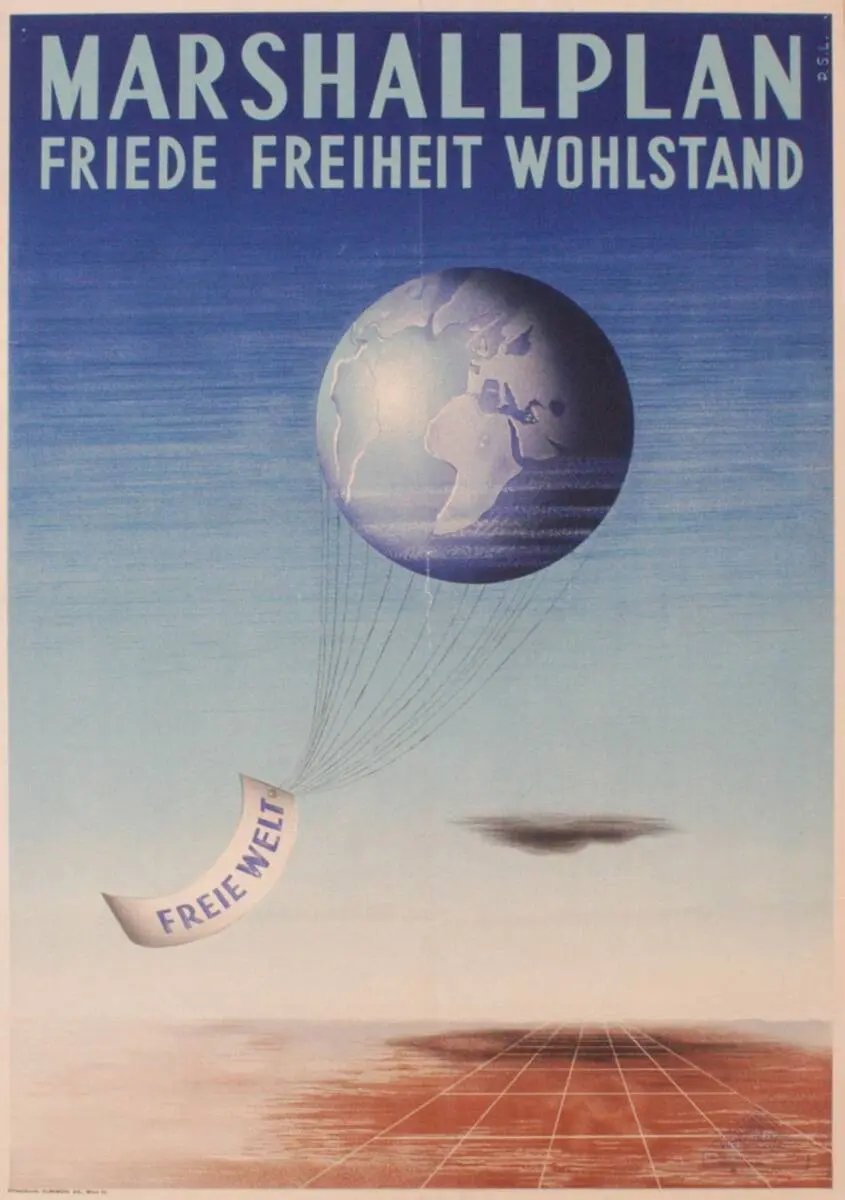
The Marshall Plan, officially the European Recovery Program, was the American programme that paid for much of Western Europe's recovery after the Second World War. George C. Marshall, the army's wartime chief of staff who had become Secretary of State, proposed it in a short speech at Harvard University on 5 June 1947; Congress passed it by large majorities, and President Truman signed it into law on 3 April 1948. A new agency, the Economic Cooperation Administration (ECA), led by Paul Hoffman, the head of the Studebaker car company, then sent about $13 billion to sixteen countries and western Germany until the end of 1951, nearly all of it as gifts rather than loans. Wheat, coal, cotton, medicines, tractors and machine tools crossed the Atlantic, beginning with the freighter John H. Quick, which sailed from Galveston, Texas, on 17 April 1948 with about 9,000 tons of wheat for France.
Two years after the war Europe was still close to breaking down. Cities, railways and factories lay in ruins, the bitter winter of 1946–47 left many people hungry and without shelter, and governments were spending their last dollars on food and coal from America. In his speech Marshall argued that the visible destruction mattered less than the collapse of trade, between farmers and towns and between countries, and that only outside help could break this 'vicious circle'. Washington also feared that poverty was making communist parties more popular with Western European voters, and it wanted Europe as a market for American goods. Three months earlier Truman had promised to help Greece and Turkey resist communism; he later called that doctrine and the Marshall Plan 'two halves of the same walnut'. Marshall insisted, however, that the Europeans draw up the plan themselves and that it be open to every country in Europe, the Soviet Union included.
Britain's foreign secretary Ernest Bevin 'grabbed the proposals with both hands'. With France's Georges Bidault he invited the Soviet foreign minister Vyacheslav Molotov to Paris, but on 2 July 1947 Molotov walked out, warning that the plan would divide Europe into two groups. Moscow then kept Czechoslovakia, Poland and the rest of Eastern Europe away, and in January 1949 the Soviet bloc set up its own Council for Mutual Economic Assistance (Comecon). Sixteen countries met at the French foreign ministry on the Quai d'Orsay on 12 July 1947 and in September sent Washington a four-year plan. On 16 April 1948 they founded the Organisation for European Economic Co-operation (OEEC) to share out the aid and lower the barriers between their economies; in October it bought the Château de la Muette in Paris as its home. Each country also signed its own agreement with the United States, and Averell Harriman ran the ECA's office for Europe in Paris.
The money reached beyond Europe. The Netherlands received about $1.1 billion, part of it for the Dutch-held parts of Indonesia. But when Dutch troops attacked the Indonesian Republic on 19 December 1948 and captured its leaders in Yogyakarta, the ECA stopped all new aid for Indonesia, announced on 22 December; aid to the Netherlands itself went on, although Washington was under growing pressure to cut that too. In Europe the results came fast: by 1950 trade between the western European countries was back at its prewar level, and by 1951 their industrial output was 43 percent above it. After the Korean War began in June 1950, American aid turned toward rearmament. The Mutual Security Act of 10 October 1951 abolished the ECA, and the plan ended on 31 December 1951, six months early, having delivered some $13.3 billion.
Historians still debate how much of the recovery the dollars themselves caused, but the plan arrived when food, fuel and confidence were scarcest, and it pushed old enemies to plan and trade together: the OEEC set up the European Payments Union in 1950 and became the OECD in 1961, and the habit of economic cooperation helped prepare the ground for today's European Union. It made foreign aid a lasting part of American policy, and by dividing Europe into those who took the aid and those who refused it, it drew the economic line of the Cold War. Marshall received the Nobel Peace Prize in 1953 'for proposing and supervising the plan for the economic recovery of Europe', the only general ever to win it.
What happened
- 1947
- 2:50 p.m.
After receiving an honorary degree that morning, Secretary of State George C. Marshall speaks for just under eleven minutes to 15,000 people in Harvard Yard: Europe needs far more food and goods than it can pay for, the United States should help break the 'vicious circle', and 'the initiative ... must come from Europe'.
Tercentenary Theatre, Harvard Yard, Cambridge, Massachusetts: Marshall spoke from the steps of Memorial Church to some 15,000 people on 5 June 1947 Meeting in Paris, Ernest Bevin and Georges Bidault welcome Marshall's offer and, that evening, hand the Soviet chargé d'affaires an invitation for Moscow to join them in drawing up a European answer.
Molotov, who arrived the evening before, sits down with Bevin and Bidault in Paris; over the following days he rejects any joint inquiry into each country's resources as a breach of national sovereignty.
At the last three-power meeting Molotov rejects the French compromise and leaves Paris, warning that the plan will bring 'a division of Europe into two groups'; Bidault answers that it is the Soviet Union that is dividing Europe.
Bevin and Bidault agree on an invitation to 22 European countries, all but Spain and the Soviet Union, to meet in Paris; it goes out the next day.
In Moscow, after two audiences with Stalin, the Czechoslovak communist leader Klement Gottwald tells his cabinet in Prague to withdraw its acceptance of the Paris invitation; the cabinet complies. Poland and the other countries under Soviet control also stay away.
Sixteen countries open their conference at the French foreign ministry on the Quai d'Orsay; four days later they set up the Committee of European Economic Co-operation under Britain's Sir Oliver Franks to work out what Europe needs.
French foreign ministry, Quai d'Orsay, Paris: the conference of the sixteen met here from 12 July 1947, and the OEEC was founded here on 16 April 1948The sixteen sign the Committee's general report, a four-year programme for recovery and their estimate of the help they need, and send it to Marshall.
French foreign ministry, Quai d'Orsay, Paris: the conference of the sixteen met here from 12 July 1947, and the OEEC was founded here on 16 April 1948Truman sends Congress his message on the European Recovery Program, asking for $17 billion from April 1948 to June 1952, $6.8 billion of it for the first fifteen months.
- 1948
The communists take full power in Czechoslovakia, the country Stalin had pulled out of the plan; in March both houses of Congress pass the aid bill by large majorities.
A day after Congress approves its final text, Truman signs the Foreign Assistance Act of 1948, whose Economic Cooperation Act creates the Marshall Plan: 'Few Presidents have had the opportunity to sign legislation of such importance.'
The White House, Washington: Truman signed the Act on 3 April 1948 and swore in Paul Hoffman on 9 AprilPaul G. Hoffman, president of the Studebaker car company, is sworn in at the White House as Administrator of the new Economic Cooperation Administration; Averell Harriman becomes its special representative in Europe, based in Paris.
The White House, Washington: Truman signed the Act on 3 April 1948 and swore in Paul Hoffman on 9 AprilMeeting again at the Quai d'Orsay with Bevin presiding, the sixteen countries and the western zones of Germany sign the Convention for European Economic Co-operation, and the new Organisation for European Economic Co-operation (OEEC) holds its first meeting.
French foreign ministry, Quai d'Orsay, Paris: the conference of the sixteen met here from 12 July 1947, and the OEEC was founded here on 16 April 1948The freighter John H. Quick, which left Galveston, Texas, on 17 April with about 9,000 tons of wheat, is welcomed at Bordeaux as the first Marshall Plan ship to reach Europe; ambassador Jefferson Caffery speaks on the quay.
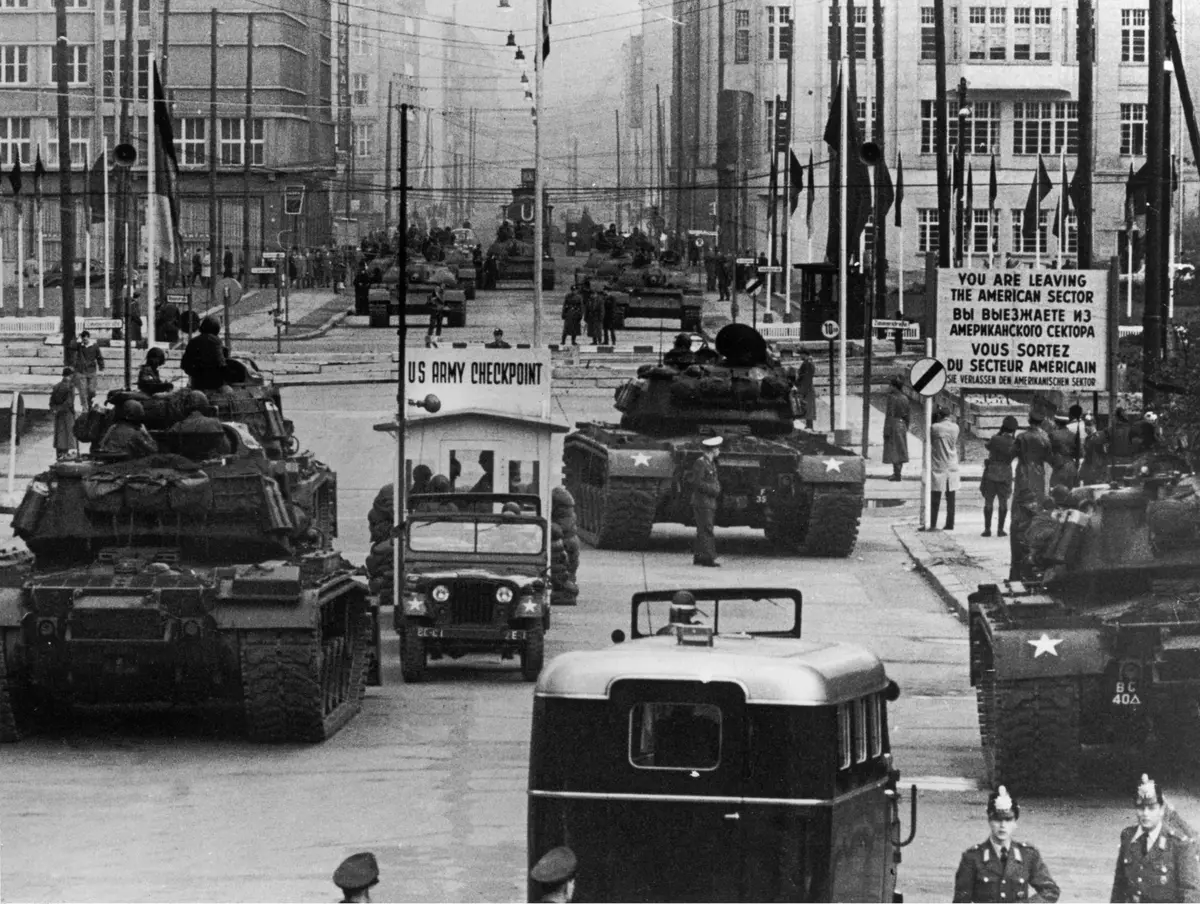
Bordeaux: the John H. Quick brought the first Marshall Plan cargo to Europe here, received on 10 May 1948The Soviet Union blockades West Berlin; until 12 May 1949 the Western allies supply the city by air.
West Berlin: blockaded from June 1948; its emergency building programme ran 'with Marshall Plan aid'In The Hague the Netherlands signs its bilateral agreement with the United States, one of the agreements each participating country makes with Washington to receive Marshall aid.
The Hague: the Netherlands signed its Marshall Plan agreement with the United States on 2 July 1948The freighter Stad Vlaardingen unloads 9,000 tons of Marshall Plan coal for the Dutch railways in the Coenhaven in Amsterdam.
Coenhaven, Amsterdam: the Stad Vlaardingen unloaded 9,000 tons of Marshall Plan coal for the Dutch railways here on 17 September 1948The OEEC buys the Château de la Muette in Paris from the heirs of Baron Henri de Rothschild and makes it its headquarters.
Château de la Muette, Paris: the OEEC's headquarters from late 1948, today the OECD'sIn the Oval Office Truman confers with Marshall, Hoffman and Harriman and decides that the European Recovery Program should go on on a large scale.
The White House, Washington: Truman signed the Act on 3 April 1948 and swore in Paul Hoffman on 9 AprilDutch forces attack the Indonesian Republic in their second 'police action'; by mid-afternoon they hold Yogyakarta, and Sukarno, Hatta and other leaders are in Dutch hands.
Tugu monument, Yogyakarta: Dutch troops took the Indonesian Republic's seat and its leaders on 19 December 1948; three days later the ECA stopped aid for IndonesiaThe ECA announces that it is suspending all new aid for Indonesia, where it had set aside $72.7 million, mostly for textiles, rice and flour; aid to the Netherlands itself continues.
- 1949
The Soviet Union, Bulgaria, Czechoslovakia, Hungary, Poland and Romania found the Council for Mutual Economic Assistance (Comecon), the Soviet bloc's answer to the Marshall Plan's cooperation in the West.
- 1950
Under the OEEC the participating countries create the European Payments Union, a clearing fund that balances their trade deficits with one another, so that their currencies can be used across borders and import quotas removed.
Château de la Muette, Paris: the OEEC's headquarters from late 1948, today the OECD's- 1951
The Mutual Security Act becomes law: with the Korean War under way it joins economic aid to military aid, and it abolishes the ECA in favour of a new Mutual Security Agency.
The Economic Cooperation Administration ceases to exist; the Mutual Security Agency takes over its work and winds up its affairs.
The European Recovery Program ends, six months early because of the Korean War, after transfers of about $13.3 billion.