Vikings reach North America
“About 1000, Norse sailors from Greenland led by Leif Erikson reached North America and called it Vinland; their camp at L'Anse aux Meadows in Newfoundland is dated to 1021.”
Around the year 1000, Norse seafarers from the young settlements in Greenland sailed west and reached North America, nearly five hundred years before Columbus. Led by Leif Erikson, the son of Erik the Red, they named three new lands, Helluland, Markland and Vinland, built a base camp and spent the winter there. Over the next years his brothers, his sister and an Icelandic trader, Thorfinn Karlsefni, made more voyages, until fighting with the people who already lived there, and the long way home, ended the venture. The only place where their presence is proven is L'Anse aux Meadows, on the northern tip of Newfoundland, where wood cut with metal blades has been dated to the year 1021.
The story begins in Greenland. Erik the Red, banished from Iceland for killings about 980, explored the coast to the west and came back to Iceland in 985 or 986 to recruit settlers: of 25 ships that sailed, about 14 arrived, and Erik took the farm of Brattahlíð at the head of a long fjord in the south-west. According to the Saga of the Greenlanders, a trader, Bjarni Herjólfsson, sailing to join his father there, was blown off course and saw wooded lands to the west, but never went ashore. Leif bought Bjarni's ship and set out with 35 men. On a coast of flat stones and ice, then on a low wooded shore, and at last in a milder land where they found timber and wild grapes, they gave the names that mean 'land of flat rocks', 'land of forests' and 'land of wine'. The other saga, the Saga of Erik the Red, tells it differently: Leif, coming home from the court of King Olaf Tryggvason in Norway, where he had become a Christian, was blown to the new land by accident.
The later voyages ended badly. Leif's brother Thorvald was killed in a fight with the local people; another brother, Thorstein, never got there. Thorfinn Karlsefni and his wife Gudrid, Thorstein's widow, came with three or more ships, perhaps 135 men and 15 women, and cattle, meaning to stay. They traded cloth for furs with the people the Norse called skrælings, ancestors of the Indigenous peoples of the region, until the trading turned to fighting. Gudrid gave birth to a son, Snorri, the first European child known to have been born in the Americas, and after about three years the settlers gave up. The last voyage the sagas tell, led by Leif's sister Freydis, ended in murder among the Norse themselves. The distances were too great and the Greenland colony, perhaps 500 people, was too small to hold a settlement more than 3,500 kilometres from home.
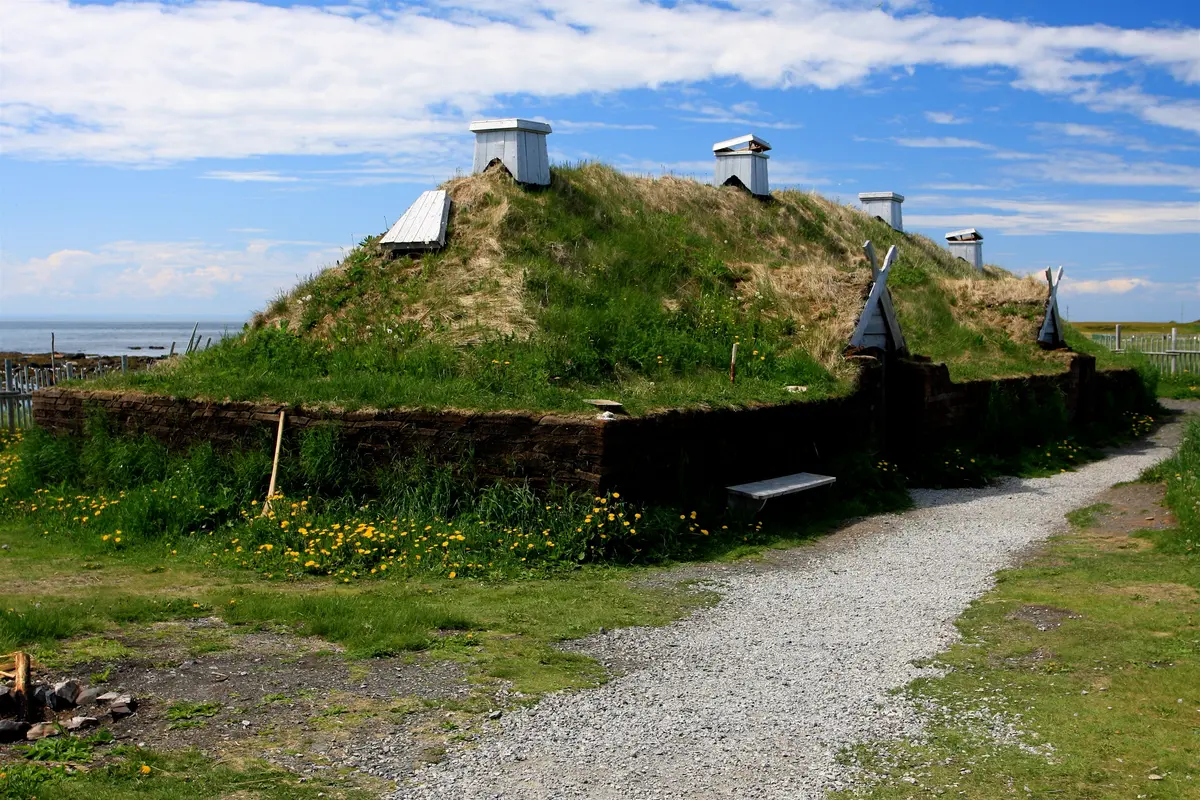
For centuries the voyages were known only from the two sagas, written down in Iceland in the 13th century and kept in manuscripts such as the Flateyjarbók of the 1390s, and from the German chronicler Adam of Bremen, who about 1075 heard from the Danish king of an island called Vinland where vines grow wild. In 1960 the Norwegian explorer Helge Ingstad, guided by a local fisherman, George Decker, found the overgrown walls of eight buildings at L'Anse aux Meadows. He and his wife, the archaeologist Anne Stine Ingstad, excavated them until 1968: halls, workshops and a smithy built of turf like those in Iceland and Greenland, a bronze cloak pin, a spindle whorl and a bone needle that show women were there, iron rivets for ship repairs, and the first iron smelted in the Americas. Butternuts, which do not grow in Newfoundland, show that the Norse went further south. In 2021 scientists in Groningen found in three pieces of cut wood the trace of a cosmic-ray burst of 993; counting the rings to the bark gave the year the trees were felled, 1021.
Vinland changed little in its own time: no colony took root, and the Norse of Greenland, who held out until the 15th century, turned back to Europe for their trade. But it is the first known meeting of Europeans and Native Americans, and, as the dating team put it, the earliest known year by which human migration had closed the circle around the globe. L'Anse aux Meadows became a Canadian national historic site in 1968 and one of the first UNESCO World Heritage Sites in 1978. The wish to prove the Vinland story also produced a famous fake: the 'Vinland Map', announced by Yale in 1965 as a medieval map of North America, was shown in 2021 to be drawn in 20th-century ink.
What happened
- 985
Erik the Red, banished from Iceland about 980, comes back from three years of exploring the land to the west and leads settlers there: of 25 ships, about 14 reach the fjords of the south-west. He calls the country Greenland to draw people, and builds his farm at Brattahlíð.
Brattahlíð (Qassiarsuk), Greenland: Erik the Red's farm at the head of his fjord, where Leif grew up and the voyages began - 986
Bjarni Herjólfsson, sailing from Iceland to join his father in Greenland, is driven off course and sees three unknown lands, wooded and then icy, but does not go ashore. The Saga of the Greenlanders begins with his voyage.
- 1000
Leif Erikson, at the court of King Olaf Tryggvason in Norway, becomes a Christian and is sent home to convert Greenland; his mother has the first church built at Brattahlíð. In the Saga of Erik the Red he is blown to the new land by chance on this voyage home.
Brattahlíð (Qassiarsuk), Greenland: Erik the Red's farm at the head of his fjord, where Leif grew up and the voyages beganIn the Saga of the Greenlanders, Leif buys Bjarni's ship and sails west with 35 men. He names a land of flat rocks Helluland and a wooded shore Markland, and further south builds houses, Leifsbúðir, and winters. One of his men, Tyrkir, finds wild grapes, and Leif calls the country Vinland, land of wine; in spring he sails home with timber and grapes.
- 1003
Leif's brother Thorvald takes the ship to Vinland, stays two winters and is killed in a fight with the people living there. A third brother, Thorstein, tries to bring his body home, but storms drive him back.
- 1010
Thorfinn Karlsefni, an Icelandic trader, and his wife Gudrid lead the largest expedition, with perhaps 135 men, 15 women and livestock, meaning to settle. They trade cloth for furs with the people the Norse call skrælings until the trade turns to fighting; Gudrid gives birth to Snorri, the first European child known to be born in the Americas. After about three years they give up and go home. A last voyage, led by Leif's sister Freydis, ends in the murder of her Icelandic partners.
- 1021
At L'Anse aux Meadows, someone cuts wood with metal tools: three pieces from three different trees, felled in 1021, one in spring and one in summer or autumn. Counted from the trace of the cosmic-ray burst of 993 in their rings, it is the only exact year known for Europeans in the Americas before Columbus.
L'Anse aux Meadows, Newfoundland: the Norse camp of about 1000, the only proven Norse site in the Americas, now a national historic site