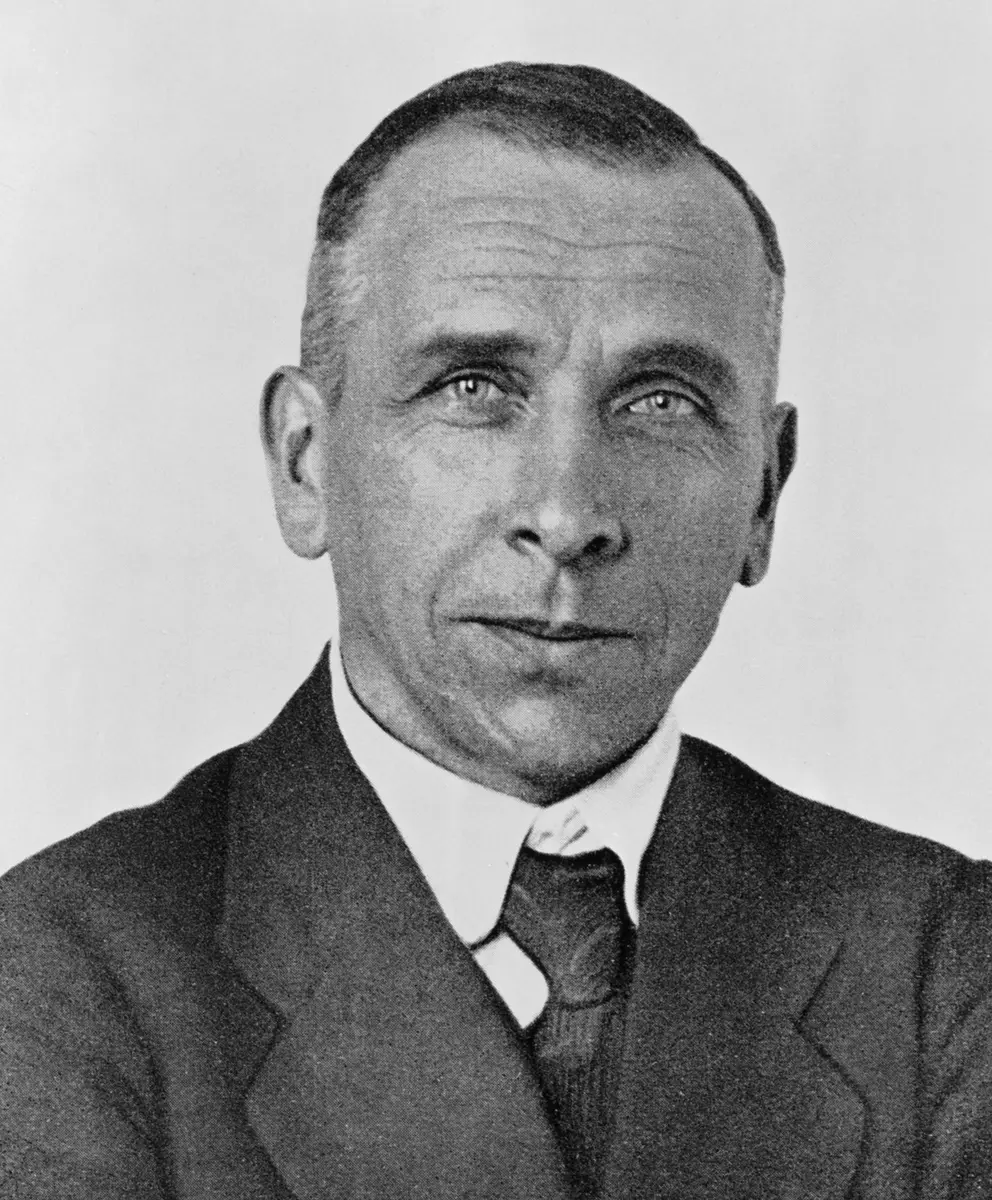
Alfred Wegener
“German weather scientist who proposed in 1912 that the continents drift apart from one supercontinent; scorned by geologists, he died on the Greenland ice in 1930 and was proved right by 1960s sea-floor finds.”
Alfred Wegener was a German meteorologist and polar explorer who, in 1912, proposed that the continents are not fixed in place but drift slowly across the Earth. He argued that they had once formed a single great landmass (his 'primal continent', later called Pangaea) that broke apart and that the pieces moved away from each other. In his own lifetime he was better known as a weather scientist: he sent kites and balloons into the Arctic air, wrote a leading textbook on the physics of the atmosphere and led expeditions to Greenland. Most geologists rejected his drift idea; from the 1950s and 1960s, evidence from rocks and from the sea floor showed that the continents do move, and he is now seen as the man who started the modern picture of a moving Earth.
He was born in Berlin on 1 November 1880, the youngest of five children of a teacher and clergyman. He studied physics, astronomy and meteorology in Berlin, Heidelberg and Innsbruck and took a doctorate in astronomy (on medieval star tables), but turned to the weather. At the Lindenberg observatory near Berlin he flew kites and balloons with his brother Kurt, and in April 1906 the two stayed up in a balloon for about 52 hours, a world record. That summer he joined the Danish expedition to north-east Greenland as its meteorologist. He built the weather station at Danmarkshavn, learned to drive dog sledges, and lost the expedition's leader and two companions on the ice. Back in Germany in 1908 he taught at the University of Marburg, and in 1911 he published his textbook on the thermodynamics of the atmosphere.
The drift idea came to him at Marburg. At the end of 1910 he noticed in an atlas how well the coast of South America fits that of Africa, and in autumn 1911 he read that the same fossil animals and plants turned up on both sides of the Atlantic, which scholars explained with land bridges that later sank. Wegener decided that the continents themselves had moved, and he began collecting matching rocks, mountain chains, fossils and signs of ancient ice from different fields of science. He first presented the idea on 6 January 1912 to the Geological Association in Frankfurt, and four days later in Marburg. Then he left for Greenland again: in 1912 and 1913, with J. P. Koch and two others, he spent a winter on the edge of the ice and crossed the ice sheet with ponies and then on foot, some 1,200 km and about twice as far as Nansen's crossing of 1888, and the four came close to starving before a boat picked them up. In 1913 he married Else Köppen, daughter of the climate scientist Wladimir Köppen.
In 1914 he was called up, wounded twice and moved to the army weather service. In 1915 he published his book The Origin of Continents and Oceans, and brought out larger editions in 1920, 1922 and 1929; the English translation of 1924 gave the theory a world audience. He worked in Hamburg and from 1924 as professor in Graz. The reaction was sharply divided. Some earth scientists, especially in the southern hemisphere, supported him, but many objected that no known force could push continents through the ocean floor, and his guess for the speed of drift, metres per year, was far too high. A symposium of American petroleum geologists in New York on 15 November 1926 was largely hostile, and Wegener, who attended, said little. The picture of a lone genius ignored by everyone is too simple: in Europe the main idea was taken seriously in the 1920s, while American geologists resisted longest.
In 1929 he made a first trip to prepare the ground, and in 1930 he led a large German expedition to measure the Greenland ice sheet from three stations. The ice in the west held the ship back for weeks, and the middle station, Eismitte, could not be supplied in time. On 21 September Wegener himself led a relief journey over the ice and reached Eismitte on 30 October. On his 50th birthday, 1 November, he started back to the west coast with a young Greenlander, Rasmus Villumsen. He died on the way in November 1930, probably of heart failure; searchers found his grave under his upright skis on 12 May 1931, and Villumsen was never seen again. Wegener's mechanism was wrong, but his core idea was right: paleomagnetism in the 1950s, the mapping of the ocean floor by Marie Tharp and Bruce Heezen, Harry Hess's idea of sea-floor spreading (1962), the magnetic stripes of Vine and Matthews (1963) and the deep-sea drilling of 1968 turned it into plate tectonics. Since the 1990s satellites have measured the drift directly.
What happened
- 1880
Alfred Lothar Wegener is born in Berlin, the youngest of five children of Richard Wegener, a teacher and clergyman. The family spends its summers, and he much of his youth, at Zechlinerhütte near Rheinsberg.
Berlin: Wegener was born here on 1 November 1880 and lived here until his doctorate in 1905- 1905
He takes his doctorate in astronomy at Berlin with a thesis on converting the medieval Alfonsine astronomical tables for modern calculators, then goes to work as an assistant at the Aeronautical Observatory at Lindenberg, where he and his brother Kurt send up kites and balloons.
- 1906
With his brother Kurt he takes off in a balloon on a test of weather instruments and a navigation method, and stays up until 7 April, a total of 52.5 hours, a world record for a continuous balloon flight at the time.
The ship Danmark leaves Copenhagen with the Danish expedition to north-east Greenland under Ludvig Mylius-Erichsen; Wegener, still learning Danish, is the expedition's meteorologist, and his diary starts the same day.
The Danmark reaches the Greenland coast at 76 degrees 46 minutes north and finds a sheltered harbour that is named Danmarkshavn; the expedition builds a house, the Villa, and sets up its base and weather station.
Danmarkshavn, north-east Greenland: base of the Danmark expedition from August 1906, where Wegener ran the weather station with kites and balloons, and the starting point of the Koch expedition in 1912- 1907
In the polar winter he runs the weather station and sends up kites and tethered balloons with recording instruments, the first use of such soundings in the polar atmosphere. The expedition's painter Bertelsen draws him at his desk.
Danmarkshavn, north-east Greenland: base of the Danmark expedition from August 1906, where Wegener ran the weather station with kites and balloons, and the starting point of the Koch expedition in 1912In spring, as the sledge teams go north to map the coast, he and Gustav Thostrup turn back from Amdrup Land as a support team and map the shoreline on the way to Danmarkshavn by dog sledge; over the expedition he covers about 1,500 km by dog sledge in 90 days of travel.
- 1908
Koch finds the body of the Greenlander Jørgen Brønlund at Lambert Land with his diary, and the deaths of Mylius-Erichsen and Høeg Hagen on the return from the north are confirmed. Wikipedia calls this Wegener's first brush with death in the ice.
The Danmark is back in Copenhagen with the 25 survivors. Wegener has made weather measurements through two years and learned the skills of polar travel; with the leader's death the expedition's results get little attention.
- 1909
He starts his university career at Marburg, lecturing on meteorology, practical astronomy and cosmic physics at the Physical Institute and getting a name for clear lectures. (Some sources date the start to 1908.)
University of Marburg: Wegener lectured here from about 1908 or 1909, had the idea of drifting continents here, and wrote the first edition of his book - 1910
Returning to his office at Marburg for the Christmas holidays, he looks through a new atlas that shows the Atlantic seabed from the Challenger survey and sees that the coasts of South America and Africa fit together even better along the 200 m depth line. In a letter to his future wife he asks whether it is a fit he must pursue.
- 1911
His textbook 'Thermodynamik der Atmosphäre' is published and soon becomes a standard text in Germany. In the autumn he reads a summary of fossils shared by Africa and South America and decides that the land-bridge explanation cannot be right.
From Marburg he answers a long letter from Wladimir Köppen, his future father-in-law, who thinks the 'primal continent' too fantastic: Wegener writes that it is only a matter of reading the evidence, and that proof must come from the geologists' own observations.
- 1912
At the annual meeting of the Geological Association at the Senckenberg Museum in Frankfurt he presents his hypothesis that the continents were once joined and have drifted apart, and that sunken land bridges are not needed.
Senckenberg Museum, Frankfurt: where Wegener first presented continental drift to the Geological Association on 6 January 1912Four days later he gives a similar lecture to the Society for the Advancement of Natural Science at Marburg.
University of Marburg: Wegener lectured here from about 1908 or 1909, had the idea of drifting continents here, and wrote the first edition of his bookHis ideas come out in print: a three-part article in Petermanns Geographische Mitteilungen (1912, pages 185 to 195, 253 to 256 and 305 to 309) and a summary in the Geologische Rundschau, issue 3 (July 1912). He is by then on his way to Greenland.
The Godthaab reaches Danmarkshavn with Koch, Wegener, Vigfús Sigurðsson, Lars Larsen and the Icelandic ponies; Koch and Wegener find the Villa from the old expedition again. Their plan is to cross the north of Greenland's ice sheet.
Danmarkshavn, north-east Greenland: base of the Danmark expedition from August 1906, where Wegener ran the weather station with kites and balloons, and the starting point of the Koch expedition in 1912At the foot of the Brede glacier a section half a kilometre long breaks off into the fjord; the camp is not hit, but supplies are lost and the passage is damaged.
They give up the plan of a base in Queen Louise Land and build the winter house Borg on the edge of the ice (9 October according to the Arctic Journal, 12 October according to Wikipedia). Wegener and Koch are among the first to spend a winter on the ice itself, drilling 25 m into it with an auger and taking weather and ice measurements.
- 1913
Back in Germany he marries Else Köppen, daughter of his mentor Wladimir Köppen, and settles with her at Marburg. Three daughters follow.
After leaving Borg in April and reaching the edge of the ice sheet on 7 May, the four men start the crossing with ponies and sledges rigged with sails; the horses die one by one and the men haul the sledges themselves. The crossing takes 75 days over about 1,200 km at heights of up to 3,000 m.
The men reach the west edge of the ice in early July, cross rivers and fjords on foot, and lose their way; after lying for hours near collapse they kill their dog for food, and then a boat with the pastor of Upernavik picks them up and takes them to Prøven. The ponies and the dog are dead, but the four men have crossed the ice sheet, about twice as far as Nansen's crossing of 1888.
- 1914
When the First World War begins he is called up as an infantry reserve officer and fights in Belgium; he is wounded twice within months, declared unfit for the front and assigned to the army weather service, which keeps him travelling between stations in Germany, the Balkans, the Western Front and the Baltic.
- 1915
He completes the first edition of 'Die Entstehung der Kontinente und Ozeane', only 94 pages long, drawing together evidence from geology, palaeontology, geophysics and climate for a single great continent that broke up. In wartime Germany it is hardly noticed.
- 1917
He publishes the first thorough study of tornadoes and waterspouts in Europe, 'Wind- und Wasserhosen in Europa', and also studies the Treysa meteorite.
- 1919
He succeeds Köppen as head of the meteorological research department of the German Maritime Observatory (Deutsche Seewarte) in Hamburg and moves there with his family; in 1921 he also becomes a professor at the new University of Hamburg.
- 1920
The second edition of his book appears, much expanded and with 33 illustrations; it is the edition that wins attention in Europe.
- 1922
The third edition, fully revised, is published; it is translated into English and several other languages, and the debate begins in earnest. He now dates the single supercontinent to about 300 million years ago.
- 1924
The English translation by J. G. A. Skerl, 'The Origin of Continents and Oceans' (London: Methuen), appears. With his father-in-law he publishes 'Die Klimate der geologischen Vorzeit', which plots ancient ice, deserts and jungles on maps based on his theory.
He accepts a professorship of meteorology and geophysics at the University of Graz in Austria, a secure post without administrative duties; he works there on atmospheric optics and tornadoes.
- 1926
At a symposium of the American Association of Petroleum Geologists in New York, convened to discuss his theory, most speakers reject it; Wegener, in the audience, says little. The papers are printed in 1928 in 'Theory of Continental Drift'.
- 1929
The fourth, expanded and final edition of his book is published, a survey of the evidence from many sciences in which he lists several possible driving forces and does not choose between them.
From April to October he leads the first expedition to prepare the German Greenland expedition, with Johannes Georgi, Fritz Loewe and Ernst Sorge: they look for a route onto the ice from the west coast near Uummannaq, test sledges and ice-boring, and make long dog-sledge trips.
- 1930
The main German Greenland expedition leaves Copenhagen on the Disko. It is to run three stations at 71 degrees north for a year, in the west, the east and the middle of the ice sheet, and to measure the thickness of the ice by seismic soundings.
The sea ice keeps the ship from landing the cargo until about 17 June (a coastal camp is set up on 16 or 17 June), and the expedition is 38 days behind schedule. Hauling about 125 tonnes of material onto the ice takes months; the two propeller sledges disappoint.
The central station Eismitte is set up at about 3,000 m on the ice sheet, with Johannes Georgi and Ernst Sorge to winter there; only a fraction of the supplies and the hut itself have reached it.
Eismitte ('mid-ice'), central Greenland: the middle station of the 1930 expedition, which Wegener reached on 30 October 1930 and left on 1 November on his last journeyWith the news that the men at Eismitte will not last the winter, Wegener himself leads a relief journey: fifteen sledges, 130 dogs, 13 Greenlanders and Fritz Loewe set out from the western station. Most of the Greenlanders turn back.
After 40 days on the ice, the last five at an average of about minus 50 degrees Celsius, Wegener, Loewe and the Greenlander Rasmus Villumsen reach Eismitte. Loewe's toes are frostbitten and are later amputated; the men at Eismitte find they can last the winter after all.
Eismitte ('mid-ice'), central Greenland: the middle station of the 1930 expedition, which Wegener reached on 30 October 1930 and left on 1 November on his last journeyThe group celebrates Wegener's 50th birthday. Because food is short and Loewe has to recover, Wegener and Villumsen set out on dog sledges for the west coast, about 400 km away. They are photographed as they leave; it is the last picture of them.
Eismitte ('mid-ice'), central Greenland: the middle station of the 1930 expedition, which Wegener reached on 30 October 1930 and left on 1 November on his last journeyWegener dies on the way back, in a tent on the ice, probably of heart failure after the exertion; the AWI gives about 16 November. Villumsen buries him with care, his skis standing upright, and goes on alone; he is never seen again. In May 1931 a search party finds the grave; his friends build a mausoleum of ice blocks over it, and his wife asks that he stay in the ice.