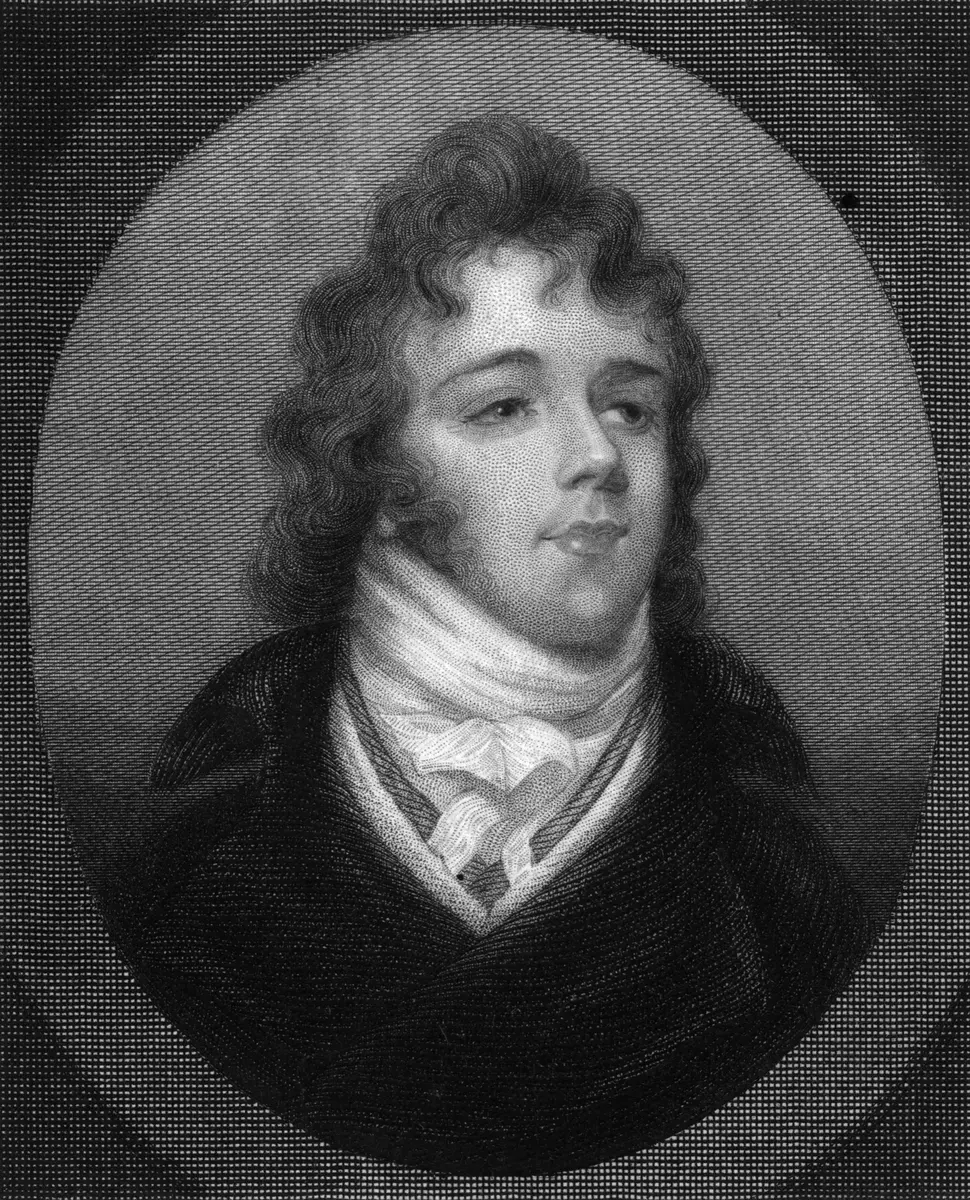
Beau Brummell
“The Regency dandy who swapped silk, lace and powder for a perfectly cut dark coat, clean linen and a white cravat, setting the pattern for the modern men's suit.”
George Bryan Brummell, known as Beau Brummell, was the man who taught English gentlemen to look rich by looking plain. In the London of the 1790s and 1800s, when fashionable men still wore coloured silks, lace, powdered hair and jewels, he set a new standard: a dark coat of fine wool cut to fit the body exactly, spotless white linen, a starched white cravat tied with great care, pale close-fitting breeches or pantaloons and polished boots. Nothing was loud; everything was clean, simple and perfectly made. As the friend of the Prince of Wales, the future George IV, he was for about fifteen years the judge of what a gentleman should wear, and the word 'dandy' has been tied to his name ever since.
He was not born into the aristocracy he ruled. He was born on 7 June 1778 in Downing Street, the younger son of William Brummell, private secretary to the prime minister Lord North, whose own father had kept a shop in St James's. George went to Eton in 1790, where he was already known for his dress, and spent only a short time at Oriel College, Oxford. His father died in March 1794, and that June he bought a commission as a cornet in the 10th Light Dragoons, the Prince of Wales's own regiment. He rose to captain, became the prince's companion, and left the army at the end of 1797. In 1799, when he came of age, he received a fortune of about £30,000 and took a house at 4 Chesterfield Street in Mayfair, where the prince and his friends are said to have come in the mornings to watch him dress.
His rules were cleanliness, restraint and the cut of the cloth. He washed every day, changed his linen often and spent his care on the fit of the coat and the folds of the cravat. Lord Byron is said to have found nothing remarkable in his dress except 'a certain exquisite propriety'. The caricaturist Robert Dighton drew him in 1805 in a dark tailcoat, high cravat and polished riding boots, and that sober outfit, made in London's best tailoring shops, is the root of the dark suit men still wear. English tailoring and the English dandy were copied in Paris from the 1820s, and the black coat became the uniform of the respectable man across the nineteenth century.
His fall was as complete as his rise. He gambled and spent beyond his means, and his sharp tongue cost him the friendship of the prince, who became Prince Regent. In July 1813 the Regent came to a ball that Brummell and three friends gave at the Argyll Rooms and pointedly ignored him; around that time Brummell is said to have asked one of the Regent's companions 'Who's your fat friend?'. In May 1816, deep in gambling debts, he slipped out of London at night and crossed to Calais, and his furniture, china and books were sold at auction. He lived in Calais for fourteen years on the help of friends, was made British consul at Caen in 1830, lost the post when the consulate was abolished in 1832, and was jailed there for debt in 1835. Strokes and a failing mind followed, and he died in the Bon Sauveur asylum at Caen on 30 March 1840, aged 61.
His world was Regency England: a court of spenders, gambling clubs such as White's in St James's Street and Watier's in Piccadilly, and long wars with France. Brummell turned that moment into a lasting idea: that a man's elegance lies in fit, cleanliness and understatement rather than in costly decoration. Captain William Jesse, who knew him in Caen, published his life in 1844, and writers in England and France made him the model of the dandy. Every plain, well-cut suit is in some way his.
What happened
- 1778
George Bryan Brummell is born in Downing Street, the younger son of William Brummell, private secretary to the prime minister Lord North.
Downing Street, Westminster: born here on 7 June 1778, while his father was private secretary to the prime minister Lord NorthHe is baptised at St Margaret's, Westminster.
- 1781
Sir Joshua Reynolds paints George, about three, with his elder brother William (dated about 1781–2).
- 1790
He is sent to Eton, where he becomes known as 'Buck Brummell' for his care over his clothes; by his own later account he is presented there to the Prince of Wales on the terrace at Windsor.
- 1794
His father is buried in the family vault at St Martin-in-the-Fields; George, not yet sixteen, soon leaves Oriel College, Oxford, after only a short stay.
He buys a commission as cornet in the 10th Light Dragoons, the regiment of which the Prince of Wales is colonel, and soon becomes the prince's companion.
- 1797
Now a captain, he sells out of the army; by his own later account he left because the regiment was ordered from Brighton to Manchester.
- 1799
Come of age, he receives a fortune of about £30,000 and takes a house at 4 Chesterfield Street, Mayfair, where the prince and his friends call in the mornings to watch him dress.
4 Chesterfield Street, Mayfair: his first house of his own, from 1799 to about 1804, where the Prince of Wales and his friends came to watch him dress; a blue plaque marks it - 1804
He moves to 18 Bruton Street, off Berkeley Square, his home until about 1808.
- 1805
Robert Dighton publishes his portrait print of Brummell, standing in a dark tailcoat, high white cravat and polished riding boots: the look that defines the dandy.
- 1812
He moves to 13 Chapel Street (now Aldford Street), off Park Lane, his last London house.
- 1813
Brummell, Lord Alvanley, Sir Henry Mildmay and Henry Pierrepoint give a masked ball at the Argyll Rooms; the Prince Regent greets Alvanley and Pierrepoint and pointedly ignores Brummell and Mildmay. The break with the Regent is final.
- 1816
Deep in gambling debts, he leaves the Opera early, drives through the night to Dover, reaches it on the morning of the 17th and crosses to Calais in a hired boat.
Rue Royale, Calais: after his flight in May 1816 he lodged here in the house of M. Leleux for most of his fourteen years of exileBy order of the Sheriff of Middlesex, Christie's auctions the contents of 13 Chapel Street, 'the genuine property of a man of fashion, gone to the Continent': Sèvres china, buhl furniture, plate, books and wine.
- 1830
After fourteen years in Calais, friends in London get him appointed British consul at Caen; he leaves Calais at the end of the month.
- 1832
The consulate at Caen is abolished, partly on his own advice to Lord Palmerston, and he loses his only income.
- 1834
He suffers another attack of paralysis (a stroke) at the dinner table of his hotel.
- 1835
His creditors have him arrested early one morning at the Hôtel d'Angleterre in Caen, and he is jailed for debt.
Released after friends in England pay his debts, he returns to his hotel; his care for his appearance slowly gives way.
- 1839
His mind gone, he is taken by carriage to the Bon Sauveur, the asylum run by nuns at Caen, and given the rooms once used by Napoleon's secretary Bourrienne.
Le Bon Sauveur, Caen: the asylum run by the Sisters of the Bon Sauveur, where he was cared for in his last months and died on 30 March 1840 - 1840
- 9:15 p.m.
He dies at the Bon Sauveur at a quarter past nine in the evening, aged 61, and is buried in the Protestant cemetery of Caen.
Le Bon Sauveur, Caen: the asylum run by the Sisters of the Bon Sauveur, where he was cared for in his last months and died on 30 March 1840