Cristóbal Balenciaga
“The Basque couturier Dior called 'the master of us all': he cut clothes like sculpture, opened his Paris house in 1937 and closed it in 1968.”
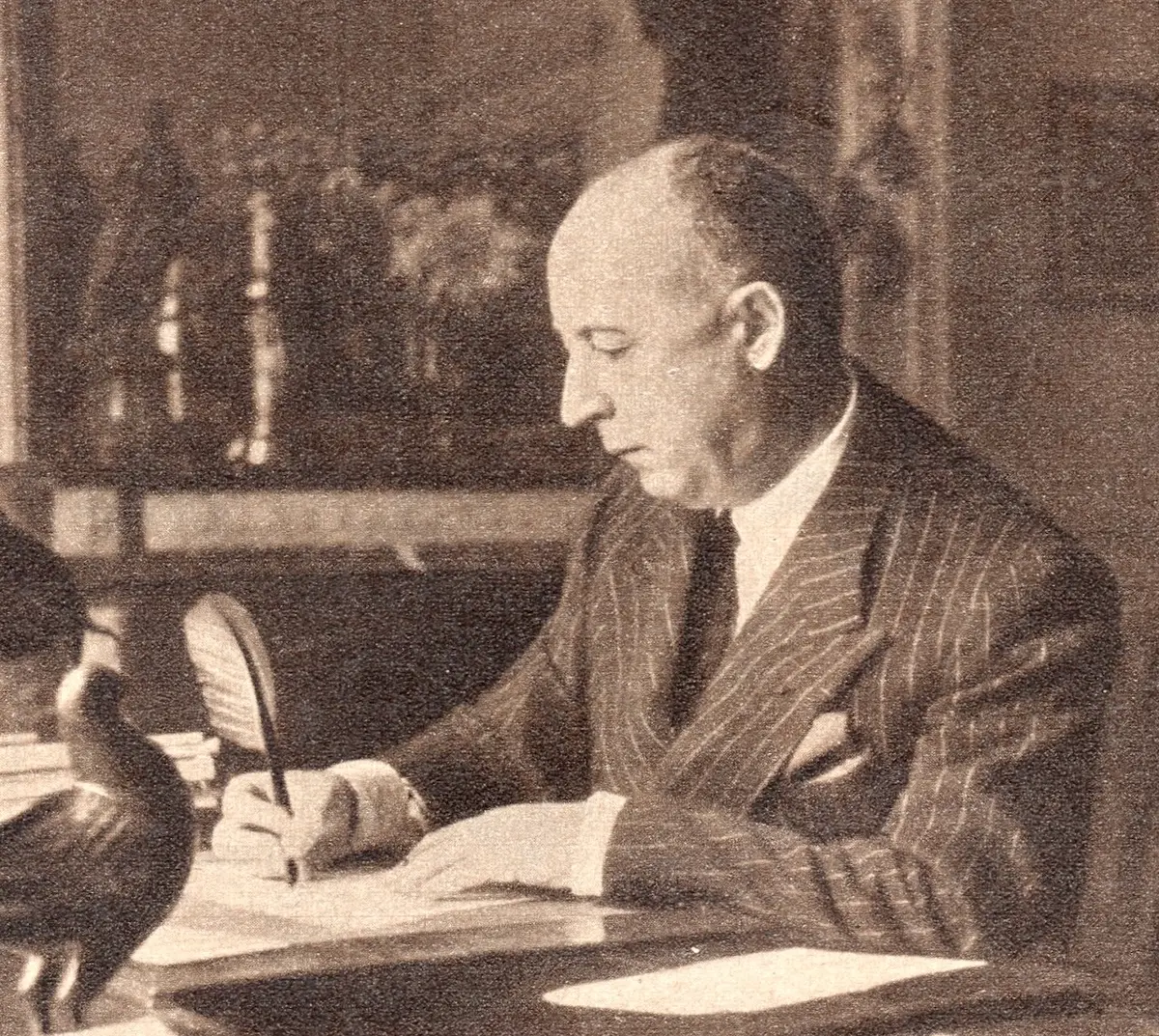
Cristóbal Balenciaga was a Spanish couturier from the Basque Country who made the most admired clothes in Paris in the 1950s and 1960s. Other designers treated him as a teacher. Christian Dior called him 'the master of us all' and compared haute couture to an orchestra with Balenciaga as the conductor; Coco Chanel said he alone was a couturier 'in the truest sense of the word', because he could cut, assemble and sew a garment himself. He began his designs with the fabric, not with a sketch ('it's the fabric that decides'), and his clothes are known for plain, sculptural shapes that stand away from the body. He was also extremely private: he rarely met the press and never took a bow.
He was born on 21 January 1895 in the fishing village of Getaria, on the Basque coast. His father, a fisherman, died while he was a boy, and his mother Martina Eizaguirre earned the family's living as a seamstress, working for the Marquises of Casa Torres, whose summer home was in Getaria. The marchioness became his first patron and client. By 1907 he was living in San Sebastián, the resort where the Spanish court spent its summers, and learning tailoring in shops tied to Paris fashion. In 1917, aged 22, he opened his first house there. In 1927 he added a second label, Eisa (his mother's surname), and Eisa shops followed in Madrid in 1933 and Barcelona in 1935. The Spanish royal family and the aristocracy wore his clothes. When the Spanish Civil War broke out in 1936 he left Spain for Paris.
In July 1937 he registered with the Paris couture trade body and opened the house of Balenciaga at 10 avenue George V; he showed his first collection that August, with a Spanish flavour. By 1952 he had 232 people working for him and produced 356 designs a year. After the war he changed the line of women's clothes step by step: the 'barrel' line (1947), the semi-fitted suit (1951), balloon skirts and jackets (1953), the tunic (1955), the sack dress (1957, at first jeered at in the press: 'It's hard to be sexy in a sack!') and the baby-doll dress (1958), with fabrics such as silk gazar, made for him by the Swiss firm Abraham. From 1956 he showed his collections a month after the other houses. His clients, admitted only on introduction, included Mona von Bismarck, Gloria Guinness, the American collector and garden designer Rachel 'Bunny' Mellon, and Spanish society; in 1960 he made the wedding dress of Fabiola de Mora y Aragón, who married King Baudouin of Belgium.
Balenciaga said a couturier must be 'an architect for plans, a sculptor for shapes, an artist for colour, a musician for harmony and a philosopher for the sense of proportion'. The photographer Cecil Beaton, who helped the Victoria and Albert Museum collect couture, treated his work as art; the V&A now holds the largest Balenciaga collection in Britain. André Courrèges and Emanuel Ungaro both worked for him before starting their own houses, and Hubert de Givenchy, a close friend and disciple, later gave the museum in Getaria many pieces and was its founding president. Mrs Mellon's wardrobe, about 660 pieces bought between 1956 and 1968, is the largest single client's collection of his work in any museum; she left it to the Getaria museum when she died in 2014.
As ready-to-wear took over, and while Paris was shaken by the events of May 1968, he decided to stop. His last collection was shown that February; his Paris house and Madrid workrooms were reported closed on 1 July 1968, and his last San Sebastián house closed in 1969. 'One of the joys of my life was to have known Cristóbal Balenciaga', Mrs Mellon later recalled of the house's closing. He retired to Spain, made one more wedding dress (for Carmen Martínez-Bordiú, on 8 March 1972) and died at Jávea on 24 March 1972, aged 77. He was buried in Getaria beside his mother. The Metropolitan Museum of Art held 'The World of Balenciaga' in 1973; the Cristóbal Balenciaga Museum opened in Getaria on 7 June 2011; and the house's name, relaunched in 1986, belongs today to Kering.
What happened
- 1895
Cristóbal Balenciaga Eizaguirre is born in the fishing village of Getaria, on the Basque coast. His father is a fisherman; his mother Martina Eizaguirre is a seamstress for the Marquises of Casa Torres.
Getaria, Basque Country: born here on 21 January 1895 in a house now marked by a plaque; the Cristóbal Balenciaga Museum opened here in 2011; he is buried in the town- 1907
By this year he is listed as a resident of San Sebastián, where, the museum says, he learns tailoring at shops linked to Paris fashion (the V&A says an apprenticeship from the age of twelve; the Met says the Marquesa de Casa Torres sent him to Madrid for his training).
Avenida de la Libertad 2, San Sebastián: his first house opened in the Calle Vergara in 1917 and his Eisa house and headquarters were on the avenue; the last of them closed in 1969 - 1917
Aged 22 he opens his first business, 'C. Balenciaga', at Calle Vergara 2 in San Sebastián, registered as a couturier in the highest tax class; before the year is out he takes the Lizaso sisters as partners (Balenciaga y Cía). The court spends its summers in the city.
Avenida de la Libertad 2, San Sebastián: his first house opened in the Calle Vergara in 1917 and his Eisa house and headquarters were on the avenue; the last of them closed in 1969 - 1927
He opens a second label, 'Martina Robes et Manteaux', at Calle Oquendo 10 (named for his mother); in October it is renamed Eisa Costura, after her surname Eizaguirre.
Avenida de la Libertad 2, San Sebastián: his first house opened in the Calle Vergara in 1917 and his Eisa house and headquarters were on the avenue; the last of them closed in 1969- 1933
Eisa opens a house in Madrid, at 42 Calle Caballero de Gracia.
Calle del Caballero de Gracia, Madrid: where his Eisa house opened in 1933 (no. 42) - 1935
Eisa opens a house in Barcelona.
- 1936
The Spanish Civil War begins; he stops the normal business of his houses in Madrid and Barcelona and settles in Paris.
10 avenue George V, Paris: the couture house of Balenciaga, opened in July 1937 and closed in 1968 - 1937
He registers with the Chambre Syndicale de la Haute Couture and, with his partners Wladzio d'Attainville and Nicolás Bizcarrondo, opens the house of Balenciaga at 10 avenue George V.
10 avenue George V, Paris: the couture house of Balenciaga, opened in July 1937 and closed in 1968He stages his first runway show in Paris, a collection with a Spanish Renaissance flavour that wins the critics.
10 avenue George V, Paris: the couture house of Balenciaga, opened in July 1937 and closed in 1968- 1939
His collection looks back to the seventeenth century, and the 'Infanta' dresses, inspired by Velázquez's portraits of Spanish princesses, are an overwhelming success; the French press praises him as a revolutionary.
10 avenue George V, Paris: the couture house of Balenciaga, opened in July 1937 and closed in 1968 - 1947
He shows the 'tonneau' (barrel) line, a looser shape in the year of Dior's New Look.
10 avenue George V, Paris: the couture house of Balenciaga, opened in July 1937 and closed in 1968- 1948
His partner Wladzio d'Attainville dies suddenly, aged 49, and Balenciaga thinks of closing the house; his next collection is all black. (The year is from Wikipedia; Prospect gives the sequence without the year.)
10 avenue George V, Paris: the couture house of Balenciaga, opened in July 1937 and closed in 1968 - 1949
The house opens its first street-level boutique, designed by Christos Bellos, with austere Spanish-style decoration.
10 avenue George V, Paris: the couture house of Balenciaga, opened in July 1937 and closed in 1968 - 1951
He shows the 'semi-fitted' suit, which blurs the waist and puts the emphasis on the shoulders and the lower part of the dress (the midi follows in August).
10 avenue George V, Paris: the couture house of Balenciaga, opened in July 1937 and closed in 1968- 1953
He introduces balloon skirts and the balloon jacket, a rounded shape that sits like a pedestal under the head.
10 avenue George V, Paris: the couture house of Balenciaga, opened in July 1937 and closed in 1968 - 1955
The 'tunic', a two-piece dress with straight, clean lines that covers the body without constricting it, appears in his collection.
10 avenue George V, Paris: the couture house of Balenciaga, opened in July 1937 and closed in 1968 - 1956
He decides to show his collections one month after the official start of the Paris shows, as Givenchy also does.
10 avenue George V, Paris: the couture house of Balenciaga, opened in July 1937 and closed in 1968Rachel 'Bunny' Mellon, the American collector and garden designer, becomes a client; her orders, 120 day outfits, 50 coats, 25 evening gowns and more, will run until the house closes, and she keeps every invoice, sketch and letter.
10 avenue George V, Paris: the couture house of Balenciaga, opened in July 1937 and closed in 1968- 1957
The 'sack' dress, with no waist, goes into his collection and is met at first with hostility ('It's hard to be sexy in a sack!', the Daily Mirror cries). With the Swiss weaver Gustav Zumsteg of Abraham he develops silk gazar, a stiff fabric for sculptural shapes.
10 avenue George V, Paris: the couture house of Balenciaga, opened in July 1937 and closed in 1968 - 1958
The baby-doll dress, a loose trapeze shape without a waistline, comes into his collection; France makes him a Chevalier of the Légion d'honneur for his services to fashion.
10 avenue George V, Paris: the couture house of Balenciaga, opened in July 1937 and closed in 1968 - 1960
Fabiola de Mora y Aragón, granddaughter of his first patron's family, marries King Baudouin of Belgium in a wedding dress made at the house of Balenciaga.
- 1967
He shows the evening ensemble of black silk gazar, dress and cape, made for Mrs Loel Guinness, and the four-pointed 'envelope' dress, a sculptural form of which only two are sold.
10 avenue George V, Paris: the couture house of Balenciaga, opened in July 1937 and closed in 1968 - 1968
He designs and makes the uniforms of the Air France hostesses, his only venture into ready-to-wear, and gives the only interview of his life, to Paris Match.
10 avenue George V, Paris: the couture house of Balenciaga, opened in July 1937 and closed in 1968He presents his last collection. Mrs Mellon orders from it a fitted bodice with black organza vine leaves and a black faille skirt, which appears in Harper's Bazaar in March.
10 avenue George V, Paris: the couture house of Balenciaga, opened in July 1937 and closed in 1968While Paris is shaken by the May events he decides to stop and closes the house, without warning his staff; no firm closing day was found in the sources.
10 avenue George V, Paris: the couture house of Balenciaga, opened in July 1937 and closed in 1968Newspapers report the closing of his Paris headquarters and his Madrid workrooms, apart from the perfume and accessory businesses. His clients are stunned: Mona von Bismarck, the V&A records, does not leave her room for three days.
10 avenue George V, Paris: the couture house of Balenciaga, opened in July 1937 and closed in 1968- 1969
The last of his Spanish houses, in San Sebastián, closes.
Avenida de la Libertad 2, San Sebastián: his first house opened in the Calle Vergara in 1917 and his Eisa house and headquarters were on the avenue; the last of them closed in 1969 - 1971
The Bellerive Museum in Zurich gives him his first retrospective. In the same year, Cecil Beaton shows 31 Balenciaga pieces in the V&A's 'Fashion: an Anthology' (the V&A dates the show 1972).
- 1972
Carmen Martínez-Bordiú, granddaughter of General Franco, marries Alfonso de Borbón in the chapel of El Pardo palace in a dress by Balenciaga, his last work.
Balenciaga dies at Jávea, on the Mediterranean coast of Alicante, aged 77, a few days after going there on holiday. He is buried the next day in Getaria beside his mother, with Givenchy and Ungaro among the mourners.
Jávea (Xàbia), Alicante: he had retired here and died on 24 March 1972