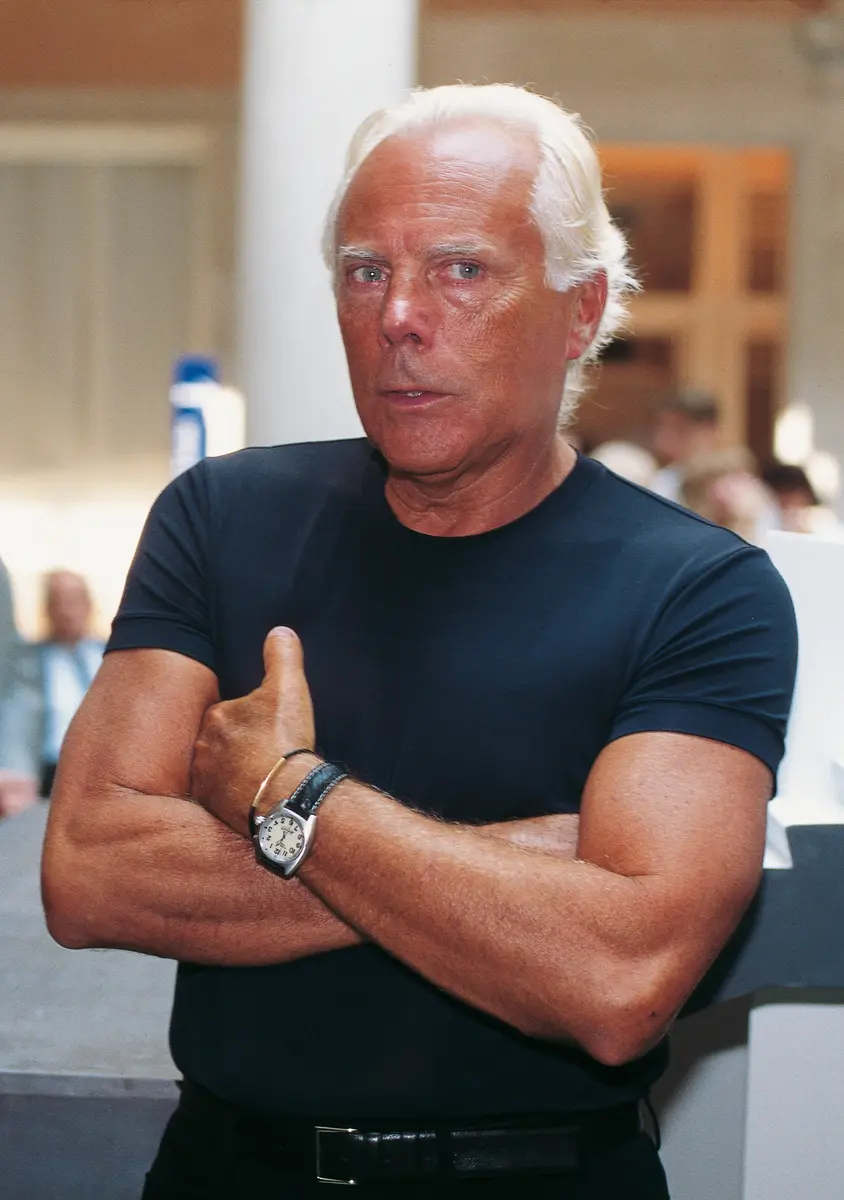
Giorgio Armani
“The Milan designer who unstructured the suit (1975), made Richard Gere's wardrobe in American Gigolo, and kept his fashion empire independent until his death on 4 September 2025.”
Giorgio Armani was born in Piacenza on 11 July 1934, the second son of a family of modest means, and came to fashion late and by accident. He began medical studies in Milan, left them for military service in a hospital in Verona, and in 1957 took a job at the Milan department store La Rinascente, dressing windows and then helping its menswear buyers. From about 1964 he worked for the cloth-maker and tailor Nino Cerruti, where he learned fabric and cut without ever training as a designer. He met Sergio Galeotti, a young architectural draughtsman, who pushed him to work for himself.
On 24 July 1975 Armani and Galeotti registered Giorgio Armani S.p.A. in Milan. His first idea was a jacket with the stiffening taken out: no hard canvas, little padding, lower lapels, sloping shoulders and the buttons moved down, so that a suit hung from the body and moved with it. He soon cut the same jacket for women, in men's cloth, just as women were entering offices in numbers. He liked to say that he softened the image of men and hardened the image of women. The first big cultural moment was American Gigolo (1980), in which Richard Gere's wardrobe made the label known to ordinary cinema audiences, and Time put him on its cover in April 1982.
After Galeotti died in August 1985, when Armani was 51, people expected the firm to be sold. Instead he learned the business side and kept control for the rest of his life: clothes made first under a licence with the textile group GFT, then the lower-priced Emporio Armani (1981) and A/X Armani Exchange (1991), perfumes and cosmetics with L'Oréal, Armani Casa (2000), the couture line Armani Privé in Paris (2005), hotels with Emaar in Dubai and Milan, the basketball club Olimpia Milano (2008), and the museum Armani/Silos (2015). The Guggenheim in New York gave him a retrospective in 2000, an honour then rare for a living designer. He designed uniforms for Italy's Olympic team in 2012, and in 2016 set up a foundation to hold his company after him.
He died at home in Milan on 4 September 2025, aged 91, still showing collections. More than 15,000 people queued at his theatre to see his coffin, and he was buried in the family chapel at Rivalta, near Piacenza. His will told his heirs to sell an initial 15 per cent stake, with priority to LVMH, EssilorLuxottica or L'Oréal, and a Milan show on 28 September 2025, the last collection he designed, closed with his own face on a crystal top. The 2026 reports say the sale may slip past the will's date, so what happens to one of the last big independent fashion houses is still open.
Armani worked in a particular Milan: the Italian clothing industry could weave, cut and sew at a high level but lacked international prestige, and he used its cloth and its new ready-to-wear methods to give it one (the Guardian). His palette stayed greige, navy and black. The Guardian called his gentler power dressing for women the easiest working clothing since Coco Chanel's tweed suit of 1954, and his friends and rivals noticed: in 1982 Yves Saint Laurent's partner Pierre Berge challenged Time to name one thing Armani had changed, and the magazine answered with the unstructured jacket and 'the Armani ease'.
What happened
- 1934
Giorgio Armani is born in Piacenza, in Via Colombo in the Lupa quarter, the second son of Ugo Armani and Maria Raimondi; his brother Sergio is older and his sister Rosanna younger. His mother makes the children's clothes from parachute silk and army cloth, and his grandfather makes wigs for the town theatre.
Piacenza, Emilia-Romagna: born here on 11 July 1934 in Via Colombo, in the Lupa quarter; the family chapel where he is buried is at Rivalta, in the same province- 1945
At about eleven, while playing with gunpowder with friends, he is badly burned; he recovers quickly. After the war his father becomes an accountant in a transport firm and the family moves to Milan, to the Citta Studi quarter, where Giorgio goes to the Liceo Scientifico Leonardo da Vinci hoping to become a doctor, inspired by A. J. Cronin's novel The Citadel. The year is worked out from his age; Wikipedia says a friend died in the accident (a shell, not gunpowder), which the catalogue does not.
- 1953
He studies medicine at the University of Milan but leaves in his third year to do his military service in the military hospital at Verona, where he works in the infirmary, goes to the operas in the Roman amphitheatre and decides a doctor's life is not for him. The year 1953 is Wikipedia's; the catalogue and Armani's interview say only 'about three years' of study.
- 1957
A friend at La Rinascente, Milan's largest department store, gets him a job: first in the advertising department as assistant photographer, then helping the people who dress the windows, then in the store's fashion office with the menswear buyers. He has no training in fashion. Sources differ on the title: window dresser (Guardian, Euronews), buyer (Britannica), assistant photographer (the chronology).
- 1964
Nino Cerruti, whom he met while the store's buyers were visiting a maker, tests him by asking him to choose a cloth; Armani picks Cerruti's own pinstripe and is taken on, first for textiles, then to design Hitman, Cerruti's new menswear line, in industrially cut jackets and shirts. Armani later says he worked for Cerruti for eight years.
- 1966
At La Capannina, a club at the seaside resort of Forte dei Marmi, he meets Sergio Galeotti, a young draughtsman who works for the Milan architects BBPR; Galeotti becomes his partner in life and work and tells him he can design under his own name. The catalogue groups this under 1966-69; Galeotti's Wikipedia page gives 1966; the Guardian says they met at Cerruti.
- 1970
Armani leaves Cerruti and freelances for firms such as Allegri (raincoats), Bagutta (shirts), Hilton (suits), Sicons (leather) and Spirito (knitwear), while still working for Hitman. At the Sala Bianca in Florence he shows leather bomber jackets cut as if the leather were cloth. The Guardian dates the move to 1970; the catalogue groups 1970-72.
- 1973
He and Galeotti take two rooms at Corso Venezia 37 in Milan, one for business and one for design, and sell Armani's old Volkswagen to pay for a table, lamps and paint. A student, Irene Pantone, is the only employee. The catalogue groups this under 1973-74; Wikipedia gives 1973.
Corso Venezia 37, Milan: the first office of Armani and Sergio Galeotti from 1973, two rooms, and the address where the company Giorgio Armani S.p.A. was registered in July 1975 - 1975
Armani shows his first men's collection under his own name, for spring/summer 1976, built round an unlined, unconstructed jacket: lower lapels, sloping shoulders, lower buttons, a lighter inside, as if rescued from an old suitcase. The catalogue dates this first show to July 1975; Wikipedia and Vogue speak of October 1975.
Giorgio Armani and Sergio Galeotti register the trademark and the company Giorgio Armani S.p.A. in Milan. Galeotti runs sales and money; the capital is about $10,000. For some years Armani still designs for other labels. (This is the event 'Giorgio Armani founds his company', now folded into the person.)
Corso Venezia 37, Milan: the first office of Armani and Sergio Galeotti from 1973, two rooms, and the address where the company Giorgio Armani S.p.A. was registered in July 1975Three months later he shows his first women's collection, also for spring/summer 1976, at the Hotel Palace in Milan, cut in men's fabrics: a women's jacket that is simple and soft, made at a time of feminism and inspired by his sister Rosanna and her friends wearing their brothers' jackets. Vogue's critic, in 2025, dates 'the first show he ever presented' to October 1975.
- 1977
He moves into the 17th-century Palazzo Durini, Via Durini 24, after a short stay in Via Santa Cecilia; the label is brought to the United States by Fred Pressman of Barneys New York (the chronology groups both under 1976-77). In the 1977-78 women's collection one jacket is worn over another, and the men's trousers have no pleats.
- 1978
He signs a licensing agreement with Gruppo Finanziario Tessile (GFT), which manufactures and distributes the Giorgio Armani collections, and launches the cheaper Le Collezioni line for men: luxury ready-to-wear made in a factory under the designer's eye. His women's jackets of this year are taper-cut, with varied lapels and small pockets, the 'power suit' of broad shoulders and slim hips.
- 1979
The Giorgio Armani Men's Wear Corporation USA is created and Gabriella Forte joins as vice-president to run U.S. operations and image; Armani receives the Neiman Marcus Fashion Award, as Italians Emilio Pucci and Roberta di Camerino had before him. A woman's suit of this year, in wool twill, is in the album.
- 1980
He hosts the White Party at Studio 54 for his autumn/winter 1980-81 collection and signs a licensing agreement with L'Oreal (then Helena Rubinstein) for fragrances, the start of Armani Beauty. He also decides to show his spring 1981 collections in his own palazzo, not at the Milan trade fair.
American Gigolo is released by Paramount with Richard Gere as Julian Kaye. John Travolta had first been cast and had been due to choose about forty Armani suits, but dropped out, so the wardrobe was remade for Gere. The scene in which Gere lays out jackets, shirts and ties on a bed made the Armani name known to cinema audiences; Armani said it 'was throwing away the whole story of the way men dress'. L'Uomo Vogue's April 1980 issue quotes a Saks Fifth Avenue executive calling him the 'Michelangelo of fashion'.
- 1981
Emporio Armani, Armani Junior and Armani Jeans are launched in Italy and then in the United States: the Armani look, at lower prices, for a younger buyer, with an eagle logo to fight copies. The first Emporio Armani shop opens in Milan, in Via Durini.
- 1982
He moves his offices to Via Borgonuovo 21 in Milan, where most of his shows are staged in a theatre built into the building. The American architect Peter Marino later designs his home there, with furniture by Jean-Michel Frank. Armani Donna, his first women's perfume, is launched in Paris the same year.
Via Borgonuovo 21, Milan: his home and the runway theatre of his palazzo from 1982, the centre of the house; he died at his home in Milan on 4 September 2025 (the sources do not give the address of his death)Armani is on the cover of Time, the first fashion designer so honoured since Christian Dior in the 1940s and only the second Italian on the cover after Luigi Pirandello, in an eight-page piece by Jay Cocks, 'Suiting Up for Easy Street'. When Pierre Berge, Yves Saint Laurent's partner, asks what one garment Armani has changed, Cocks answers with the unstructured jacket and 'the Armani ease'. The Time archive lists the cover as 5 April 1982.
- 1983
The first Giorgio Armani boutique opens, in Via Sant'Andrea, Milan, and he wins the CFDA's Best International Designer award. He also revises the GFT agreement, which now produces the high-end line, renamed Borgonuovo 21 after his address.
- 1984
A Giorgio Armani boutique opens at 815 Madison Avenue in New York. Armani dresses Don Johnson and Philip Michael Thomas in the television series Miami Vice (the linen tailoring, the Guardian says; the actors added the bare ankles and stubble) and Willem Dafoe in Streets of Fire; the first men's perfume, Armani, is launched.
- 1985
Sergio Galeotti dies in Milan at the age of 40, after some years of poor health. The industry expects the house to close; Armani keeps designing every collection and takes over the business side. The catalogue says cancer; Wikipedia says complications of AIDS, and that a heart attack was reported at the time. Armani called his inability to save Galeotti the greatest failure of his career.
- 1987
Armani dresses Sean Connery, Kevin Costner, Andy Garcia, Charles Martin Smith and Billy Drago, whose Frank Nitti wears white, ice and cream, in Brian De Palma's The Untouchables. The film's costume designer, Marilyn Vance-Straker, is the one nominated for an Oscar (Connery won for supporting actor); the Guggenheim chronology wrongly says the film won one for costumes. A 1987 newspaper piece was headed 'A Clothes Controversy', and a Clothes on Film account says Vance-Straker had to re-cut much of what Armani delivered. That year he also receives the CFDA's Lifetime Achievement Award for menswear and goes into a joint venture in Japan with Itochu.
- 1988
Armani is at the Museum of Contemporary Art in Los Angeles, talking his models through the runway; that year he opens a Rodeo Drive boutique with a gala at the museum, invites the Lakers coach Pat Riley to wear Armani in public, and Michelle Pfeiffer wears an Armani skirt suit to the Oscars, after which Hollywood follows. A woman's ensemble of spring 1987 is in the album.
- 1990
The Museum at the Fashion Institute of Technology in New York shows 'Giorgio Armani: Images of Man', curated by Richard Martin and Harold Koda; Koda later co-curates the Guggenheim show. Armani also designs the Italian national football team's clothes for the World Cup played in Italy. An evening ensemble of autumn/winter 1990-91 is in the album.
- 1991
The first A/X Armani Exchange shop opens in SoHo, New York: casual clothes, T-shirts and jeans at a lower price for a younger, American buyer. Armani also receives an honorary doctorate from the Royal College of Art in London, at the Royal Albert Hall, and designs the uniforms of Alitalia's female staff.
- 1996
The new Giorgio Armani flagship on Madison Avenue at 65th Street in New York, designed by Peter Marino, opens; the evening's party at the Armory, 'An Evening of Music and Style', has Eric Clapton, Joaquin Cortes, the Fugees and the Wallflowers playing. Winona Ryder and Spike Lee are among the guests (AP).
- 1997
Armani arrives at the funeral of Gianni Versace in Milan; the two were the best-known Italian designers of their day. The AP reel shows the arrival, in pool footage of 22 July 1997.
- 1999
He buys the former Nestle factory at Via Bergognone 59-61, near the Ansaldo quarter, as the new headquarters, with showrooms, offices and a theatre for runway shows, finished in 2000 (Armani/Teatro). The spring/summer 2000 women's collection, shown on 28 September 1999, is staged in the factory; Vogue says it follows Kandinsky and the 'real woman of 2000'.
- 2000
Armani/Via Manzoni 31 opens in a 1937 building bought in 1999: his shops, a restaurant, a flower shop, books, the Sony shop, and Armani Casa, the new home collection of furniture and table settings. The Giorgio Armani website, Armani Cosmetics and the Armani Collezioni line are launched too.
The Solomon R. Guggenheim Museum in New York opens 'Giorgio Armani', a retrospective for the 25th anniversary of the company, organised by Germano Celant and Harold Koda and designed by the stage director Robert Wilson; it runs to 17 January 2001. The Guardian remembers it as staged 'as art rather than fashion'.
- 2001
The retrospective moves to the Guggenheim Museum Bilbao, where it runs until 26 August 2001 (the Guardian's obituary says it also toured to the Royal Academy in London, a venue the catalogue does not list).
- 2002
He is appointed a Goodwill Ambassador of the United Nations High Commissioner for Refugees (UNHCR).
- 2005
Giorgio Armani Privé, his haute couture line, opens in Paris with 31 evening looks: a long-line fishtail silhouette in fluted gowns and tiny beaded jackets, 22 seamstresses newly hired in Milan, and the Hollywood red carpet in mind. Vogue's Sarah Mower, who dates her review 23 January 2005, calls it the 'last remaining untraversed peak' of his career; the show may have been on 23 or 24 January.
Giorgio Armani S.p.A. signs a long-term licence with Emaar Properties of Dubai for a collection of Armani hotels and resorts: Emaar builds and runs them, Armani designs the interiors and furnishings. Wikipedia's date for the signing is 31 May 2005.
- 2007
The spring 2007 Armani Prive show in Paris, with Cate Blanchett and Katie Holmes in the front row and 65 looks inspired by India ('Maharani of Milan'), is broadcast live on the Internet, via MSN and on mobile phones, the first haute couture show to be shown so (Britannica). Vogue's review is dated 23 January 2007; Wikipedia says the broadcast was on 24 January.
- 2008
Armani buys the basketball club Olimpia Milano from Giorgio Corbelli and becomes its sole owner, after sponsoring it as Armani Jeans from 2004; the club wins six Italian league titles under him and reaches the EuroLeague Final Four in 2021. In 2008 he also becomes an Officer of the Legion of Honour.
- 2010
Armani Hotel Dubai opens in the Burj Khalifa, the tallest building in the world, with Armani and Emaar's chairman Mohamed Alabbar cutting the ribbon: 160 rooms and suites on the lower floors and levels 38-39, eight restaurants and a spa, all designed by Armani; 144 Armani Residences sit above. A trade report dated 28 April says it opened 'today'; others give 27 April, after a delay from 21 April; the Guardian's obituary gives 2011.
- 2012
In May 2012 Armani unveils, in his Milan showroom, the Emporio Armani EA7 uniforms for the Italian team at the London Olympics: 50 pieces in white and midnight blue, a navy darker than the usual azzurri, with the first lines of the national anthem embroidered in gold inside the jackets. Fifteen of the 280 athletes model them, among them the fencer Valentina Vezzali; they are worn at the opening ceremony on 27 July.
- 2015
Armani/Silos opens in Via Bergognone 40, Milan, as part of the celebrations of 40 years of the house, with a star-studded gala and a retrospective show of Armani Privé: a four-level, 4,500 square metre museum in a granary of 1950, converted under Armani's own direction, with a digital archive of sketches and technical drawings on the top floor. Euronews' report is dated 4 May; the opening date comes from Wikipedia.
- 2016
The Giorgio Armani Foundation is set up as a vehicle for the succession of his company; it will hold at least 30 per cent of it after his death.
- 2025
In Paris Armani Prive celebrates its 20th anniversary with the collection 'Lumieres', 93 looks inspired by light, shown in a hotel particulier, the 'Palazzo Armani', unveiled for the occasion. Vogue's review is dated 28 January 2025, on the eve of the show or the day itself.
For the first time he is absent from his own men's shows in Milan, as he recovers from an undisclosed condition; the house says he is following the design of the collections. A big celebration is planned for the end of September for the 50th anniversary of the Giorgio Armani line.
Giorgio Armani dies at his home in Milan on 4 September 2025, aged 91, still at the head of the company he had run for fifty years, one of the last big independent fashion houses; Italy's prime minister Giorgia Meloni calls him 'a symbol of the best of Italy'. Wikipedia gives the cause as liver failure. (This is the event 'Giorgio Armani dies at 91', now folded into the person.) AFTERMATH. His coffin lies in public view at the Armani/Teatro in Via Bergognone on 6 and 7 September, with white roses, carabinieri in ceremonial dress and candles in paper bags; more than 15,000 people come. On 8 September a strictly private funeral Mass is held in the 14th-century Church of San Martino Vescovo at Rivalta, near Piacenza, and he is buried in the family chapel beside his parents and brother. On 12 September his two wills are made public: the foundation, set up in 2016, is to sell an initial 15 per cent stake no sooner than a year and no later than 18 months after his death, with priority to LVMH, EssilorLuxottica or L'Oreal, then a further stake of 30 and 54.9 per cent to the same buyer or a stock market listing three to five years on; Leo Dell'Orco controls 40 per cent of the business and Silvana Armani and Andrea Camerana 15 per cent each. On 24 September the Pinacoteca di Brera opens 'Giorgio Armani. Milano, per amore', about 120 of his garments among its paintings. On 28 September, in the Brera courtyard, the house shows spring/summer 2026, the last collection he designed (87 looks; Vogue notes look 34 as close to the ideal menswear look, and the last look, number 86, is a crystal top carrying his portrait); Silvana Armani and Dell'Orco bow among the candles. On 1 October a EuroLeague game observes a moment of silence for the owner of Olimpia Milano. On 28 November the group names an eight-member board with Giuseppe Marsocci as chief executive. Later reports (Reuters, 12 August 2026) say the sale of the first 15 per cent may slip past the March 2027 date in the will, with the work expected to run through 2027.
Via Borgonuovo 21, Milan: his home and the runway theatre of his palazzo from 1982, the centre of the house; he died at his home in Milan on 4 September 2025 (the sources do not give the address of his death)