Yves Saint Laurent
“French couturier who ran Dior at 21 and, from 1961, his own house: he gave women the tuxedo (Le Smoking, 1966) and opened Rive Gauche, the first ready-to-wear shop of a couturier (1966).”
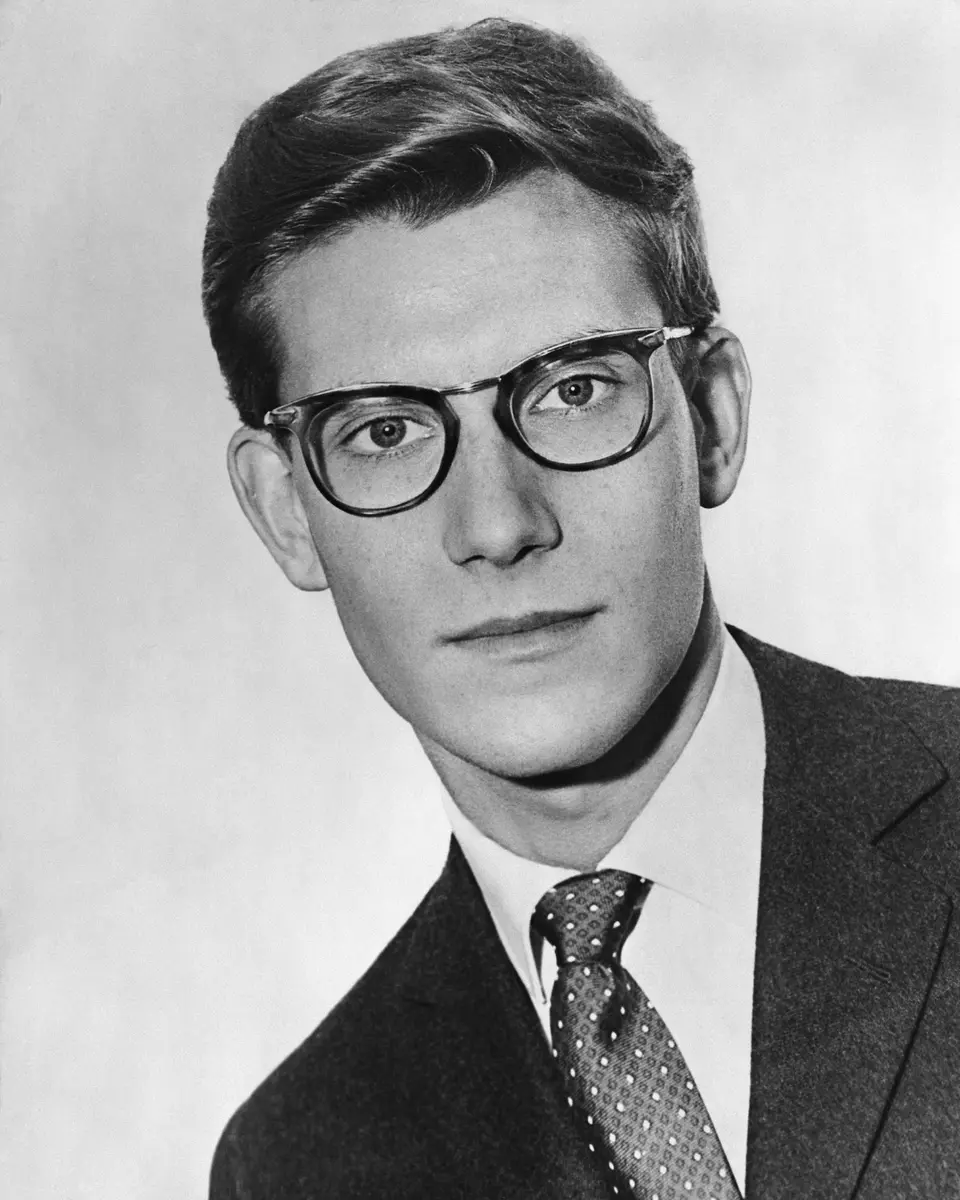
Yves Saint Laurent was a French couturier who changed what women wear. At 21 he took over the house of Dior; in 1961, with his partner Pierre Bergé, he opened his own house, and over the next forty years he borrowed from the male wardrobe (the pea coat, the trench coat, the tuxedo, the safari jacket, the trouser suit) and gave it to women. His friend Bergé put it simply: Chanel gave women freedom, Saint Laurent gave them power. He also turned paintings, ballets and the Orient into clothes, and he made fashion an art that museums collect.
He was born on 1 August 1936 in Oran, in French Algeria, and grew up there among his mother's fashion magazines, with a toy theatre and paper dolls he dressed himself. A prize in the International Wool Secretariat's dress-design competition took him to Paris, where Michel de Brunhoff of Vogue sent his sketches to Dior. Dior hired him on 20 June 1955 and died on 24 October 1957; on 15 November the 21-year-old was named his successor, and on 30 January 1958 his first collection, the Trapeze line, was a triumph. His last Dior collection, in 1960, with black leather and turtlenecks, was not. He was called up for military service on 1 September 1960, in the Algerian war, was hospitalised with depression, and was replaced at Dior by Marc Bohan.
With Bergé running the business and an American investor's money, he opened the house of Yves Saint Laurent on 4 December 1961; the first collection, shown on 29 January 1962, opened with a pea coat. The 1960s then made him a star: the Mondrian dresses of autumn-winter 1965, the Pop Art collection and Le Smoking, the women's tuxedo, in 1966, the trouser suit in 1967, the safari jacket, the jumpsuit and the sheer evening gown in 1968. On 26 September 1966 he became the first couturier to open a ready-to-wear boutique under his own name, Saint Laurent Rive Gauche, at 21 rue de Tournon in Paris.
The later decades were of spectacle and colour. The 1971 'Scandal' collection, the Ballets Russes collection of 1976 (his first show with music), the Chinese collection and the perfume Opium in 1977, with its own scandal, and a long line of homages to Picasso, Matisse, Van Gogh and Mondrian. He and Bergé fell in love with Marrakech in 1966 and in 1980 bought the Jardin Majorelle to save it from developers. In 1983 the Metropolitan Museum gave him a retrospective, the first its Costume Institute had devoted to a living designer. The group around him was sold to Elf-Sanofi in 1993 and, in 1999, to the Pinault group (Gucci Group), with Tom Ford running ready-to-wear and beauty.
On 7 January 2002 he announced his retirement, and after a last show at the Centre Pompidou on 22 January the house at 5 avenue Marceau closed on 31 October. He died in Paris on 1 June 2008, aged 71; Bergé said his ashes would rest in the gardens of Marrakech. The name went on without him: Hedi Slimane relaunched it as Saint Laurent Paris in 2012, Anthony Vaccarello took over in 2016, and in October 2017 two museums opened, in his old house in Paris and in Marrakech.
What happened
- 1936
Yves Mathieu-Saint-Laurent is born at the Jarsaillon Clinic in Oran, Algeria, the eldest child of Lucienne and Charles Mathieu-Saint-Laurent; his father manages an insurance company and owns a chain of cinemas. His sisters Michèle (1942) and Brigitte (1945) follow. He grows up in a house full of his mother's dresses and fashion magazines.
Oran, Algeria: born at the Jarsaillon Clinic on 1 August 1936; he grew up in the family house at 11 rue Stora, in the Plateau Saint-Michel, and left for Paris in September 1954- 1948
He enters the Catholic Collège du Sacré-Coeur in Oran. He is shy, he is bullied, and he takes refuge in drawing: at home there are the sets, costumes and a wooden toy theatre, at school only the tests.
- 1950
He sees Molière's 'L'École des femmes' in Oran, directed by Louis Jouvet with Christian Bérard's set and costumes, and later calls it the strongest feeling of his life. He builds a small theatre, 'L'Illustre Théâtre', and dresses cardboard characters in scraps of his mother's dresses.
- 1953
He makes a house of his dreams on paper: 'Yves Mathieu Saint Laurent Haute Couture Place Vendôme', with silhouettes cut from Vogue, Jardin des Modes and Paris Match and whole wardrobes drawn for them in gouache, ink and watercolour.
At 17 he wins third prize in the dress category of the International Wool Secretariat's competition and travels to Paris with his mother to collect it. His father's contacts introduce him to Michel de Brunhoff, editor of French Vogue, who tells him to finish school and keep drawing.
- 1954
After his baccalauréat he leaves Oran for Paris and takes a room at 209 boulevard Pereire; he studies at the Chambre syndicale de la couture school for a few months.
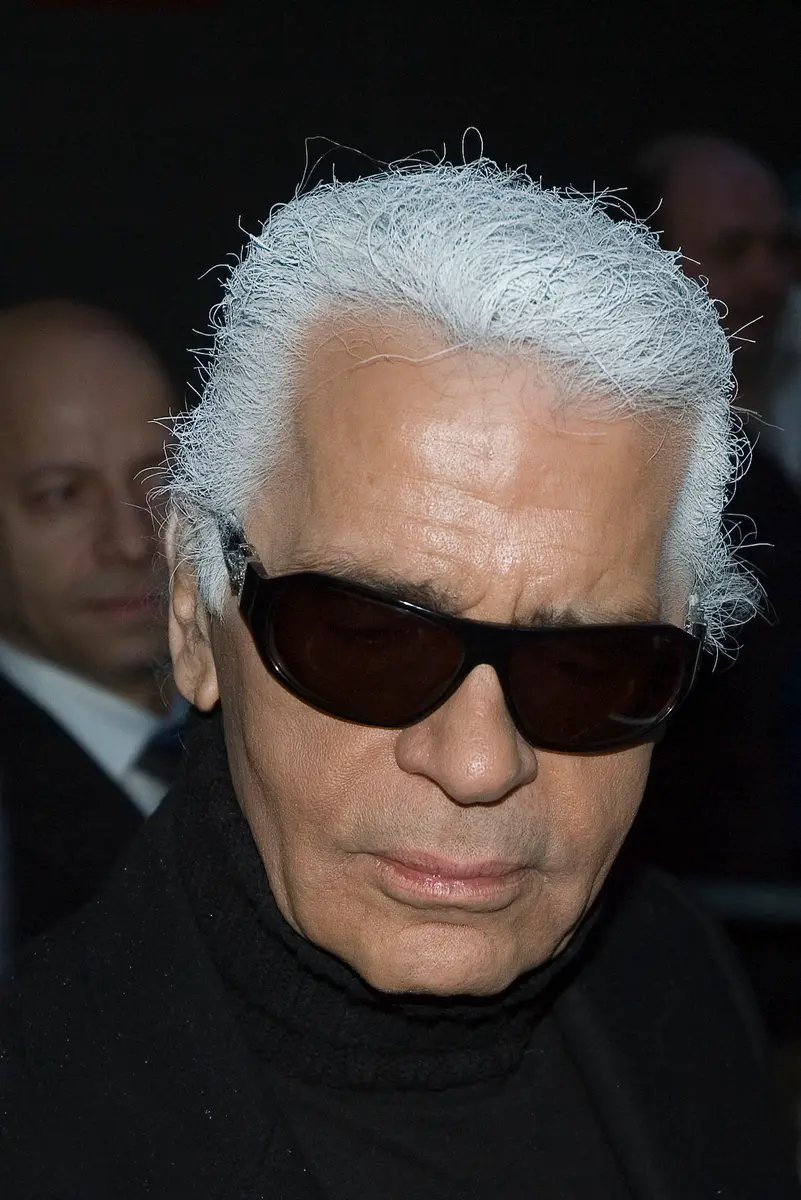
In the second Wool Secretariat competition he wins first and third prizes in the dress category among 6,000 anonymous entries (the museum dates the win to November); the black crepe cocktail dress is made up in Hubert de Givenchy's ateliers. In the picture of 11 December he stands beside Karl Lagerfeld, 21, who has won the coat prize.
- 1955
Michel de Brunhoff, astonished at how close his sketches are to Dior's own lines, shows them to Dior; on 20 June 1955 the 18-year-old is hired as Dior's assistant at 30 avenue Montaigne. He decorates boutiques, helps make dresses, and meets the model Victoire Doutreleau and Anne-Marie Muñoz, who will work with him all his life.
30 avenue Montaigne, Paris: the house of Christian Dior, where he worked from 20 June 1955, where he took over in November 1957 and showed the Trapeze collection on 30 January 1958- 1957
Christian Dior dies of a heart attack at Montecatini, in Tuscany. Saint Laurent, who has a hand in 34 of the 180 designs of Dior's last collection by Dior's own count, attends the funeral at Callian, in the Var, without yet knowing Pierre Bergé, who is there too.
As Dior wished, Saint Laurent is named his successor and artistic director of the house, at 21 the youngest couturier in the world. The house exports almost half of French haute couture, employs 1,400 people across five continents and is worth two billion francs. He has never run a house.
30 avenue Montaigne, Paris: the house of Christian Dior, where he worked from 20 June 1955, where he took over in November 1957 and showed the Trapeze collection on 30 January 1958- 1958
Le Figaro writes that 'Saint Laurent has saved France' and the house from financial ruin; the American press calls the Trapeze the biggest change since the New Look. That year he is given the Neiman Marcus Award, which went to Dior in 1947. The National Gallery of Victoria's red silk gown 'Rose rouge' (look 150), from the wardrobe of Jacqueline de Ribes, is a surviving piece.
30 avenue Montaigne, Paris: the house of Christian Dior, where he worked from 20 June 1955, where he took over in November 1957 and showed the Trapeze collection on 30 January 1958- 10:00 a.m.
At 10:00 in the morning Saint Laurent presents his first collection for Dior, the Trapeze line: the cinched waist is gone, the dress hangs from the shoulders and the body disappears under a fluid silhouette. An hour later the audience stands and applauds; the press, in euphoria, calls him 'the little prince of fashion', groups of admirers weep with joy, and he comes out on the balcony of the house.
30 avenue Montaigne, Paris: the house of Christian Dior, where he worked from 20 June 1955, where he took over in November 1957 and showed the Trapeze collection on 30 January 1958 Pierre Bergé, at his first fashion show with the painter Bernard Buffet, has seen the triumph; a few days later they meet at a dinner at the Cloche d'Or, in the rue Mansart, given by Marie-Louise Bousquet of Harper's Bazaar. Bergé leaves Buffet within months and stays with Saint Laurent for fifty years.
- 1960
His last collection for Dior, 'Souplesse, Légèreté, Vie' (autumn-winter 1960), is dark, in purple and black, with a crocodile-style leather jacket and turtlenecks, and takes the street and the beatniks as its model. It is the first collection of his that the press and Dior's customers do not all love; the Christian Science Monitor later says its black leathers so horrified the house's conservative clients that they cost him his job.
As the war in Algeria grows fiercer, Saint Laurent is called up for military service on 1 September 1960. Soon afterwards he is taken to the Val-de-Grâce military hospital with depression. The house of Dior dismisses him and gives his place to Marc Bohan; he is declared unfit for service and Bergé gets him out of the army. Bergé delivers the news; Saint Laurent says, 'We will found a haute couture house together, and you will manage it.' They sue Dior for breach of contract and win.
- 1961
The house of Yves Saint Laurent opens at 11 rue Jean-Goujon, a temporary address, with money Bergé raised by selling his flat and from the American investor J. Mack Robinson, the first American to back a Paris couture house. The first gown, number 00001, goes to Patricia Lopez-Willshaw; the logo is drawn by Cassandre. More than half the seamstresses come from Dior's workshops.
- 1962
The first collection is shown at 30 bis rue Spontini. It opens with a pea coat worn with white trousers, the first piece shown under his own name; the first trench coat comes the same year. Life calls it the best suit collection since Chanel; Jour de France: 'Paris crowns Dior's dauphin'.
- 1964
He launches his first perfume, Y, a 'lush, heavy, languid' scent. The collection of the year is badly reviewed, the press speaking only of André Courrèges's 'bombshell'; he later calls it the only collection he made a mess of.
- 1965
The autumn-winter 1965 collection is shown on 6 August. Most of its 106 designs are classic, but 26 echo the paintings of Piet Mondrian, taken from a book his mother gave him at Christmas: short, sleeveless cocktail dresses of wool jersey inlaid with invisible seams, with black lines and primary-colour blocks. 'A resounding success' (Combat, 7 August); Diana Vreeland calls it the best collection.
The Mondrian dresses are on the cover of French Vogue in September 1965 and are copied by mass manufacturers almost at once. The V&A holds one that Cecil Beaton collected; the National Gallery of Victoria's 'Mondrian' dress was sold by the New York store Bonwit Teller.
- 1966
In the autumn-winter 1966 haute couture collection he shows the tuxedo for women, Le Smoking: the codes of the man's dinner suit cut for a woman's body. It is too far ahead of its time for his couture clients, and only one is sold; in the Rive Gauche shops it becomes a classic and he puts it in every collection until 2002. The same season, the Pop Art collection includes two Tom Wesselmann dresses.
The Pop Art collection of autumn-winter 1966 looks to the New York painters: bright dresses, and two cut-out gowns, one of them with a woman's profile, in homage to Tom Wesselmann, whose play on the codes of consumer society he borrows.
A Dutch press photographer pictures Saint Laurent's Mondrian dresses on three models in front of a Mondrian painting in the Gemeentemuseum at The Hague: the idea has crossed the border in five months.
Saint Laurent and Bergé go to Marrakech for the first time, staying at the then-dilapidated La Mamounia, and in the end buy a small house in the medina, Dar el-Hanch, 'the Snake's House'. Saint Laurent says Morocco taught him colour; he goes twice a year, in December and June, to design his collections.
On 26 September 1966 he opens Saint Laurent Rive Gauche at 21 rue de Tournon, the first ready-to-wear boutique opened by a couturier under his own name, with Catherine Deneuve as godmother. It is a separate collection, made with as much care as couture, for younger women: 'I had had enough of making dresses for jaded billionaires.' Shops follow in New York (1968) and London (1969).
21 rue de Tournon, Paris 6e: the first Saint Laurent Rive Gauche boutique, opened on 26 September 1966- 1967
The spring-summer 1967 collection brings his first trouser suit, in men's fabric with a tie and felt hat, and his African dresses of raffia, wooden beads and gold thread, one in homage to Bambara sculpture. Women's Wear Daily (31 January): 'American women are going to want to burn all the clothes they have.'
- 1968
The autumn-winter 1968 collection includes the most emblematic of his sheer designs, a fully transparent chiffon gown with a belt and hem of ostrich feathers: 'Nothing is more beautiful than a naked body.' He had shown his first sheer look in 1966.
The spring-summer 1968 collection brings the safari jacket (shown in 1967 runway shows and made famous by a Vogue Paris photo essay in 1968), the first jumpsuit and more see-through garments. The safari jacket is inspired by the uniforms of the Afrika Korps and of Western men in Africa; the ready-to-wear version at Rive Gauche in 1969 is an immediate success. Catherine Deneuve, whom he dresses in 'Belle de jour' (1967), is backstage at the show.
- 1971
Coco Chanel dies on 10 January 1971 in her apartment at the Ritz; in 1968 she had called him her heir. Saint Laurent is photographed after her funeral at the Madeleine on 15 January. Bergé: 'Chanel gave women freedom. Yves Saint Laurent gave them power.'
On 29 January 1971 he shows the 'Libération' (or 'Quarante') collection, inspired by wartime Paris and by Paloma Picasso's flea-market finds: short dresses, platform shoes, padded shoulders, heavy make-up, and a green fox jacket. The press is furious, but the retro look conquers popular fashion. That year he also poses nude for Jeanloup Sieff in the advertisement for his first men's scent, Pour Homme, a second scandal.
- 1972
Bergé buys back from Charles of the Ritz, now owned by the drug company Squibb, its share of the couture house, taking control of the couture and ready-to-wear businesses and building the licensing business; Andy Warhol paints a series of portraits of Saint Laurent.
- 1974
The couture house moves from 30 bis rue Spontini to a Second Empire mansion at 5 avenue Marceau, where he works for nearly thirty years with a studio of six or seven collaborators and some two hundred seamstresses and tailors. The same year he and Bergé buy Dar Es Saada in Marrakech.
5 avenue Marceau, Paris: the Second Empire mansion where his house worked from 1974 until it closed on 31 October 2002; now the Fondation Pierre Bergé-Yves Saint Laurent and, since 3 October 2017, the Musée Yves Saint Laurent Paris- 1975
Helmut Newton photographs Le Smoking in the rue Aubriot, in the Marais, for French Vogue: a woman with slicked-back hair in a tuxedo, at night, in a lit alley. It becomes one of the most reproduced fashion photographs and makes the tuxedo an icon; Hedi Slimane's first Saint Laurent show in 2012 (pictured) opens with tuxedo jackets in the same spirit.
- 1976
The 'Opéras - Ballets russes' collection, his first show at the Salon impérial of the Hôtel Inter-Continental, brings opulence back to couture, in fur, velvet, gold lamé and Bakst colours, and for the first time a fashion show has music. The New York Times puts it on its front page; he says it may not be his best collection, but it is his most beautiful.
- 1977
His autumn-winter 1977 'Chinese' collection comes with the perfume Opium, blended of patchouli, myrrh and vanilla, a bottle based on a Japanese inro, advertised with Jerry Hall photographed by Helmut Newton. The name causes a scandal, above all in the United States, and the perfume is a huge success, within a year selling $30 million in Europe.
- 1978
For the American launch, Opium is presented on the Chinese-themed junk 'Peking' at New York's South Street Seaport, with Truman Capote and a bronze Buddha. Chinese-American groups form the American Coalition Against Opium and Drug Abuse and demand an apology, but the scandal makes the perfume a best-seller. Gale adds that the advertising slogan, 'for those who are addicted to Yves Saint Laurent', also caused a scandal.
- 1980
Learning that the Jardin Majorelle in Marrakech is threatened by a property development, Saint Laurent and Bergé buy the garden and the neighbouring villa, which they restore as the Villa Oasis; the garden, laid out by the painter Jacques Majorelle over forty years, becomes a place of pilgrimage. He is photographed there in November 1983.
Jardin Majorelle, Marrakech: the garden and the Villa Oasis that he and Pierre Bergé bought in 1980; a memorial to him stands in the garden, where his ashes are said to rest - 1983
'Yves Saint Laurent: 25 Years of Design' opens at the Metropolitan Museum's Costume Institute, organised by Diana Vreeland: the first show the Costume Institute has given a living designer. The Christian Science Monitor calls him the first living designer so honoured; Gale puts the visitors at a million.
- 1985
François Mitterrand awards him the Légion d'honneur as a Chevalier at the Élysée; he is later promoted Officier, Commandeur (14 July 2000, by Jacques Chirac) and in 2007 Grand Officier.
- 1988
His spring-summer 1988 haute couture collection pays homage to Vincent van Gogh in an evening jacket covered with sunflowers embroidered by the house of Lesage in sequins, beads and ribbon; one of the series of homages (Picasso, Matisse, Braque, Hockney, Bonnard) of his later years.
- 1989
The Groupe Yves Saint Laurent is listed on the Paris stock exchange, 420,000 shares at 854 francs, 10 percent of the capital, with a presentation at the Louvre; demand far exceeds the offer.
- 1993
Deep in debt, the Groupe Yves Saint Laurent joins Elf-Sanofi. Sanofi takes the perfumes and part of the capital of the couture business, which Bergé and Saint Laurent keep running; Saint Laurent says he is happy with 'a powerful group and above all a French group'.
- 1998
At the final of the FIFA World Cup, at the Stade de France, he stages a fifteen-minute retrospective show with 300 models and 900 helpers, seen live by 1.7 billion television viewers.
- 1999
Sanofi sells the group to Gucci, a subsidiary of the Pinault-Printemps-Redoute group (now Kering); Bergé and Saint Laurent keep the haute couture, while ready-to-wear and cosmetics are run by Domenico De Sole and Tom Ford. The house, now Kering's, later passes to Hedi Slimane (2012) and Anthony Vaccarello (2016, first look pictured).
- 2002
At a press conference on 7 January 2002 he announces the end of his career and the closing of the haute couture house: 'I am proud that women all over the world wear pantsuits, tuxedoes, pea coats and trench coats. I tell myself that I have created the contemporary woman's wardrobe.' He is 65.
A retrospective show of forty years takes place on 22 January 2002 at the Centre Pompidou, watched by a crowd outside on a giant screen; it ends with tuxedos, and Catherine Deneuve and Laetitia Casta sing Barbara's 'Ma plus belle histoire d'amour, c'est vous' as he takes his bow.
The haute couture house closes for good on 31 October 2002. In December the Fondation Pierre Bergé - Yves Saint Laurent is recognised as a public-utility foundation, in the same building, to look after his work.
5 avenue Marceau, Paris: the Second Empire mansion where his house worked from 1974 until it closed on 31 October 2002; now the Fondation Pierre Bergé-Yves Saint Laurent and, since 3 October 2017, the Musée Yves Saint Laurent Paris- 2008
Yves Saint Laurent dies in Paris on 1 June 2008, aged 71, after a long illness; Bergé says he died at his home. The funeral is held on 5 June at the church of Saint-Roch, attended by the president Nicolas Sarkozy, with screens outside for the crowd; Bergé tells him that his ashes will join 'the resting place awaiting you in the gardens in Marrakech'. After his death: from 23 to 25 February 2009 Bergé sells the 733-work collection they built over forty years at the Grand Palais for 375.3 million euros, keeping only the Senufo bird, their first purchase (1960); a retrospective of more than 300 designs at the Petit Palais (11 March to 29 August 2010) draws about 300,000 visitors. On 7 March 2012 Hedi Slimane is named creative director, the ready-to-wear label becomes Saint Laurent Paris in June, and his first women's show at the Grand Palais on 1 October 2012 opens with tuxedo jackets. Slimane leaves on 1 April 2016; on 4 April 2016 Kering appoints Anthony Vaccarello, whose first show is on 27 September 2016. Pierre Bergé dies on 8 September 2017, and the Musée Yves Saint Laurent Paris opens on 3 October 2017 at 5 avenue Marceau, followed on 19 October by the musée YVES SAINT LAURENT marrakech beside the Jardin Majorelle.