Sukarno
“The orator-engineer who led Indonesia's fight against Dutch rule, proclaimed its independence on August 17, 1945, and ruled as its first president until Suharto pushed him aside in 1966–67.”
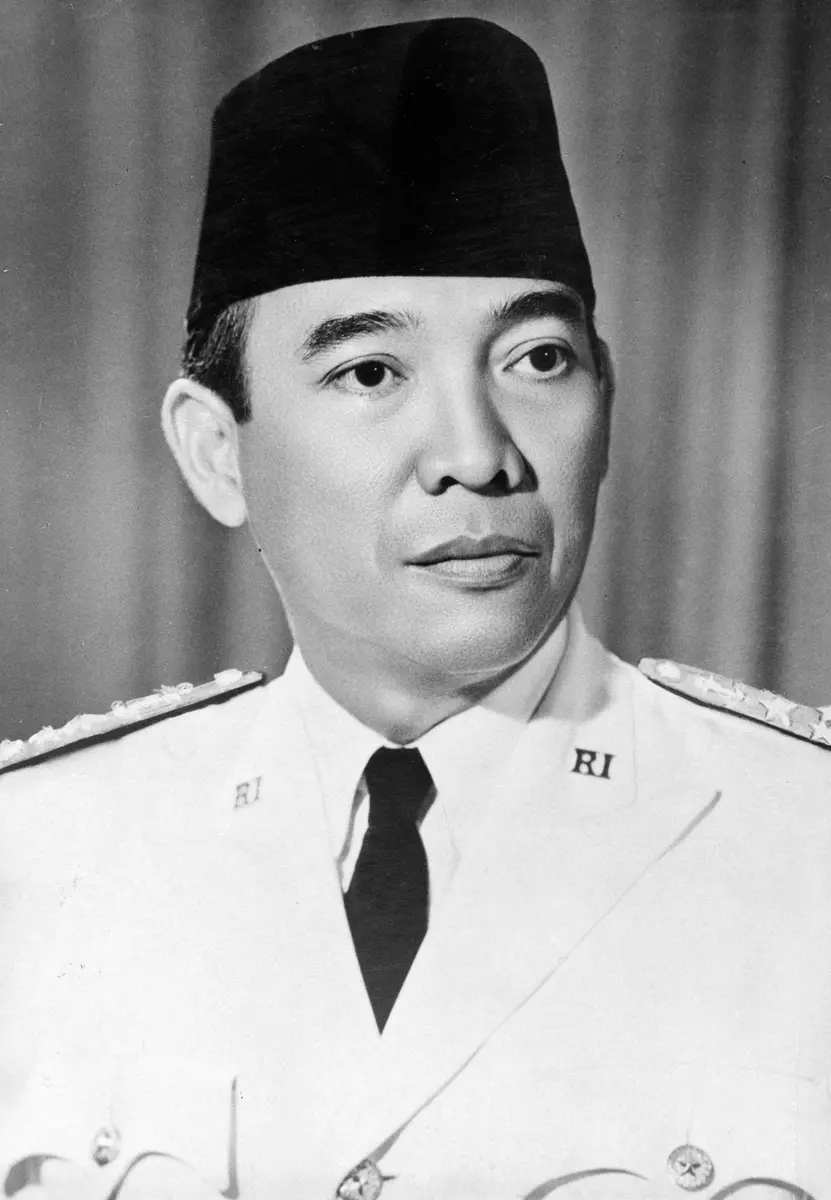
Sukarno was the leader of Indonesia's struggle for independence from the Netherlands and the country's first president, from the proclamation of August 1945 until the army under General Suharto pushed him aside in 1966 and 1967. To his people he was Bung Karno, 'brother Karno'. He was born in Surabaya on June 6, 1901, the only son of a poor Javanese schoolteacher and his Balinese wife, spent long stretches of his childhood with his grandparents in rural East Java, where he fell for the all-night shadow-puppet plays, the wayang, and at fifteen went to the Dutch secondary school in Surabaya, lodging with Omar Said Tjokroaminoto, leader of the mass movement Sarekat Islam, who treated him as a foster son. He trained as an engineer, learned some ten languages and did much to shape modern Indonesian, but his real gift was the spoken word.
He made his name in Bandung, where he took his engineering degree in 1926 and in July 1927 founded the Indonesian Nationalist Party (PNI), which demanded independence. Arrested at the end of 1929, he turned his defence at his trial, 'Indonesia Accuses', into a case against colonial rule; from 1933 the Dutch kept him in exile, at Ende on Flores and then at Bengkulu on Sumatra. When Japan conquered the Indies in 1942 he welcomed the Japanese, who made him their chief adviser and propagandist and the recruiter of labourers and soldiers for their war. He used the position to press for independence: on June 1, 1945 he set out the Pancasila, the five principles that are still the state's creed, and on August 17, two days after Japan's surrender, he and Mohammad Hatta proclaimed the Republic of Indonesia. For four years he led it from Yogyakarta through war and talks with the returning Dutch, who captured him in December 1948 and transferred sovereignty a year later.
From December 1949 he lived in the palace of the former Dutch governors-general in Jakarta. Under the parliamentary constitution of 1950 he was a figurehead and chafed at it; as cabinets fell and regions rebelled he called in 1957 for a 'Guided Democracy' of consensus under his own guidance, and on July 5, 1959 he brought back by decree the presidential constitution of 1945. For six years he balanced the army against the Communist Party, which he protected. He gave the young nation symbols of greatness: he hosted the Bandung Conference of Asian and African states in 1955, raised grand buildings and national monuments and a vast stadium for the Asian Games of 1962, won western New Guinea from the Dutch in 1962, vowed in 1963 to 'crush' the new federation of Malaysia, and took Indonesia out of the United Nations in 1965. Meanwhile the economy collapsed: the cost of living rose 180-fold between 1958 and 1965.
In the night of September 30, 1965 a group of officers murdered six of the army's generals. General Suharto crushed the movement within a day, the army blamed the Communists, and in the killings that followed between 80,000 and more than a million people died. On March 11, 1966 Sukarno was made to hand Suharto wide powers; in March 1967 the People's Consultative Assembly made Suharto acting president, and Sukarno lived under house arrest until he died in Jakarta on June 21, 1970. Suharto ordered a quick, quiet funeral, but half a million people turned out in Jakarta, and he was buried beside his mother at Blitar in East Java. His name was kept out of public life until the government began to rehabilitate it in the late 1970s; today he is honoured as the man who proclaimed independence, and Indonesians still call him Bung Karno.
What happened
- 1901
Born in Surabaya, East Java, the only son of Raden Sukemi Sosrodihardjo, a Javanese schoolteacher, and his Balinese wife, Ida Njoman Rai. He is named Kusnasosro; after a run of childhood illnesses he is given a new name, Sukarno, in the hope of better luck.
Surabaya, East Java: where he was born on June 6, 1901, and where he went to school from 1916, lodging in Tjokroaminoto's house- 1916
At fifteen he is sent to the Hogere Burgerschool, the Dutch secondary school in Surabaya, and lodges with Omar Said Tjokroaminoto, chairman of Sarekat Islam, the great Muslim mass movement. In that house he meets the coming leaders of every camp, from princes to communists; at twenty Tjokroaminoto marries him to his daughter Siti Utari.
Surabaya, East Java: where he was born on June 6, 1901, and where he went to school from 1916, lodging in Tjokroaminoto's house - 1926
Takes his degree in civil engineering at the Technische Hoogeschool in Bandung, where he has studied since 1921, and becomes secretary of the city's General Study Club, where he begins to shape a nationalism that Muslims and communists could both support. He has divorced Siti Utari and in 1923 married Inggit Garnasih.
- 1927
In Bandung he founds the Indonesian Nationalist Association, soon the Indonesian Nationalist Party (PNI), and is its chairman. It demands independence and refuses to cooperate with the colonial government or sit in its People's Council.
- 1929
At the end of the year the colonial police arrest Sukarno and other PNI leaders in raids across Java; he is taken while on a visit to Yogyakarta and jailed in Bandung.
- 1930
Tried with three PNI colleagues before the Landraad, the colonial court in Bandung, he reads in his defence a long speech written in his cell, 'Indonesia Accuses' (Indonesia Menggugat), an indictment of colonialism and imperialism that the press reports widely. In December he is sentenced to four years in prison.
Gedung Indonesia Menggugat, Bandung: the former colonial court (Landraad) where he was tried in 1930 and read his defence, 'Indonesia Accuses'- 1934
Released at the end of 1931, he finds the nationalist movement split; in 1933 he is arrested again and this time exiled without trial. In 1934 he is shipped with Inggit to Ende, a small port on the island of Flores, where he reads, writes and starts a theatre group.
Ende, Flores: his place of exile from 1934 to 1938; the house he lived in is a memorial - 1938
Because of malaria on Flores the Dutch move him to Bengkulu (Bencoolen) on the west coast of Sumatra. He teaches at a school of the Muslim organisation Muhammadiyah and falls in love with one of his pupils, Fatmawati, whom he marries in 1943.
- 1942
Japan's invasion of the Indies in March 1942 ends Dutch rule. Taken by the retreating Dutch to Padang and left behind there, Sukarno welcomes the Japanese as liberators and offers to work with them; in July they bring him back to Jakarta.
- 1943
In March the Japanese make him chairman of Putera, the 'Centre of the People's Power', which gives him a platform across Java and the burden of recruiting romusha, forced labourers, for Japan's war. In July Prime Minister Tojo visits Java, and in November Sukarno and Hatta tour Japan for seventeen days.
- 1945
Before the committee preparing independence he gives the most famous of his speeches, setting out the Pancasila, five principles for the coming state: nationalism, internationalism, democracy, social prosperity and belief in God. They remain the state's creed.
- 10:00 a.m.
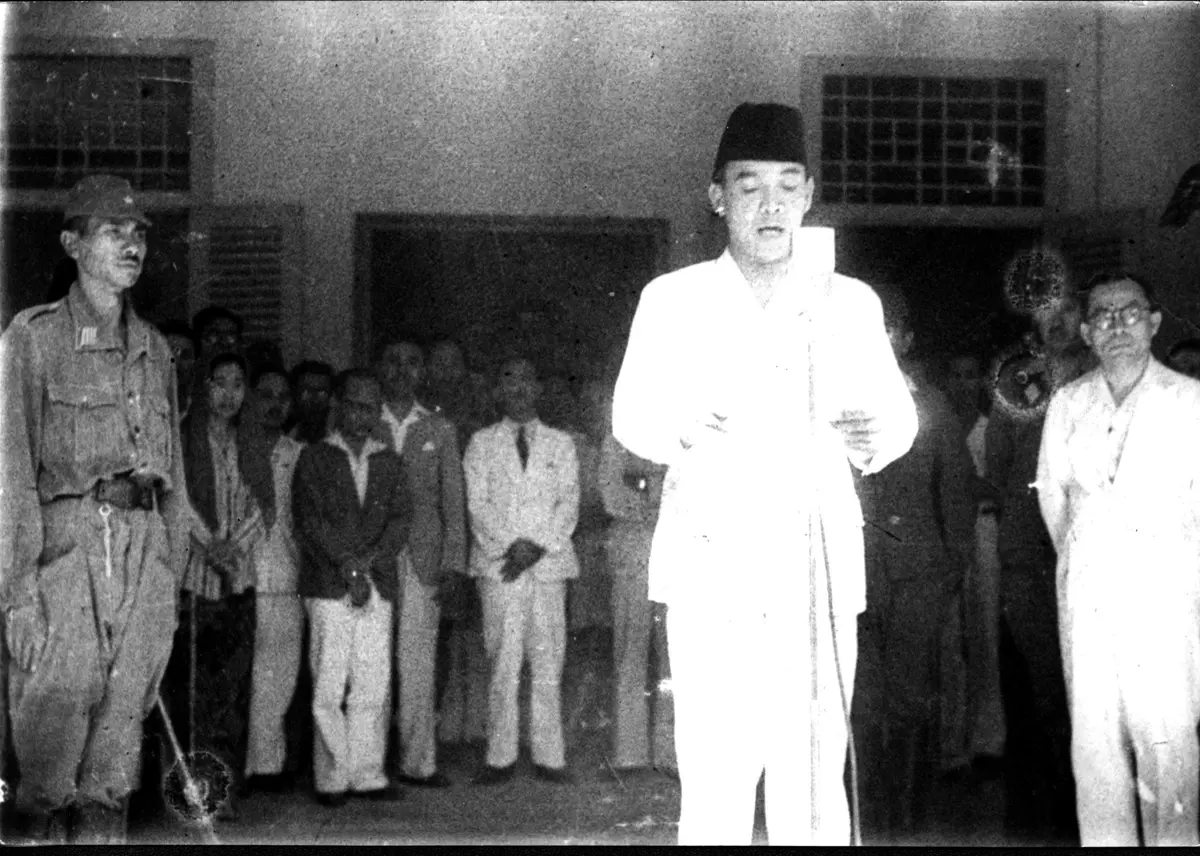
Two days after Japan's surrender, and a day after young activists took him out of the city to press him, he reads the proclamation of independence from the steps of his house in Jakarta, with Hatta beside him. The next day a committee names him president and Hatta vice-president.
- 1946
With Jakarta in the hands of the British and the returning Dutch, the republic's government moves to Yogyakarta, under the protection of its sultan. It stays there through the Linggadjati talks and the first Dutch 'police action' of July 1947.
- 1948
The Dutch launch their second 'police action' with an airborne attack on Yogyakarta. Sukarno, Hatta and most of the cabinet let themselves be taken prisoner while the army fights on as guerrillas; he is sent into exile at Prapat in northern Sumatra and then on Bangka.
- 1949
After the Roem–van Roijen agreement of May the Dutch give Yogyakarta back to the republic, and Sukarno returns from Bangka standing in an open car, cheered through the streets.
The day after the Netherlands transfers sovereignty to the United States of Indonesia, he returns in triumph to Jakarta and moves into the palace of the Dutch governors-general, renamed Merdeka Palace; the same day the American ambassador presents his credentials to him.
Merdeka Palace, Jakarta: the palace of the Dutch governors-general, his home and office as president from December 1949 to 1967- 1955
He opens the Asian-African Conference in Bandung, where delegates of 29 countries, Nehru and Zhou Enlai among them, meet for a week to speak for the newly independent world; it lays the ground for the Non-Aligned Movement.
- 1956
Arrives in Washington on a state visit; the next day he addresses the US Congress, and he tours the country for two weeks, from Detroit to the Grand Canyon.
- 1959
After two years of crisis, martial law and rebellion in Sumatra and Sulawesi, and with the Constituent Assembly unable to agree, he restores by decree the constitution of 1945, which gives the president executive power: the start of the 'Guided Democracy' he had called for in February 1957.
- 1962
Jakarta hosts the Fourth Asian Games in a new sports complex whose great stadium bears his name, one of the symbols of greatness he pursues; the same year the Dutch agree to hand western New Guinea to Indonesia after a period of UN administration.
- 1963
When the federation of Malaysia is formed, he commits Indonesia to 'confrontation' with it, vowing to 'crush' what he calls an imperialist plot of encirclement.
- 1965
Because the United Nations has seated Malaysia on the Security Council, he takes Indonesia out of the UN.
In the early hours a group of officers calling itself the September 30th Movement kidnaps and kills six army generals. General Suharto, commander of the army's strategic reserve, takes control by evening; the army blames the Communist Party, which Sukarno had protected, and in the months that follow between 80,000 and more than a million people are killed.
- 1966
With students demonstrating against him, he signs at the Bogor Palace an order giving General Suharto authority to take whatever measures he thinks necessary to restore order. Suharto uses it to ban the Communist Party and take over the running of the state.
- 1967
The People's Consultative Assembly strips him of his powers and names Suharto acting president. Sukarno is kept under house arrest in Jakarta.
- 1970
Dies of kidney disease in Jakarta, aged 69, still under house arrest. Suharto orders a quick and quiet funeral, but at least half a million people turn out in Jakarta, and the next day 200,000 gather at Blitar, where he is buried in a simple grave beside his mother.
Blitar, East Java: his grave beside his mother's, where he was buried on June 22, 1970