Chang'e 4 lands on the far side of the Moon
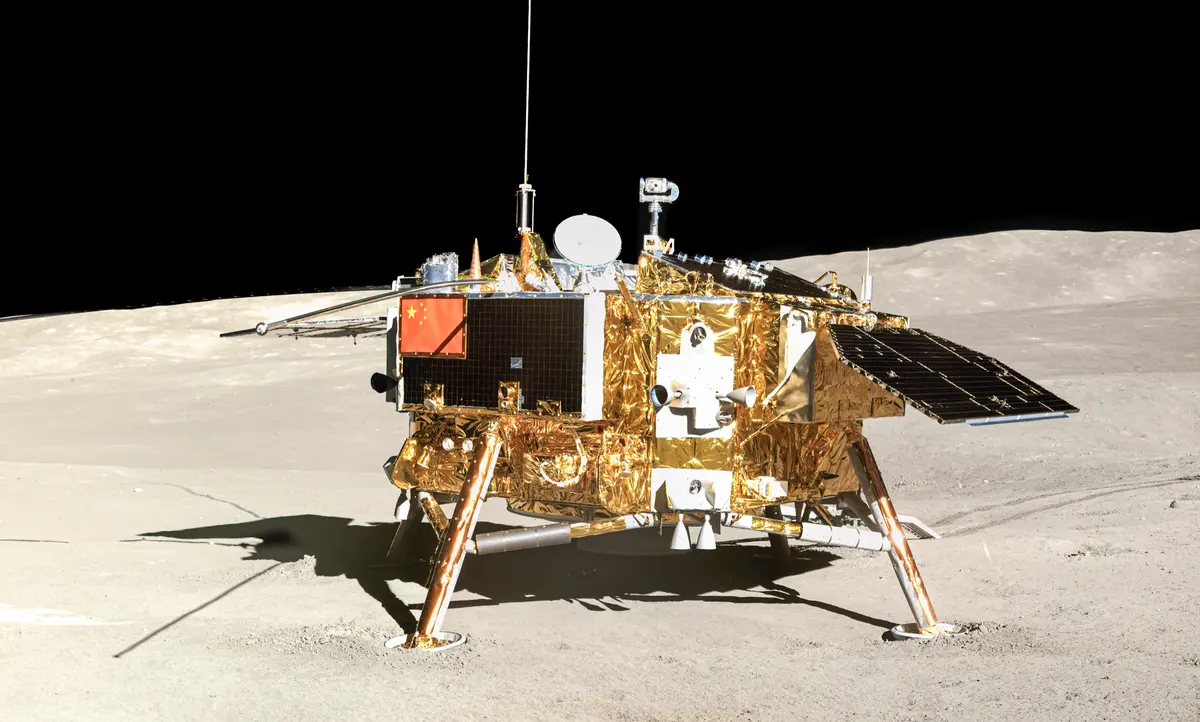
“Chang'e 4: on 3 January 2019 China made the first soft landing on the Moon's far side, in Von Kármán crater, with the Yutu-2 rover, helped by the relay satellite Queqiao.”
The Moon turns once for every orbit it makes round the Earth, so the same face always looks at us. The other face, the far side, was first photographed by the Soviet probe Luna 3 in 1959, and by 2018 it had been mapped in detail from orbit. But nothing had ever landed there. One reason is radio: signals cannot pass through the Moon, so a lander behind it cannot talk to the Earth.
China's answer was to send a relay first. On 20 May 2018 (21 May in China) the satellite Queqiao, 'Magpie Bridge', left Xichang on a Long March 4C. By 14 June it was in a slow orbit about 65,000 km beyond the Moon, a place where it can see both the Earth and the far side. The lander and its rover followed on 7 December 2018. They had been built as spares for Chang'e 3, the lander that put the rover Yutu on the near side in 2013, and were changed for the new job. After a flight of about 110 hours Chang'e 4 entered orbit round the Moon on 12 December, and on 30 December it dipped to an orbit only 15 km above the far side at its lowest.
At 02:26 UTC on 3 January 2019 (10:26 in Beijing) the lander touched down on the floor of Von Kármán crater, which is 186 km wide and lies inside the South Pole-Aitken basin, the Moon's largest and oldest impact scar. The crater carries the name of Theodore von Kármán, the engineer whose Caltech student Qian Xuesen became the father of China's space programme; Xinhua noted the link that day. Twelve hours later the rover Yutu-2 rolled down a ramp onto the dust. The landing site was soon named Statio Tianhe. NASA's orbiter found the machines from space four weeks after the landing, and the Chinese and American teams had traded the landing time and place before it.
The first science came quickly. On 11 January the lander and rover photographed each other, and China called the mission a complete success. A cotton seed sprouted in a sealed canister, then froze in the lunar night. On 15 May 2019 the journal Nature published spectra from Yutu-2 that the team read as olivine and low-calcium pyroxene, possibly rock from the Moon's mantle. Later studies argued that the minerals came from the nearby Finsen crater, or that the rock was lower crust, not mantle, so the question stayed open. Yutu-2 went on working far longer than its three planned months, and in November 2019 it passed the Soviet Lunokhod 1's record for the longest-working rover on the Moon.
What happened
- 2018
- 9:28 p.m.
At 21:28 UTC on 20 May (5:28 in the morning on 21 May in China) a Long March 4C rises from Xichang with the relay satellite Queqiao, 'Magpie Bridge'. Without it, no radio signal could pass from a lander behind the Moon to the Earth.
Xichang Satellite Launch Center, Sichuan: launched Queqiao on a Long March 4C at 21:28 UTC on 20 May 2018 and Chang'e 4 on a Long March 3B at 18:23 UTC on 7 December 2018 - 3:06 a.m.
After a trip of more than twenty days, with a swing past the Moon to save fuel, Queqiao enters its working orbit around the Earth-Moon L2 point, about 65,000 km from the Moon, at 11:06 Beijing time (03:06 UTC). It is the first communications satellite ever to work in that orbit.
- 6:23 p.m.
At 18:23 UTC (02:23 on 8 December in China) a Long March 3B lifts off from Xichang at night with the Chang'e 4 lander and Yutu-2 rover. It puts them straight onto a path to the Moon, and only one of the three planned course corrections is needed.
Xichang Satellite Launch Center, Sichuan: launched Queqiao on a Long March 4C at 21:28 UTC on 20 May 2018 and Chang'e 4 on a Long March 3B at 18:23 UTC on 7 December 2018 - 8:45 a.m.
After about 110 hours of flight the Beijing control centre commands a braking burn at 08:39 UTC, and at 08:45 UTC Chang'e 4 is in orbit round the Moon, about 100 km at its lowest. There it waits three weeks for the Sun to rise over the landing site.
Beijing Aerospace Command and Control Center: the control room that sent the braking command of 12 December 2018 and received the pictures from the far side - 12:55 a.m.
At 00:55 UTC (8:55 in Beijing) the probe drops into a lower, elliptical orbit, 15 km at its lowest and 100 km at its highest, from which it will start its descent. Controllers have also tested the radio link with Queqiao.
- 2019
- 2:26 a.m.
At 02:26 UTC (10:26 in Beijing) Chang'e 4 touches down on the floor of Von Kármán crater, inside the South Pole-Aitken basin: the first soft landing on the far side of the Moon. The descent is fully automatic, and the pictures come home through Queqiao.
- 2:22 p.m.
About twelve hours later, at 22:22 Beijing time (14:22 UTC), the rover Yutu-2, 'Jade Rabbit 2', rolls down the lander's ramp and leaves its first wheel tracks on the far side; the lander's camera films the moment.
China's space agency declares the mission 'a complete success': the lander and the rover have photographed each other, and the cameras on the lander have taken panoramic pictures of the site. The Beijing control centre shows both on its screens.
Beijing Aerospace Command and Control Center: the control room that sent the braking command of 12 December 2018 and received the pictures from the far sideChinese officials announce that cotton seeds in the lander's sealed canister have sprouted, the first plants ever grown on the Moon. The canister has no heating at night, and the plants die as the lunar night falls and the canister drops to about minus 52 degrees.
Chongqing University: the team of Liu Hanlong built and ran the lander's sealed mini-biosphere, whose cotton seeds were reported to have sprouted on 15 January 2019NASA's Lunar Reconnaissance Orbiter, rolled 70 degrees to look sideways as it approaches, takes the first picture of the Chinese lander from orbit: a bright speck two pixels wide on the floor of the crater. The Chinese side had given NASA the time and place of the landing.
Just after midnight UTC, LRO passes almost directly over the site at 82 km and sees both machines, the rover 29 m north-west of the lander. NASA publishes the pictures two weeks later.
At a press conference in Beijing the Chinese space agency says the International Astronomical Union has named the landing site Statio Tianhe, 'Heavenly River Station' (the Chinese name of the Milky Way), together with a hill and three craters; the agency releases the landing-site panorama the same day.
By the end of the month LRO sees the rover 69 m from the lander: Yutu-2 has driven 46 m to the west during February, much of the month spent asleep through the lunar night.
The journal Nature publishes the first science from the far side's floor: Yutu-2's infrared spectrometer saw minerals, olivine and low-calcium pyroxene, that may come from the Moon's mantle, thrown there by the nearby Finsen crater. The authors say more data are needed.