Kutai inscriptions in Kalimantan
“Seven stone posts raised for King Mulavarman on the Mahakam in eastern Borneo about 400: Sanskrit verses in a South Indian script, the oldest writing found in Indonesia.”
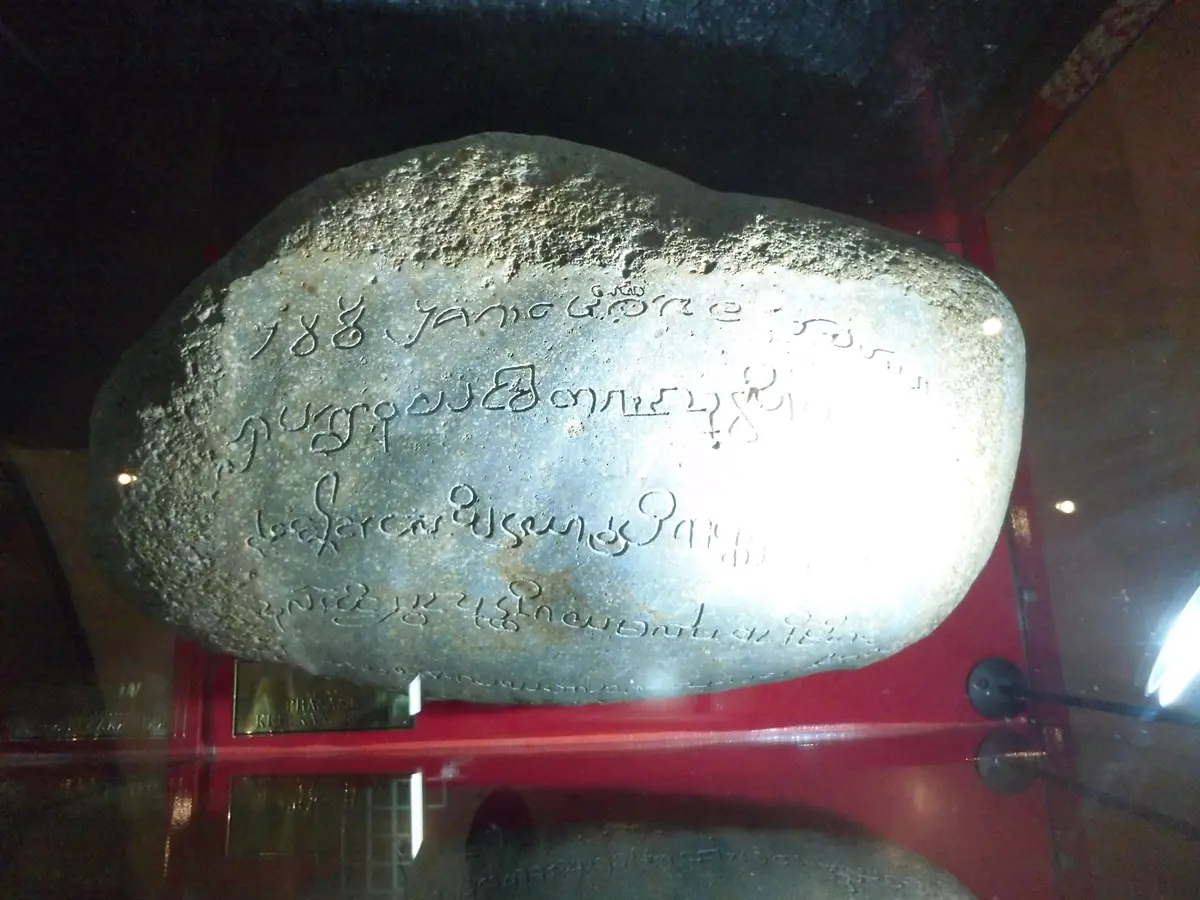
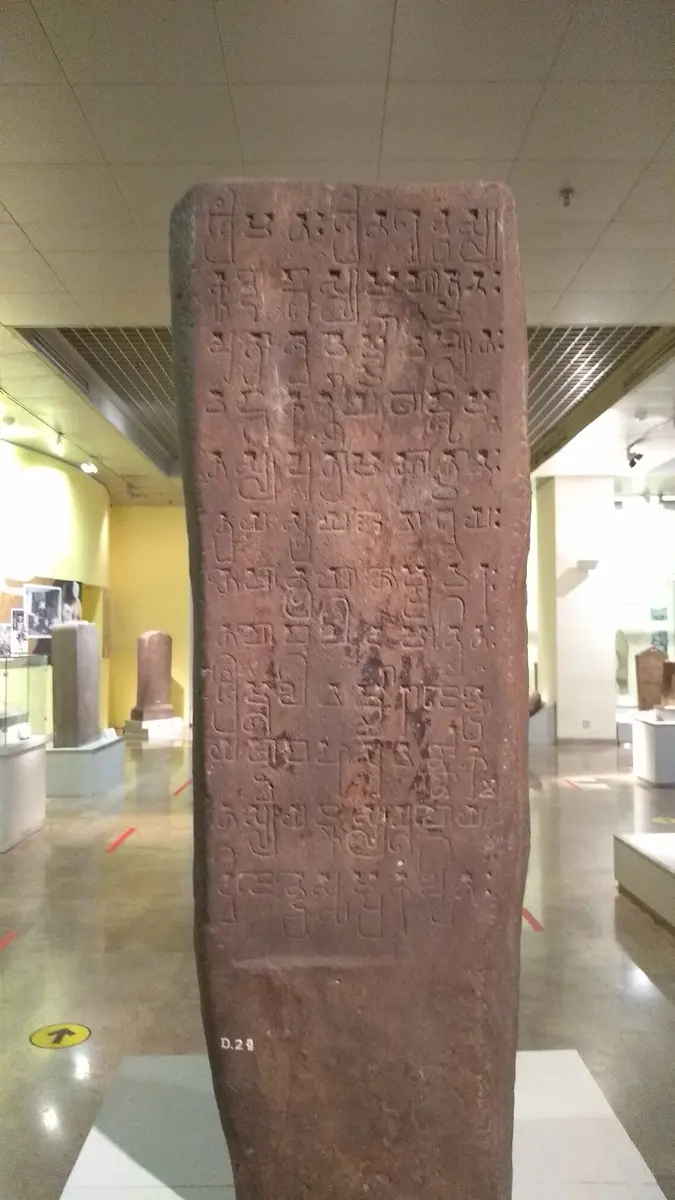
About the year 400, Brahmin priests at a river kingdom in eastern Borneo set up stone posts for their king, Mulavarman, and cut verses in his praise into them. Seven survive, and they carry the oldest writing ever found in Indonesia. The language is Sanskrit, the learned language of India; the letters are an early form of the script of the Pallava kings of south-east India, a descendant of the Brahmi script of Ashoka's edicts. Each stone calls itself a yupa, the post to which the animal was tied at a Vedic sacrifice. Yet they are not the carved, eight-sided posts of India: the first four found are roughly dressed blocks of andesite, 1.2 to 1.9 metres high. None carries a date. Scholars place them by the shapes of their letters, a little later than the oldest inscriptions of Champa in Vietnam and a little earlier than King Purnavarman's in West Java: about 400, give or take half a century.
The longest post names three generations. The grandfather, Kundunga, has a name that is not Sanskrit at all: a local chief, as Hendrik Kern thought, or a Tamil from South India, as B. Ch. Chhabra argued. His son Asvavarman has an Indian royal name and is praised as the founder of the line, like the sun. Of Asvavarman's three sons the foremost was Mulavarman, 'lord of kings', who held a sacrifice called 'much gold'. The other posts list the king's gifts to the priests 'who had come hither', several of them at a holy place called Vaprakesvara: cows by the thousand, land, a 'wishing tree', water, ghee and sesame, eleven bulls, a mountain of sesame with a row of lamps. One boasts that he beat other kings in battle and made them pay tribute, as King Yudhishthira does in the Mahabharata.
The kingdom's own name is never given, and no other known record mentions Mulavarman. But the picture is clear: a ruler on a Borneo river using India's sacred language, ritual and poetry to show his power, served by Brahmins who had crossed the sea, at a time when ships already linked India, mainland Southeast Asia and the islands. Early in the fifth century the Chinese pilgrim Faxian, driven off course on his way home from Sri Lanka, spent five months in a land called Yepoti, perhaps Java, perhaps western Borneo, and found Brahmins flourishing there and Buddhism hardly known.
The stones' modern story began on 3 June 1879, when K. F. Holle told the Batavian Society of Arts and Sciences of an inscribed stone said to lie somewhere in the sultanate of Kutai. That September the Dutch Assistant Resident reported inscribed stones at Muara Kaman, the village where the Kaman river joins the Mahakam; the traveller Carl Bock, at the sultan's court that summer, heard they came from Sangkulirang on the coast, and a later letter named Kutai Lama, the sultans' old seat. On 26 August 1880 the official reported that Sultan Muhammad Sulaiman had decided to give the four stones to the Society, and before the year was out they stood in its museum in Batavia. Meanwhile, on 13 September 1880, Hendrik Kern of Leiden told the Academy of Sciences in Amsterdam that one of them was in pure Sanskrit; he finally dated them to about 400. J. Ph. Vogel re-edited them in 1918 from inked rubbings and judged Muara Kaman the likeliest find spot. Three more posts came to light in 1940; with Java cut off by the war, Chhabra published their texts from India in 1945. All seven are in the National Museum of Indonesia in Jakarta.
With these posts Indonesia passes from prehistory into history. Purnavarman's inscriptions near Bogor and Jakarta follow, in the same family of script, about half a century later; in the 680s the rulers of Srivijaya were having their inscriptions cut in Old Malay; by the middle of the eighth century the Pallava letters had grown into Kawi, found across Java, Sumatra, Bali and the Malay Peninsula. Mulavarman's kingdom itself vanished. The Muslim sultans of Kutai who handed over the stones ruled a much later Malay state, and no record joins the two. Even the find spot was spoiled: treasure hunters had dug at Muara Kaman since at least the 1840s, when a golden Hindu image found there was already part of the sultan's regalia, and when a hundred of the sultan's men later dug for more they found only old bricks and potsherds.
What happened
- 400
The chief Brahmins set up a stone post for King Mulavarman after a sacrifice called 'much gold'. Its twelve lines of Sanskrit verse give his line: the 'lord of men' Kundunga, whose name is not Sanskrit; his son Asvavarman, founder of the dynasty, likened to the sun; and Asvavarman's three sons, the foremost of them Mulavarman, 'lord of kings'.
Muara Kaman: the village where the Kaman joins the Mahakam, the most likely find spot of the postsAt 'the most blessed field' of Vaprakesvara the king gives the Brahmins a great gift of cows, twenty thousand or, as Vogel read the verse, a thousand and twenty, and the priests 'who had come hither' raise a post for it. Another asks the foremost priests and all good men to hear of his gifts of many things, of living beings, of a wishing tree and of land.
Muara Kaman: the village where the Kaman joins the Mahakam, the most likely find spot of the postsA post found in 1940 says that Mulavarman beat other kings in battle and made them pay tribute, as King Yudhishthira did; at Vaprakesvara he gave forty thousand and then thirty thousand of something the worn stone no longer names, made gifts of life of many kinds, and lit lights in his own town.
Muara Kaman: the village where the Kaman joins the Mahakam, the most likely find spot of the postsAnother post found in 1940 hails 'the mighty king, the illustrious Mulavarman' for gifts written down 'at this great holy place': water, ghee, tawny cows and sesame seeds, given to the Brahmins together with eleven bulls.
Muara Kaman: the village where the Kaman joins the Mahakam, the most likely find spot of the postsThe shortest post, four lines, is carved for two gifts: a 'mountain of sesame' given away with a row of lamps.
Muara Kaman: the village where the Kaman joins the Mahakam, the most likely find spot of the posts