Srivijaya is a major Buddhist power in Sumatra
“Srivijaya, the Buddhist port kingdom of Palembang in Sumatra, held the straits between India and China from the 670s until a Chola fleet broke its power in 1025.”
Late in 671 a Chinese monk named Yijing sailed from Canton for India and, in less than twenty days, came to a river port in south-eastern Sumatra that he called Fo-shih: Srivijaya, at today's Palembang on the Musi river. He stayed six months to learn Sanskrit grammar, went on in the king's own ship by way of Malayu (Jambi) and Kedah, and later came back from India to live and write there until 695. In its 'fortified city' he found more than a thousand Buddhist monks who studied exactly as they did in India, and he told Chinese pilgrims to train there for a year or two before going on. The kingdom's own stones tell the same story of a young power on the move: in 682 its king, Dapunta Hyang Jayanasa, came back to Palembang from a victorious 'sacred expedition', in 684 he gave a park for the good of all living beings, and by 686 he had taken the Jambi river country and the island of Bangka and sent an army against Java.
Srivijaya's power rested on geography and trade. Ships sailing between India and China had to wait near the straits for the monsoon to turn, and the kings of Palembang set out to hold both passages, the Strait of Malacca and the Sunda Strait, with the ports on their shores. The Musi river brought them gold, food and forest goods from the interior; the orang laut, the sea people of the coast, made passing ships call at their harbour whether they wished to or not; and regular embassies to the Chinese court kept their merchants welcome in Chinese ports. The wealth paid for a Mahayana Buddhist court whose monks were known across Asia, but it built in brick and wood rather than stone and left few monuments: the brick temples of Muara Jambi and a handful of inscriptions in Old Malay, among the oldest writing in any form of Malay, are most of what survives.
Its height lasted more than three centuries. By 775 a king of Srivijaya was building Buddhist sanctuaries at Ligor on the Malay Peninsula. In the ninth century the kingdom was tied to the Sailendra kings of Java, the builders of Borobudur: Balaputra, a Sailendra prince whose mother was the daughter of a Srivijayan king, came to rule it after losing a war for Java in 856, and about 860 he built a monastery at Nalanda, the great Buddhist university in India. Arab geographers called its ruler the maharaja of Zabag, master of Sribuza and Kalah on both shores of the strait and richer in perfumes and spices than any other king. About 1005 a later king built a Buddhist temple at Nagapattinam in south India, endowed by the Chola king, while his envoys went to the Song emperors of China. The rivalry with Java turned into war: a Javanese invasion about 992 was answered, it seems, in 1016, when the capital of the Javanese king was destroyed.
The blow that ended Srivijaya's height came from India. In 1025 the Chola king Rajendra I sent a fleet across the Bay of Bengal that sacked Srivijaya and a string of ports from Jambi and Kedah to the north of Sumatra and the Nicobar Islands, seized the king, Sangramavijayottungavarman, and carried off his treasure. The kingdom lived on, but its centre moved to Jambi and its grip on the straits loosened; by the end of the twelfth century it had become a small kingdom, the lead in Sumatra had passed to Malayu at Jambi, and Java's Singhasari and Majapahit would soon claim the islands.
Srivijaya then vanished so completely from memory that even its name had to be rediscovered. In 1918 the French scholar George Coedès showed that the Shih-li-fo-shih of the Chinese pilgrims, the Sribuza of the Arabs and the Srivijaya of the Old Malay stones were one kingdom, centred on Palembang. Indonesian nationalists then took it, with Majapahit, as proof that the archipelago had been one great state long before the Dutch, and its name now belongs to Palembang's university and to an airline. Its way of power, a port that controls the straits and lives on the trade between India and China, passed to Malacca, whose rulers traced their line to Palembang.
What happened
- 671
In the eleventh month of the year (December 671 into January 672 by our calendar) the monk Yijing sails from Canton for India and, in under twenty days, reaches Fo-shih, Srivijaya. He stays six months learning Sanskrit grammar; the king supports him and sends him on to Malayu and then to Kedah, where he boards the king's ship for India.
Palembang on the Musi river: the seat of Srivijaya's kings, Yijing's 'fortified city of Bhoga', sacked by the Chola fleet in 1025 - 682
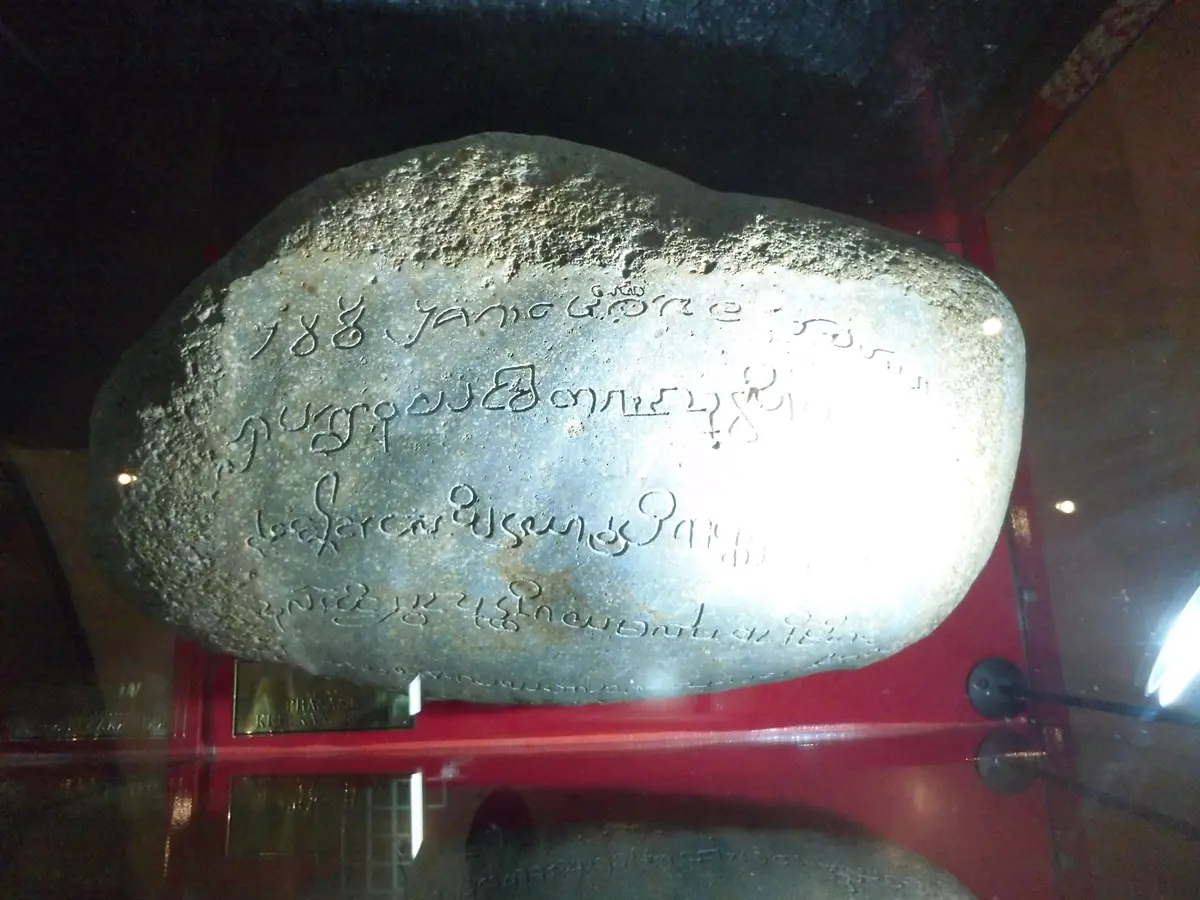
Dapunta Hyang, the king, boards his boat to begin a siddhayatra, a sacred expedition. On 19 May he leaves the river mouth with an army moving by land and water, twenty thousand men by the stone's count, and a month later he brings 'victory, power and wealth' to Srivijaya. The Kedukan Bukit stone, set up near Seguntang hill, records it: the first time the name Srivijaya is written.
Bukit Siguntang, Palembang: the sacred hill where the great granite Buddha was found; the Kedukan Bukit stone of 682 was set up near its foot- 684
King Jayanasa founds the park Sriksetra west of Palembang, planted with coconut and areca palms, sugar palms, sago and bamboo, and has a prayer carved that the merit of his gift may lead all creatures to enlightenment: the Talang Tuwo inscription, the first dated witness of Mahayana Buddhism in South-East Asia.
Palembang on the Musi river: the seat of Srivijaya's kings, Yijing's 'fortified city of Bhoga', sacked by the Chola fleet in 1025- 686
On Bangka a pillar in Old Malay calls down the curses of the gods on anyone who rebels against Srivijaya or its officers, and records an army setting out against 'the land of Java', which had not submitted. A twin stone at Karang Brahi in the Jambi uplands shows that the river country of Malayu has been conquered too.
Kota Kapur, Bangka: where the inscription of 686 was found- 689
Back in Srivijaya from India, Yijing goes aboard a merchant ship at the mouth of the river to send a letter to Canton asking for paper and ink; the wind turns, the ship sails, and he lands at Canton on the twentieth day of the seventh month. On the first day of the eleventh month he sails back with four helpers, to copy and translate the 500,000 verses of scripture he had left in Srivijaya.
Canton (Guangzhou): the Chinese port of Yijing's voyages and of Srivijaya's envoys - 695
Yijing, who had sent his Record of the Buddhist religion and his Memoirs of eminent monks home in 692, returns to China at midsummer after twenty-five years abroad, with some four hundred Buddhist texts. In the same year Srivijaya sends the first embassy to China whose date is known.
Canton (Guangzhou): the Chinese port of Yijing's voyages and of Srivijaya's envoys - 775
At Ligor (Nakhon Si Thammarat) on the Malay Peninsula, a king of Srivijaya, probably called Dharmasetu, has sanctuaries built for the Buddha and the bodhisattvas Padmapani and Vajrapani, and records it in Sanskrit on a stele: Srivijaya now holds the peninsula's eastern shore.
Wat Sema Mueang, Nakhon Si Thammarat (Ligor): where the Ligor stele of 775 was found - 830
About this time an Arab ship, its planks sewn together in the Persian Gulf manner, sinks off the island of Belitung on its way home from southern China with some 60,000 goods: tens of thousands of Changsha bowls, Yue celadons, white wares, bronze mirrors and vessels of gold and silver. Found in 1998, the Belitung wreck shows the trade that passed through Srivijaya's waters.
The Belitung wreck: an Arab ship that sank off Belitung about 830 with a cargo from Tang China - 856
In Java, the Sailendra prince Balaputra loses his war with his brother-in-law Rakai Pikatan, the Hindu king of Mataram, and goes to Srivijaya, the country of his mother Tara, daughter of King Dharmasetu. He becomes the first Sailendra to rule it.
- 860
About this year King Devapala of Bengal, at the request of Balaputra, 'king of Suvarnadvipa', grants five villages to the monastery Balaputra has built at Nalanda, the greatest Buddhist university of India. The copper charter, with Devapala's seal of the wheel of the law between two deer, was dug up at Nalanda in 1921.
Nalanda, Bihar: the Buddhist university where Balaputra of Srivijaya built a monastery about 860 - 916
About this year an Arab writer describes the maharaja of Zabag, lord of Sribuza and of Kalah, the port where the ships of Oman come and go: his island is so thickly settled that when the cocks crow at sunrise they answer one another from village to village for a hundred parasangs.
- 992
A Srivijayan envoy who reached China in 988 learns at Canton that his country has been invaded from Java, waits a year, and in the spring of 992 sails as far as Champa; hearing no good news, he turns back and asks the emperor to take Srivijaya under China's protection. Javanese envoys the same year say their country is at war with Srivijaya.
Canton (Guangzhou): the Chinese port of Yijing's voyages and of Srivijaya's envoys - 1003
Envoys of King Chulamanivarmadeva tell the Song emperor that their king has built a Buddhist temple to pray for the emperor's long life, and ask for a name and bells for it; the emperor names it 'Ten thousand years of receiving from Heaven' and has bells cast and sent.
- 1005
About this year the king of Srivijaya builds a Buddhist temple bearing his name, the Chulamanivarma-vihara, at Nagapattinam on the Coromandel coast, and the Chola king Rajaraja I gives it the revenue of a large village. His son Rajendra later confirms the gift on copper plates that call the Srivijayan king, Maravijayottungavarman, a Sailendra, 'king of Srivijaya and Kataha'.
Nagapattinam: the Chola port where the king of Srivijaya built a Buddhist temple about 1005 - 1016
The capital of the Javanese king Dharmawangsa is destroyed in a disaster the Javanese called the pralaya, and the king is killed. The attacker was a prince of Wurawari; that Srivijaya stood behind him, in revenge for the invasion of 992, is the usual but unproven view.
- 1025
The Chola king Rajendra I sends a fleet across the Bay of Bengal. His inscription at Tanjore, dated 1030-31, says it seized Sangramavijayottungavarman, king of Kadaram, and took Srivijaya, Pannai, Malaiyur, Langkasuka, Tambralinga, Lamuri, the Nicobars and Kadaram. Britannica: Palembang was seized, the king captured and his treasure carried off. Srivijaya never regains its old command of the straits.
The Bujang Valley, Kedah: Kataha or Kadaram, the peninsular pole of Srivijaya, where Yijing took ship for India and whose king the Cholas seized in 1025