SpaceX catches a Starship booster with the launch tower
“On 13 October 2024 SpaceX's Starship booster flew back to its Texas pad and was caught in mid-air by the launch tower's 'chopstick' arms about seven minutes after liftoff, a first for a rocket this size.”
On the morning of 13 October 2024 SpaceX did something no one had done with a rocket this big: it caught the first stage of its Starship rocket out of the air. The stage, Super Heavy Booster 12, had pushed Starship up from the company's site at Starbase, Texas, then turned around, flown back to the pad and hovered beside the launch tower, whose two steel arms, nicknamed the 'chopsticks', closed around it about seven minutes after liftoff. The tower is called Mechazilla. The same flight sent the upper stage, Ship 30, on a suborbital arc that ended with a soft splashdown in the Indian Ocean about 66 minutes after liftoff.
The point was to reuse the rocket. Most rockets drop their stages into the sea, and even SpaceX's smaller Falcon 9 lands on legs. Catching the booster on the tower is meant to do without the legs, save their weight and let the stage be readied at the pad for its next flight. Starship's 33 engines all ran well on this flight, the first without an engine failure; the booster used first thirteen and then three of its centre engines for the landing burn, moved sideways in the last seconds, and was held by the arms with its engines shutting down.
It took four tries to get here. Flight 1 on 20 April 2023 ended with the vehicle destroyed; on flight 2, in November 2023, both stages were lost; on flight 3, in March 2024, the booster broke up above the water; and on flight 4, on 6 June 2024, the booster came down on a 'virtual tower' in the Gulf of Mexico and the ship splashed down in the Indian Ocean. The tower's arms were tested through the summer. The paperwork was harder: in September SpaceX said the FAA had put its decision off until November; the FAA said a catch changed where parts would fall and how loud the sonic boom would be, which needed extra review. Its chief executive Elon Musk had criticised the agency publicly, including over a proposed 633,000-dollar fine, and called for its head to resign. The FAA nevertheless issued the licence on 12 October, saying SpaceX had met all safety, environmental and licensing requirements.
The catch changed what Starship was expected to do. On flight 6, on 19 November 2024, the booster was diverted to the sea because the tower was damaged; on flight 7, on 16 January 2025, a second booster was caught while the ship was lost; and on flight 8, on 6 March 2025, a third. NASA's Bill Nelson congratulated SpaceX the same day, and for NASA the point was larger than the booster: it has chosen Starship to land its astronauts on the Moon on the Artemis missions. Reuse of a whole Starship, the ship as well as the booster, was still ahead.
What happened
- 2024
NASA Administrator Bill Nelson congratulates SpaceX on 'its successful booster catch and fifth Starship flight test', and other launch companies congratulate it too; NASA has chosen Starship to land astronauts on the Moon.
- 11:35 a.m.
Almost fifty minutes before liftoff, at 49 minutes 50 seconds before launch, SpaceX starts loading Ship 30 with its fuel, liquid methane; the ship's oxygen and then Booster 12's propellants follow, and the last tank is full about three minutes before liftoff.
The Starbase launch site, Boca Chica, Texas: the pad where Ship 30 and Booster 12 stood on 13 October 2024 and where the booster came back - 12:25 p.m.
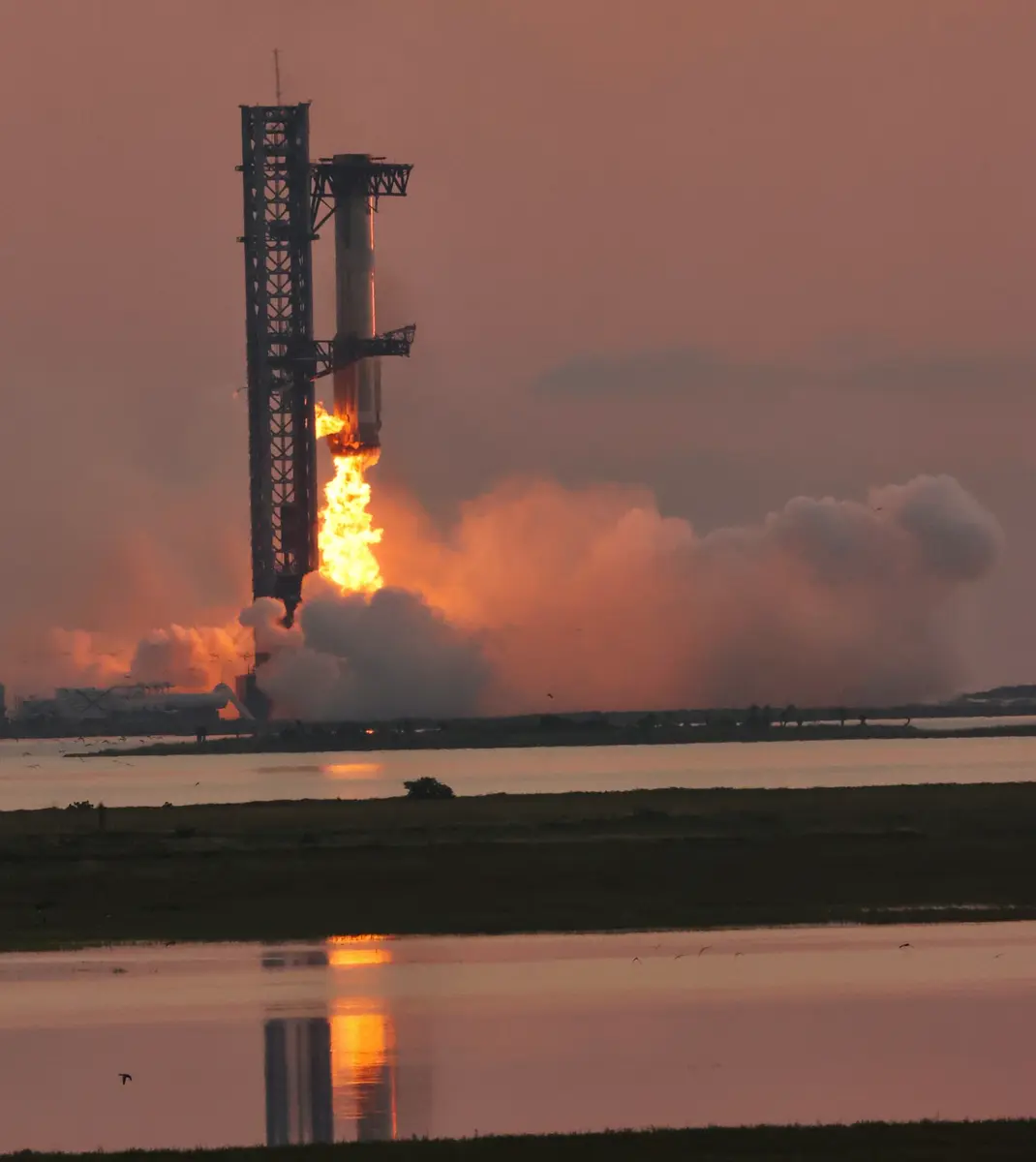
At 12:25 UTC (7:25 a.m. Central Time) Booster 12's 33 engines ignite and Starship lifts off from Starbase, the day after the FAA issued its licence; every one of the 33 engines runs all the way to stage separation, the first Starship flight without an engine failure.
The Starbase launch site, Boca Chica, Texas: the pad where Ship 30 and Booster 12 stood on 13 October 2024 and where the booster came back - 12:26 p.m.
About a minute after liftoff the booster throttles down through the point of greatest stress on the rocket, 'max q', and the stack climbs on towards the edge of space.
The Starbase launch site, Boca Chica, Texas: the pad where Ship 30 and Booster 12 stood on 13 October 2024 and where the booster came back - 12:27 p.m.
At about 2 min 35 s the booster shuts down most of its engines; five seconds later Ship 30's six engines ignite and the stages separate by 'hot staging', the ship lighting its engines before it is free of the booster; the ship climbs on towards the Indian Ocean.
- 12:28 p.m.
Booster 12 relights ten engines for its boostback burn, which runs from about 2 min 45 s to 3 min 41 s and turns the stage back towards Texas instead of letting it fall into the Gulf of Mexico as on flights 3 and 4; the hot-stage ring drops away two seconds later.
- 12:31 p.m.
About 6 min 30 s after liftoff Booster 12 lights its centre engines, thirteen and then three, for the landing burn, slows from supersonic speed over the pad, and slides sideways until it hangs between the tower's arms.
Starbase Integration Tower 1, the launch tower nicknamed Mechazilla: its two arms caught Booster 12 at 12:31 UTC on 13 October 2024 - 12:31 p.m.
At about 12:31:56 UTC, roughly seven minutes after liftoff, the tower's two arms, the 'chopsticks', close on the booster and its engines shut down: the first time a rocket stage of this size has been caught out of the air by a launch tower. NASA's Inspector General describes it as the flight that 'demonstrated the provider's ability to catch the booster at the launch pad using the launch tower arms'.
Starbase Integration Tower 1, the launch tower nicknamed Mechazilla: its two arms caught Booster 12 at 12:31 UTC on 13 October 2024 - 12:33 p.m.
Ship 30 shuts down its engines at about 8 min 27 s, reaching an apogee of about 212 km on a suborbital path; it then coasts for most of an hour with nothing to do but wait for the atmosphere.
- 1:13 p.m.
About 48 minutes after liftoff Ship 30 meets the atmosphere over the Indian Ocean with its reworked heat shield; there is some burn-through on a forward flap, but the ship keeps control.
- 1:30 p.m.
At 13:30 UTC, about 65 minutes 40 seconds after liftoff, Ship 30 flips upright, fires its engines and lowers itself into the Indian Ocean beside a buoy that films it; it then tips over and bursts into a fireball, as planned, since the ship was never to be recovered.