The Asian financial crisis
“In July 1997 Thailand's baht broke and panic swept East Asia: currencies crashed, the IMF led $118 billion of rescues for Thailand, Indonesia and Korea, and in Indonesia the crisis brought Suharto down.”
The Asian financial crisis began on 2 July 1997, when Thailand could no longer hold its currency, the baht, at a fixed rate to the US dollar and let it float. Within months the panic spread to Indonesia, South Korea, Malaysia, the Philippines and Hong Kong. Currencies collapsed: at their worst a dollar bought more than twice as many baht or won as in June 1997, and the Indonesian rupiah, about 2,450 to the dollar in June 1997, passed 15,000 in June 1998, losing more than four-fifths of its value. Banks and companies failed by the thousand, and in 1998 Indonesia's economy shrank by 13 percent, Thailand's by 8 percent and Malaysia's by 7 percent.
These were among the world's fastest-growing economies, praised for high savings and careful budgets. But for years their banks and firms had borrowed heavily abroad, often short-term and in dollars, trusting the fixed exchange rates to protect them. Much of the money went into property and doubtful projects: towers in Bangkok still stand half-built. Supervision of banks was weak, and many loans went to friends of those in power. When Thailand's peg broke, the dollar debts became unpayable in local money, foreign lenders, Japanese banks among them, pulled back from the whole region, and investors fled any country that looked similar.
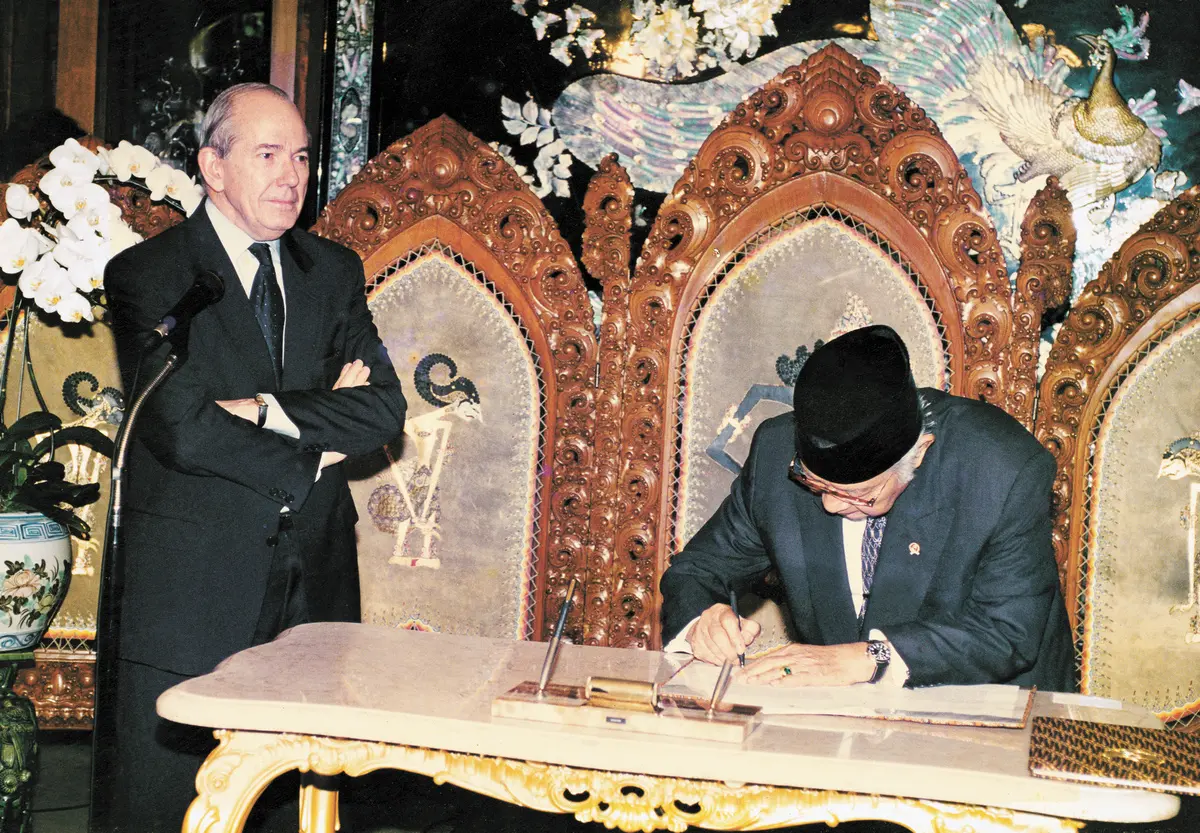
The International Monetary Fund led rescues worth about $118 billion for Thailand, Indonesia and Korea, the loan to Korea the largest in its history. In return it asked for high interest rates, budget cuts, the closing of bad banks and deep reforms, conditions many economists and Asians called too harsh. Korea, days from default, was saved at Christmas 1997 when foreign banks agreed to keep lending. In Indonesia the crisis became political: on 15 January 1998 President Suharto signed a new programme while the IMF's head, Michel Camdessus, watched with his arms folded, a photograph many Indonesians read as a humiliation. In May, after security forces shot four students, riots in Jakarta killed hundreds, Chinese-Indonesians were attacked and raped, and on 21 May Suharto resigned after 32 years.
The crisis then went global. Russia defaulted on 17 August 1998; the American hedge fund Long-Term Capital Management was rescued at the New York Fed in September; the Federal Reserve cut interest rates three times; Hong Kong bought shares to beat speculators, and Malaysia shut its borders to capital. Brazil let its currency float in January 1999. Yet recovery came quickly where reforms took hold: Korea's economy grew by more than 11 percent in 1999, and by 2001 it had repaid the IMF in full.
The crisis changed Asia. Its governments built up huge reserves of foreign currency so they would never again depend on the IMF: South Korea's grew from $20 billion at the end of 1997 to $262 billion ten years later. In Korea the years became known as 'the IMF crisis', and the IMF itself concluded that its conditions should have been fewer and more narrowly aimed. In December 1999 the finance ministers of a new Group of Twenty, rich and emerging economies together, met for the first time in Berlin; in the crisis of 2008 that group became the world's main forum for economic rescue.
What happened
- 1997
After months of speculative attacks, in which the Bank of Thailand had secretly committed almost all its reserves to forward contracts, Thailand stops defending the baht's link to the dollar and lets it float. It closes the day down by nearly 17 percent offshore: the Asian financial crisis has begun.
Bank of Thailand head office, Bangkok: it let the baht float on 2 July 1997Contagion: the Philippines lets the peso float, and Bank Indonesia widens the band in which it holds the rupiah.
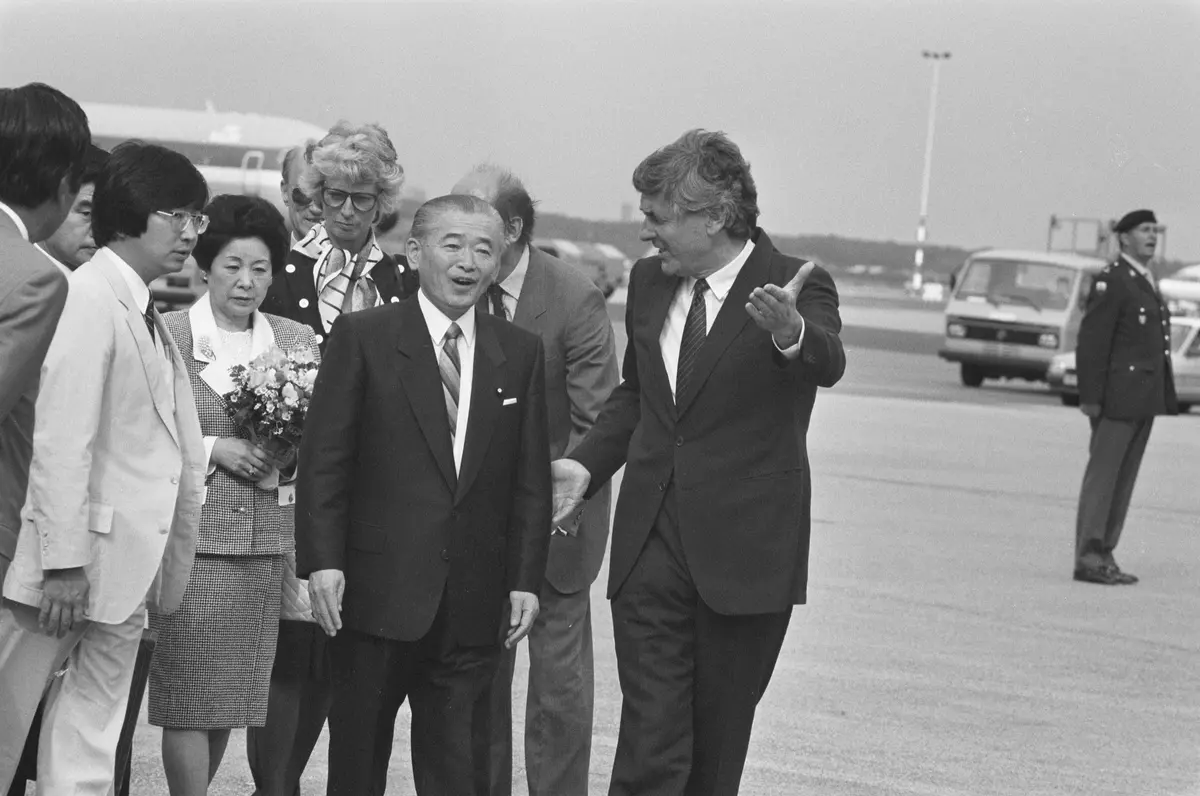
Bangko Sentral ng Pilipinas, Roxas Boulevard, Manila: the peso floated on 11 July 1997At the Imperial Hotel in Tokyo the IMF and Japan's finance ministry host the 'Friends of Thailand'. Japan matches the IMF's $4 billion, six Asian central banks pledge $5 billion, and the package reaches at least $16 billion (later counted as $17.2 billion). The United States, held back by Congress, gives nothing.
Imperial Hotel, Tokyo: the 'Friends of Thailand' meeting of 11 August 1997Indonesia lets the rupiah float and tightens money to slow its fall, squeezing banks that are already weak.
Bank Indonesia, Jakarta: the rupiah floated on 14 August 1997The IMF's Executive Board approves a stand-by loan of SDR 2.9 billion (about $4 billion) for Thailand, five times its quota, and pays out $1.6 billion at once; the programme shuts down failing finance companies (56 in the end) and raises VAT from 7 to 10 percent.
IMF headquarters, 700 19th Street NW, Washington: the Board approved the rescue loansAt the IMF and World Bank annual meetings in Hong Kong, Malaysia's prime minister Mahathir Mohamad attacks currency trading as 'unnecessary, unproductive and immoral' and singles out George Soros, who denies selling the ringgit.
Hong Kong Convention and Exhibition Centre: the IMF and World Bank annual meetings, September 1997With the rupiah down by more than a third since it floated, Suharto announces that Indonesia will seek help from the IMF, the World Bank and the Asian Development Bank.
Bank Indonesia, Jakarta: the rupiah floated on 14 August 1997Hong Kong raises interest rates sharply to defend its dollar's peg, and the Hang Seng index falls 1,211.47 points, 10.41 percent, to 10,426.30. Tokyo and London fall 3 percent.
Exchange Square, Hong Kong: the stock market crash of 23 October 1997- 2:36 p.m.
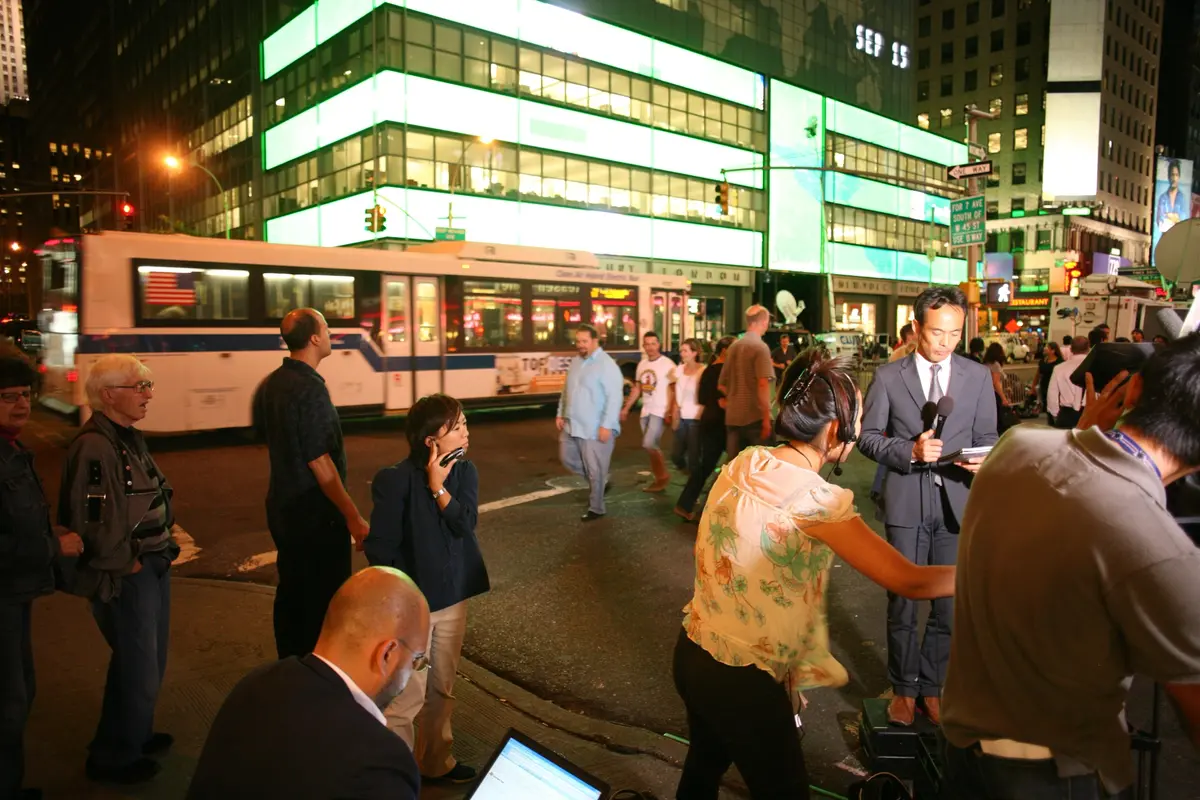
The crisis reaches Wall Street: fearing for profits in Asia, investors sell, and the Dow Jones falls 554.26 points (7.18 percent), its biggest fall in points ever. For the first time the circuit breakers stop trading, at 2:36 p.m. and for the day at 3:30 p.m.
Indonesia's first IMF programme is announced; it closes 16 insolvent banks, two of them tied to Suharto's family, but guarantees deposits only up to 20 million rupiah, and runs on the banks that stay open soon follow.
Bank Indonesia, Jakarta: the rupiah floated on 14 August 1997The IMF Board approves up to $10 billion (SDR 7.3 billion) for Indonesia, 490 percent of its quota, and pays out $3 billion.
IMF headquarters, 700 19th Street NW, Washington: the Board approved the rescue loansCamdessus flies secretly to Seoul and meets Korea's finance minister and central bank governor at a hotel under an assumed name; Korea's usable reserves could run out by the end of December.
South Korea, the world's eleventh-largest economy, asks the IMF for help.
Camdessus lands in Seoul at dawn and spends the day at the Blue House with President Kim Young-sam; the programme is agreed, and all three candidates in the coming election promise in writing to carry it out.
Blue House, Seoul: Camdessus and President Kim Young-sam agreed the programme on 3 December 1997The IMF approves $21 billion (SDR 15.5 billion) for Korea, the largest loan in its history and 1,939 percent of Korea's quota; with the World Bank, the Asian Development Bank and twelve countries the package reaches $55 billion.
IMF headquarters, 700 19th Street NW, Washington: the Board approved the rescue loansKim Dae-jung, a former dissident, is elected President of South Korea; in two weeks under the programme the won has lost 45 percent and Seoul's shares 20 percent.
With Korea days from running out of dollars, the G7 agree on a plan, and at a meeting hosted by the Federal Reserve Bank of New York the American banks most exposed to Korea agree to roll over their short-term loans; banks in other countries follow over the holiday.
Federal Reserve Bank of New York, 33 Liberty Street: the Korea rollover of 24 December 1997 and the LTCM rescue of 23 September 1998- 1998
As Camdessus arrives in Jakarta, Suharto receives the US Defense Secretary, William Cohen, at his home; Clinton, Kohl and Hashimoto have telephoned him to urge agreement with the IMF.
Suharto's house, Jalan Cendana, Menteng, Jakarta: the signing of 15 January 1998- 10:00 a.m.
Suharto signs a new, sweeping reform programme while Camdessus stands by with his arms folded. The photograph is on front pages across Asia the next day and is read as a humiliation; Suharto soon undercuts the reforms.
Suharto's house, Jalan Cendana, Menteng, Jakarta: the signing of 15 January 1998 The rupiah trades near 13,000 to the dollar, about four-fifths below its value of July (Bank for International Settlements daily average: 12,900).
Bank Indonesia, Jakarta: the rupiah floated on 14 August 1997Korea and a group of its foreign creditor banks agree to restructure Korean banks' short-term debts into longer loans; the deal, for about $22 billion, is completed in March.
Kim Dae-jung takes office as President of South Korea, committed to carrying out, and going beyond, the IMF programme.
Blue House, Seoul: Camdessus and President Kim Young-sam agreed the programme on 3 December 1997Indonesia's People's Consultative Assembly re-elects Suharto for a seventh five-year term; his new cabinet leaves out most of the reformers.
Suharto announces steep rises in fuel and electricity prices, a condition of the IMF programme, on the same day the IMF Board pays out another $1 billion; student protests against him grow.
Security forces shoot dead four unarmed students at a peaceful demonstration at Trisakti University in Jakarta.
Riots break out in Jakarta and other cities and last three days. Mobs loot and burn shops and homes, above all those of Chinese-Indonesians; the government counts 499 dead, the National Human Rights Commission 1,188. The government's fact-finding team later verifies 66 rapes, most of them of Chinese-Indonesian women.
Glodok, Jakarta's Chinatown: among the places worst hit by the riots of 13–15 May 1998Thousands of students occupy the grounds and buildings of the parliament in Jakarta, demanding reform and Suharto's resignation.
Parliament (MPR/DPR), Senayan, Jakarta: students occupied it in May 1998Suharto resigns after 32 years in power and hands the presidency to his vice-president, B. J. Habibie. (The fall of Suharto is told in full in the Reformasi entry.)
Merdeka Palace, Jakarta: Suharto resigned here on 21 May 1998The rupiah reaches its weakest: the BIS daily average is 15,250 to the dollar, against 2,450 a year earlier, a loss of more than four-fifths of its value (the IMF's history gives a low of 16,650).
Bank Indonesia, Jakarta: the rupiah floated on 14 August 1997In the second half of August the Hong Kong government buys the shares of the Hang Seng index and index futures with its reserves, to defeat speculators betting against both its currency and its stock market at once.
Exchange Square, Hong Kong: the stock market crash of 23 October 1997Russia, whose short-term rouble bonds were largely held by foreigners, lets the rouble fall and defaults on those bonds, a default on debt in its own currency that the IMF's historian calls unprecedented; investors flee risk everywhere.
Bank of Russia, Neglinnaya Street, Moscow: the devaluation and default of 17 August 1998Malaysia imposes capital controls: ringgit held abroad must come home within a month and foreign portfolio money must stay a year. The next day the ringgit is pegged at 3.80 to the dollar.
Bank Negara Malaysia, Kuala Lumpur: capital controls of 1 September 1998- 6:00 p.m.
At the Federal Reserve Bank of New York fourteen banks and brokers agree to put $3.6 billion into Long-Term Capital Management, a hedge fund with about $30 of debt for every dollar of capital that lost 44 percent of its value in August; the Fed brings them together but lends nothing.
Federal Reserve Bank of New York, 33 Liberty Street: the Korea rollover of 24 December 1997 and the LTCM rescue of 23 September 1998 The Federal Reserve cuts its federal funds target by a quarter point, to 5¼ percent, 'to cushion the effects ... of increasing weakness in foreign economies'.
The G7 finance ministers and central bank governors meet in Washington and agree that 'the balance of risks on a global basis has shifted' towards weaker growth.
Blair House, Washington: the G7 finance ministers met on 3 October 1998The IMF and its partners announce a $42 billion package for Brazil, the next country under attack; the IMF Board approves its part on 2 December.
The Federal Reserve cuts rates for the third time in seven weeks, to 4¾ percent, 75 basis points since September.
Korea repays $2.8 billion of its emergency IMF loans, a year after it came close to default.
- 1999
Brazil gives up defending the real and lets it float; it falls about 10 percent that day, the last great wave of the contagion.
The finance ministers and central bank governors of the new Group of Twenty, rich and emerging economies together, end their first meeting in Berlin, chaired by Canada's Paul Martin; they agree that unsustainable exchange-rate regimes are 'a critical source of vulnerability'.