The euro crisis
“From 2010 Greece, Ireland, Portugal, Spain and Cyprus needed rescues to stay in the euro; Draghi's 'whatever it takes' (July 2012) turned the tide, and Greece's last bailout ended in 2018.”
The euro crisis was the long emergency, from 2009 to 2018, in which several countries that use the euro could no longer borrow on the markets and had to be rescued by the other euro countries and the International Monetary Fund (IMF). It began in Greece. On 21 October 2009 the new Greek government told the EU's statistics office that the budget deficit for the year would be 12.5 percent of GDP, not the 3.7 percent reported in the spring; the earlier figures had been wrong. Investors stopped trusting Greek debt, the interest Greece had to pay shot up, and on 23 April 2010 the government asked for help. On 2 May the euro countries and the IMF agreed a loan of €110 billion, the first of three Greek rescues.
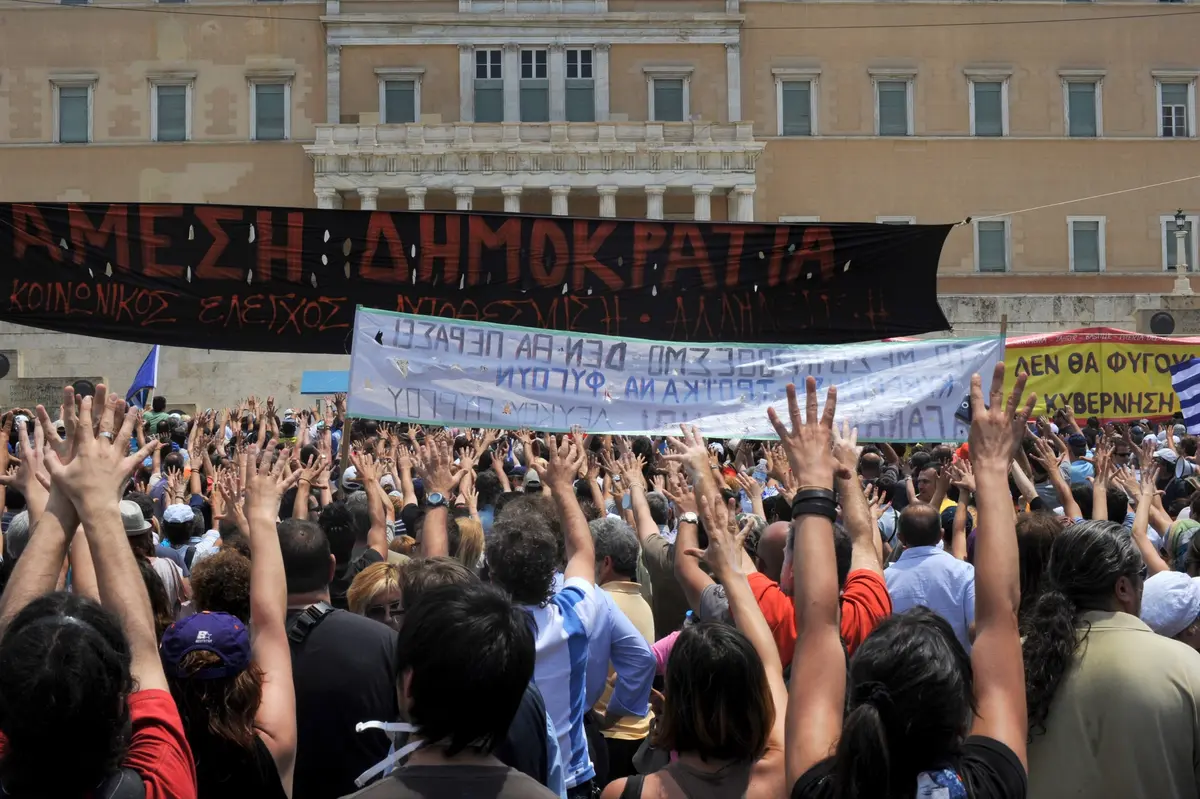
Fear then spread to other countries with heavy debts or broken banks. Ireland, whose banks had been ruined by a property bubble, needed €85 billion in November 2010; Portugal took €78 billion in May 2011; Spain borrowed for its banks in 2012; and Cyprus was rescued in March 2013, in a deal that closed its second-largest bank and took money from large depositors. Every loan came with hard conditions: spending cuts, higher taxes and reforms. Deep recessions followed. By 2013 more than one worker in four was unemployed in Greece and in Spain, and protesters filled the squares from Athens to Lisbon and Madrid.
Europe had no tools for such a crisis, so it built them under pressure: a temporary rescue fund (the EFSF) in June 2010, a permanent one (the European Stability Mechanism, ESM) in October 2012, and stricter budget rules. Angela Merkel and Nicolas Sarkozy led summit after summit, and in March 2012 private investors holding Greek bonds were forced to accept large losses. The turning point came in London on 26 July 2012, when Mario Draghi, president of the European Central Bank (ECB), said the bank was 'ready to do whatever it takes to preserve the euro'. In September the ECB set out a plan to buy the short-term bonds of countries in a rescue programme, with no limit fixed in advance, and borrowing costs began to fall.
Greece's ordeal lasted longest. In January 2015 voters chose Alexis Tsipras, who promised to end austerity. Talks with the lenders broke down: on 29 June the banks closed and cash machines paid out only €60 a day, on 30 June Greece failed to repay the IMF, and on 5 July Greeks voted 'No' to the lenders' terms in a referendum. A week later Tsipras accepted a third rescue of up to €86 billion. Greece left its last programme on 20 August 2018, after about €289 billion of loans since 2010.
The euro survived, and no country left it. But the crisis showed how fragile a shared currency is without a shared budget or a shared watch over the banks, and it left the euro area with new institutions: a permanent rescue fund, a central bank willing to stand behind governments, and the beginnings of a banking union. Its costs, in lost jobs and anger at Brussels and Berlin, fed the Eurosceptic and populist parties that rose across Europe in the 2010s.
What happened
- 2009
Greece's new government tells Eurostat that the budget deficit for 2009 will be 12.5 percent of GDP, not 3.7 percent as reported in the spring, and that 2008's was 7.7 percent, not 5.0. Eurostat publishes the figures the next day with a reservation about their quality.
- 2010
Greece formally asks the euro countries and the IMF for financial help; four days later its 10-year bonds pay 7.55 percentage points more than Germany's.
Greece, the Commission, the ECB and the IMF agree a three-year programme, and the Eurogroup unanimously agrees to lend: €110 billion in all, €80 billion from the euro countries and €30 billion from the IMF, in return for deep cuts.
The Justus Lipsius building, Brussels: the Council's building, where the Eurogroup and the euro area's leaders metA general strike: the unions' march fills the streets of Athens to Syntagma Square, and three people die when the protests turn violent; a branch of Marfin Egnatia Bank on Stadiou Street is burned out.
Syntagma Square, Athens, in front of the Greek parliament: the heart of the protests against the rescue programmes, 2010–2015After a weekend of meetings the EU agrees a financial stabilisation mechanism, with the IMF a fund of about €750 billion for the euro area, and the ECB begins to buy government bonds in its Securities Markets Programme.
The Eurotower, Kaiserstrasse 29, Frankfurt: the European Central Bank's headquarters through the crisis, until its new building was completed in November 2014The euro countries sign the European Financial Stability Facility (EFSF), a temporary rescue fund that will lend to Ireland, Portugal and Greece.
Ireland's central bank says rescuing Anglo Irish Bank could cost up to €34.3 billion, pushing the year's deficit to 32 percent of GDP; on the 29th protesters against the cuts and the bank bail-outs gather in Dublin.
Leinster House, Dublin, the Irish parliament: protests against cuts and bank bail-outs on 29 September 2010Ireland agrees an €85 billion rescue with the EU and the IMF: €22.5 billion from the IMF, €45 billion from the EU and bilateral lenders, and €17.5 billion from Ireland's own reserves.
- 2011
In Lisbon the 'Geração à Rasca' ('generation in trouble') protest of young Portuguese fills the city centre around Restauradores.
Praça dos Restauradores, Lisbon: the 'Geração à Rasca' protest of 12 March 2011Portugal, its government already resigned, asks the EU, the euro countries and the IMF for help.
The Eurogroup and the EU's finance ministers adopt Portugal's programme in Brussels: €78 billion, a third each from the EU, the EFSF and the IMF.
The Justus Lipsius building, Brussels: the Council's building, where the Eurogroup and the euro area's leaders metIn Madrid the camp of the 'indignados', the 15-M movement against unemployment and the cuts, fills the Puerta del Sol for a second week.
Puerta del Sol, Madrid: the camp of the 15-M movement, the 'indignados', May 2011As the Greek parliament debates a new round of budget cuts, thousands protest in front of it on Syntagma Square, and riot police fire tear gas in the streets around it.
Syntagma Square, Athens, in front of the Greek parliament: the heart of the protests against the rescue programmes, 2010–2015Europe's leaders promise Greece a second rescue of €109 billion and easier terms on its loans; private bondholders are to share the cost, and Fitch calls it a 'selective default', the first by a euro country.
At a summit in Brussels the euro leaders agree that Greece's private bondholders will lose half the value of their bonds, that Europe's banks must hold more capital, and that the EFSF's firepower is to be multiplied; at the end of the month Papandreou calls a referendum on the deal.
The Justus Lipsius building, Brussels: the Council's building, where the Eurogroup and the euro area's leaders met- 11:01 p.m.
At a dinner on the eve of the G20 summit in Cannes, Merkel and Sarkozy confront Papandreou over his referendum. On 3 November, for the first time, European leaders say openly that Greece may leave the euro, and Papandreou abandons the vote.
Palais des Festivals et des Congrès, Cannes: the G20 summit and the dinner of 2 November 2011 at which Merkel and Sarkozy confronted Papandreou over his referendum Lucas Papademos, a former vice-president of the ECB, is sworn in as Greece's prime minister at the head of a caretaker government, after Papandreou's resignation.
With Italy's 10-year borrowing costs above 7 percent, Silvio Berlusconi resigns once parliament passes his budget; the economist Mario Monti replaces him.
At a summit in Brussels the EU leaders agree a 'fiscal compact' of stricter budget rules; Britain's David Cameron refuses to join, and the others go ahead with a separate treaty, signed on 2 March 2012.
The Justus Lipsius building, Brussels: the Council's building, where the Eurogroup and the euro area's leaders metThe ECB lends €489 billion for three years at 1 percent to more than 500 banks, the first of two huge long-term loans; a second, of about €530 billion, follows in February.
The Eurotower, Kaiserstrasse 29, Frankfurt: the European Central Bank's headquarters through the crisis, until its new building was completed in November 2014- 2012
- 5:40 p.m.
While the Greek parliament prepares to vote the cuts demanded for a second rescue of €130 billion, riot police fire tear gas at the crowd on Syntagma Square and buildings burn in central Athens; the cuts are passed that night.
Syntagma Square, Athens, in front of the Greek parliament: the heart of the protests against the rescue programmes, 2010–2015 Greece forces the last of its private bondholders to swap their bonds for new ones worth less than half as much: about €100 billion of debt is wiped out, in what Britannica calls a true default. Greek 10-year rates had averaged 29 percent in February.
Spain asks the euro countries for up to €100 billion to recapitalise its banks, weeks after the government took over Bankia, its largest mortgage lender.
In Greece's second election in six weeks the pro-bailout New Democracy wins narrowly; Antonis Samaras forms a coalition and Greece stays on its programme.
Speaking at the Global Investment Conference at Lancaster House in London, Mario Draghi says that within its mandate the ECB is 'ready to do whatever it takes to preserve the euro. And believe me, it will be enough.'
Lancaster House, London: Mario Draghi's 'whatever it takes' speech at the Global Investment Conference, 26 July 2012The ECB sets out its Outright Monetary Transactions: it can buy the short-term bonds of any euro country in an EFSF or ESM programme, with no limit fixed in advance.
The Eurotower, Kaiserstrasse 29, Frankfurt: the European Central Bank's headquarters through the crisis, until its new building was completed in November 2014The European Stability Mechanism, the euro area's permanent rescue fund, holds the first meeting of its Board of Governors and comes into being.
The ESM pays out its first loan: €39.5 billion for Spain's banks.
- 2013
After a first plan to tax all bank deposits in Cyprus, small ones included, met fierce opposition, the Eurogroup agrees a new deal: Laiki, the second-largest bank, is wound up and large deposits in the Bank of Cyprus are cut, in return for a rescue of up to €10 billion.
The Central Bank of Cyprus, Nicosia: it took control of Laiki and the Bank of Cyprus on 25 March 2013After a six-day bank holiday Cyprus's banks reopen with capital controls: withdrawals and transfers abroad are limited.
The Central Bank of Cyprus, Nicosia: it took control of Laiki and the Bank of Cyprus on 25 March 2013Greek unemployment reaches its peak of 28.3 percent; Spain's had peaked at 26.4 percent in February.
Ireland becomes the first country to complete its rescue programme; Spain completes its bank programme the same month.
Leinster House, Dublin, the Irish parliament: protests against cuts and bank bail-outs on 29 September 2010- 2014
Greece sells bonds to investors for the first time in four years, and its economy grows in 2014 for the first time since 2007.
Portugal completes its rescue programme without asking for more help.
- 2015
Greek voters elect Alexis Tsipras of the radical-left Syriza, who promises to end austerity and renegotiate the rescue; the economist Yanis Varoufakis becomes finance minister.
Varoufakis meets Germany's finance minister Wolfgang Schäuble in Berlin on his tour of Europe's capitals.
Tsipras makes his first visit to Berlin as prime minister and meets Angela Merkel.
After Tsipras calls a referendum on the lenders' terms and the euro countries refuse to extend the programme, the ECB freezes its emergency lending to Greek banks at the level of 26 June.
Greece's banks stay shut, and cash machines pay out no more than €60 a day per card; the stock exchange closes too.
Greece fails to repay €1.5 billion due to the IMF, and Greece is declared in arrears; its second rescue programme expires.
In the referendum Greeks vote 'No' (OXI) to the lenders' terms by a wide margin, and crowds celebrate on Syntagma Square.
Syntagma Square, Athens, in front of the Greek parliament: the heart of the protests against the rescue programmes, 2010–2015At a Euro Summit in Brussels that runs through the night into 13 July, Tsipras accepts the outline of a third rescue of up to €86 billion, on terms that keep most of the lenders' demands.
The Justus Lipsius building, Brussels: the Council's building, where the Eurogroup and the euro area's leaders metA bridge loan of €7.16 billion from the EU lets Greece pay its creditors until the new programme starts.
The day after Greece signs the memorandum, the ESM pays the first €13 billion of the third programme.
- 2016
The Eurogroup closes the programme's first review and agrees a package of possible debt relief for Greece.
- 2018
The Eurogroup agrees the last steps: a final payment, longer maturities and more debt relief, and Greece's commitments for the years after the programme.
The Justus Lipsius building, Brussels: the Council's building, where the Eurogroup and the euro area's leaders metThe ESM pays its last loan to Greece, €15 billion, to build a cash buffer for the years after the programme.
Greece leaves its third programme, the last of the crisis, after €61.9 billion from the ESM, €141.8 billion from the EFSF, €52.9 billion from the euro countries and €32.1 billion from the IMF since 2010.