The euro is launched
“On 1 January 1999 eleven EU countries locked their currencies to the euro, run by the new European Central Bank; euro notes and coins followed on 1 January 2002, and by March 2002 the old national money was gone.”
The euro is the shared money of most countries of the European Union. It was launched on 1 January 1999, when eleven countries (Belgium, Germany, Spain, France, Ireland, Italy, Luxembourg, the Netherlands, Austria, Portugal and Finland) locked their currencies to it at fixed rates for ever and handed their monetary policy to a new European Central Bank (ECB) in Frankfurt. For three years the euro existed only as 'book money': in bank accounts, in electronic payments and on the financial markets, while people still paid in marks, francs and lire. Euro notes and coins arrived on 1 January 2002 in twelve countries, Greece having joined in 2001, and at the end of February 2002 the old national money stopped being legal tender. The ECB calls it the largest currency changeover the world has seen.
The idea was older than the euro. A plan written in 1970 by Pierre Werner, the prime minister of Luxembourg, was halted when the Bretton Woods system of fixed exchange rates fell apart, and the European Monetary System, agreed in 1978, tied Europe's currencies together only loosely. Once the single market was agreed in 1985, many argued that it needed a single currency, without the cost of changing money and the risk of sudden exchange-rate swings. A committee under Jacques Delors, the President of the European Commission, proposed in 1989 to get there in three stages. The Maastricht Treaty, signed on 7 February 1992, made those stages law and set tests for joining: low inflation and interest rates, a budget deficit under 3% and public debt under 60% of GDP, and a stable exchange rate. The road was rough. In September 1992 the markets drove the British pound and the Italian lira out of the Exchange Rate Mechanism, and in August 1993 the bands within which the other currencies could move had to be widened to 15% either way.
The European Monetary Institute, set up on 1 January 1994, prepared the new central bank. At Madrid in December 1995 the EU's leaders chose a name that would be the same in every language, the 'euro', and confirmed 1 January 1999 as the start. A year later, at Dublin, the banknotes of the Austrian designer Robert Kalina were shown: seven notes on the theme 'ages and styles of Europe', with windows, gateways and bridges that stand for no real building; the common side of the coins came from Luc Luycx of the Royal Belgian Mint. A Stability and Growth Pact was meant to keep national budgets in order. On 2 May 1998 the leaders decided that eleven countries qualified, even Belgium and Italy, whose public debt was above 120% of GDP, and chose the Dutchman Wim Duisenberg as the ECB's first President; the bank opened on 1 June 1998. On 31 December 1998 the rates were fixed for good: one euro was worth 1.95583 Deutsche Mark, 6.55957 French francs or 1,936.27 Italian lire.
The new currency started at 1.1789 dollars on 4 January 1999, then fell for almost two years, to 0.8252 dollars in October 2000, even after the ECB, the US Federal Reserve and the Bank of Japan had intervened together in September to support it. Meanwhile fifteen printing works produced 14.9 billion banknotes and sixteen mints about 52 billion coins. Banks received the cash from September 2001, and in mid-December people could buy small 'starter kits' of coins. At midnight on New Year's Eve 2002 crowds queued at cash machines; by the end of the first day more than 80% of the machines gave out euros, and within two months most of the national notes and coins had been withdrawn.
The euro became the world's second most important currency after the US dollar, and the euro area has grown to 21 countries, the last being Bulgaria in 2026; about 358 million people now pay with it, while Denmark keeps an opt-out and Sweden and others remain outside. It gave very different economies one interest rate and one central bank, but no common budget, and that gap was exposed by the debt crisis of 2009-2012 (see the euro crisis). The euro survived it, and for most Europeans prices, savings and wages have been counted in euros ever since.
What happened
- 1992
In the provincial government building at Maastricht, the foreign and finance ministers of the twelve Community countries sign the Treaty on European Union. It sets out economic and monetary union in three stages, a European Central Bank and the tests a country must pass to join the single currency.
Gouvernement aan de Maas, the Limburg provincial government building in Maastricht: the Maastricht Treaty signed here on 7 February 1992Black Wednesday: after weeks of speculative attacks on Europe's exchange-rate mechanism, Britain suspends the pound's membership; the Italian lira, already devalued, also leaves the mechanism.
- 1993
To save the exchange-rate mechanism from new attacks, the governments widen the bands within which its currencies may move from 2.25% to 15% either way.
After delays in ratification, the Maastricht Treaty comes into force.
- 1994
Stage Two begins: the European Monetary Institute is set up to strengthen cooperation among the central banks and to prepare the future central bank and currency.
- 1995
At the European Council in Madrid the leaders name the new currency the 'euro', a full name that is the same in every language, adopt the changeover scenario and confirm that Stage Three will start on 1 January 1999. 'We have unanimously decided on the euro,' says France's finance minister Jean Arthuis.
Madrid: the European Council of 15-16 December 1995 names the currency the 'euro'- 1996
In Dublin and Frankfurt the European Monetary Institute unveils the seven euro banknotes, 5 to 500 euros, drawn by Robert Kalina on the theme 'ages and styles of Europe', and the € sign is shown. The Dublin summit also prepares the Stability and Growth Pact.
Dublin Castle: the European Council of 13-14 December 1996, where the euro banknote designs and the euro symbol were shown- 1997
The European Council at Amsterdam (16-17 June) adopts the Resolution on the Stability and Growth Pact, agrees the new exchange-rate mechanism ERM II and fully endorses the design of the euro coins, whose common side is by Luc Luycx of the Royal Belgian Mint.
- 1998
The Commission presents its convergence report and the European Monetary Institute publishes its own. The Commission recommends entry even for countries whose public debt is far above the 60% reference value: in 1997 it stood at 122.2% of GDP in Belgium and 121.6% in Italy.
Meeting in Brussels, the heads of state or government decide that eleven countries qualify for the euro. In the early hours of 3 May Tony Blair, chairing, announces that Wim Duisenberg will be the European Central Bank's President for eight years and that his successor should be French, Jean-Claude Trichet. The ministers agree to use the existing central rates to fix the conversion rates.
Justus Lipsius building, Brussels, the seat of the Council of the EU: eleven countries chosen on 2 May 1998, the conversion rates adopted on 31 December 1998The European Central Bank is established in Frankfurt, its Executive Board having been appointed by the eleven governments on 25 May; the European Monetary Institute is wound up.
Eurotower, Kaiserstrasse 29, Frankfurt: the European Central Bank's seat from 1998 until its new building opened in 2014At a ceremony in Frankfurt with Blair, Kohl and Santer, Duisenberg marks the establishment of the European System of Central Banks and thanks the euro's 'founding fathers', among them Pierre Werner, Jacques Delors and Alexandre Lamfalussy.
At the Royal Mint of Belgium in Brussels, King Albert II watches the first Belgian euro coins being struck.
Royal Mint of Belgium, Brussels: the first Belgian euro coins struck on 7 September 1998, Belgian francs destroyed in December 2001- 12:30 p.m.
In the Breydel building the Commission signs its proposal for the final rates and, at 12.30, makes it public in a televised session; the central banks had set the figures in a teleconference that morning, and the ECB gave its opinion shortly after noon.
Breydel building, Brussels, then the European Commission's headquarters: the Commission signed its proposal on the final euro rates here on 31 December 1998 - 1:40 p.m.
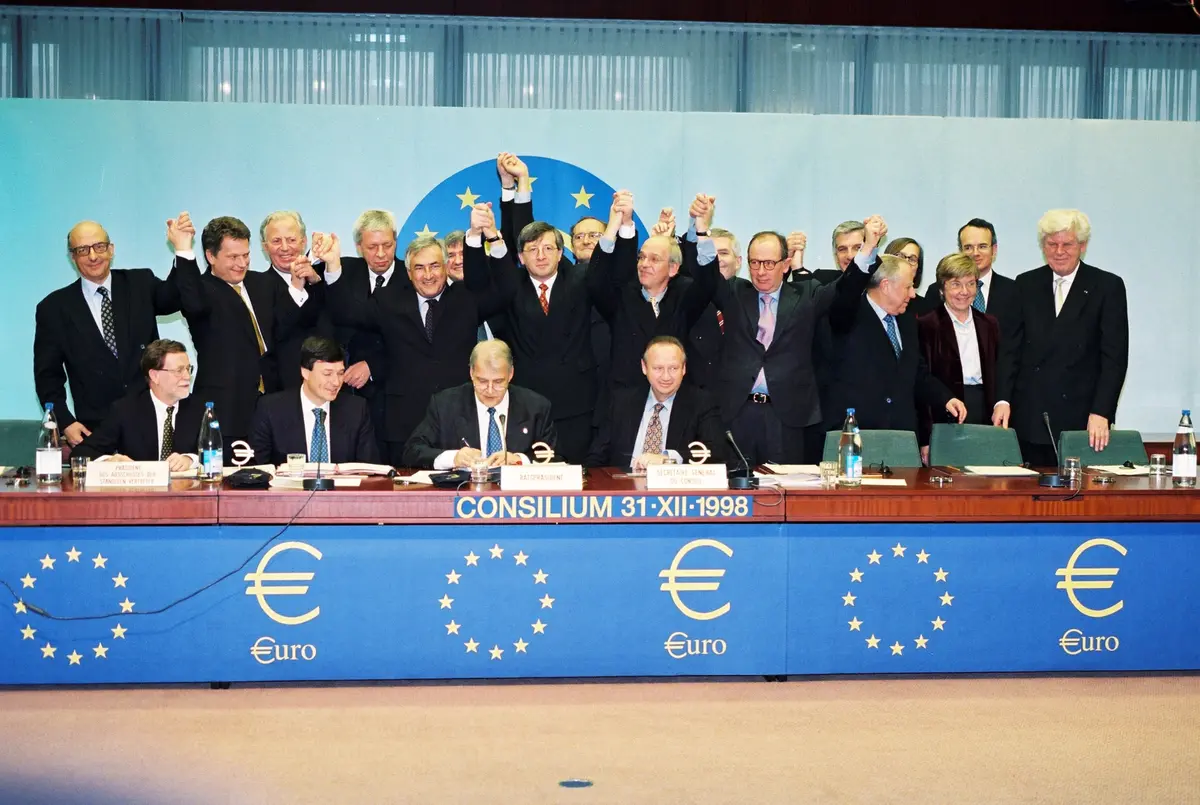
At 13.40 the Council announces that it has adopted the irrevocable conversion rates: one euro equals 1.95583 Deutsche Mark, 6.55957 French francs, 1,936.27 lire, 166.386 pesetas, 2.20371 guilders and so on. The ministers and Duisenberg celebrate before an illuminated board of the rates, and Santer hands Pierre Werner the Official Journal that publishes them.
Justus Lipsius building, Brussels, the seat of the Council of the EU: eleven countries chosen on 2 May 1998, the conversion rates adopted on 31 December 1998 - 1999
At midnight local time the euro becomes the currency of eleven countries and the ECB takes over their monetary policy. Notes and coins are still three years away; for now the euro lives in accounts, cheques and electronic payments.
On the first business day of the year the markets trade the euro for the first time. Traders at the Brussels stock exchange cheer, and the ECB's first reference rate is 1.1789 US dollars.
Bourse Palace, Brussels: cheers at the stock exchange as euro trading opened on 4 January 1999- 2000
With the euro at about 85 US cents, the ECB, the US Federal Reserve and the Bank of Japan intervene together in the currency markets to support it.
The euro reaches its lowest point, 0.8252 dollars in the ECB's reference rate, about 30% below its starting value.
- 2001
Greece becomes the twelfth member of the euro area, at 340.750 drachmas to the euro.
Duisenberg unveils the security features and final look of the euro banknotes; until then no details had been given out, which the ECB credits for the absence of forgeries before the launch.
Banks and retailers begin to receive euro notes and coins in advance ('frontloading'), so that the cash is everywhere on the first day; in all, 15 printing works have made 14.9 billion notes and 16 mints about 52 billion coins.
At the Royal Mint of Belgium a machine crushes Belgian coins as the countries begin destroying their national money.
Royal Mint of Belgium, Brussels: the first Belgian euro coins struck on 7 September 1998, Belgian francs destroyed in December 2001In Brussels the public can buy euro 'kits' of coins from the banks; on 17 December Germany, Greece and Portugal are the last countries to start selling them.
- 2002
- 12:00 a.m.
At midnight euro notes and coins become money in twelve countries with 308 million people. Most cash machines dispense euros within minutes, more than 80% by the end of the day, and in some countries withdrawals reach four times the usual New Year level.
The ECB reports that 6.4 billion euro banknotes worth 133 billion euros went into circulation on the first day and that 97% of cash machines have been converted. 'I share the enthusiasm of Europeans for their new money,' says Duisenberg.
The last day of dual circulation: at midnight the twelve national currencies cease to be legal tender (in the Netherlands, Ireland and France they had already gone). National notes still out have fallen from 270 billion euros' worth on 1 January to 42 billion.