Nixon ends the dollar's link to gold
“On 15 August 1971 Nixon stopped foreign governments exchanging dollars for gold at $35 an ounce; by March 1973 the world's currencies floated, and money has been backed by trust, not metal, ever since.”
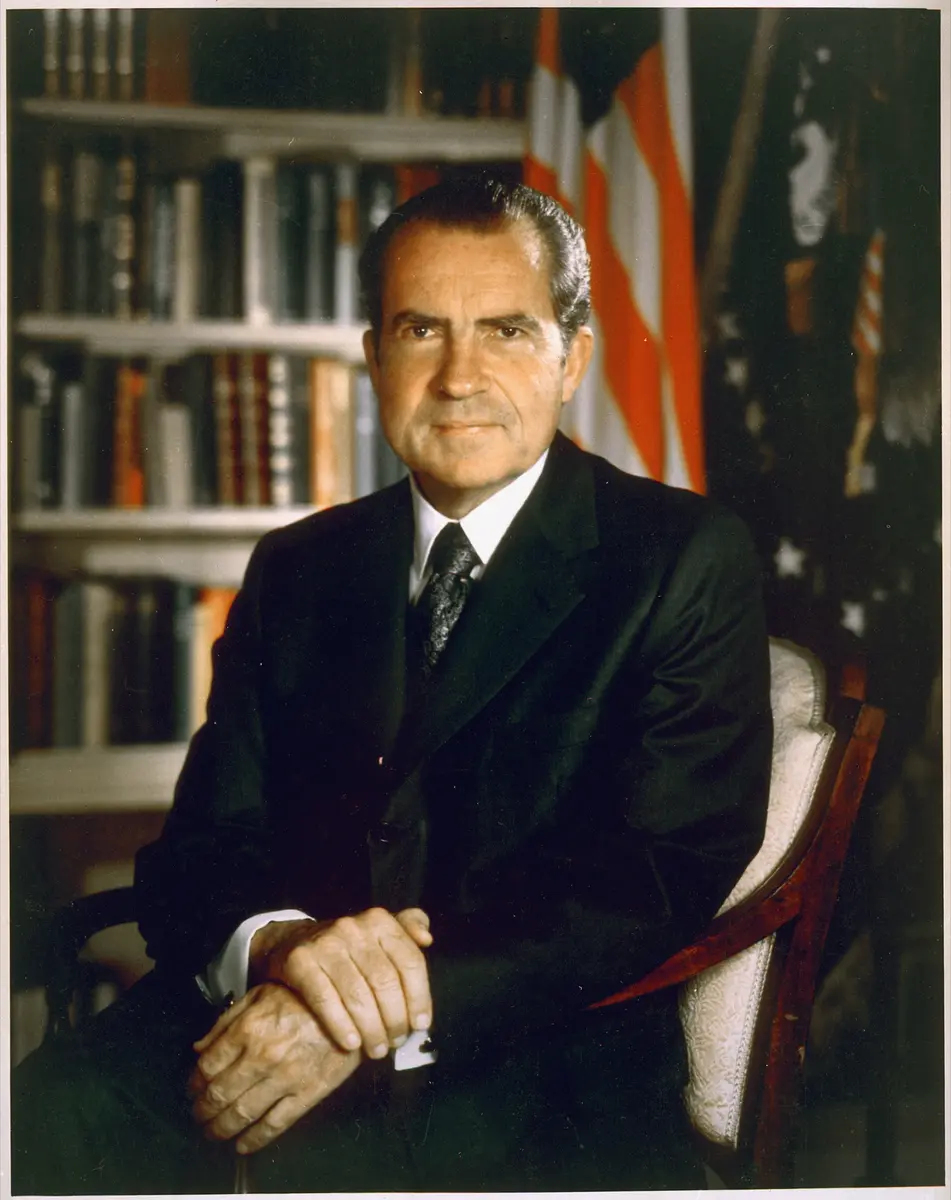
On Sunday evening, 15 August 1971, President Richard Nixon spoke to Americans on television from the Oval Office and announced that he had told his Treasury Secretary, John Connally, to 'suspend temporarily' the right to exchange dollars for gold. Since the Bretton Woods agreement of 1944, foreign governments and central banks had been able to hand in their dollars at the US Treasury and receive gold at $35 an ounce. That promise was the anchor of the world's money: other currencies were fixed to the dollar, and the dollar was fixed to gold. In the same speech Nixon froze all wages and prices for 90 days and put an extra tax of 10 percent on imports. The 'temporary' suspension was never lifted.
The promise had become impossible to keep. Through the 1960s the United States spent and invested more abroad than it earned, on foreign aid, on its armies in Europe and Vietnam and on companies overseas, and inflation at home rose from under 2 percent in 1965 to about 6 percent at the end of 1969. Dollars piled up in foreign central banks until they were worth far more than the gold in Fort Knox. Earlier defences had cracked: the London Gold Pool, in which eight central banks had sold gold together to hold its price at $35, broke up in March 1968, and in May 1971 Germany let the mark float after a flood of dollars. In the first two weeks of August 1971, after a committee of Congress called the dollar overvalued, about $3.7 billion moved into foreign central banks in a single week, and the Bank of England asked the Americans to protect part of its dollar reserves against a devaluation. How large that British request was, and whether it really forced the decision, is still argued over.
Connally, a Texas politician rather than a banker, had already laid out the whole plan to Nixon on 2 August. On Friday 13 August the President took about fifteen advisers to Camp David, the presidential retreat in the Maryland hills, in great secrecy: Connally, the Federal Reserve chairman Arthur Burns, the budget director George Shultz, the economists Paul McCracken and Herbert Stein, the Treasury's Paul Volcker and others, but nobody from the State Department or Henry Kissinger's staff. Burns argued alone for keeping the gold window open. The speech two days later was popular at home, where people liked the price freeze, and a shock abroad. Most European exchange markets stayed closed for a week, and then each country let its money rise against the dollar in its own way.
Connally then bargained hard with America's allies, using the import tax as a lever. In the Smithsonian Agreement, signed by the ten richest member countries of the IMF in Washington on 18 December 1971, the United States raised the official price of gold to $38 an ounce, other currencies were revalued against the dollar, and the import tax was dropped. Nixon called it 'the most significant monetary agreement in the history of the world', but the dollar still could not be exchanged for gold and the new fixed rates did not hold. Britain let the pound float in June 1972. On 12 February 1973 the dollar was devalued again, by 10 percent, and after another rush of dollars into Europe on 1 March the markets closed. When they reopened on 19 March 1973, the main currencies were floating against each other: the Bretton Woods system was over.
Since then the dollar, like every major currency, has been 'fiat' money: it is worth what people trust the American economy and its government to make it worth, not a fixed weight of metal. The IMF later wrote into its rules that no member may tie its currency to gold. Freed from the gold anchor, the 1970s brought the Great Inflation, with American prices rising more than 12 percent a year in 1974 and nearly 15 percent in 1980, until Paul Volcker, by then chairman of the Federal Reserve, broke it with very high interest rates. Yet the dollar stayed the world's main currency, and every argument about 'returning to gold' or about the dollar's power begins with that Sunday night in 1971.
What happened
- 1971
- 9:58 a.m.
In the Oval Office, Treasury Secretary John Connally sets out for Nixon almost the whole program the President will announce two weeks later: a freeze on wages and prices, tax incentives, cuts in spending, an end to gold convertibility, a floating dollar and a 10 percent tax on imports. Nixon hesitates over the gold window but warms to the plan.
The Oval Office, White House: Connally lays out the plan on 2 August, and Nixon's address of 15 August 1971 A subcommittee of Congress's Joint Economic Committee, led by Henry Reuss, reports that the dollar is overvalued and that the United States may have to stop converting it into gold. The same day the Treasury reports a loss of more than $1 billion of reserves; over the next week $3.7 billion flows into foreign central banks.
On Monday the dollar falls to its lowest point against the German mark since the Second World War, and Paul McCracken, chairman of the Council of Economic Advisers, sends Nixon a memorandum on the dollars taken in that day.
- 5:30 p.m.
With over $1 billion forced on European central banks that day, Nixon meets Connally and Budget Director George Shultz in his office in the Executive Office Building from 5:30 to 7 p.m. and decides to do 'the whole program' at once: they will go to Camp David the next afternoon, and Shultz suggests a speech on Sunday night.
Executive Office Building (today the Eisenhower Executive Office Building), where Nixon had his working office: the meetings of 11 and 12 August 1971 The Federal Reserve draws $750 million on its swap line with the Bank of England, giving the British cover against a dollar devaluation, after a British request the day before. American memoirs later told it as a demand for gold worth $3 billion; the Bank and the British Treasury denied asking for gold at all.
Federal Reserve Bank of New York, 33 Liberty Street: agent for the Treasury and the Fed in the exchange markets; the $750 million swap with the Bank of England, 13 August 1971- 3:15 p.m.
From 3:15 to 7 p.m. Nixon meets his advisers in secret at Camp David: Connally, Federal Reserve chairman Arthur Burns, Shultz, McCracken, Herbert Stein, Paul Volcker of the Treasury, Peter Peterson and the White House staff, with no one from the State Department or the National Security Council. Burns argues alone for keeping the gold window open.
Camp David, the presidential retreat in Catoctin Mountain Park, Maryland: the secret meeting of 13 to 15 August 1971 - 11:30 a.m.
The Camp David meetings end at 11:30 a.m. after two days of working groups on the details; the participants sign the guest book Nixon asked them to keep, and the White House photographer records the last session.
Camp David, the presidential retreat in Catoctin Mountain Park, Maryland: the secret meeting of 13 to 15 August 1971 - 9:00 p.m.
At 9 p.m. Nixon speaks live on radio and television from the Oval Office. To 'defend the dollar against the speculators' he suspends the convertibility of the dollar into gold, freezes wages and prices for 90 days and imposes a 10 percent tax on imports. 'Let me lay to rest the bugaboo of what is called devaluation,' he tells viewers.
The Oval Office, White House: Connally lays out the plan on 2 August, and Nixon's address of 15 August 1971 The 10 percent surcharge applies to goods entered from 12:01 a.m. Most European exchange markets stay closed all week. At 4 p.m. in London, Volcker explains the program to officials of France, Germany, Italy, Japan and Britain, saying he has not come to negotiate.
London: Volcker explains the program to European and Japanese officials, 16 August 1971The Federal Register prints the President's proclamation and Executive Order 11615, which freezes all prices, rents, wages and salaries at their highest level of the 30 days before 15 August and creates a Cost of Living Council chaired by the Secretary of the Treasury.
European exchange markets reopen without a common plan. Each country keeps its old parity on paper, but all except France stop defending the old ceilings, so their currencies rise against the dollar; France splits its market into a commercial and a financial franc.
Japan, which has taken in $4.4 billion during August trying to hold the yen at 360 to the dollar, stops buying dollars at the ceiling, and the yen immediately rises 4.7 percent.
The 90-day freeze ends on the date Nixon had promised Congress; controls on wages and prices continue in a looser form.
The finance ministers of the Group of Ten meet in Rome under Connally's chairmanship until 1 December. Under pressure, Connally offers for the first time to devalue the dollar against gold, raising its official price; back in Washington Shultz calls the change 'irretrievable'.
Rome: the Group of Ten ministers meet, 30 November to 1 December 1971Nixon and the French President Georges Pompidou meet in the Azores until 14 December and agree a framework: the United States will devalue the dollar, others will revalue, and the surcharge will go.
Angra do Heroísmo, Terceira, Azores: Nixon and Pompidou agree the framework of the settlement, 13 and 14 December 1971The ministers of the Group of Ten meet at the Smithsonian Institution in Washington, chaired by Connally, to fix the new exchange rates.
Smithsonian Institution Building, Washington: the Group of Ten agree the Smithsonian realignment, 17 and 18 December 1971- 5:48 p.m.
At 5:48 p.m., in the Commons Room of the Smithsonian building, Nixon announces 'the most significant monetary agreement in the history of the world': gold goes from $35 to $38 an ounce, the yen, the mark and other currencies are revalued, wider bands of 2.25 percent either side are allowed, and the surcharge will be removed. The dollar stays inconvertible.
Smithsonian Institution Building, Washington: the Group of Ten agree the Smithsonian realignment, 17 and 18 December 1971 Meeting the British Prime Minister Edward Heath at Government House in Bermuda, Nixon announces the removal of the 10 percent import surcharge.
Government House, Bermuda: Nixon and Heath meet, and the import surcharge is lifted, 20 December 1971- 1972
Nixon signs the Par Value Modification Act, which sets the dollar at one thirty-eighth of an ounce of gold: the gold price of $38 becomes law, though no one can exchange dollars for gold at it.
After a run on sterling, the British government lets the pound float, the first big breach in the Smithsonian rates.
- 1973
With markets in Europe and Japan closed by a new rush out of dollars, Treasury Secretary George Shultz announces in the evening that the dollar will be devalued by another 10 percent and that the yen will float.
In a sudden new flight from the dollar, more than $3.6 billion is dumped on European central banks in one day, $2.6 billion of it on the German Bundesbank. The next day the European exchange markets close.
In Brussels the European Community's ministers agree that their currencies will keep fixed rates with one another but float together against the dollar, and Germany revalues the mark by 3 percent.
In Paris the finance ministers of the Group of Ten, with Shultz, accept the joint float and agree that central banks may intervene when markets become disorderly: the end of the attempt to restore fixed rates.
Paris: the enlarged Group of Ten accepts floating rates, 16 March 1973The exchange markets officially reopen with the major currencies floating against the dollar. The Bretton Woods system of fixed rates tied to gold is over.