The Great Inflation
“From 1965 to 1982 prices rose year after year in America and the West, nearly 15 percent in 1980, until Paul Volcker's Fed broke inflation with interest rates near 20 percent and a deep recession.”
The Great Inflation is the name economists give to the years from 1965 to 1982, when prices in the United States rose faster and faster, year after year. In 1964 American consumer prices went up by about 1 percent; at the end of 1969 by 6 percent, at the end of 1974 by 12 percent, and in the spring of 1980 by almost 15 percent. Over those eighteen years the country lived through four recessions, two oil shocks, the end of the dollar's link to gold and, for the first time in peacetime, government controls on wages and prices. The rest of the rich world suffered too, often worse: prices in Britain rose 26.9 percent in the year to August 1975, Japan's rose 23 percent in 1974 and Italy's 21 percent in 1980, while West Germany, the most careful, never went much above 7 percent.
There was no single cause, but the Federal Reserve's own historians put the source in money: the Fed allowed the money supply to grow too fast. After the Second World War, governments believed they could buy lower unemployment with a little more inflation, a trade-off drawn as the 'Phillips curve'. President Lyndon Johnson paid for the Vietnam War and his Great Society programmes at the same time, and leaned on the Fed not to raise interest rates; when its chairman William McChesney Martin did so in December 1965, Johnson summoned him to his Texas ranch. Martin's successor from 1970, Arthur Burns, was slow to tighten whenever unemployment rose. In 1967 and 1968 the economists Edmund Phelps and Milton Friedman warned that the trade-off would vanish once people came to expect inflation, and they were right. When Richard Nixon cut the dollar's last link to gold in 1971, money lost its anchor, and the oil shocks of 1973–74 and 1979 pushed costs up further.
Politicians tried almost everything except a hard squeeze on money. Nixon froze wages and prices in August 1971 and again froze prices for 60 days in June 1973, but the controls only delayed the rises and caused shortages. Gerald Ford called inflation 'public enemy number one' and launched 'Whip Inflation Now' in October 1974, asking citizens to save and wear red WIN buttons; it became a joke. Jimmy Carter asked for voluntary limits on wages and prices in 1978 and restrictions on credit in 1980. By then the country had 'stagflation', high inflation and high unemployment together, long queues at petrol stations, and in July 1979 Carter spoke on television of a national 'crisis of confidence'. Britain borrowed $3.9 billion from the International Monetary Fund at the end of 1976 to steady the pound.
The turn came with Paul Volcker, a former Treasury official and head of the New York Fed whom Carter made chairman of the Fed in August 1979. On Saturday evening, 6 October 1979, Volcker announced that the Fed would now control the quantity of money and let interest rates go wherever that took them. The rate at which banks lend to each other approached 20 percent in 1980 and 1981, mortgages and car loans became almost unaffordable, and the economy fell into two recessions, the second, from July 1981 to November 1982, the worst since the 1930s, with unemployment at 10.8 percent. Farmers drove their tractors to the Fed's building, home builders posted Volcker pieces of timber begging for lower rates and car dealers sent coffins full of car keys; members of Congress threatened Volcker with impeachment. President Ronald Reagan stood by him, and Margaret Thatcher's government fought the same battle in Britain. By the end of 1982 American inflation was under 4 percent.
The Great Inflation changed how the world thinks about money. It taught that inflation, once people expect it, feeds on itself, and that only a central bank that is trusted and free from day-to-day politics can stop it. Its cost also reached far beyond America: the high interest rates helped push Mexico and much of Latin America into a debt crisis in August 1982. Today most central banks, the Fed among them since 2012, aim openly at a low inflation rate, usually 2 percent, so that people will never again come to expect prices to run away. The calm decades that followed, from the mid-1980s to 2007, are known as the Great Moderation.
What happened
- 1965
American consumer prices are 1.1 percent higher than a year earlier, as they have been for six years. Federal Reserve History dates the start of the Great Inflation from this month: from now on the rate creeps upward.
By four votes to three, the Federal Reserve Board raises its discount rate from 4 to 4.5 percent, against President Johnson's wishes, as Vietnam and Great Society spending heat the economy. Johnson, recovering from gallbladder surgery, calls Chairman Martin to his Texas ranch and berates him; Martin holds firm.
The LBJ Ranch, Texas: Johnson summoned the Fed's chairman here after the rate rise of December 1965- 1968
Milton Friedman's presidential address to the American Economic Association, 'The Role of Monetary Policy', appears in print. With Edmund Phelps (1967) he warns that any trade-off between inflation and unemployment will vanish once people learn to expect inflation.
- 1970
Arthur Burns, Nixon's counsellor, becomes chairman of the Federal Reserve. Inflation is about 6 percent; in his eight years the Fed repeatedly eases as soon as unemployment rises.
- 1971
Nixon closes the gold window and freezes wages and prices for 90 days (see 'Nixon ends the dollar's link to gold'). Controls follow in phases, run by a Cost of Living Council, until 1974; they hold prices back for a time but cause shortages.
- 1973
- 8:30 p.m.
With food prices soaring under the looser Phase III rules, Nixon tells the nation from the Oval Office that he is freezing all prices except raw farm products and rents, for at most 60 days, from 9 p.m. Wages are not frozen; the freeze is due to end by August 12.
The White House, Washington: Ford's WIN press conference, Carter's 'crisis of confidence' speech, Volcker's swearing-in, Reagan's 36-cent dollar The Arab oil producers' embargo on the United States begins; by January 1974 oil costs about four times its pre-war price (see 'The oil crisis'). Inflation, already 8 percent, heads into double digits.
- 1974
The government's legal power to control wages and prices, the Economic Stabilization Act, runs out, and the last controls end. Prices jump as they are released.
Three days after taking office, President Ford tells a joint session of Congress that 'inflation is domestic enemy number one' and accepts the Senate's call for an economic summit.
The US Capitol, Washington: Ford asked Congress to 'whip inflation now' on October 8, 1974Ford holds the first of his conferences on inflation at the White House, with economists, members of Congress and his new chief economic adviser, Alan Greenspan.
The White House, Washington: Ford's WIN press conference, Carter's 'crisis of confidence' speech, Volcker's swearing-in, Reagan's 36-cent dollar- 9:07 a.m.
Ford opens the two-day Summit Conference on Inflation in the International Ballroom of the Washington Hilton, broadcast live on public television: a 'battle plan against public enemy number one'.
The Washington Hilton: the Summit Conference on Inflation, September 27–28, 1974 - 4:02 p.m.
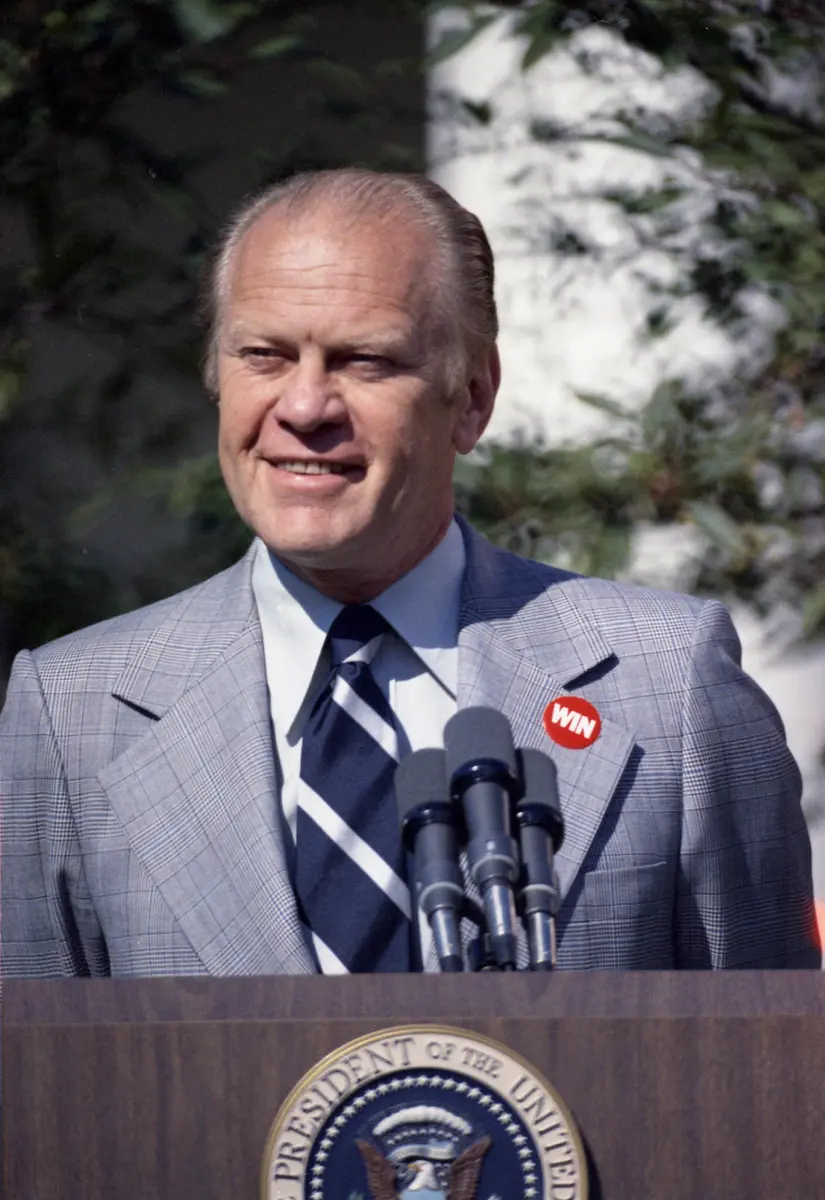
In the House Chamber Ford asks Congress for a one-year 5 percent surtax on companies and higher incomes and calls on every American to enlist as a volunteer inflation fighter, wearing the campaign's symbol on his lapel: a button with the single word WIN, 'Whip Inflation Now'.
The US Capitol, Washington: Ford asked Congress to 'whip inflation now' on October 8, 1974 At his press conference in the Rose Garden Ford wears the red WIN button. The voluntary campaign of thrift fails and is soon mocked; prices are rising 12 percent a year by November.
The White House, Washington: Ford's WIN press conference, Carter's 'crisis of confidence' speech, Volcker's swearing-in, Reagan's 36-cent dollar- 1975
In Britain, retail prices are 26.9 percent higher than a year earlier, the peak of its inflation; Japan's prices had risen 23 percent in 1974, while West Germany's never rise much above 7 percent a year.
- 1976
After weeks of Cabinet arguments, Chancellor Denis Healey tells the House of Commons the terms on which Britain will borrow from the International Monetary Fund to save the pound: cuts in public spending and sales of state assets.
The Palace of Westminster, London: Denis Healey set out the terms of Britain's IMF loan on December 15, 1976- 1977
The IMF approves a two-year stand-by loan of SDR 3,360 million, about $3.9 billion, for the United Kingdom, the largest it has ever made to a member.
President Carter names the businessman G. William Miller to succeed Arthur Burns as chairman of the Fed; Miller takes office on March 8, 1978. Inflation, which fell to 5 percent at the end of 1976, is rising again.
The White House, Washington: Ford's WIN press conference, Carter's 'crisis of confidence' speech, Volcker's swearing-in, Reagan's 36-cent dollar- 1978
- 10:00 p.m.
Carter asks Americans on television to keep pay rises under 7 percent and sets a price target of 5 3/4 percent: voluntary standards, not controls.
The White House, Washington: Ford's WIN press conference, Carter's 'crisis of confidence' speech, Volcker's swearing-in, Reagan's 36-cent dollar Carter signs the Humphrey-Hawkins Act, which orders the Fed to pursue both full employment and stable prices and to report its money targets to Congress twice a year.
- 1979
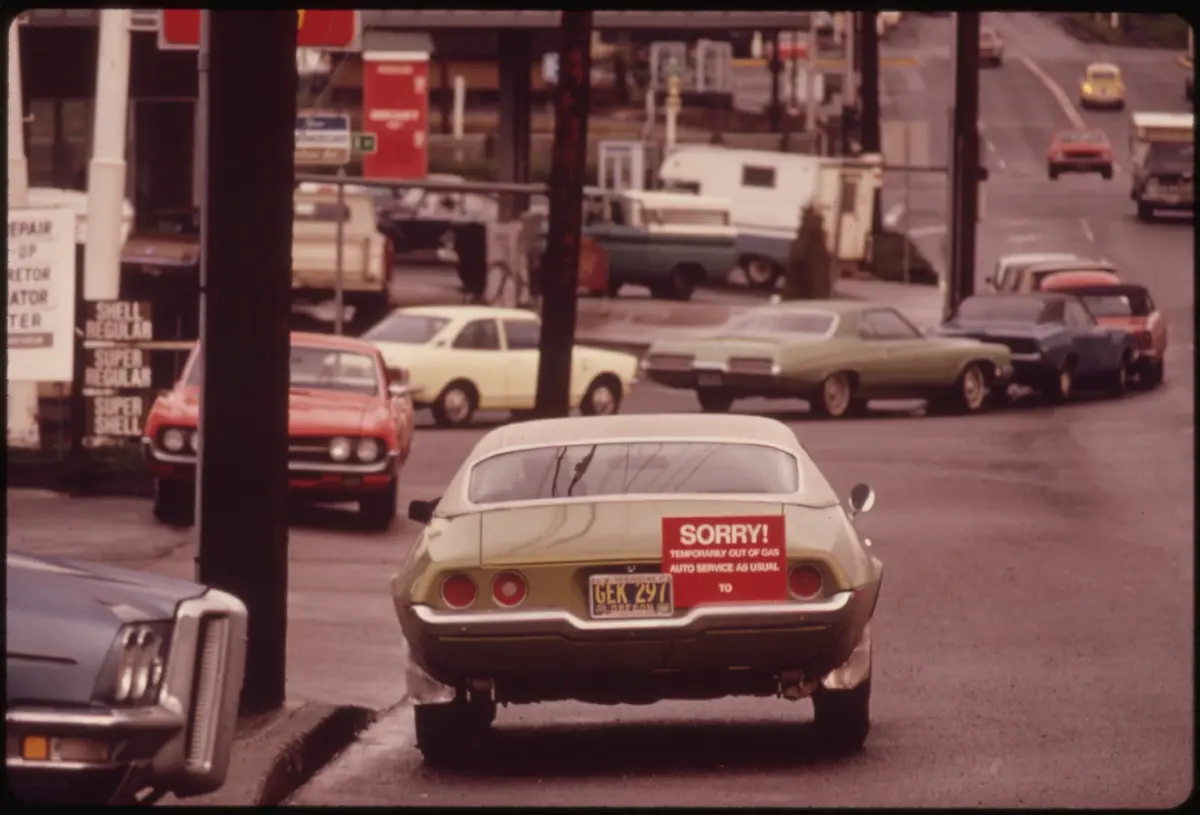
Drivers queue for petrol across America as the Iranian revolution cuts oil supply; California has rationed fuel since May 9, and oil prices more than double between April 1979 and April 1980. American inflation passes 11 percent.
- 10:00 p.m.
After ten days of consultations at Camp David, Carter speaks to the nation of 'a crisis of confidence' that is 'deeper than gasoline lines or energy shortages, deeper even than inflation or recession'. The word 'malaise' is never used, but the speech is remembered by it.
The White House, Washington: Ford's WIN press conference, Carter's 'crisis of confidence' speech, Volcker's swearing-in, Reagan's 36-cent dollar In a cabinet shake-up, Carter moves Miller to the Treasury and nominates Paul Volcker, president of the Federal Reserve Bank of New York and a known inflation hawk, as chairman of the Fed.
Volcker and Miller are sworn in together at the White House. Inflation is above 11 percent; within weeks Volcker raises the discount rate.
The White House, Washington: Ford's WIN press conference, Carter's 'crisis of confidence' speech, Volcker's swearing-in, Reagan's 36-cent dollarOn a Saturday evening, after an unscheduled meeting of the Federal Open Market Committee, Volcker tells reporters in the Board Room of the Eccles Building, partly to show that he has not resigned, as rumour says, that the Fed will now control the supply of bank reserves and let interest rates move more widely. The discount rate rises from 11 to 12 percent.
The Eccles Building, the Federal Reserve Board in Washington: Volcker announced the new policy here on the evening of October 6, 1979- 1980
American consumer prices are 14.6 percent higher than a year earlier, the peak of the Great Inflation; the federal funds rate averages over 17 percent.
- 4:31 p.m.
In the East Room Carter announces spending cuts and, through the Fed, controls on consumer credit. Borrowing collapses and the economy falls into a sharp recession from January to July 1980.
The White House, Washington: Ford's WIN press conference, Carter's 'crisis of confidence' speech, Volcker's swearing-in, Reagan's 36-cent dollar Carter signs the Depository Institutions Deregulation and Monetary Control Act: the old ceilings on deposit interest are to go, and every bank and savings institution must hold reserves at the Fed.
In Britain, a year after Margaret Thatcher came to power, retail prices are 21.9 percent higher than a year earlier, a second peak; her government too squeezes money to break inflation.
The short recession ends. As unemployment rose the Fed let the federal funds rate fall to about 9 percent, the old 'stop-go' pattern; with inflation still 13 percent, it tightens again in the autumn.
- 1981
The federal funds rate averages 19.1 percent. Ten-year Treasury rates keep rising, to over 15 percent by the autumn, because markets doubt the Fed will hold out.
- 9:02 p.m.
In his first address to the nation on the economy, President Reagan holds up a 1960 dollar and 36 cents in coins: 'That's what this 1960 dollar is worth today.'
The White House, Washington: Ford's WIN press conference, Carter's 'crisis of confidence' speech, Volcker's swearing-in, Reagan's 36-cent dollar A second, deeper recession begins as high rates hit housing, cars and factories. Farmers block the Fed's building with tractors, home builders post Volcker two-by-fours and car dealers coffins of keys; in Congress Henry Gonzalez threatens to impeach him.
Volcker meets Reagan in the Oval Office to discuss monetary policy. The White House says it respects the Fed's independence, though Treasury Secretary Donald Regan has criticised it in public, and Volcker holds his course.
The White House, Washington: Ford's WIN press conference, Carter's 'crisis of confidence' speech, Volcker's swearing-in, Reagan's 36-cent dollar- 1982
Volcker tells Congress he is easing his tight money targets and that recovery is 'highly likely'; the federal funds rate falls from 14 percent in June to 10 percent in August.
Mexico's finance minister, Jesús Silva Herzog, tells the Fed, the US Treasury and the IMF that his country can no longer pay its $80 billion of foreign debt: the start of the Latin American debt crisis, one of the costs of high world interest rates.
The recession ends, but unemployment stands at 10.8 percent, the highest since the 1930s.
American inflation is down to 3.8 percent, from 14.6 percent in 1980. Federal Reserve History ends the Great Inflation with this month; the long calm of the Great Moderation follows.