The US Federal Reserve is created
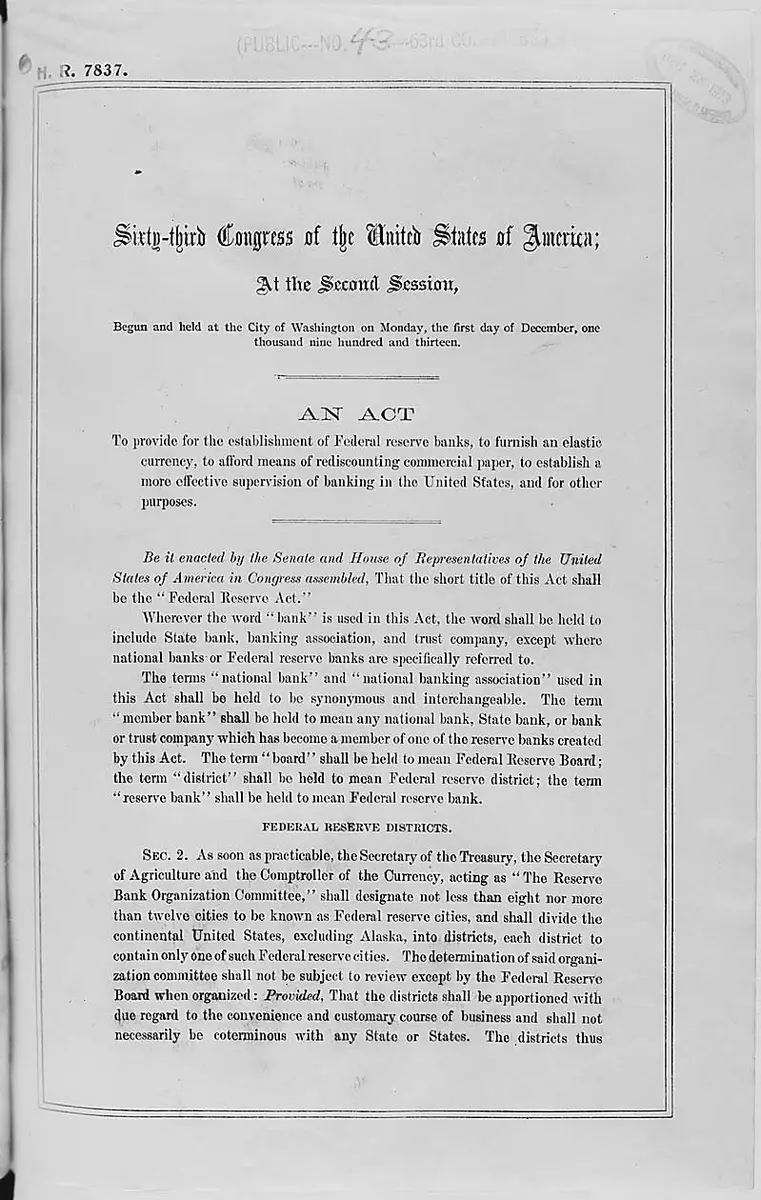
“In December 1913, after the panic of 1907 and a secret plan drafted on Jekyll Island, Wilson signed the Federal Reserve Act: twelve regional banks under a public board, open from November 1914.”
On 23 December 1913 President Woodrow Wilson signed the Federal Reserve Act, and the United States had a central bank again for the first time since the charter of the Second Bank of the United States ran out in 1836, after Andrew Jackson's veto. The new Federal Reserve System was not one bank but twelve regional Federal Reserve Banks, owned by the commercial banks that joined them and each run by nine directors, under a Federal Reserve Board in Washington whose members the president appointed. The Reserve Banks held the member banks' reserves, lent to them against short-term business loans, and issued a new paper money, the Federal Reserve note, so that the supply of cash could grow when trade needed it and shrink again afterwards.
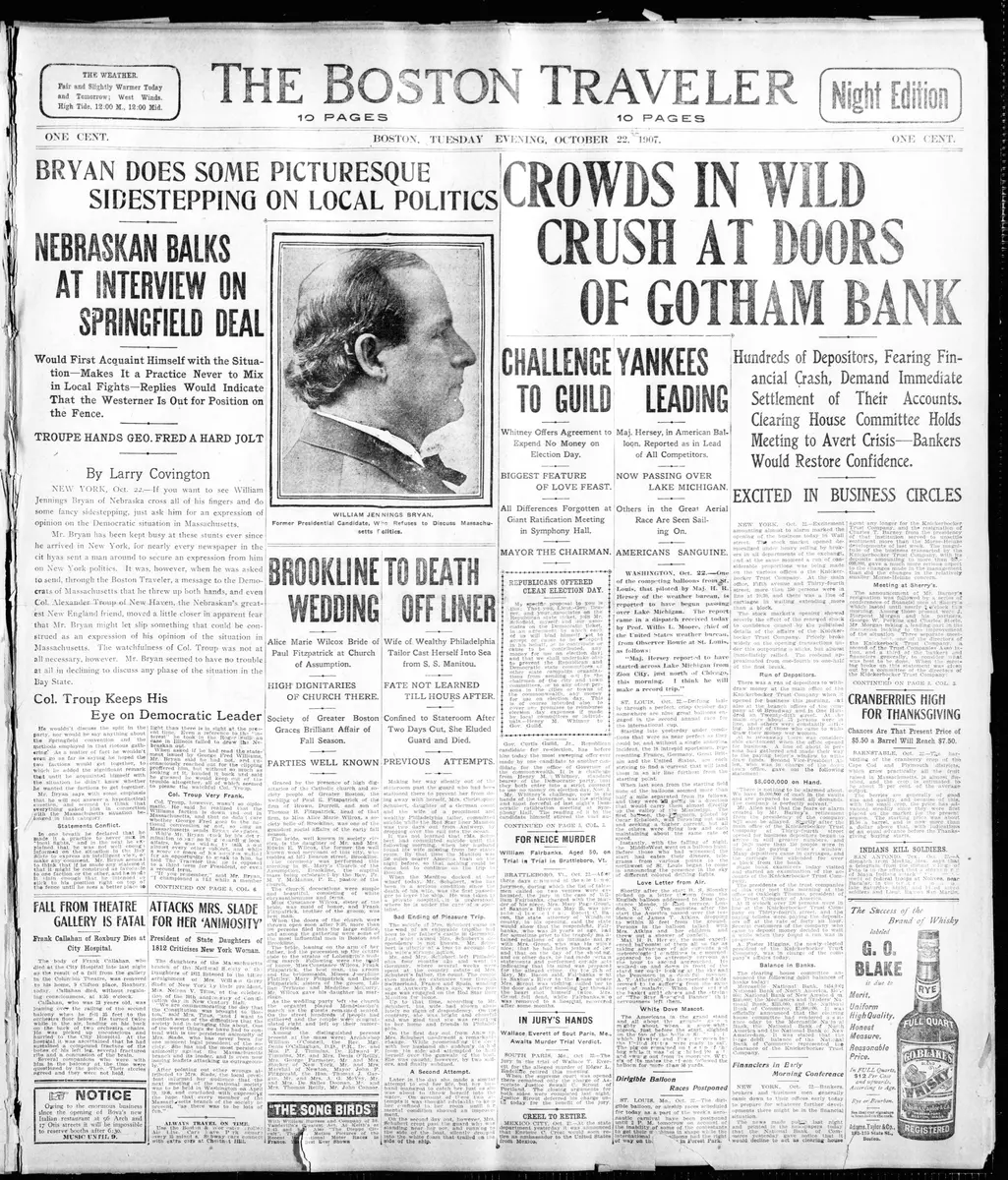
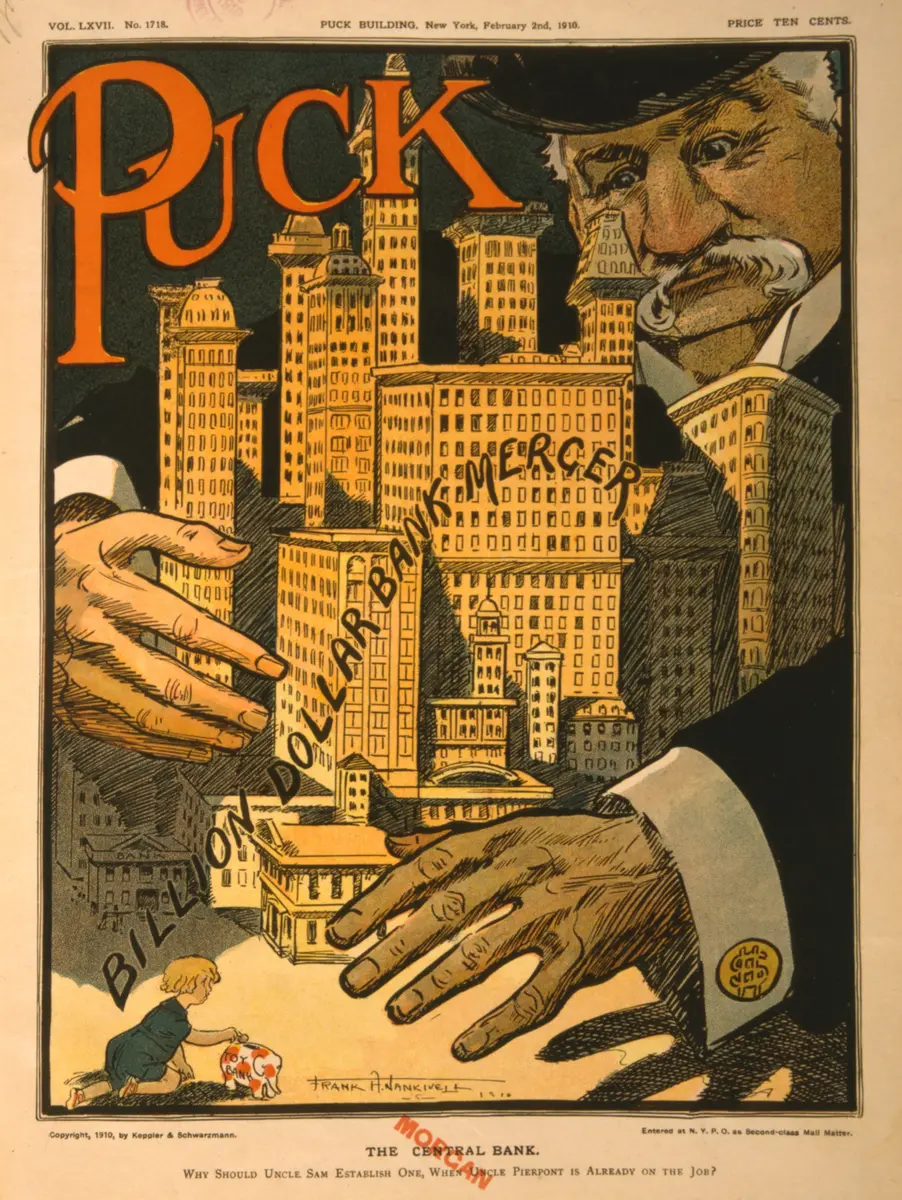
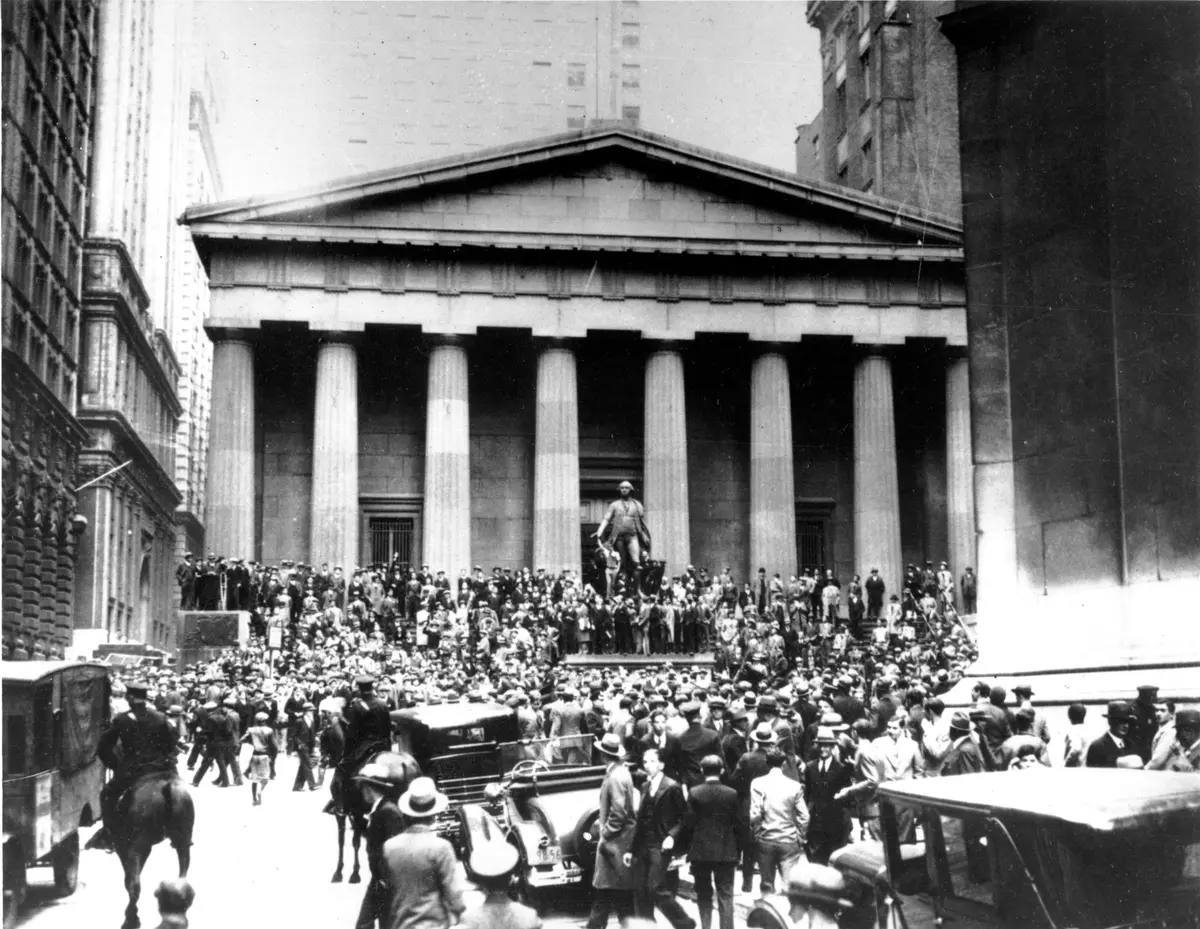
The reason was panic. Every fifteen years or so a run on the banks froze the country's reserves, which lay scattered in thousands of vaults or piled up in New York lending to stock speculators, and the amount of currency, tied to government bonds, could not stretch to meet a crisis or even the autumn harvest. In 1907 it took J. P. Morgan and his fellow bankers to stop one. Congress answered with the Aldrich–Vreeland Act of May 1908, which allowed emergency money and set up a National Monetary Commission under Senator Nelson Aldrich. In November 1910 Aldrich took five companions, his secretary and four men from Wall Street and the Treasury, among them Paul Warburg of Kuhn, Loeb, to the Jekyll Island Club in Georgia, in secret and using first names only. There they wrote a plan for a single 'Reserve Association' run largely by bankers.
The Aldrich plan died with the election of 1912, which gave the Democrats the White House and both houses of Congress, and the House's 'money trust' hearings of 1912–13, where Morgan himself testified, had made Wall Street's power a national worry. Carter Glass in the House, helped by the economist H. Parker Willis, drafted a bill for regional reserve banks instead; Wilson insisted that a public board sit above them, and told Congress in June 1913 that control 'must be public, not private'. Senator Robert Owen carried the bill in the Senate, whose version capped the banks at twelve. After six months of argument it passed the House in September and the Senate on 19 December, and the final text, agreed in conference, was signed at 6:02 in the evening of 23 December with four gold pens. Its machinery owed much to the Aldrich plan; its control did not.
Building the system took most of 1914. A committee of Treasury Secretary William McAdoo, Agriculture Secretary David Houston and the Comptroller of the Currency, John Skelton Williams, heard bankers in eighteen cities and on 2 April named the twelve Reserve Bank cities, from Boston to San Francisco, leaving New Orleans and Baltimore indignant and Missouri with two. The Board took office on 10 August, days after war in Europe had closed the stock exchanges and forced the Treasury to issue some $380 million of the emergency money the 1908 law allowed. On Monday 16 November 1914 all twelve banks opened at once, some in borrowed rooms with a handful of clerks; New York's, under Benjamin Strong, took in $100 million from 211 member banks on its first day and received its first shipment of the new notes.
The Fed grew into the most powerful central bank in the world, but not at once and not without failures. Its first great test, the crash of 1929 and the Depression that followed, went badly: in 2002 Ben Bernanke, then a Fed governor, told Milton Friedman and Anna Schwartz, who had blamed the Fed for the collapse, 'You're right, we did it.' The Banking Act of 1935 moved power from the twelve banks to the Board in Washington, yet the twelve cities of 1914 are still the Reserve Bank cities and the district lines have hardly moved. The arguments of 1913, between bankers and the government and between Wall Street and the rest of the country, never ended, and the secrecy of Jekyll Island still feeds suspicion of the Fed. Every dollar bill in an American pocket says 'Federal Reserve Note'.
What happened
- 1908
After the panic of 1907, Congress passes the Aldrich–Vreeland Act. It lets banks issue emergency currency in a crisis and sets up an eighteen-member National Monetary Commission of senators and congressmen, chaired by Senator Nelson Aldrich, to find out what America's money and banks need.
The United States Capitol: the votes of 1913, and Wilson's address to both houses on 23 June- 1910
Aldrich, his secretary Arthur Shelton, the Morgan partner Henry Davison, the Treasury's A. Piatt Andrew, Frank Vanderlip of National City Bank and Paul Warburg of Kuhn, Loeb board Aldrich's private railroad car in New Jersey one by one, as if going duck hunting, and spend more than a week at the Jekyll Island Club. Using only first names, they write a plan for a central Reserve Association with fifteen branches.
The Jekyll Island Club, Georgia: the clubhouse, now a hotel, where Aldrich's group wrote its plan in November 1910- 1911
Aldrich presents the plan to the Monetary Commission without saying how it was written. Revised, it goes to Congress a year later as the bill for a National Reserve Association, whose 46-member board would have had only six members chosen by the government.
- 1912
Woodrow Wilson is elected president and the Democrats win both houses of Congress; their platform had rejected the Aldrich plan. Carter Glass, at the head of a House subcommittee, starts on a Democratic bill with the economist H. Parker Willis.
- 1913
Wilson addresses both houses in person: the country needs a currency that can stretch with credit, reserves that can move, and a system whose control is 'public, not private', so that the banks are 'the instruments, not the masters, of business'.
The United States Capitol: the votes of 1913, and Wilson's address to both houses on 23 JuneThe administration's currency bill is introduced in both houses on the same day, by Senator Robert Owen in the Senate and by Carter Glass in the House.
The United States Capitol: the votes of 1913, and Wilson's address to both houses on 23 JuneThe House of Representatives passes Glass's bill. In the Senate the Banking and Currency Committee is split, and the argument runs on into the winter.
The United States Capitol: the votes of 1913, and Wilson's address to both houses on 23 JuneThe Senate passes Owen's version by 54 votes to 34, every Democrat present voting for it with six Republicans and one Progressive. Among Owen's changes: no more than twelve Reserve Banks.
The United States Capitol: the votes of 1913, and Wilson's address to both houses on 23 JuneNegotiators of both houses settle the differences: eight to twelve Reserve Banks, ten-year terms for the Board's members, the deposit guarantee dropped. Shortly before 11 at night the House adopts their report by 298 votes to 60.
The United States Capitol: the votes of 1913, and Wilson's address to both houses on 23 June- 6:02 p.m.
The Senate adopts the final text by 43 to 25 in the afternoon. At 6:02 p.m., in his oval office, among his family, cabinet members and the banking committees, Wilson writes 'Approved 23 December, 1913' with one gold pen and his name with three more: the Federal Reserve Act is law.
The White House, Washington: Wilson signed the Act at 6:02 p.m. on 23 December 1913 in his oval office in the executive office building - 1914
After six weeks of hearings in eighteen cities and a ballot of the country's 7,471 national banks, the Reserve Bank Organization Committee of McAdoo, Houston and Williams names the twelve cities: Boston, New York, Philadelphia, Cleveland, Richmond, Atlanta, Chicago, St. Louis, Minneapolis, Kansas City, Dallas and San Francisco. New Orleans and Baltimore protest.
War in Europe: foreign investors sell American shares, the stock exchanges close and gold drains away. With the new banks not yet open, the Treasury issues about $380 million of emergency currency under the Aldrich–Vreeland law, amended for the purpose.
The Treasury Building, Washington: the department of William McAdoo, who chaired the Organization Committee and, by his office, the new Board; it issued the emergency currency of August 1914The five appointed members of the Federal Reserve Board take the oath: Charles Hamlin as governor, Frederic Delano as vice governor, Paul Warburg, Adolph Miller and W. P. G. Harding, with McAdoo and Comptroller Williams as members by office.
The Board calls on the member banks to pay the first instalment of the Reserve Banks' capital as of 2 November; at about the same time McAdoo fixes 16 November as the opening day.
All twelve Federal Reserve Banks open on the same Monday, some in borrowed rooms: Minneapolis with eight employees in another bank's board room, New York with seven officers and 85 clerks under Benjamin Strong, taking in $100 million from 211 member banks and its first shipment of Federal Reserve notes.
Federal Reserve Bank of New York, 33 Liberty Street: the largest of the twelve, opened on 16 November 1914 under Benjamin Strong; this building is later, the bank moved in only in 1924