Wall Street Crash
“In the autumn of 1929 the New York stock market collapsed: from Black Thursday to Black Tuesday the Dow lost a quarter of its value, by mid-November almost half, and the Great Depression followed.”
The Wall Street Crash was the collapse of share prices on the New York Stock Exchange in the autumn of 1929. All through the 1920s American shares had risen almost without a break: the Dow Jones Industrial Average, an index of thirty big industrial companies, climbed six-fold from 63 in August 1921 to a peak of 381.17 on September 3, 1929. Ordinary people as well as bankers were buying, and much of the buying was done on margin: the investor paid part of the price and borrowed the rest from a broker, with the shares as security, so that brokers' loans passed six billion dollars that autumn. The Federal Reserve, afraid that credit was being drawn into speculation, raised its New York discount rate to 6 percent in August, and a recession had quietly begun in the summer.
Prices slipped in September, after the forecaster Roger Babson warned on September 5 that 'sooner or later a crash is coming', and broke in the second half of October. On Thursday, October 24, Black Thursday, sell orders swamped the floor: a record 12.9 million shares changed hands, the ticker fell hours behind, and crowds filled Wall Street and Broad Street. At noon five of the city's leading bankers met at J.P. Morgan & Co. across the street and agreed to support the market; when Richard Whitney, the Exchange's acting president, bid 205 for a block of U.S. Steel, the panic stopped, and the average closed only six points down. The next day President Hoover called the country's business 'sound and prosperous'. But on Monday, October 28, the Dow fell 12.8 percent, and on Black Tuesday, October 29, it fell another 12 percent on 16.4 million shares. In the four business days from Black Thursday it had lost a quarter of its value.
The Federal Reserve Bank of New York kept the banks at the centre of the storm open, buying government bonds, lending freely and cutting its rate to 5 percent on October 31, and the Exchange shortened its hours and closed for two days so that its clerks could catch up. Prices still slid until November 13, when the Dow stood at 198.69, almost half below its September peak. The crash wiped out savings, frightened families and firms into spending less and deepened the recession, but it did not by itself make the Great Depression: that came when waves of bank failures from the autumn of 1930 turned a sharp recession into the longest and deepest slump of the industrial age. By July 8, 1932, the Dow had fallen to 41.22, 89 percent below its peak, and it did not climb back to its 1929 high until November 1954.
The crash changed how markets are run. A Senate inquiry, led from 1933 by its counsel Ferdinand Pecora, laid bare the practices of the 1920s, and Congress answered with the Securities Act of 1933, the Banking Act of 1933 (Glass–Steagall) and the Securities Exchange Act of 1934, which created the Securities and Exchange Commission to police the markets. Richard Whitney, the hero of Black Thursday, told the senators that the Exchange was 'a perfect institution'; in 1938 his own firm failed and he went to Sing Sing prison. Central bankers learned that bubbles are hard to spot and dangerous to fight with interest rates, and that after a crash the central bank must keep the banks supplied with money, as New York did in 1929. Black Monday in 1987 and the financial crisis of 2008 were both measured against it.
What happened
- 1929
The Dow Jones Industrial Average closes at 381.17, the top of the bull market: six times its level of August 1921.
New York Stock Exchange, Broad and Wall Streets: where the shares were tradedAt the National Business Conference at Babson Park, Wellesley, the forecaster Roger Babson warns that 'sooner or later a crash is coming, and it may be terrific'; when his words reach New York, prices break in the last hour of trading: the 'Babson break'.
Babson Park, Wellesley, Massachusetts: Roger Babson's warning to the National Business Conference, September 5Irving Fisher of Yale, one of the country's best-known economists, tells the Purchasing Agents Association at the Builders Exchange Club that stock prices have reached 'what looks like a permanently high plateau'.
2 Park Avenue, New York: the Builders Exchange Club, where Irving Fisher spoke on October 15A wave of selling knocks four billion dollars, 4.6 percent, off the market's value; the next morning's Times reports 'Prices of stocks crash in heavy liquidation'.
New York Stock Exchange, Broad and Wall Streets: where the shares were tradedRichard Whitney, the Exchange's acting president and the Morgan firm's broker, walks to the U.S. Steel post and bids 205 for a large block of shares; buying spreads to the whole list, and by 2 o'clock the market has turned up.
New York Stock Exchange, Broad and Wall Streets: where the shares were traded- 11:15 a.m.
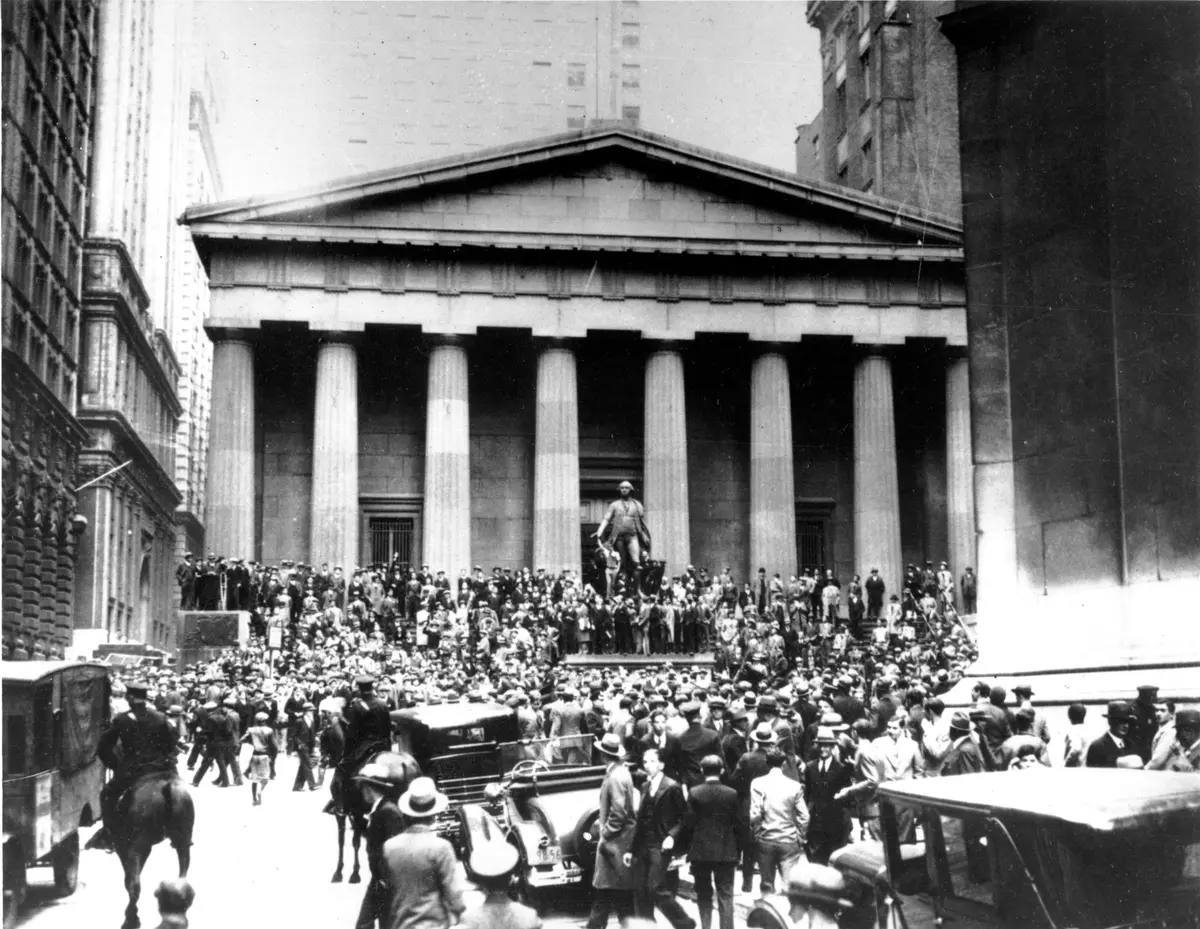
Black Thursday: sell orders swamp the floor, and between 11:15 and 12:15 prices reach their lowest, the average about 11 percent down; crowds fill Wall Street and Broad Street and the steps of the Sub-Treasury, with mounted police in the streets.
The Sub-Treasury (now Federal Hall National Memorial), 26 Wall Street: the crowds gathered on its steps - 12:00 p.m.
Five bankers, Charles Mitchell of the National City Bank, Albert Wiggin of the Chase, William Potter of the Guaranty Trust, Seward Prosser of Bankers Trust and Thomas Lamont of J.P. Morgan & Co., meet at the Morgan office and agree to support the market; word spreads on the floor that 'they' are buying.
J.P. Morgan & Co., 23 Wall Street: the bankers met here at noon on Black Thursday - 3:00 p.m.
The market closes with the Dow at 299.47, only six points down, after a record 12,894,650 shares; the tickers run hours behind, and after the close the bankers meet again at 4:30.
New York Stock Exchange, Broad and Wall Streets: where the shares were traded Asked by reporters at the White House, President Hoover says that 'the fundamental business of the country, that is production and distribution of commodities, is on a sound and prosperous basis'.
The White House, Washington: Hoover's statement of October 25Black Monday: the selling returns and the Dow falls 12.8 percent on 9.2 million shares, three million of them in the last hour.
New York Stock Exchange, Broad and Wall Streets: where the shares were tradedBlack Tuesday: a record 16,410,030 shares are sold and the Dow loses almost 12 percent more, closing at 230.07, a quarter below where it stood before Black Thursday; the ticker prints the day's last price at 5:32 in the evening.
New York Stock Exchange, Broad and Wall Streets: where the shares were tradedVariety's front page reads 'Wall St. Lays an Egg'. John D. Rockefeller lets it be known that he and his son are buying, prices rally, and the Exchange's governors announce a short session the next day and a holiday on Friday and Saturday so that the clerks can catch up.
New York Stock Exchange, Broad and Wall Streets: where the shares were tradedThe Federal Reserve Bank of New York cuts its rate from 6 to 5 percent, the same day the Bank of England cuts from 6½ to 6; the Exchange trades for three hours from noon, 7.1 million shares, and then stays shut until Monday.
Federal Reserve Bank of New York, 33 Liberty Street: it lent to the banks and cut its rate to 5 percent on October 31The slide reaches its autumn bottom: the Dow closes at 198.69, almost half below its September peak; the same day the Hoover administration promises a cut in income taxes, and a bid for a million shares of Standard Oil of New Jersey is put down to John D. Rockefeller.
New York Stock Exchange, Broad and Wall Streets: where the shares were traded