Black Monday crash
“On Monday, October 19, 1987, the Dow fell 22.6 percent, its worst day ever; markets crashed around the world, but the Fed's promise of cash calmed the panic and no recession followed.”
Black Monday was the stock market crash of Monday, October 19, 1987, when the Dow Jones Industrial Average fell 508 points, or 22.6 percent, in a single day: still the largest one-day fall in its history, far worse than either of the two worst days of 1929. It ended a five-year bull market that had more than tripled American share prices. Fed by takeovers, foreign money and new investors such as pension funds, the Dow had gained 44 percent in seven months to a record 2,722.42 on August 25, and some warned that shares had become overvalued. In early September the Federal Reserve, led for only a few weeks by Alan Greenspan, raised its discount rate as interest rates climbed around the world and the dollar weakened.
The market broke in the week of October 14. A bigger trade deficit than expected sent the dollar down and long-term bond yields above 10 percent, and a committee of the House of Representatives moved to end the tax breaks on loans for takeovers. By Friday, October 16, the Dow was 17.5 percent below its peak, while London's exchange stood idle after the Great Storm. Many big investors had bought 'portfolio insurance': computer models that told them to sell stock-index futures, traded in Chicago, as prices fell, while 'index arbitrage' traders carried that selling straight back to the New York Stock Exchange. Over the weekend the models called for billions of dollars more in sales, and the Sunday papers reported that the Treasury might stop supporting the dollar.
On Monday the selling went round the world: Tokyo and Hong Kong fell first, then London, then New York, where the orders swamped the Exchange's specialists and computers and trades were reported more than an hour late. Three portfolio insurers alone sold nearly $2 billion of stock and futures worth $2.8 billion more. The Dow closed at 1,738 on a record 604 million shares; about $500 billion of share value was gone. Tuesday was even more dangerous. Before the opening Greenspan promised that the Fed stood ready 'to serve as a source of liquidity', and the New York Fed pressed the big banks to keep lending to brokers; the Dow touched bottom at midday, when Chicago's futures and options exchanges stopped trading, then closed 102 points up. Hong Kong shut its stock exchange for four days and lost a third of its value when it reopened; Australia's market fell more than 40 percent, and New Zealand's eventually 60.
President Reagan asked a task force under Nicholas Brady, a Wall Street banker and former senator, to find out what had happened. Its report of January 8, 1988 found that stocks, futures and options had become 'one market' that the rules still treated as three, and that the fall had been driven by the 'mechanical, price-insensitive selling' of a few big institutions. It called for one agency to coordinate the markets, common clearing and margins, and 'circuit breakers' to pause trading in a panic, which the exchanges adopted and still use; in March 1988 Reagan set up a working group of the Treasury, the Fed, the SEC and the futures regulator to carry the work on. The real economy hardly noticed: no recession or banking crisis followed, the Dow ended 1987 slightly up for the year, and it passed its August peak in 1989.
Black Monday was the first crash in which computer-driven trading played a leading part, and the first that people could watch spreading live, market by market, on television. The Fed's quick public promise of cash set the pattern for later rescues, though critics say it also taught investors to count on being saved. It lives on in film too: in Martin Scorsese's The Wolf of Wall Street (2013), Jordan Belfort's first day as a licensed stockbroker, at L.F. Rothschild, is Black Monday, and the firm soon goes under.
What happened
- 1987
The Dow Jones Industrial Average closes at a record 2,722.42, having gained 44 percent in seven months, the top of a five-year bull market that has more than tripled share prices.
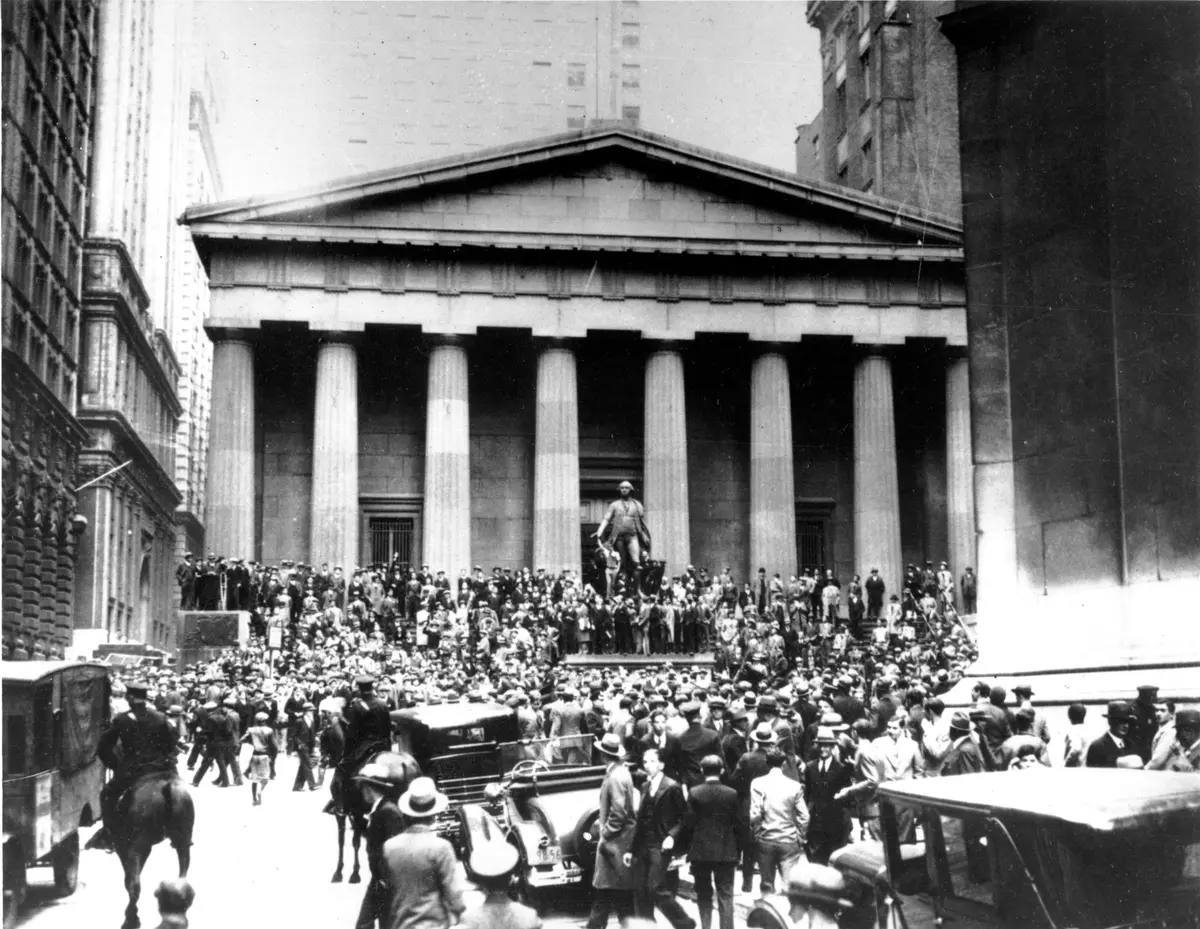
New York Stock Exchange, Wall and Broad Streets: the Dow fell 22.6 percent here on October 19With the dollar under pressure and fears of inflation rising, the Federal Reserve under its new chairman, Alan Greenspan, raises its discount rate from 5.5 to 6 percent.
Federal Reserve Board, Eccles Building, Washington: Greenspan's statement of October 20- 8:30 a.m.
The government reports a trade deficit of $15.7 billion for August, $1.5 billion more than expected; the dollar falls and the 30-year Treasury bond yields more than 10 percent for the first time in two years. The same morning a House committee files a bill to end tax benefits for takeover loans, and takeover stocks collapse. The Dow falls 95 points, a record.
New York Stock Exchange, Wall and Broad Streets: the Dow fell 22.6 percent here on October 19 In the night the worst storm in south-east England since 1703 kills 18 people and fells about 15 million trees; with the City paralysed, the London Stock Exchange is effectively closed for the day, and London's selling waits for Monday.
The Stock Exchange tower, Old Broad Street, London: shut by the storm on October 16; the FT-SE 100 fell 10.8 percent on October 19In New York options on stock indexes expire, portfolio insurers sell futures heavily, and the Dow falls 108.35 points, 4.6 percent: its first fall of more than 100 points in a day. For the week it is down 9.5 percent, 17.5 percent below its August peak.
New York Stock Exchange, Wall and Broad Streets: the Dow fell 22.6 percent here on October 19The Sunday New York Times quotes Treasury Secretary James Baker pressing West Germany's central bank to ease credit and appearing to warn that the United States might stop supporting the dollar: to the markets, the end of the Louvre accord that was holding the currency steady.
The selling starts in Asia: Tokyo's Nikkei falls 2.5 percent, and Hong Kong's Hang Seng index loses 420 points, 11.3 percent, the biggest one-day fall in its history. By midday in London the FT-SE 100 is down 10 percent; it closes down 10.8 percent.
Exchange Square, Central, Hong Kong: the Stock Exchange of Hong Kong closed from October 20 to 23 and fell 33 percent when it reopened- 8:05 a.m.
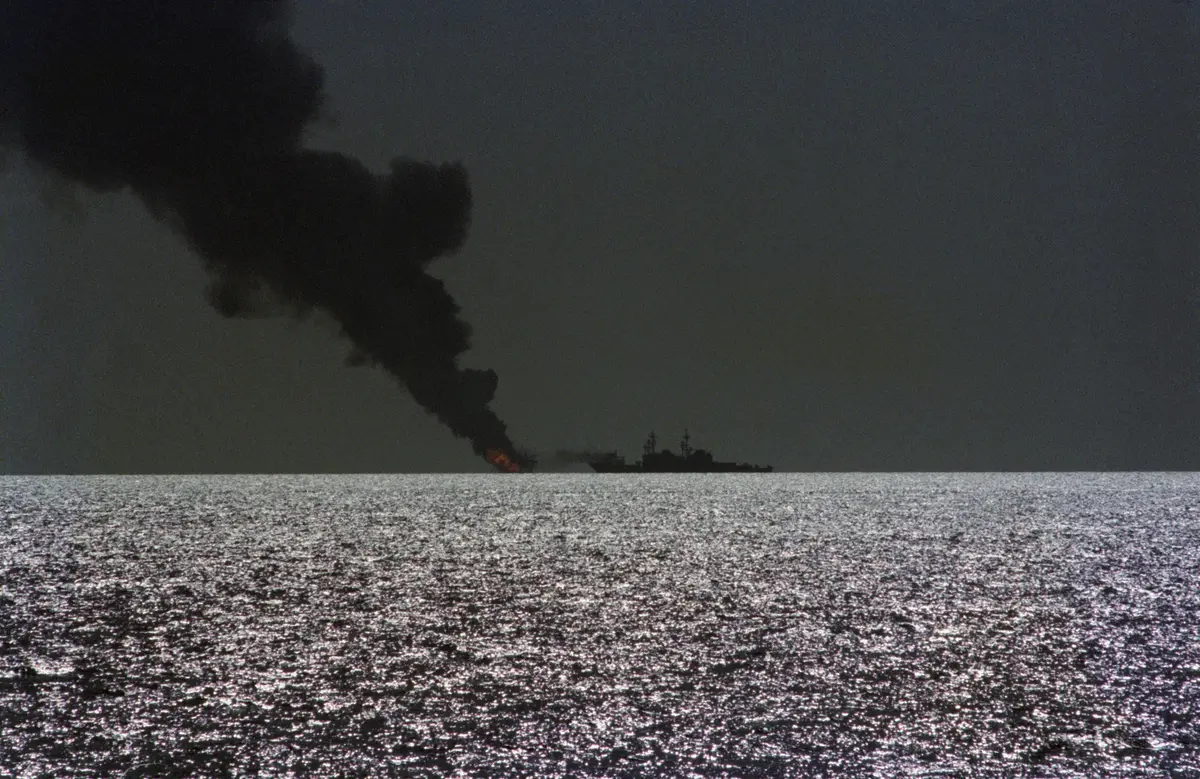
News reaches New York that four US Navy destroyers have shelled Iranian oil platforms in the Persian Gulf in answer to Friday's missile attack on a US-flagged Kuwaiti tanker; instead of buying dollars as a safe haven, investors sell them.
- 9:30 a.m.
The New York Stock Exchange opens to a flood of sell orders: about $500 million of stock is already queued in its DOT order computer, many big stocks cannot open for an hour, and at 10 o'clock 95 stocks of the S&P 500, 30 percent of the index's value, are still not trading. In Chicago the portfolio insurers sell more than 3,000 futures contracts in the first half hour.
New York Stock Exchange, Wall and Broad Streets: the Dow fell 22.6 percent here on October 19 - 1:09 p.m.
The Dow Jones news wire reports SEC chairman David Ruder saying there is 'some point' at which he would talk to the Exchange about 'a temporary, very temporary halt in trading'. Fear of being locked in feeds the selling: between 1:15 and 2:05 the Dow falls from 2,081 to 1,969, below 2,000 for the first time since January.
New York Stock Exchange, Wall and Broad Streets: the Dow fell 22.6 percent here on October 19 - 4:00 p.m.
The closing bell stops the fall: the Dow has lost 508 points, 22.6 percent, to 1,738, on a record 604 million shares, and S&P 500 futures have fallen 29 percent. The White House says that 'the underlying economy remains sound'.
New York Stock Exchange, Wall and Broad Streets: the Dow fell 22.6 percent here on October 19 Overnight Tokyo's Nikkei falls 3,836 points, 14.9 percent, to 21,910 as nearly every stock hits its daily limit, and by midday London is down 14 percent more. Hong Kong's stock exchange closes for the rest of the week.
Tokyo Stock Exchange, Kabutochō: the Nikkei fell 14.9 percent on October 20- 8:41 a.m.
Before the opening Alan Greenspan issues the Fed's one-sentence statement: 'The Federal Reserve, consistent with its responsibilities as the Nation's central bank, affirmed today its readiness to serve as a source of liquidity to support the economic and financial system.' The New York Fed telephones the big banks to keep them lending to brokers.
Federal Reserve Board, Eccles Building, Washington: Greenspan's statement of October 20 - 9:30 a.m.
Buyers flood back at the opening, and the NYSE asks its members not to use the DOT system for program trading; by 10:27 the Dow has risen from 1,739 to 1,936.
New York Stock Exchange, Wall and Broad Streets: the Dow fell 22.6 percent here on October 19 - 11:35 a.m.
In the Oval Office Reagan tells reporters he is 'very pleased and gratified' with the Federal Reserve's action and that 'everyone has been caught by surprise'; the same day he meets Greenspan, Treasury Secretary James Baker and his chief of staff Howard Baker in the White House residence.
The White House, Washington: Reagan's meetings, his news conference of October 22 and his executive order of November 5 - 12:15 p.m.
With S&P 500 futures down 27 percent since 10 a.m., the Chicago Mercantile Exchange suspends trading, after the Chicago Board Options Exchange stopped at 11:45, as stock after stock halts on the NYSE and rumours spread that the Exchange itself will close; at 12:30 the Dow stands near 1,712. After the futures reopen just after 1 p.m., companies announce buybacks of their own shares, and the Dow closes at 1,841, up 102 points, on a record 608 million shares.
Chicago Mercantile Exchange Center, South Wacker Drive, Chicago: S&P 500 futures, where the portfolio insurers sold; trading stopped at 12:15 on October 20 Wall Street rebounds: the Dow gains 186.84 points, 10.1 percent, its biggest one-day rise until then; in two sessions it has won back 288 points, 57 percent of Monday's loss.
New York Stock Exchange, Wall and Broad Streets: the Dow fell 22.6 percent here on October 19After the close the NYSE announces that for the time being it will close at 2 p.m., so that brokers' back offices can catch up with the record volume.
New York Stock Exchange, Wall and Broad Streets: the Dow fell 22.6 percent here on October 19- 8:00 p.m.
In a news conference broadcast live from the East Room, Reagan announces a task force under former Senator Nicholas Brady to examine 'the stock market procedures' within 30 to 60 days, and calls Congress to talks on the budget deficit.
The White House, Washington: Reagan's meetings, his news conference of October 22 and his executive order of November 5 Hong Kong's exchange reopens after four days shut, despite a HK$2 billion rescue of its futures market agreed over the weekend, and the Hang Seng index falls 1,120 points, 33 percent, as investors facing huge margin calls sell. In New York the Dow falls 156.83 points, 8 percent.
Exchange Square, Central, Hong Kong: the Stock Exchange of Hong Kong closed from October 20 to 23 and fell 33 percent when it reopenedExecutive Order 12614 creates the Presidential Task Force on Market Mechanisms, five members who must report within 60 days.
The White House, Washington: Reagan's meetings, his news conference of October 22 and his executive order of November 5- 3:42 p.m.
Reagan announces a two-year budget agreement with the leaders of Congress, saying the nation 'was stunned as the stock market took a dramatic dive' and that it had been time for action.
The White House, Washington: Reagan's meetings, his news conference of October 22 and his executive order of November 5 - 1988
The Brady task force submits its report: stocks, futures and options are 'one market', the break was driven by the mechanical selling of a few institutions, and it recommends one coordinating agency, unified clearing, consistent margins and circuit breakers. That afternoon Reagan says he has received it.
Federal Reserve Bank of New York, 33 Liberty Street: it pressed the banks to keep lending to brokers, and the Brady task force worked here