The New York Stock Exchange begins
“On May 17, 1792, two months after Wall Street's first crash, New York brokers signed the Buttonwood Agreement to trade among themselves at a fixed commission: the start of the New York Stock Exchange.”
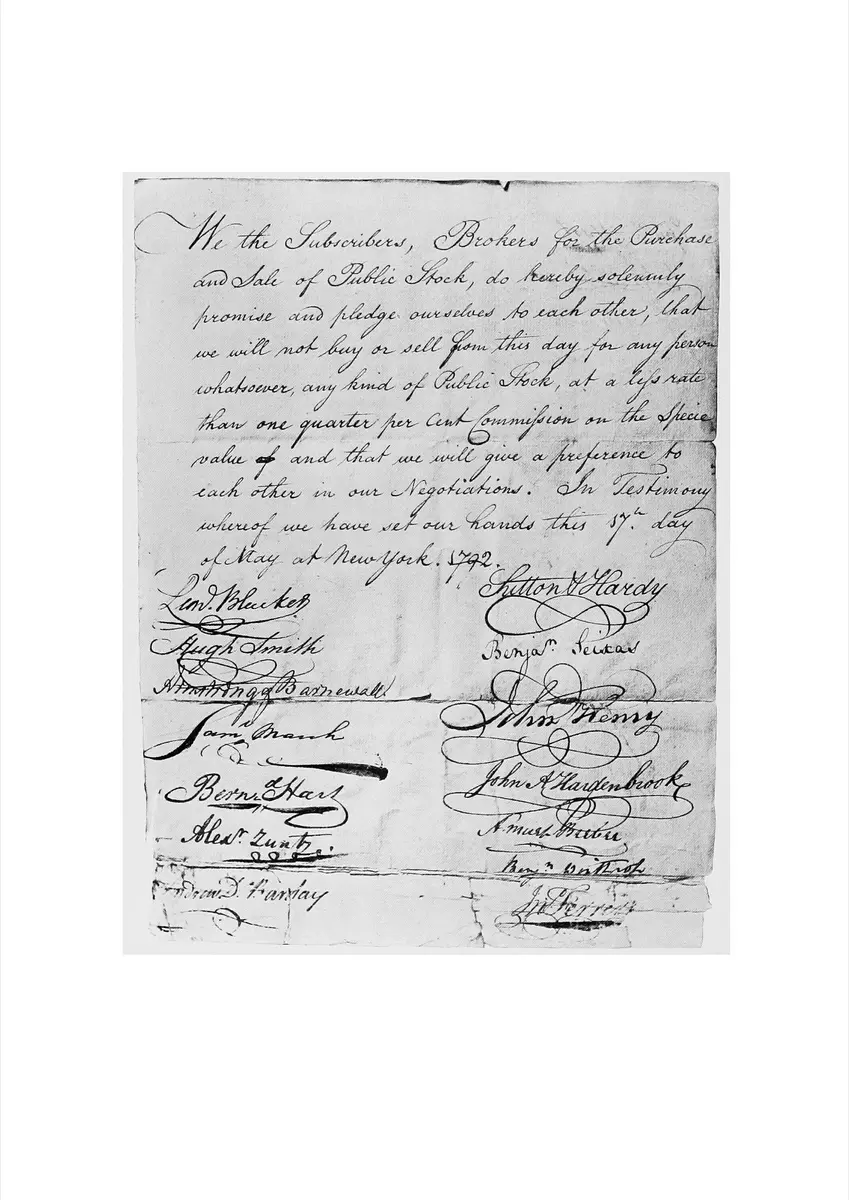
The New York Stock Exchange counts its birthday as May 17, 1792. On that day a group of New York brokers signed a one-page promise, now called the Buttonwood Agreement: from then on they would buy and sell 'public stock' for their customers at a commission of no less than one quarter of one per cent, and when they traded they would give preference to each other. The paper carries 24 names, some of them partnerships; 22 signed in May and two more were added on November 13. Tradition says the brokers signed it under a buttonwood tree, an American sycamore, on Wall Street. The Exchange's own history of 1894 says only that their trading in the street usually took place near such a tree in front of 68 and 70 Wall Street; where the paper itself was signed is not recorded.
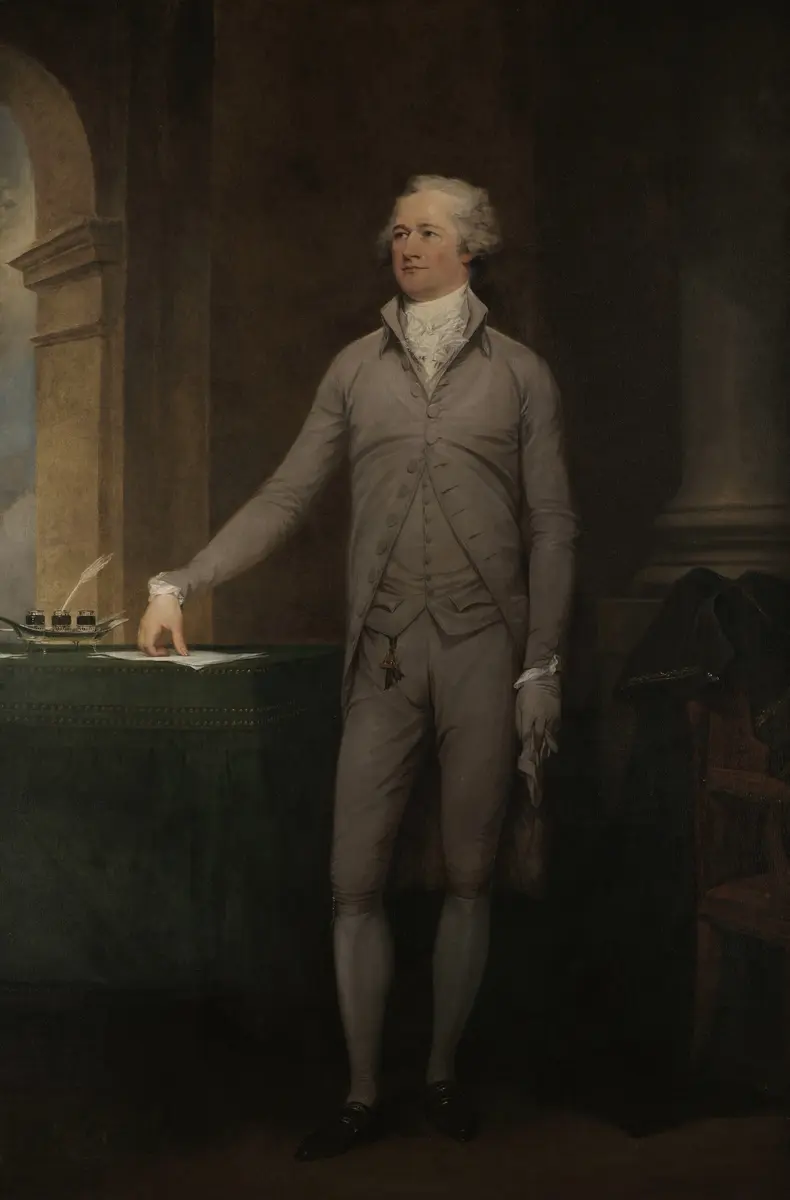
There was something to trade because of Alexander Hamilton, the first Secretary of the Treasury. In January 1790 he sent Congress, then meeting in Federal Hall on Wall Street, his Report on Public Credit: the debts left by the War of Independence, the nation's and the states', should be paid in full and exchanged for new federal bonds. Congress adopted the plan that summer, and by the autumn the new 6 per cent bonds, the 'Sixes', together with 3 per cent and 'deferred' bonds, were trading in New York, Philadelphia and Boston. In 1791 came shares in Hamilton's Bank of the United States, the largest company in the country. Its subscription rights, the 'scrips', sold out on July 4 and set off six weeks of wild speculation, which Hamilton calmed by having the Treasury buy bonds in the market. Buyers and sellers went to merchants and to auctioneers, and in March 1792 the auctioneers opened a 'Stock Exchange Office' at 22 Wall Street, with public sales every day at noon.
Then came Wall Street's first crash. William Duer, a New York speculator who had been Hamilton's assistant at the Treasury, borrowed heavily with his partners to corner the market in Sixes, just as the new national bank first lent freely and then pulled back. On March 9, 1792 Duer stopped paying his debts; within two weeks the Sixes lost a quarter of their price, and failures spread through the city. Hamilton acted like a modern central bank: the Treasury bought bonds in the market, and he pressed the Bank of New York to keep lending against good collateral at a higher rate of interest, rules Walter Bagehot would write down eighty years later. By mid-April the panic was over. In the middle of it, on March 21, the merchants and dealers in stocks met at Corre's Hotel, resolved to stop attending the public auctions of stock and named a committee to find them a room of their own; the agreement of May 17 followed. Ten of its signers were among the dealers from whom the Bank of New York's cashier, William Seton, had bought bonds for the Treasury in April.
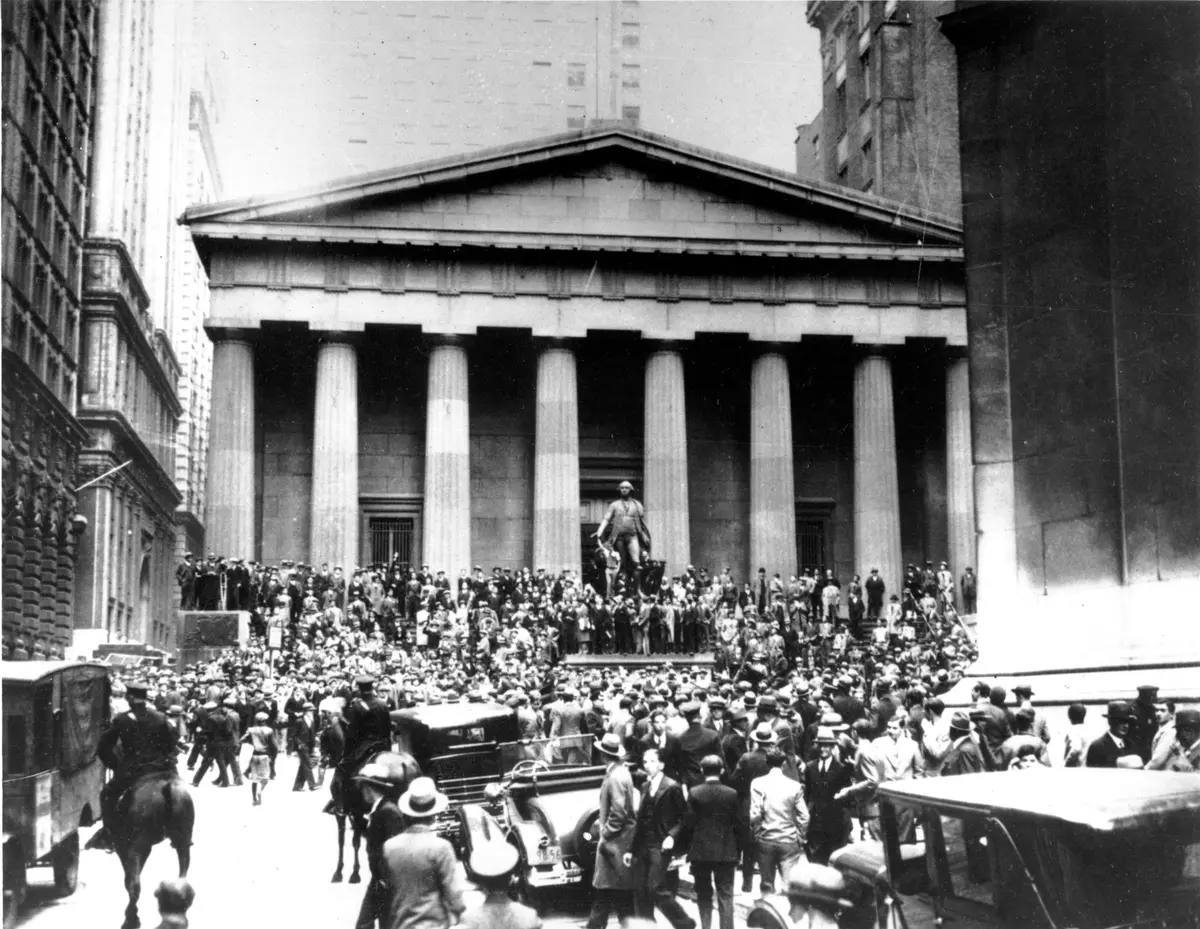
The agreement turned the brokers into a private club that cut out the auctioneers and kept the price of its members' services fixed. In 1793 they moved indoors, into the new Tontine Coffee House on the corner of Wall and Water Streets, built by subscribers in 1792 and 1793 as a merchants' exchange. As business grew they wrote a constitution on March 8, 1817 and became the New York Stock and Exchange Board, renting a room at 40 Wall Street where the president called out a list of about thirty stocks and bonds twice a day while the brokers bid from their chairs: the origin of a 'seat' on the Exchange. The board took the name New York Stock Exchange in January 1863, moved to Broad Street in 1865 and opened its present building, designed by George B. Post, in 1903.
The fixed minimum commission of 1792 lasted, in one form or another, until May 1, 1975, when the Securities and Exchange Commission ended it. What began as two dozen dealers in war bonds and bank shares became one of the world's largest markets for securities, and 'Wall Street' became a word for American finance as a whole. Its birth also shows a pattern that returns in later crises: a new market, a burst of speculation on borrowed money, a crash, and a public authority that steps in to stop the panic.
What happened
- 1790
Hamilton's Report on Public Credit is presented to the House of Representatives in Federal Hall: the war debts of the nation and the states are to be paid in full and exchanged for new federal bonds, with a sinking fund that may buy bonds in the market.
Federal Hall, 26 Wall Street: Congress met here in 1789-90 and received Hamilton's Report on Public Credit; the present building of 1842 stands on the siteCongress adopts the essence of the plan. Holders begin to exchange their old certificates for new 6 per cent bonds, the 'Sixes', 'deferred' 6 per cent bonds and 3 per cent bonds, and by October the Sixes are trading in New York, Philadelphia and Boston.
Federal Hall, 26 Wall Street: Congress met here in 1789-90 and received Hamilton's Report on Public Credit; the present building of 1842 stands on the site- 1791
President Washington signs the bill that charters Hamilton's Bank of the United States, with a capital of $10 million: the largest corporation in the country.
The Bank's shares go on sale and are heavily oversubscribed. Buyers pay $25 for a 'scrip', the right to a share, with the rest to be paid later, three quarters of it in federal bonds; scrip prices double within weeks.
The scrip bubble peaks: 264 bid and 280 asked in New York, more than 300 in Philadelphia that evening. Within days prices tumble, and the Sixes fall with them.
Hamilton calls the sinking fund's commissioners together; the Treasury starts buying bonds in Philadelphia, and William Seton, cashier of the Bank of New York, is told to buy up to $150,000 in New York. By September the market is calm.
The Bank of the United States opens for business in Philadelphia, in Carpenters' Hall, and starts to lend and to issue its notes.
Carpenters' Hall, Philadelphia: the Bank of the United States opened here in December 1791- 1792
William Duer and his partners, 'the company', borrow heavily to corner the Sixes and try to launch a rival bank in New York; fed also by the new Bank's credit, the Sixes climb from about 110 in early December to 125 by mid-January.
Auctioneers advertise a 'Stock Exchange Office' at 22 Wall Street, where public sales of stock are held every day at noon.
With the Bank of the United States calling in its loans, Duer stops paying his debts. His default spreads from creditor to creditor; the Sixes, at 125.83 on March 5, are down to 95 by March 20.
The merchants and dealers in stocks meet at Corre's Hotel and resolve that from April 21 they will not attend any sale of stocks at public auction; a committee is to find them a room and draw up rules.
Hamilton writes to Seton: let the Bank of New York lend up to a million dollars against deposits of federal bonds, at 7 per cent instead of the usual 6, and the Treasury will take part of the pledged bonds off its hands if need be. On March 26 the sinking fund's commissioners allow $100,000 more of purchases, and the big dealers agree among themselves to pledge bonds for their loans and not to draw gold and silver out of the banks.
Seton reports that he has bought bonds from more than eighty sellers; the speculator Alexander Macomb has failed too, but Hamilton writes that the fall of the funds 'may be considered as arrested'. The panic is over.
Subscribers pay in for a new coffee house 'on a Tontine Plan' at Wall and Water Streets, to serve as a merchants' exchange.
Tontine Coffee House, corner of Wall and Water Streets: built in 1792-93, the brokers' first indoor home from 1793The brokers sign the Buttonwood Agreement: no public stock to be bought or sold for anyone at less than a quarter of one per cent commission, and preference to each other in their dealings.
68 Wall Street: by tradition the buttonwood tree under which the brokers traded, and signed their agreement, stood in front of numbers 68 and 70A price list shows what they trade: the 6 per cents at 22 shillings in the pound (110 per cent of their face value), the 3 per cents, deferred bonds and old certificates, half shares of the Bank of the United States at 50 per cent above par and shares of Philadelphia's Bank of North America.
Two more members sign: the broker David Reedy and the merchants Robinson & Hartshorne, bringing the names on the agreement to 24.
- 1793
The Tontine Coffee House is finished on the northwest corner of Wall and Water Streets, and the brokers move in from the street: their first indoor home.
Tontine Coffee House, corner of Wall and Water Streets: built in 1792-93, the brokers' first indoor home from 1793