The Panic of 1907
“In October 1907 runs on New York's trust companies set off a national panic; J. P. Morgan and his fellow bankers, with Treasury money, stopped it, and the scare led to the Federal Reserve.”
The Panic of 1907 was the last great banking panic in the United States before the Federal Reserve. It broke out in New York in October 1907, when depositors ran on the city's trust companies, and within days it spread across the country: banks everywhere stopped paying out cash, cash itself was bought and sold at a premium, and a recession that had begun in the spring became one of the sharpest the country had known. There was no central bank to lend in an emergency, so the rescue was organised by a private banker, J. P. Morgan, then seventy, working with the heads of the big New York banks and with money that the Secretary of the Treasury, George Cortelyou, deposited in them. The scare convinced bankers and politicians that the country needed a lender of last resort, and the road from it led, through an emergency currency law of 1908 and a national inquiry, to the Federal Reserve in 1913.
Money had been tight for a year. After the San Francisco earthquake of April 1906, British insurance companies paid their Californian claims with gold from London, and the Bank of England answered by raising its rate and turning away American borrowers; share prices fell hard in March 1907, and the economy began to shrink in May. The weak point was the trust companies: state-chartered firms that had grown fast by paying interest on deposits and lending to stockbrokers, but kept only about 5 per cent of their deposits in cash, against 25 per cent for the national banks, and stood outside the New York Clearing House, the banks' own association, which could pool its members' reserves in a crisis. The spark was a failed speculation. On 14 October the brokerage of the brothers of F. Augustus Heinze, a Montana copper magnate who had bought a New York bank, began a squeeze on the shares of United Copper, with Heinze and the speculator Charles W. Morse behind it; two days later the price collapsed from about 60 dollars to 10, and depositors fled the banks the two men controlled.
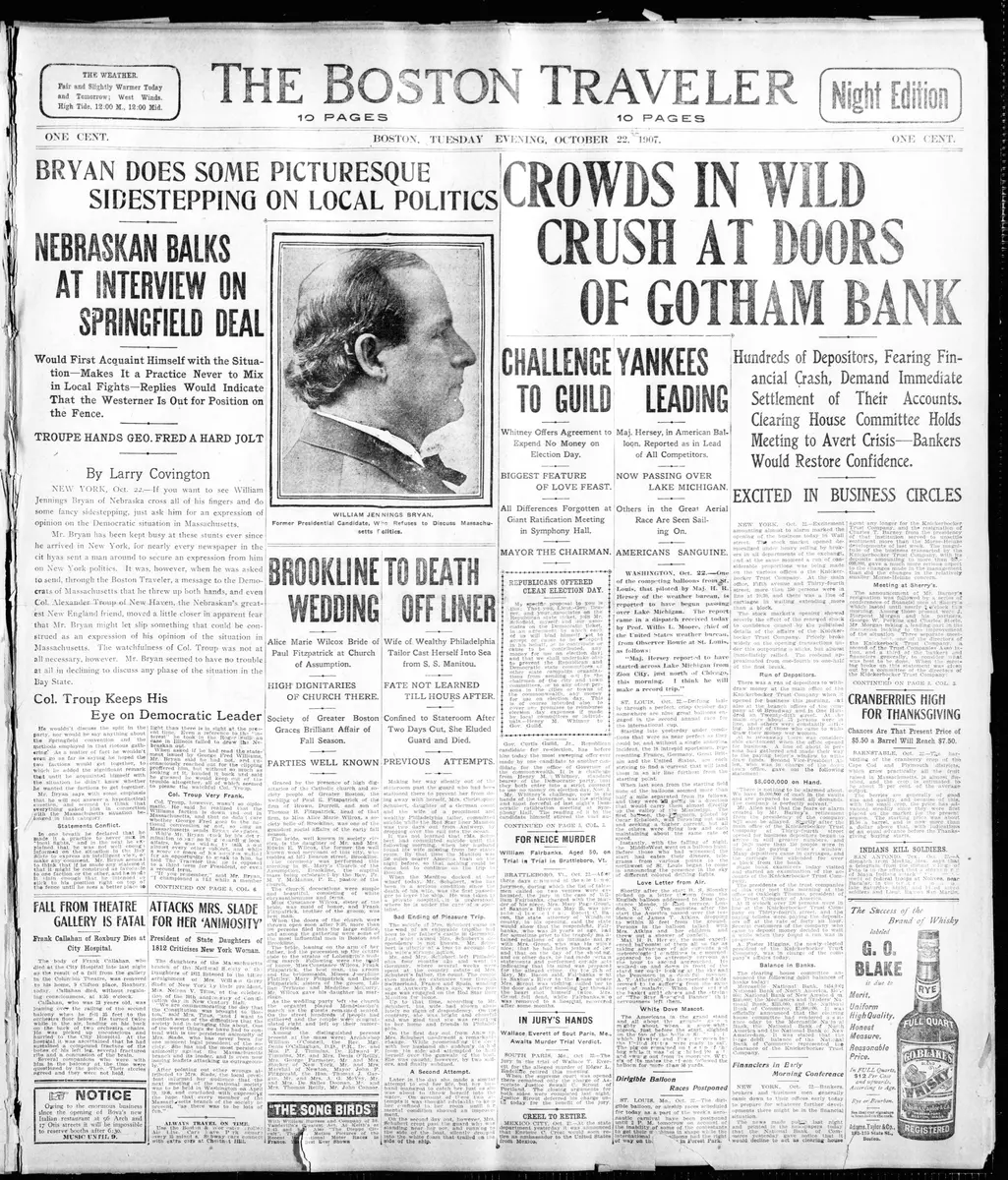
The Clearing House propped up the Heinze and Morse banks and forced both men out, but the fear jumped to the trust companies. When it became known that Charles T. Barney, president of the Knickerbocker Trust, one of the largest, was an associate of Morse, depositors queued at its marble hall on Fifth Avenue; on 22 October it paid out 8 million dollars in about three hours and closed its doors. The next day the run moved to the Trust Company of America on Wall Street, and Morgan, told by Benjamin Strong of Bankers Trust that its assets were sound, decided that this was 'the place to stop the trouble'. As banks across the country called their money home, overnight loans to stockbrokers cost 100 per cent a year, and on 24 October Morgan raised about 25 million dollars in minutes to keep the Stock Exchange going, while the Treasury put 25 million dollars into the New York banks. From 26 October the clearing houses of New York and then of other cities issued loan certificates and limited cash payments; for two months people paid with clearing-house scrip, cashier's checks and company pay checks, more than 500 million dollars of them by one estimate, while nearly 100 million dollars in gold was shipped from Europe. Morgan's bankers also took 30 million dollars of New York City bonds when the city could borrow nowhere else. In the night of 3 to 4 November he kept the trust company presidents in his library until they signed for a 25-million-dollar rescue fund, and on 4 November President Theodore Roosevelt let the United States Steel Corporation buy the Tennessee Coal, Iron and Railroad Company from a brokerage house about to fail. The runs ended on 6 November.
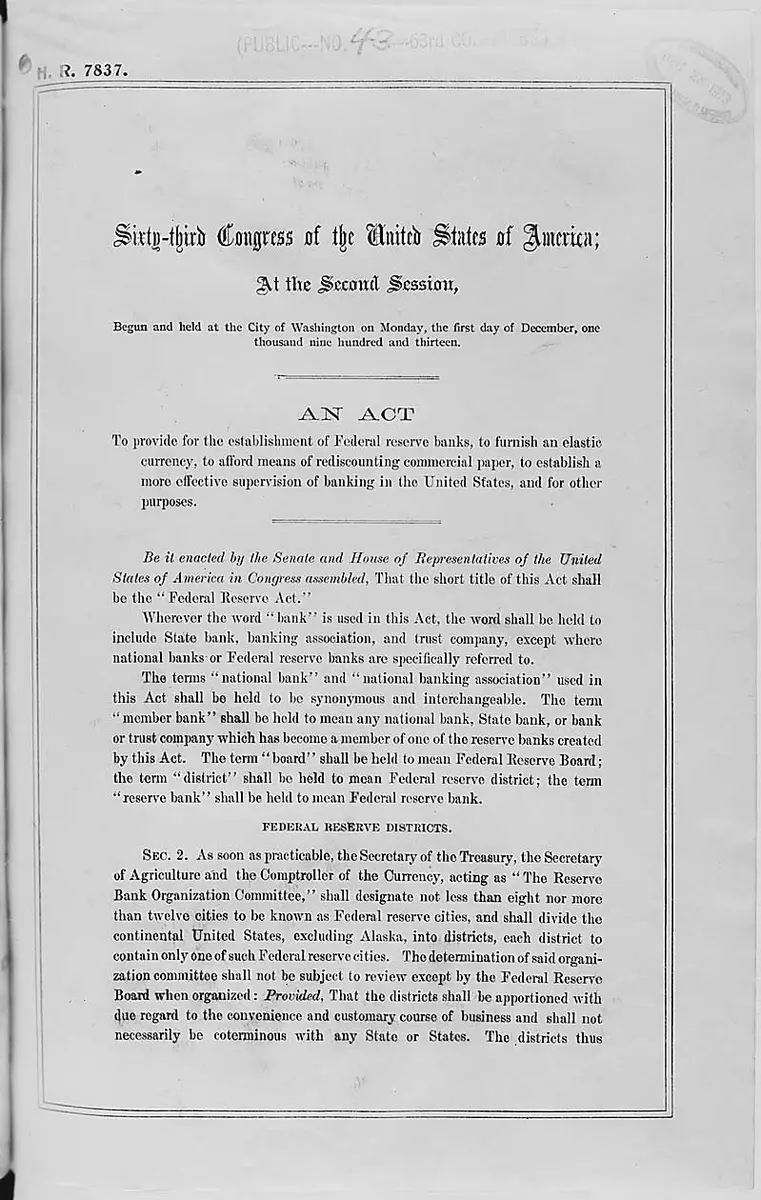
The panic was short, but the damage was not. New York's trust companies lost more than a third of their deposits between August and December; industrial output fell by about 17 per cent in 1908, America's furnaces were making less than half as much pig iron in January 1908 as in October, and the recession lasted until June 1908. The New York banks paid out cash freely again only in January, and the Knickerbocker reopened in March with new capital; Barney had shot himself in November. Congress answered with the Aldrich–Vreeland Act of 30 May 1908, which let groups of banks issue up to 500 million dollars of emergency notes in a crisis and created the National Monetary Commission of nine senators and nine representatives to study the money and banking system. Its recommendations, much changed, led to the Federal Reserve Act of 1913.
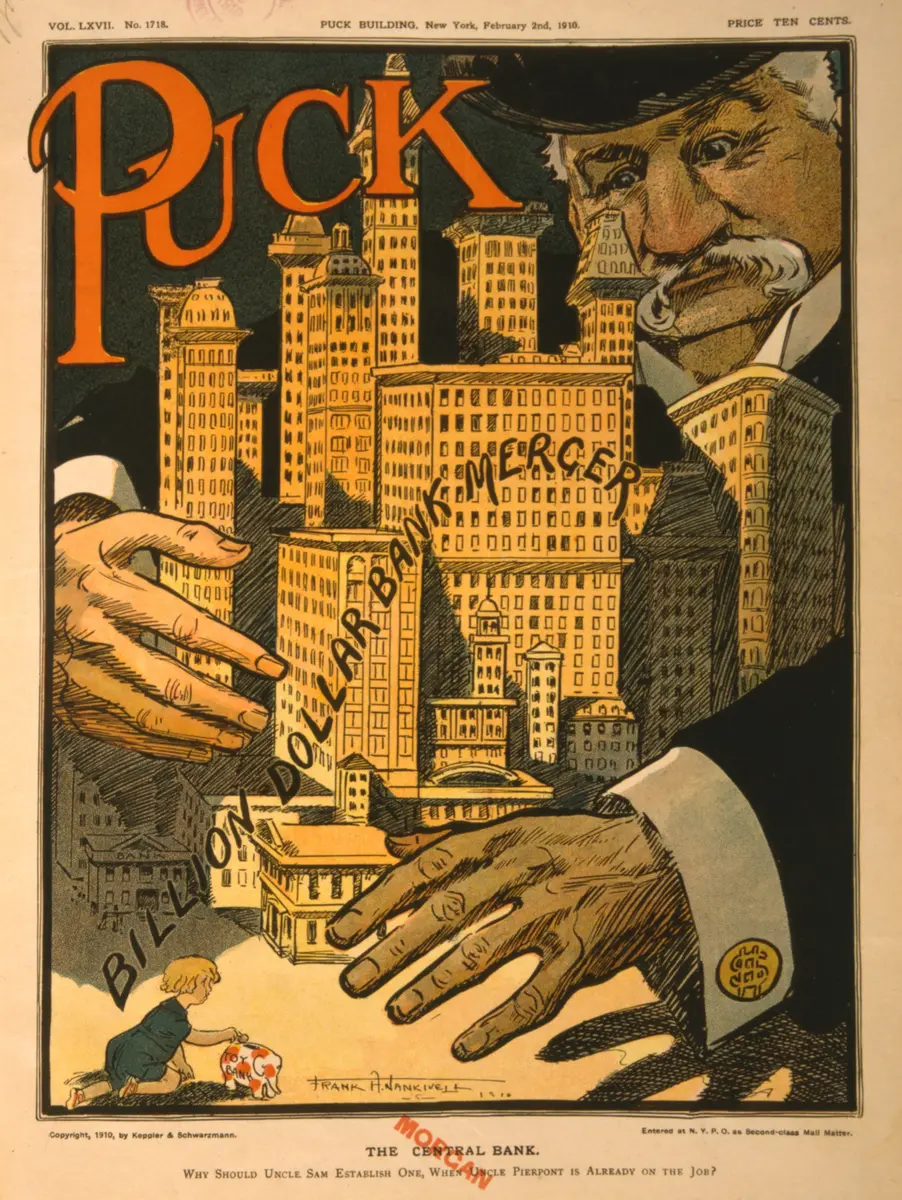
The Panic of 1907 is remembered as the moment when one private man did the work of a central bank, which made Morgan a hero to some and, to others, proof of a dangerous 'money trust': Congress later investigated the steel deal and, in 1912, Wall Street's 'money trust'. It also showed how a panic can start outside the protected core of the banking system. Economists writing for the Federal Reserve's history site compare the trust companies of 1907, which lent to brokers without the safety net of the Clearing House, with the 'shadow banks' whose runs set off the financial crisis of 2007–09.
What happened
- 1907
Otto Heinze & Co., the brokerage of F. Augustus Heinze's brothers, starts buying United Copper shares to squeeze the speculators who have sold them short, and the price runs up from about 39 dollars to 60.
The corner fails. United Copper crashes to about 10 dollars on the curb market, the Heinze brokerage collapses, and frightened depositors pull their money out of Heinze's Mercantile National Bank, which asks the New York Clearing House for help.
New York Clearing House, 77–83 Cedar Street: the loan certificates authorised on October 26, 1907 (the building, of 1896, was demolished in the 1960s)The Clearing House agrees to support the Mercantile National Bank, on condition that Heinze and all its directors resign.
New York Clearing House, 77–83 Cedar Street: the loan certificates authorised on October 26, 1907 (the building, of 1896, was demolished in the 1960s)News that Charles T. Barney, president of the Knickerbocker Trust Company, is an associate of Charles W. Morse starts a run on the Knickerbocker. The National Bank of Commerce lends it the money to pay.
Knickerbocker Trust Company, Fifth Avenue at 34th Street: the run of October 18 to 22, 1907 and the reopening of March 26, 1908Depositors leave Morse's other banks, the largest of them the National Bank of North America; two of them ask the Clearing House for help, which is given on condition that Morse leave New York banking altogether. In Richmond, Virginia, J. P. Morgan leaves the Episcopal Church's convention for New York.
Morgan reaches New York early on Sunday and goes straight to his library, where he sets up a small command: the bank presidents George F. Baker and James Stillman, and younger men to examine the books of firms in trouble, among them Benjamin Strong. The Clearing House announces that the banks linked to Heinze have been examined and are solvent.
Morgan's library on East 36th Street: the headquarters of the rescue, and the all-night meeting of November 3 to 4The Knickerbocker's directors force Barney to resign, and in the afternoon the National Bank of Commerce announces that it will no longer clear the Knickerbocker's checks. The bankers talk until 2 a.m. and decide to let it open and have its books examined.
Knickerbocker Trust Company, Fifth Avenue at 34th Street: the run of October 18 to 22, 1907 and the reopening of March 26, 1908Depositors line up at the Knickerbocker on Fifth Avenue from early morning. It pays out 8 million dollars in about three hours and then closes its doors; Morgan, without time to judge its assets, does not save it. Call money on the Stock Exchange jumps from 9.5 to 70 per cent.
Knickerbocker Trust Company, Fifth Avenue at 34th Street: the run of October 18 to 22, 1907 and the reopening of March 26, 1908In Nashville, President Theodore Roosevelt tells his audience that he doubts his policies, 'the effort to punish successful dishonesty', caused the trouble in the stock market, and that he will keep to them.
The Hermitage near Nashville, Tennessee: Roosevelt's visit on the day of his Nashville speech, October 22Treasury Secretary George Cortelyou, who came up from Washington the day before and met Morgan, Baker, Stillman and other bankers late into the night, spends the day at the Sub-Treasury on Wall Street, promising that the Treasury's help will be 'prompt and thorough'.
U.S. Sub-Treasury (today Federal Hall), Wall and Nassau Streets: Secretary Cortelyou worked here on October 23, and the Treasury's deposits went through itThe run moves to the Trust Company of America at 37 Wall Street and to the Lincoln Trust. Told by Strong that its assets are sound, Morgan decides that 'this is the place to stop the trouble', and by three o'clock about 3 million dollars has been brought to its counters. In Pittsburgh the Westinghouse companies go into receivership and the stock exchange closes.
Trust Company of America, 37 Wall Street: the run from October 23 to November 6, 1907, which Morgan chose to stop- 2:00 p.m.
The Treasury deposits 25 million dollars in the New York banks. With call money at 100 per cent and brokers about to fail, Morgan calls the bank presidents to his office at two o'clock and raises about 25 million dollars within minutes for loans on the Stock Exchange floor. Nevada declares the first of the legal holidays that free banks from paying.
J. P. Morgan & Co., the corner of Wall and Broad Streets: the bankers' meeting of October 24 that raised the money for the Stock Exchange Call money rises past 100 per cent again, and a second bankers' pool of about 10 million dollars carries the Stock Exchange through Friday.
New York Stock Exchange, Broad Street: call money at 100 per cent and Morgan's pools of October 24 and 25The New York Clearing House votes to issue loan certificates, which its member banks can use instead of cash to settle with each other, and the banks begin to limit the cash they pay out to depositors.
New York Clearing House, 77–83 Cedar Street: the loan certificates authorised on October 26, 1907 (the building, of 1896, was demolished in the 1960s)The Sunday papers print a letter from Roosevelt to Cortelyou praising the Treasury and the 'conservative and substantial business men' who have acted in the crisis. The cartoonist Clifford Berryman draws Wall Street as an invalid surrounded by their remedies.
The White House, Washington: Roosevelt agrees to U.S. Steel's purchase of Tennessee Coal, Iron and Railroad on November 4New York's mayor, George B. McClellan, tells Morgan, Baker and Stillman that the city cannot borrow the 30 million dollars it needs; Morgan forms a syndicate that takes 30 million dollars of 6 per cent city bonds. The same day the clearing houses of many other cities follow New York and issue certificates.
Cash now costs a premium in New York, as much as 4 per cent at times, and the premium lasts two months. California declares the first of its legal holidays, which run until December 21; across the country people are paid in clearing-house scrip, cashier's checks and company pay checks.
The brokerage house Moore & Schley, which holds a large block of Tennessee Coal, Iron and Railroad shares as security for its loans, is close to failing. In Morgan's library U.S. Steel's finance committee discusses buying the Tennessee company.
Ensley, Birmingham, Alabama: the steel works of the Tennessee Coal, Iron and Railroad Company, bought by U.S. Steel in November 1907- 9:30 p.m.
From half past nine in the evening more than fifty bankers wait in Morgan's library while he presses the trust company presidents to support the weakest trust companies. He keeps the key of the locked doors; at about a quarter past four in the morning they sign for a rescue fund of 25 million dollars, and the doors open at 4:45.
Morgan's library on East 36th Street: the headquarters of the rescue, and the all-night meeting of November 3 to 4 Elbert Gary and Henry Clay Frick of U.S. Steel see Roosevelt at the White House, with Secretary of State Elihu Root. Roosevelt raises no objection to their buying the Tennessee company and, before they leave, dictates a note saying so to Attorney General Bonaparte. The news reaches Wall Street just before the market opens, and shares rise.
The White House, Washington: Roosevelt agrees to U.S. Steel's purchase of Tennessee Coal, Iron and Railroad on November 4A committee of trust company presidents under Edward King takes control of the Trust Company of America and the Lincoln Trust and promises to pay their depositors in full. The runs, which have taken some 34 million dollars from the Trust Company of America in two weeks, stop.
Trust Company of America, 37 Wall Street: the run from October 23 to November 6, 1907, which Morgan chose to stopWith gold flowing to New York, the Bank of England raises its rate to 7 per cent, the highest since 1873. About 96 million dollars in gold reaches New York in November and December.
Bank of England, Threadneedle Street, London: its rate raised to 7 per cent on November 7 as gold flowed to New YorkCharles T. Barney, the former president of the Knickerbocker Trust, shoots himself.
The Treasury offers 50 million dollars of 2 per cent Panama Canal bonds and 100 million dollars of 3 per cent certificates, to give the banks a basis for new banknotes; only about 25 million dollars of the bonds and 15 million of the certificates are taken.
- 1908
In the first days of January the New York banks pay out cash freely again, and the currency premium is gone.
New York Clearing House, 77–83 Cedar Street: the loan certificates authorised on October 26, 1907 (the building, of 1896, was demolished in the 1960s)Industry hits bottom: America's furnaces make 33,700 tons of pig iron a day, less than half the 75,400 of October 1907. The recession lasts until June.
The Knickerbocker Trust Company reopens after five months, with 2.4 million dollars of new capital under a reorganisation agreed by its depositors and shareholders. By about the end of March the last of New York's loan certificates are paid off, after twenty-two weeks in use.
Knickerbocker Trust Company, Fifth Avenue at 34th Street: the run of October 18 to 22, 1907 and the reopening of March 26, 1908Roosevelt signs the Aldrich–Vreeland Act. Groups of at least ten national banks may now issue up to 500 million dollars of emergency notes in a crisis, and a National Monetary Commission of nine senators and nine representatives is set up to work out a lasting reform; the act is to expire on June 30, 1914.