The first ascent of Mount Everest
“On 29 May 1953 Edmund Hillary and the Sherpa Tenzing Norgay reached the top of Everest, the last stage of John Hunt's British expedition that Sherpas and porters carried up the mountain.”
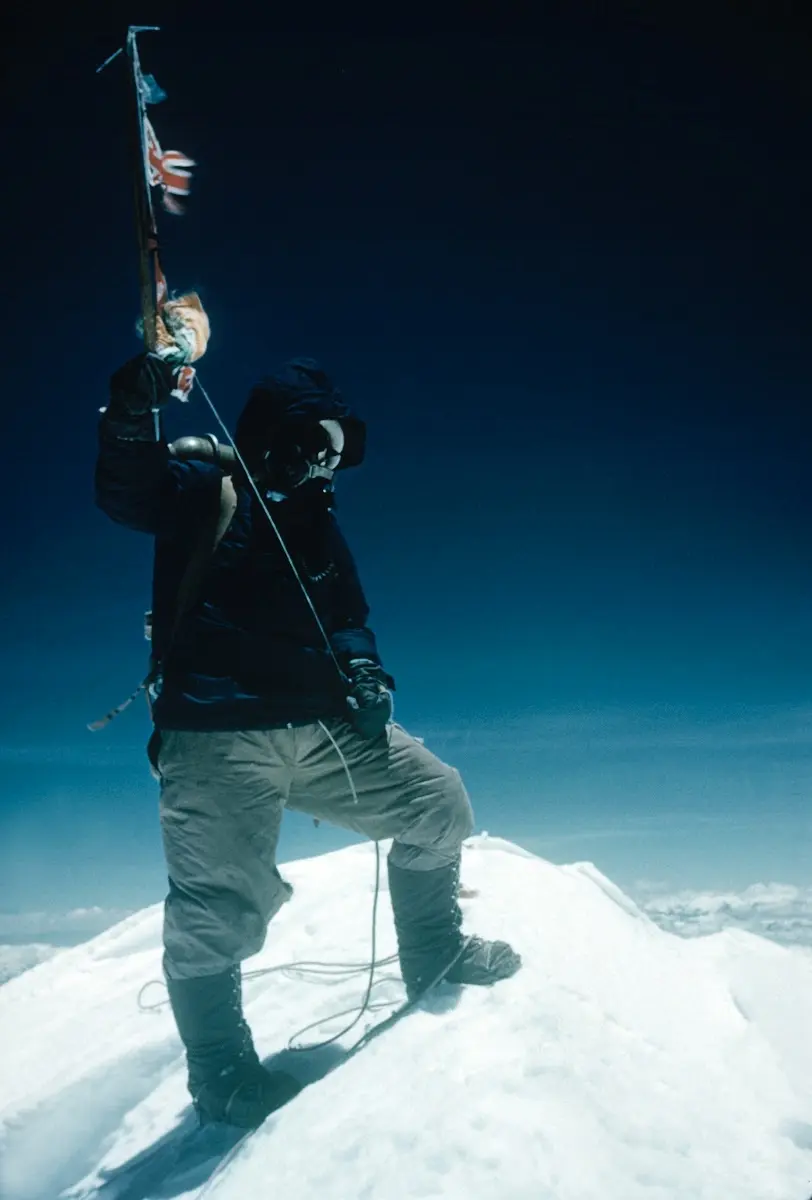
At 11:30 on the morning of 29 May 1953 two men stood on the top of Mount Everest, then reckoned at about 29,000 feet (about 8,850 m) high. One was Edmund Hillary, a beekeeper from New Zealand. The other was Tenzing Norgay, a Sherpa mountaineer who lived in Darjeeling, on his sixth visit to the mountain. Hillary took off his oxygen mask for about eight minutes and photographed Tenzing holding up an ice axe with the flags of the United Nations, Britain, Nepal and India. Tenzing buried sweets and biscuits in the snow as an offering to the mountain's gods, and Hillary left a small cross that John Hunt had given him. Then they turned round and went down.
They were the second pair of a large team, and the summit was the end of a thirty-year story. The first British expeditions went up from the north, through Tibet, in 1921, 1922 and 1924. In 1921 George Mallory looked from a pass across to the Western Cwm, the valley on the mountain's southern side that would become the approach of 1953. In 1924 Mallory and Andrew Irvine were last seen climbing high on the north-east ridge, and never came back. After the Second World War Tibet closed and Nepal opened its borders. A British party under Eric Shipton explored the southern route in 1951, and in 1952 two Swiss expeditions tried it, and the Swiss guide Raymond Lambert and Tenzing got within about 1,000 feet of the top. When the Swiss failed, the British expedition was ready. Its leader was Colonel John Hunt, who was invited to take over on 11 September 1952.
Hunt planned the climb like a military operation, and the Sherpas carried it. The Himalayan Club chose twenty of its best Sherpas, mostly from Darjeeling, to work at high altitude, with Tenzing as their leader and also a member of the climbing party. About 350 more Nepali porters carried the baggage on the march from Kathmandu. Sherpas fixed and carried loads through the Khumbu Icefall and the Western Cwm, up the Lhotse Face and across to the South Col, and some of them made history there: on 21 May Wilfrid Noyce and the Sherpa Annullu were the first to reach the Col, and on 28 May the Sherpa Ang Nyima helped carry the last loads up to the ridge camp at 27,900 feet. Hunt had planned two summit pairs. On 26 May Tom Bourdillon and Charles Evans, using new closed-circuit oxygen sets, reached the South Summit but turned back, about 300 feet short, when Evans's set failed. Two days later Hillary and Tenzing were put on the ridge by their supporters, slept a cold night, and set off at 6:30 the next morning.
The last part was Hillary's chimney: a 40-foot crack between a rock step and the snow cornice, which Hillary climbed first and Tenzing followed. The step was later named after Hillary. The two agreed not to say who put a foot on the top first, and only in 1955 did Tenzing's book say that it was Hillary. The Times correspondent, James Morris, sent the news down the mountain in a prearranged code by runner to the wireless post at Namche Bazaar, and it reached London on the eve of Queen Elizabeth II's coronation. On 2 June the crowds on the coronation route heard it, and the morning papers carried it. Hillary and Hunt were knighted, and Tenzing was given the George Medal, not a knighthood. In India and Nepal the press asked who had reached the top first, because both countries thought of Tenzing as their own.
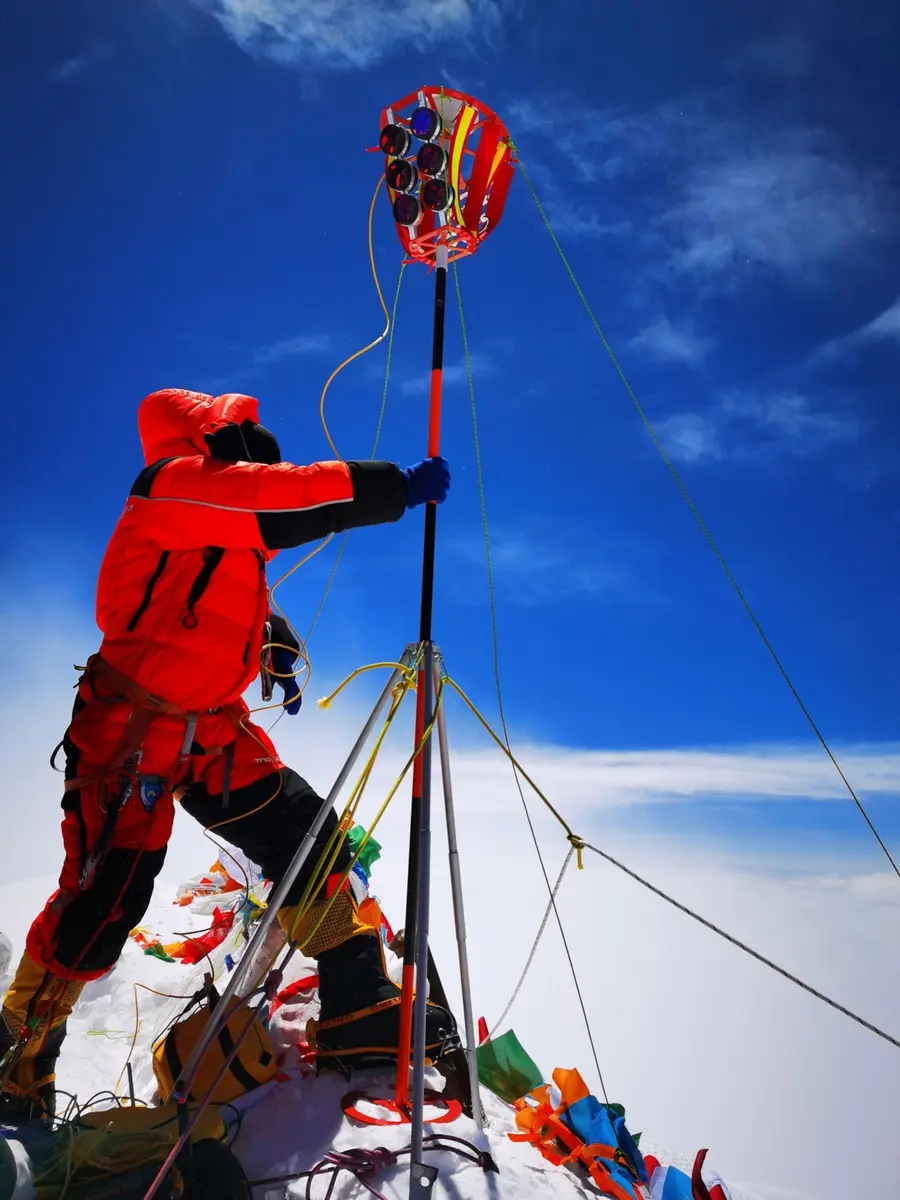
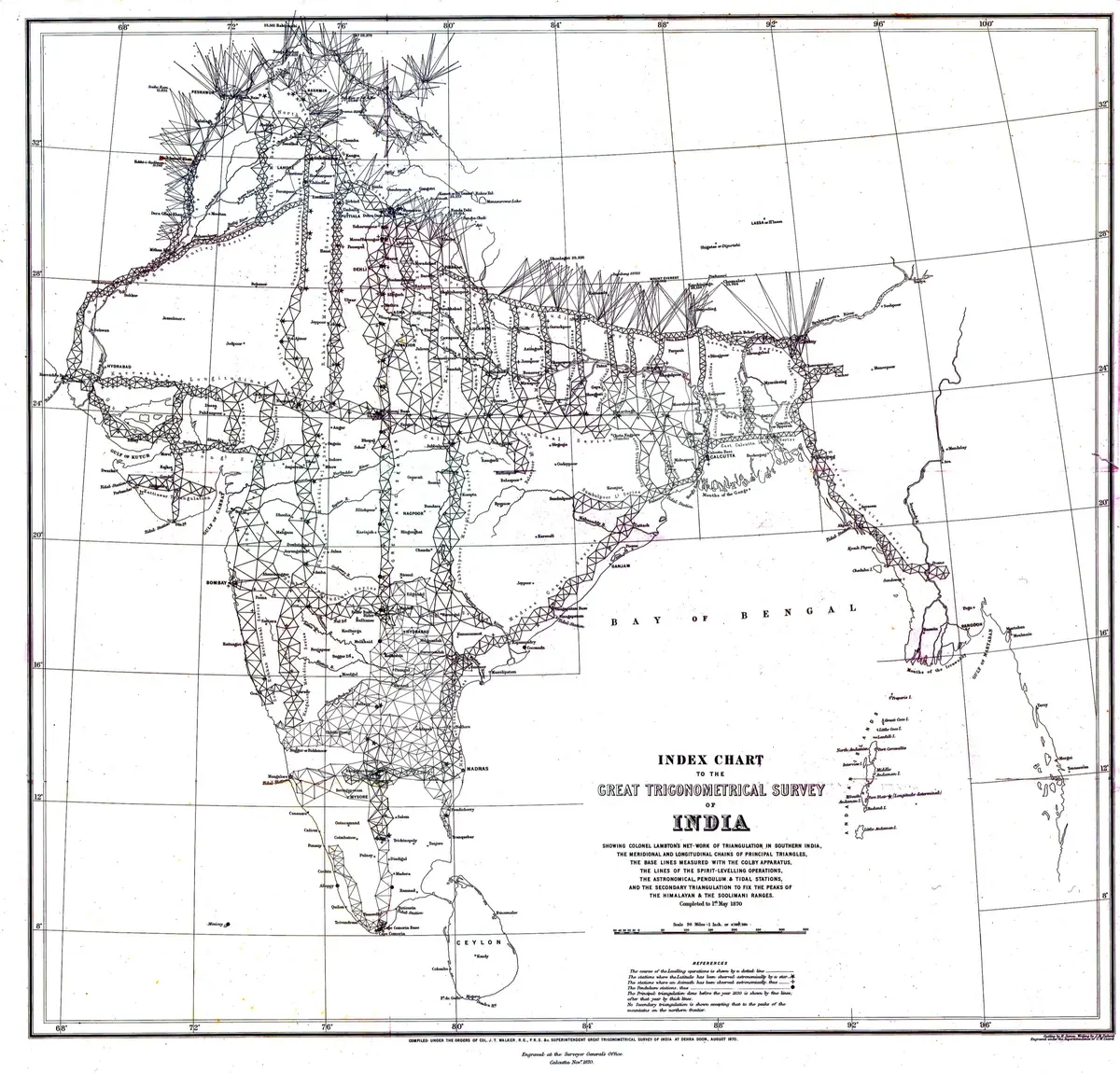
What it still shows is how mountaineering works. Two men reached the top, but twenty Sherpas, hundreds of porters and a team of ten climbers, a doctor and scientists put them there, and the route they used, through the Icefall and the Cwm, is still the standard way up from Nepal. The ascent also changed Everest from the goal of a few explorers into a place that many thousands now visit, and it is why the height of the mountain, first measured by the Survey of India in the 1850s and last agreed in 2020, matters to so many.
What happened
- 1921
The first British expedition to look at Everest, under Charles Howard-Bury, leaves Darjeeling for Tibet; Mallory is one of its four climbers. The mountain has never been closely seen or surveyed.
Darjeeling, home of the Sherpas who worked on Everest expeditions and of Tenzing; the Himalayan Mountaineering Institute stands there- 5:00 a.m.
At 5 a.m. Mallory reaches a col at the head of the West Rongbuk glacier and looks across into the Western Cwm, 'terribly cold and forbidding' under Everest. He sees a drop of about 1,500 feet and judges the approach hopeless from there. Thirty-two years later it becomes the way to the summit.
The Western Cwm, the high valley under Everest and Lhotse that Mallory saw in 1921 and the expedition used in 1953 - 1924
- 12:50 p.m.
Noel Odell, climbing below, sees two small figures high on the north-east ridge, close to a rock step: George Mallory and Andrew Irvine, who left Camp IV on 6 June with porters. They are never seen again, and whether they reached the top is still not known.
Summit of Everest (Sagarmatha, Chomolungma), on the Nepal-Tibet border, where Hillary and Tenzing stood at 11:30 on 29 May 1953 - 1952
Two Swiss expeditions try the new southern route in 1952; in the spring attempt the Swiss guide Raymond Lambert and the Sherpa Tenzing climb the south-east ridge to about 1,000 feet below the top, as high as Norton had gone on the north face. They are turned back by cold and exhaustion.
The South Col, the pass between Everest and Lhotse (about 26,000 ft) where the expedition's high camp stoodJohn Hunt, a British Army officer, receives a telegram inviting him to lead the 1953 British expedition. He is in Germany preparing for manoeuvres and cannot be released for another month; he reaches London on 8 October. The party of ten climbers is decided by 1 November.
- 1953
The main party and its baggage sail from Britain for Bombay on the S.S. Stratheden. The baggage, 473 packages weighing seven and a half tons, has been packed in London and goes to Kathmandu by sea, rail, road and a ropeway. Evans and Gregory fly on ahead to Kathmandu on 20 February.
The twenty Sherpas chosen by the Himalayan Club arrive at Kathmandu from Darjeeling with their sirdar Tenzing, who is also to climb. Hunt writes that this is Tenzing's sixth visit to Everest, and that he is 'a mountaineer of world standing' after 1952.
Kathmandu, where the expedition assembled in March and was welcomed back in June 1953The expedition climbs the path to Namche Bazaar, the chief village of Khumbu. Hunt is surprised to find a small wireless station there; it will carry the expedition's messages and, in May, the news of the summit.
Namche Bazaar, the Sherpa market town with the wireless post that sent the news outThe Icefall party, led by Hillary, reaches Base Camp at 17,900 feet on the Khumbu glacier, after the march from Thyangboche. Over the next ten days the climbers and Sherpas find and fix a route through the Khumbu Icefall, which Mallory had thought unclimbable in 1921.
The Khumbu Icefall, the glacier's frozen cascade that the climbers and Sherpas had to cross to reach the Western CwmCamp III is set up at the head of the Icefall, at 20,200 feet. From here the route runs up the Western Cwm to Advance Base, which will be Camp IV.
The Western Cwm, the high valley under Everest and Lhotse that Mallory saw in 1921 and the expedition used in 1953- 2:40 p.m.
Wilfrid Noyce and the Sherpa Annullu climb across the Geneva Spur and stand on the South Col at 2:40 p.m., the first men of the expedition there. Hunt, watching from Advance Base, sees them as a blue dot against the rocks; Annullu leads much of the way. Their return, unhurt, convinces the waiting Sherpas that the Col can be reached.
The South Col, the pass between Everest and Lhotse (about 26,000 ft) where the expedition's high camp stood Charles Wylie leads fourteen Sherpas up to the South Col, with Hillary and Tenzing ahead, and they dump the loads there. One Sherpa does not complete the climb. The stocking of the Col, by Sherpas carrying loads up the Lhotse Face, is what makes both summit attempts possible.
The South Col, the pass between Everest and Lhotse (about 26,000 ft) where the expedition's high camp stood- 1:00 p.m.
Tom Bourdillon and Charles Evans, using closed-circuit oxygen, reach the South Summit at about 1 p.m., some 300 feet below the top, and turn back. Evans's oxygen set has failed: two valves, one broken and one frozen, delayed their start by an hour and a half. The same day Hunt and the Sherpa Da Namgyal carry loads up the ridge to 27,350 feet, a dump that Hillary and Tenzing will pass.
Summit of Everest (Sagarmatha, Chomolungma), on the Nepal-Tibet border, where Hillary and Tenzing stood at 11:30 on 29 May 1953 Hillary and Tenzing, the second pair, reach the South Col with their support party: Gregory, Lowe and the Sherpas Pemba, Ang Temba and Ang Nyima, while other Sherpas carry extra loads. Strong wind keeps them on the Col.
The South Col, the pass between Everest and Lhotse (about 26,000 ft) where the expedition's high camp stood- 2:30 p.m.
Hillary, Tenzing, Gregory, Lowe and the Sherpa Ang Nyima carry loads to a ledge on the south-east ridge at about 27,900 feet and cut a platform for one tent. The three supporters go back down; Hillary and Tenzing spend a cold night, sitting up, with two hours of oxygen to doze on. At 4 a.m. the thermometer reads minus 27 degrees Celsius.
Hillary and Tenzing climb down the ridge and the couloir to the South Col, where George Lowe meets them with hot drinks and they tell him the news. Noyce and the Sherpa Pasang Phutar are on the Col; that evening Noyce lies out on the Geneva Spur in a T-shape of sleeping bags as a signal agreed with Hunt, who sees it from below.
The South Col, the pass between Everest and Lhotse (about 26,000 ft) where the expedition's high camp stood- 6:30 a.m.
After tea and a few biscuits Hillary and Tenzing leave the ridge camp at about 6:30 a.m. in oxygen masks and climb the narrow ridge and the steep 400-foot snow slope to the South Summit, at about 28,700 feet. Alfred Gregory, watching from the South Col, sees them at 9 o'clock climbing well. Beyond the South Summit Tenzing's oxygen tube freezes; Hillary clears it.
Summit of Everest (Sagarmatha, Chomolungma), on the Nepal-Tibet border, where Hillary and Tenzing stood at 11:30 on 29 May 1953 - 11:30 a.m.
Hillary climbs a 40-foot crack between the rock step and the cornice and pulls Tenzing up after him; they cut steps along the last snow humps and reach the top at 11:30. Hillary takes off his mask and photographs Tenzing with his ice axe and the four flags, and then the view down every ridge. Tenzing buries sweets and biscuits; Hillary leaves a cross. After about eight minutes without a mask, they put the oxygen back on and start down.
Summit of Everest (Sagarmatha, Chomolungma), on the Nepal-Tibet border, where Hillary and Tenzing stood at 11:30 on 29 May 1953 Hillary and Tenzing come down the Lhotse Face to Camp IV. George Lowe runs to meet them and gives a thumbs-up; Sherpas shake Hillary's hand and treat Tenzing with deep respect. James Morris of The Times takes down their story at once, and goes down the Icefall that night to Base Camp with Mike Westmacott.
The Western Cwm, the high valley under Everest and Lhotse that Mallory saw in 1921 and the expedition used in 1953At Base Camp Morris sends his message down the valley by runner to the wireless post at Namche Bazaar, in the prearranged code, 'Snow conditions bad. Advance base abandoned yesterday. Awaiting improvement. All well', so that rival newspapers will not understand it. From Namche it goes to Kathmandu and by cable to London.
Namche Bazaar, the Sherpa market town with the wireless post that sent the news outThe news that Everest has been climbed reaches London on the night before the Coronation. Hunt later heard on the radio that it 'broke in London last night'.
On the way back it is learned that Hillary has been appointed a Knight Commander of the Order of the British Empire and Hunt a knight. Hillary first has doubts about accepting a title.
On Coronation Day the announcement is read over loudspeakers along the route to Westminster Abbey and The Times prints the scoop; the crowds cheer. The Queen and the Prime Minister send telegrams of congratulation to the expedition through the British ambassador at Kathmandu.
Buckingham Palace, London, where the new Queen waved from the balcony on Coronation Day, 2 June 1953, and where the honours were later givenAt Base Camp that evening the expedition tunes the radio to All India Radio for the Coronation news. The announcer's second headline says that Everest has been climbed. Hunt writes that they were 'dumbfounded' to find that London had known for 24 hours. A runner is sent to Namche with cables to the Queen and the Prime Minister.
Everest base camp on the Nepal side, on the Khumbu glacier at 17,900 ft, the expedition's base from 12 April 1953The main party reaches Kathmandu, with a crowd, bunting and troops in the street; the advance party under Hunt had arrived on 13 June. The Sherpas who had carried the expedition come with them.
Kathmandu, where the expedition assembled in March and was welcomed back in June 1953Tenzing is awarded the George Medal. The British honour is chosen after consultation with the governments of India and Nepal; Hunt is knighted on his return to London. The team visits Buckingham Palace.
Buckingham Palace, London, where the new Queen waved from the balcony on Coronation Day, 2 June 1953, and where the honours were later givenHillary and Hunt receive the Livingstone Medal of the Royal Scottish Geographical Society at the Usher Hall in Edinburgh. Hillary had married Louise Rose on 3 September and begun a five-month lecture tour of Europe and America.
Hillary lectures at the Concertgebouw in Amsterdam, meeting Crown Princess Beatrix, in the middle of his lecture tour. The Nationaal Archief's caption says that in his lecture he gives the credit mainly to Tenzing.
- 1954
The National Geographic Society gives its Hubbard Medal 'to the British Everest Expedition' in Washington, with the names of Hunt, Hillary and Tenzing; the case says it was presented on behalf of the Society by President Eisenhower.