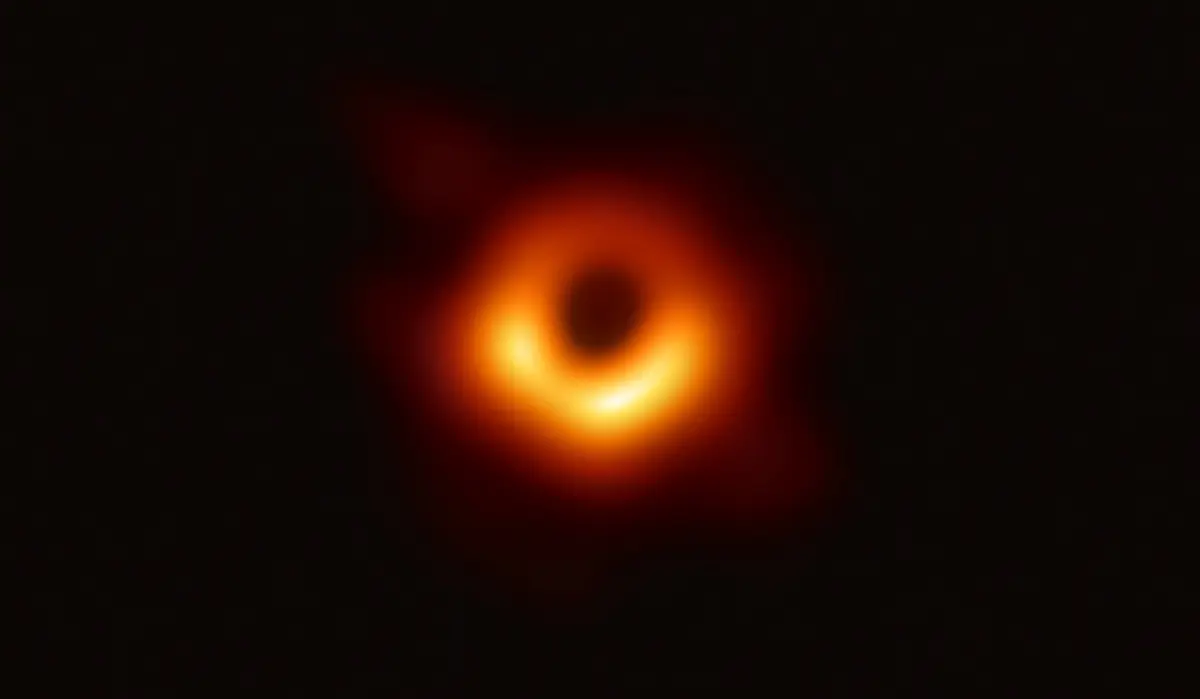
The first photo of a black hole
“In April 2019 the Event Horizon Telescope, eight radio telescopes linked into one Earth-sized dish, showed the first image of a black hole: a glowing ring around the shadow of the giant black hole in M87.”
On 10 April 2019, at six press conferences held at the same moment in Brussels, Washington, Santiago, Shanghai, Taipei and Tokyo, astronomers showed the first image of a black hole: a lopsided ring of light, shown in orange, around a dark centre. The black hole sits at the heart of M87, a giant galaxy in the constellation Virgo about 55 million light-years away, and weighs about 6.5 billion times as much as the Sun. The picture is not a photograph in the everyday sense. Computers built it from radio waves 1.3 millimetres long, recorded in April 2017 by eight radio telescopes in Hawaii, Arizona, Mexico, Chile, Spain and at the South Pole, linked into one instrument called the Event Horizon Telescope. The dark centre is the black hole's 'shadow', the place from which no light reaches us; it is about two and a half times wider than the event horizon itself, the edge beyond which nothing, not even light, can get out.
The idea is a century old. In January 1916, only weeks after Einstein presented his general theory of relativity in November 1915, the German astronomer Karl Schwarzschild, then serving with the army in Russia, found the first exact solution of its equations; it describes the space around a mass squeezed into a point, and contains the boundary now called the event horizon. Schwarzschild died of an illness caught at the front a few months later. In 1939 Robert Oppenheimer and Hartland Snyder showed that a heavy enough burnt-out star must collapse without end. The name 'black hole' was in print by 1964 and caught on after the American physicist John Wheeler took it up in 1967. Astronomers came to think that giant black holes power the jets of galaxies like M87, whose 'curious straight ray' Heber Curtis had noticed in 1918; and in 2000 Heino Falcke, Fulvio Melia and Eric Agol predicted that the black hole at the centre of our own galaxy, lit by the hot gas around it, would cast a 'shadow' just large enough for radio telescopes linked across the Earth, working at wavelengths below a millimetre, to see.
No single dish could be big enough, so the Event Horizon Telescope links observatories thousands of kilometres apart, each timed by an atomic clock, and lets the turning Earth fill in the gaps between them: a technique called very-long-baseline interferometry. On four nights, 5, 6, 10 and 11 April 2017, the eight telescopes, among them 37 antennas of the ALMA array in Chile working as one dish, recorded about a petabyte of data each. That was far too much to send over the internet, so the hard disks were flown by courier to two supercomputers called correlators, at MIT's Haystack Observatory near Boston and at the Max Planck Institute for Radio Astronomy in Bonn; the South Pole's disks had to wait out the Antarctic winter and arrived only in December. After months of checking, the data went in June 2018 to four teams who worked apart, without talking, so that nobody's expectations could shape the result; seven weeks later all four had found the same ring.
The ring looked just as Einstein's theory predicts for the shadow of a black hole, and its size gave a mass of 6.5 billion Suns, in line with the earlier estimate from the motions of the galaxy's stars rather than the lower one from its gas; the EHT called it the strongest evidence yet that supermassive black holes exist. It was described in six papers in The Astrophysical Journal Letters, published the same day and signed by the whole collaboration, formed by 13 partner institutions; in September 2019 the papers' 347 co-authors were awarded the Breakthrough Prize in Fundamental Physics. 'We have taken the first picture of a black hole,' said the project's director, Sheperd Doeleman. In Hawaii the black hole received a name, Pōwehi, 'embellished dark source of unending creation', taken from the Kumulipo creation chant.
The image opened a new way of testing gravity where it is strongest. In March 2021 the same team showed M87's black hole in polarised light, which traces the magnetic fields near its edge that are thought to launch its jet, and on 12 May 2022 it released the first image of Sagittarius A*, the far smaller black hole at the centre of our own Milky Way. In between, the 2020 Nobel Prize in Physics went to Roger Penrose for proving that general relativity leads to black holes, and to Reinhard Genzel and Andrea Ghez for finding the one in our galaxy by the stars that orbit it.
What happened
- 2017
The Event Horizon Telescope's campaign begins with the first of four nights on M87. From Hawaii, Arizona, Mexico, Chile and Spain the telescopes watch the same spot at the same moments, each recording radio waves 1.3 mm long onto hard disks stamped by an atomic clock; the eighth, at the South Pole, cannot see M87 and observes other targets. In Chile 37 of ALMA's antennas, joining for the first time, work as one dish 73 metres wide; the weather is good to excellent everywhere.
ALMA on the Chajnantor plateau, Chile: 37 of its antennas worked as one dish, the EHT's most sensitive stationThe fourth and last night on M87 ends the campaign; the image later shown to the world is the one made from this night. Each station has filled about a petabyte of disks, far more than the internet could carry, so they are packed and flown by courier: one frequency band to MIT's Haystack Observatory, the other to the Max Planck Institute for Radio Astronomy in Bonn.
With the first flights after the Antarctic winter, the South Pole Telescope's disks, in cold storage since April, leave the Pole in early November on a journey by air, sea and land through McMurdo Station, Christchurch in New Zealand and Port Hueneme in California.
The South Pole Telescope at the Amundsen–Scott South Pole Station, whose disks waited out the winterOn Wednesday 13 December the South Pole disks reach Haystack, the last of the 2017 data; half go on to Bonn. Once warmed up, they are played back into the correlators, which line up the recordings of every pair of telescopes by their atomic-clock time stamps, a job of about three weeks.
MIT Haystack Observatory, Westford, Massachusetts: one of the two correlators that combined the data- 2018
At Haystack and Bonn the correlated data are checked and calibrated through five 'engineering releases', the teams finding and fixing problems at the different telescopes and correlating again until the data can be trusted: a year-long effort.
The Max Planck Institute for Radio Astronomy, Bonn: the other correlatorIn the second week of June an early release of the 11 April data goes to four imaging teams, who work for seven weeks without contact, two with newer methods and two with the classic CLEAN, so that no shared expectation can shape the result. When they meet at Harvard's Black Hole Initiative to compare, all four have found the same lopsided ring, about 40 microarcseconds across.
- 2019
The first three of six papers, on the array, the processing of the data and the imaging, reach The Astrophysical Journal Letters; the papers on the shadow, its physics and the black hole's mass follow in early March.
The last of the six papers, which weighs the black hole at about 6.5 billion Suns from the size of its shadow, is accepted.
The European Commission, the European Research Council and the EHT invite the press to six simultaneous press conferences on 10 April, in Brussels, Washington, Santiago, Shanghai, Taipei and Tokyo, 'to present a groundbreaking result', without saying what it is.
The Berlaymont, Brussels: the European press conference, one of six held at the same moment on 10 April 2019The six papers appear in a special issue of The Astrophysical Journal Letters, signed by the Event Horizon Telescope Collaboration. The same day the University of Hawaiʻi gives the black hole a Hawaiian name, Pōwehi, 'embellished dark source of unending creation', chosen by the language professor Larry Kimura from the Kumulipo creation chant.
- 3:07 p.m.
At 15:07 Brussels time, seven minutes into the press conferences (9:07 in Washington), the image is released. In Brussels the EU research commissioner Carlos Moedas opens and Heino Falcke, chair of the EHT Science Council, sits on the panel; in Washington the NSF director France Córdova calls it 'seeing the unseeable'. 'We have taken the first picture of a black hole,' says the project's director, Sheperd Doeleman.
The Berlaymont, Brussels: the European press conference, one of six held at the same moment on 10 April 2019