Aztec Empire
“Tenochtitlan's Triple Alliance, which taxed central Mexico from 1428 until Cortés, Tlaxcala and smallpox brought the city down on August 13, 1521.”
The Aztec Empire was the alliance of three cities in the Valley of Mexico, Tenochtitlan, Texcoco and Tlacopan, that ruled most of central Mexico for less than a century before the Spaniards destroyed it. Its makers called themselves Mexica. By their own account they had wandered south from a homeland called Aztlan until, in 1325, they saw an eagle on a cactus on an island in Lake Texcoco and built Tenochtitlan there, a city of canals and causeways that grew to 200,000 people or more, larger than any city in Spain. In 1428 their ruler Itzcoatl joined Texcoco and Tlacopan to overthrow the lake's overlord, Azcapotzalco; the three victors divided its lands and agreed to conquer together, and this Triple Alliance, with Tenochtitlan soon the senior partner, is what the world calls the Aztec Empire.
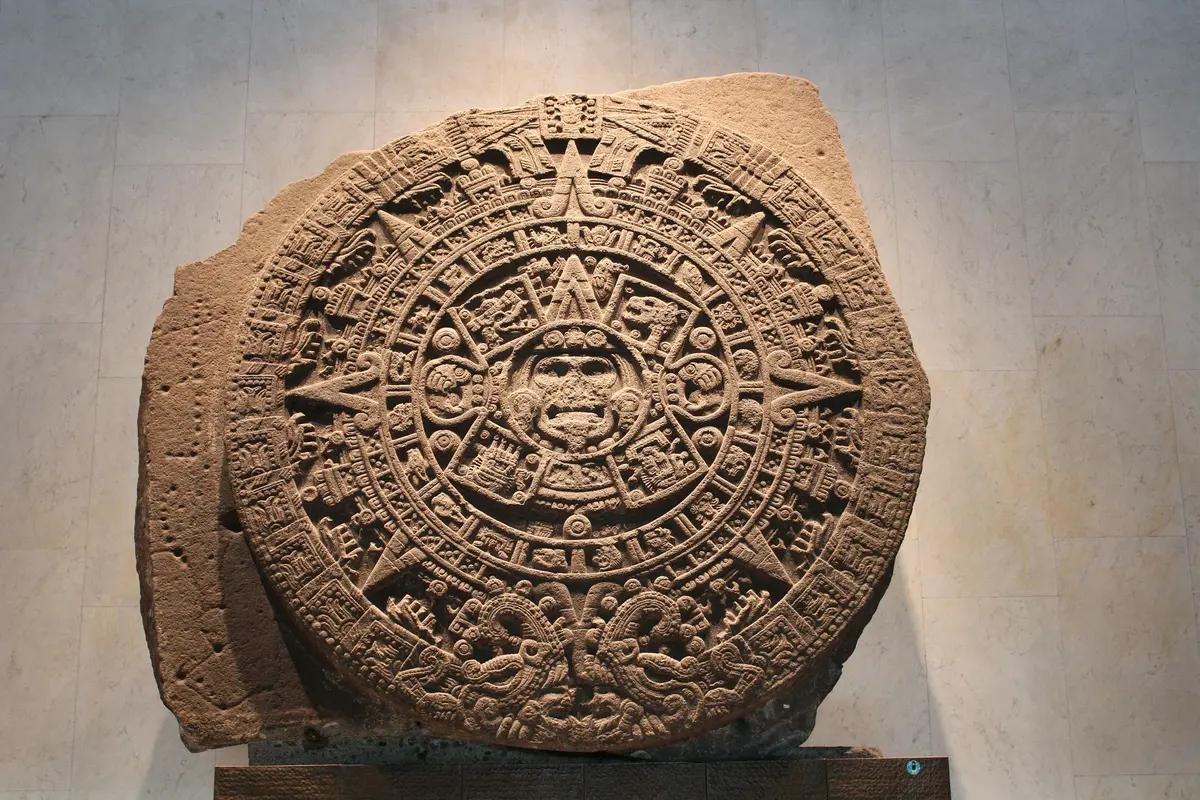
The alliance did not govern its conquests; it taxed them. Armies marched out each dry season. Cities that submitted kept their own lords and sent tribute, cotton cloth, maize, cacao, feathers, gold, jade and warriors, which the Codex Mendoza lists province by province, and cities that resisted were burned. By the reign of Moctezuma II, crowned in 1502, the alliance reached from the Gulf to the Pacific and south to Guatemala, with the independent Tlaxcalans, the Tarascans and a few others left as enemies inside and beyond its borders. At the centre stood the Templo Mayor, the twin pyramid of the rain god Tlaloc and the war god Huitzilopochtli, whose rebuilding in 1487 was marked by the sacrifice of thousands of captives, for the Mexica held that the sun had to be fed with blood. Around it lay palaces, a market the Spaniards compared to Constantinople's, schools for every child, and sculptors who carved the Sun Stone and the Coyolxauhqui disc.
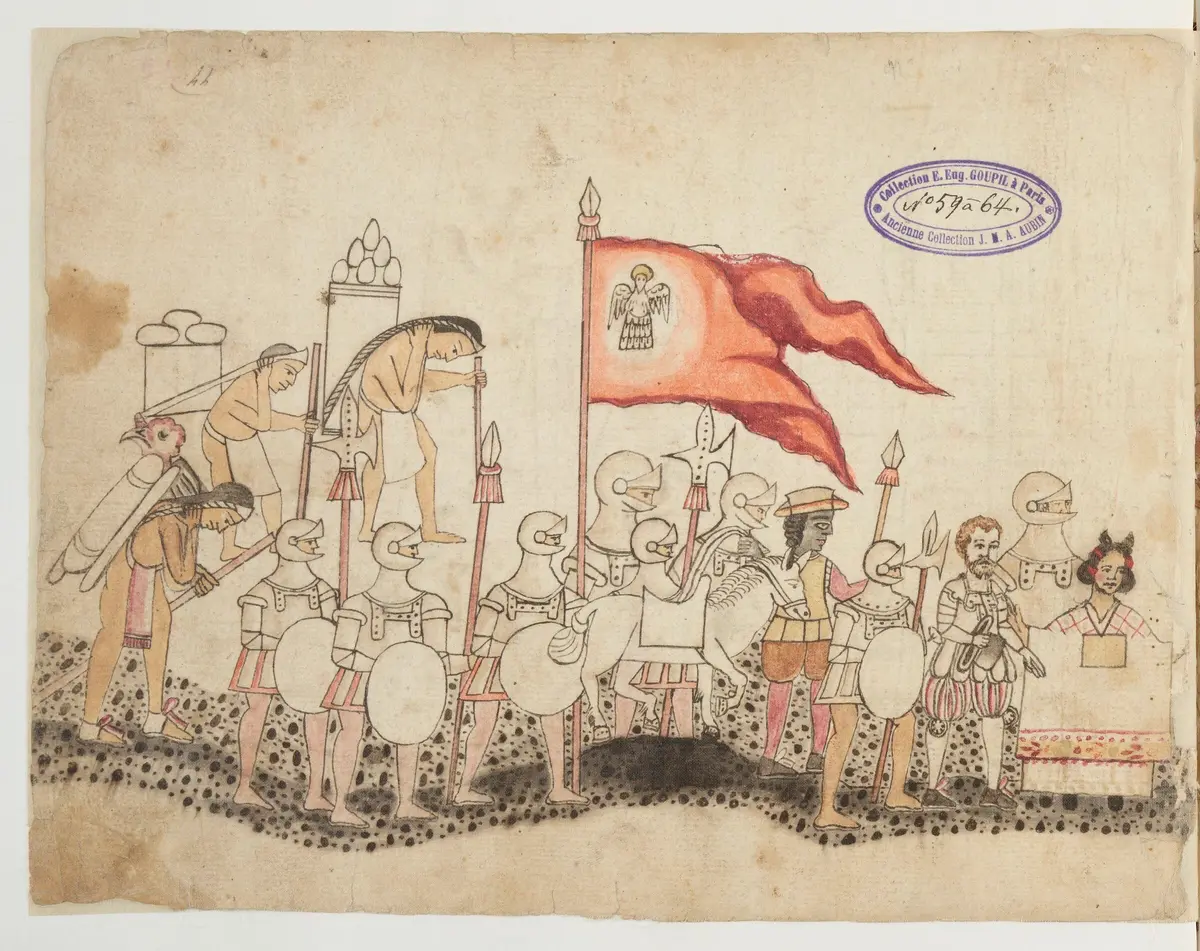
In April 1519 Hernán Cortés landed on the Gulf coast with some five hundred men and sixteen horses, scuttled his ships, and found that the empire's subjects and enemies would fight for him: Tlaxcala, after losing to him in battle, became his ally, and he entered Tenochtitlan as Moctezuma's guest on November 8, 1519, and seized the emperor within days. A massacre of nobles at a festival in May 1520 brought the city up in arms; Moctezuma died, and on the night of June 30 the Spaniards fled along the causeway to Tlacopan and lost most of their force. Smallpox, carried in by the Spaniards, then killed Moctezuma's successor and a large part of the people. Cortés came back in 1521 with brigantines to command the lake and tens of thousands of native allies, besieged the city for three months, and took it street by street; Cuauhtémoc, the last ruler, was captured on August 13, 1521.
Mexico City was built on the ruins, its cathedral beside the Templo Mayor, whose remains electricity workers struck in 1978. Spanish friars and Nahua writers recorded the empire within a generation, in the Codex Mendoza, Sahagún's Florentine Codex and the Tlaxcalans' painted histories, so it is the best-documented of the American civilisations. Nahuatl survives with more than a million speakers and gave the world the words tomato, chocolate and avocado; the eagle on the cactus is on Mexico's flag, and the Sun Stone is the country's emblem of its past.
What happened
- 1428
Itzcoatl of Tenochtitlan, with Nezahualcoyotl of Texcoco and the lord of Tlacopan, destroys Azcapotzalco, the overlord of the lake; the three cities divide its lands and agree to conquer together: the Triple Alliance.
The Templo Mayor, Tenochtitlan: the twin pyramid of Tlaloc and Huitzilopochtli, found again in 1978 - 1440
Moctezuma I succeeds Itzcoatl and, with Nezahualcoyotl, pushes the alliance's wars beyond the valley into Morelos and towards the Gulf; a four-year drought from 1450 halts them and brings famine.
- 1473
Tenochtitlan conquers its twin city Tlatelolco, whose great market it keeps; the Coyolxauhqui stone is set at the foot of the Templo Mayor around this time.
Tlatelolco: Tenochtitlan's twin city, conquered in 1473, where the defenders made their last stand in August 1521 - 1487
Ahuitzotl dedicates the rebuilt Templo Mayor with the sacrifice of thousands of captives over four days; the chronicles' figure of 80,400 is not believed, but the scale is not in doubt.
The Templo Mayor, Tenochtitlan: the twin pyramid of Tlaloc and Huitzilopochtli, found again in 1978 - 1502
Moctezuma II is crowned; the alliance is at its greatest extent, from the Gulf to the Pacific and south to Guatemala, and its subjects resent the growing demands for tribute and victims.
The Aztec Empire about 1500, from the Gulf to the Pacific, as the historical-basemaps dataset draws it - 1519
Cortés lands near San Juan de Ulúa with 508 soldiers and 16 horses, founds Veracruz to make himself independent of the governor of Cuba, and scuttles his ships; Moctezuma's envoys bring gifts of gold.
San Juan de Ulúa, Veracruz: where Cortés landed on April 21, 1519The Tlaxcalans, who had fought the Mexica for generations, battle Cortés for two weeks and then make him their ally; their warriors will outnumber his Spaniards a hundred to one.
Tlaxcala: the unconquered republic that became Cortés's ally in September 1519At Cholula, Moctezuma's holy city, Cortés's men and the Tlaxcalans kill thousands of unarmed townsmen in the main square, claiming a plot.
Cholula: the Great Pyramid of the holy city where Cortés's men killed thousands in October 1519Moctezuma meets Cortés on the southern causeway and lodges the Spaniards in his father's palace; within days they take him hostage and rule the city through him.
The Templo Mayor, Tenochtitlan: the twin pyramid of Tlaloc and Huitzilopochtli, found again in 1978- 1520
While Cortés marches to the coast to defeat Narváez, sent to arrest him, Pedro de Alvarado massacres the Mexica nobles at the festival of Toxcatl; the city rises and besieges the Spaniards in the palace.
Moctezuma dies, stoned by his own people as the Spaniards tell it, killed by the Spaniards as the Mexica tell it; that night Cortés's army breaks out along the Tlacopan causeway and loses most of its men and all its gold: the Noche Triste.
Tlacopan (Tacuba): the third ally; the Spaniards fled along its causeway on the Noche TristeAt Otumba the pursuing Mexica army catches the fugitives; the Spanish horsemen cut down its commanders and the survivors reach Tlaxcala.
Otumba: the battle of July 7, 1520 that let the beaten Spaniards reach TlaxcalaSmallpox, carried in with Narváez's men, has swept the valley since October; it kills the new ruler Cuitláhuac after eighty days on the throne, and his young cousin Cuauhtémoc succeeds him.
- 1521
Cortés returns with thirteen brigantines built in Tlaxcala and carried to the lake, cuts the aqueduct and the causeways, and besieges Tenochtitlan with tens of thousands of native allies.
The Templo Mayor, Tenochtitlan: the twin pyramid of Tlaloc and Huitzilopochtli, found again in 1978After three months of famine and street fighting the last defenders are cornered in Tlatelolco; Cuauhtémoc is captured trying to escape by canoe, and the Aztec Empire is over.
Tlatelolco: Tenochtitlan's twin city, conquered in 1473, where the defenders made their last stand in August 1521