Punk
“Punk: torn clothes, safety pins and bondage gear from a London shop and the New York club scene; the style that taught high fashion to copy the street.”
Punk was the first youth style to make a look out of damage. Clothes were torn, then held together with safety pins; T-shirts were slashed and scrawled with slogans; jeans were ripped; leather jackets were covered in chains, studs and badges; hair was cropped, spiked and dyed. Nothing had to be expensive. The point was to look as if you did not care what the grown-up world thought of you, and to make that world flinch. It started with music and with two places, a club in New York and a shop in London, and within a few years it had spread beyond both, as far as the Dutch punks of Amsterdam.
In New York, around 1974, the bands at the CBGB club on the Bowery wore little that was new. The Ramones, founded that year, made their name in ripped jeans and black leather jackets, and Britannica adds that Richard Hell of Television took to tearing his T-shirt. In London, Malcolm McLaren and Vivienne Westwood ran a shop at 430 King's Road, Chelsea, which became SEX in 1974 and Seditionaries in 1976. McLaren, back from a short spell managing the New York Dolls, put together the Sex Pistols in 1975 to advertise the shop, and the band wore its fetish and bondage clothes: the bondage suit, muslin shirts printed with slogans, mohair jumpers, torn tops with chains and pins. Jordan, who worked at SEX, became one of the look's first icons. Vivienne Westwood's own deeds are in her entry; this one is about the style that grew round them.
The peak was 1976 to 1977. 'Anarchy in the UK' came out in November 1976 and the Sex Pistols' swearing on live television on 1 December made them the most talked-about band in Britain. The Roxy, a club in Covent Garden given over to punk, opened that month. 'God Save the Queen' was released in May 1977 and banned by the BBC; on Jubilee Day, 7 June, McLaren was arrested when the band tried to play it on a boat on the Thames. Most punks could not afford the shop, so they made their own look from bin liners, pins and whatever they had, and cheaper shops such as BOY sold the bondage trousers and T-shirts to the many. The look reached the catwalk almost at once: in 1977 Zandra Rhodes showed her 'Conceptual Chic' collection, with ripped jersey and beaded safety pins, which the Philadelphia Museum of Art calls the first time punk elements appeared in high-end design.
The end is a convention, and the dates here are rounded. The Sex Pistols played their last gig of a disastrous American tour in San Francisco on 14 January 1978, and on 18 January John Lydon said the band had split; Sid Vicious died of a heroin overdose in New York on 2 February 1979. Britannica says British punk had 'self-destructed as a pop style' by 1979. The look was already for sale: the sociologist Dick Hebdige's 'Subculture: The Meaning of Style' (1979) described how such styles are turned into goods, and the pins, studs and slogans could by then be bought in shops. Westwood and McLaren moved on to Pirate in 1981, and the club scene round the Blitz in Covent Garden took the young and fashionable away to the New Romantics.
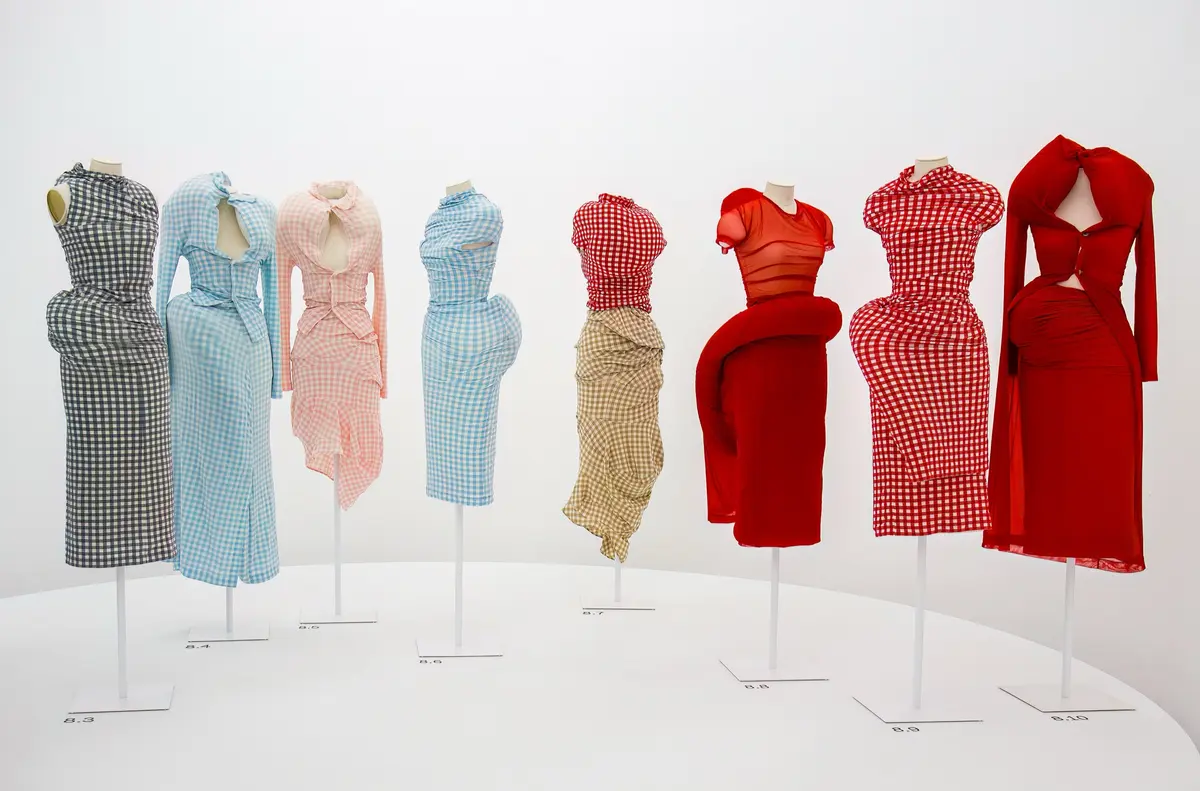
Its legacy is that street style became a source for high fashion. Gianni Versace's 'safety-pin' dress, worn by Elizabeth Hurley at the London premiere of 'Four Weddings and a Funeral' in May 1994, put the punk pin on the red carpet. In 2013 the Metropolitan Museum's Costume Institute devoted its spring show, 'PUNK: Chaos to Couture', to the subject: about 100 designs, from original 1970s garments to work by Versace, Alexander McQueen, Rei Kawakubo and many others. Its curator, Andrew Bolton, said punk had 'changed the face of fashion', and that designers such as Kawakubo and Martin Margiela had taken on the mantle of punk.
What happened
- 1974
The Ramones form in New York. Dressed in ripped jeans and black leather jackets, they build their name at CBGB on the Bowery, the club where Television, with Richard Hell, had become the centre of a punk scene.
CBGB, 315 Bowery, Manhattan: the club where Television, the Ramones and others made the New York scene from 1973-74; the Met's 2013 show opened with a gallery on itAt 430 King's Road, Chelsea, Westwood and McLaren's shop becomes SEX, with the name in huge pink padded letters over the door and rubber, PVC and fetish wear inside, much of it customised by Westwood; their customers are prostitutes, men and women with 'underground' tastes and a few brave proto-punks.
430 King's Road, Chelsea: McLaren and Westwood's shop, SEX from 1974 and Seditionaries from 1976, whose clothes dressed the Sex Pistols- 1975
After a brief stint managing and costuming the New York Dolls, McLaren starts to work with a band that he names the Sex Pistols, in a cross-marketing plan for the shop. Britannica says that Richard Hell's habit of tearing his T-shirt at CBGB had inspired him to have the Sex Pistols do the same.
CBGB, 315 Bowery, Manhattan: the club where Television, the Ramones and others made the New York scene from 1973-74; the Met's 2013 show opened with a gallery on itThe Sex Pistols play their first gig, in a small room at St Martin's School of Art in central London; Steve Jones later said it was as loud as 'a jumbo jet landing in your living room'. The school's student-union president that year, Jeremy Diggle, is the man who unplugged them.
- 1976
The Bondage collection for Spring/Summer 1976 puts the zip-and-strap bondage suit on sale at 430 King's Road, and the shop is renamed Seditionaries: Clothes for Heroes, selling bondage trousers, 'unravelling' mohair jumpers, muslin tops printed with slogans and torn-looking tops hung with chains and safety pins.
430 King's Road, Chelsea: McLaren and Westwood's shop, SEX from 1974 and Seditionaries from 1976, whose clothes dressed the Sex PistolsMcLaren's Punk festival at the 100 Club, Oxford Street, puts the new bands together on one stage, most accounts say on 20 and 21 September. The V&A records that the Sex Pistols had played the club all year until punk bands were banned after violence at the festival.
100 Club, 100 Oxford Street, London: where the Sex Pistols played in 1976 and McLaren's Punk festival took place in September 1976EMI releases the Sex Pistols' first single, 'Anarchy in the UK'. The muslin Destroy shirt of 1977 prints its lyrics, and Jamie Reid's cut-and-paste 'ransom note' lettering, the V&A says, becomes part of the defining imagery of the Sex Pistols and the punk era.
The Sex Pistols, standing in for Queen on Thames Television's early-evening 'Today' programme, swear at its presenter, Bill Grundy, on live television. Gigs are cancelled, and in January EMI drops them. Fans who dress like them, among them Siouxsie Sioux, stand behind the band on the set.
The Roxy opens in Covent Garden, a club given over to punk. The Clash, the Damned, Siouxsie and the Banshees, Generation X, the Buzzcocks and the Slits play there.
The Roxy, 41-43 Neal Street, Covent Garden: the club given over to punk, open from December 1976 (plaque: 1976-78)- 1977
BOY, a shop and label opened on King's Road by John Krevine and Stephane Raynor, who had earlier run Acme Attractions, starts selling bondage trousers and T-shirts, in the shop and by 'blackmail' catalogue: the look reaching the many punks who, the London Museum says, could not afford Seditionaries.
Zandra Rhodes designs her 'Conceptual Chic' collection in London: evening dresses in jersey deliberately ripped, with zigzag-stitched holes, ball-link chains, rhinestones and safety pins sewn with beads. The Philadelphia Museum of Art calls it the first time punk elements appeared in glamorous, high-end design.
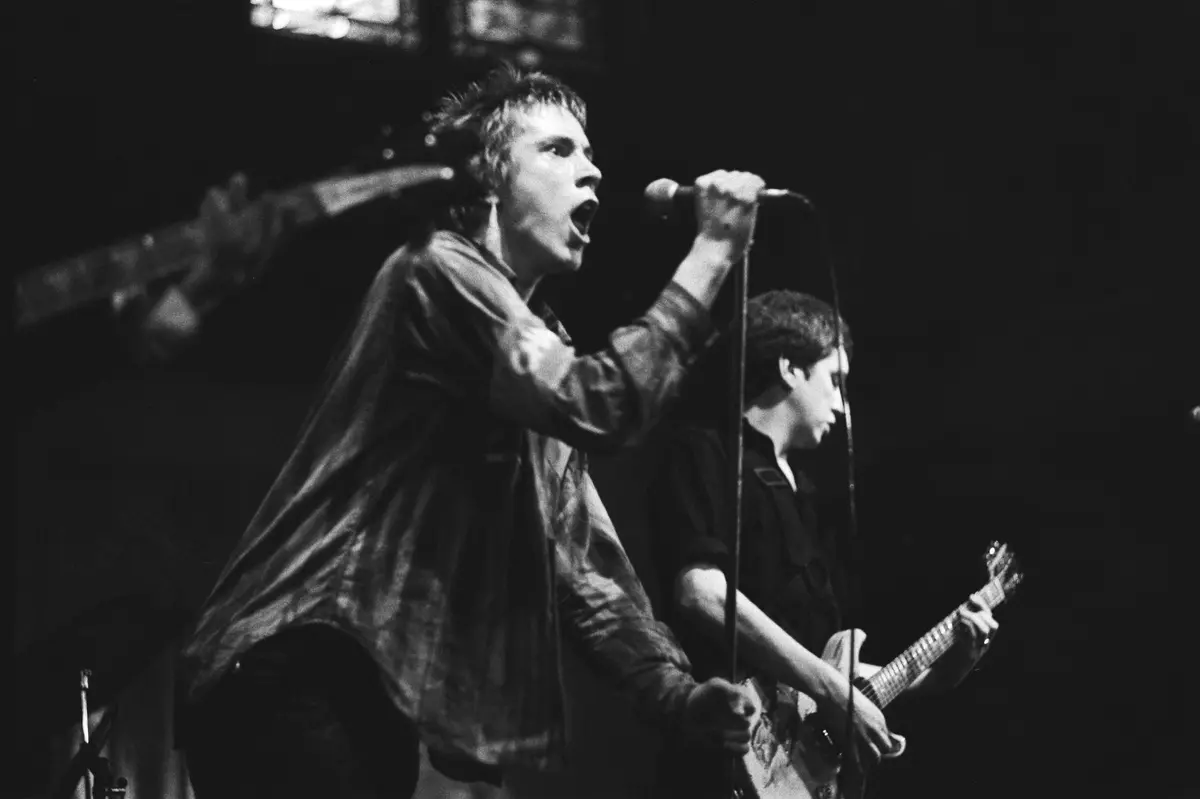
The Sex Pistols play Paradiso in Amsterdam. Koen Suyk photographs the gig for the Dutch press agency ANEFO, and the negatives show the band in the clothes of the moment. In the same month their label, EMI, the company of 'Anarchy in the UK', drops the band after the television scandal.
Paradiso, Amsterdam: the Sex Pistols played here on 6 January 1977 and the first Dutch punk festival was held here on 18 February 1978Bassist Glen Matlock, who had worked at SEX as a shop assistant, leaves the Sex Pistols and is replaced by Sid Vicious, a friend of Rotten's who did not yet know how to play the bass but, in Britannica's words, had the spiked black hair and deathly pale complexion of the look.
The Sex Pistols sign to A&M Records outside Buckingham Palace, and are sacked days after signing the contract.
Virgin Records releases 'God Save the Queen' in time for the Silver Jubilee; on 31 May the BBC bans it, calling it 'gross bad taste'. It sells up to 150,000 copies a day at the end of May and in early June and reaches number two, listed as a blank behind Rod Stewart. At Seditionaries the V&A records shirts showing the Queen with a safety pin through her lips.
On Jubilee Day, 7 June, the Sex Pistols try to play 'God Save the Queen' from a boat on the Thames, outside the Houses of Parliament, during the Silver Jubilee celebrations. The police are called, chase the boat and arrest those on board at the dock, McLaren among them. The Jubilee draws other protests too, such as the Socialist Workers Party's 'Stuff the Jubilee' campaign.
'Pretty Vacant', the Sex Pistols' third single, is released by Virgin and reaches number six; it is the first of their records shown on 'Top of the Pops' with a promotional video.
The Sex Pistols' only album, 'Never Mind the Bollocks, Here's the Sex Pistols', is released with Jamie Reid's fluorescent cover; it reaches number one in early November. A Nottingham record shop is taken to court for displaying it, and acquitted.
The Sex Pistols play their last British concert, at Huddersfield on Christmas Day, a show for the children of striking firefighters; McLaren has a silk banner printed for it with a George Cruikshank cartoon and a long manifesto.
- 1978
The Sex Pistols play the last gig of a short, disastrous US tour at the Winterland Ballroom, San Francisco; Rotten leaves the stage with the words 'Ever get the feeling you've been cheated?'. They had played only seven of the nine planned concerts.
Winterland Ballroom, San Francisco (demolished): the Sex Pistols' last gig of the US tour, 14 January 1978John Lydon announces that the Sex Pistols have split. Sid Vicious had been hospitalised after an overdose a few days earlier.
At the first Dutch punk festival, at Paradiso in Amsterdam, the audience wears the English look in its own version: safety pins, chains, badges, and 'PUNK' written on a forehead. Rob Bogaerts photographs them for ANEFO.
Paradiso, Amsterdam: the Sex Pistols played here on 6 January 1977 and the first Dutch punk festival was held here on 18 February 1978- 1979
Dick Hebdige's 'Subculture: The Meaning of Style' is published. It reads punk's safety pins and torn clothes as signs, and argues that such styles are soon turned into goods. Britannica says punk had self-destructed as a pop style by 1979.
The Blitz begins as a Tuesday night in a wartime-themed wine bar at 4 Great Queen Street, Covent Garden, hosted by Steve Strange and the DJ Rusty Egan. It runs until 1981, with a door policy of 'would you let yourself in?', and, the museum says, defines the youth culture of the next decade.
The Blitz, 4 Great Queen Street, Covent Garden: Tuesday nights of the Blitz Kids and the New Romantics, 1979 to 1981Sid Vicious dies of a heroin overdose in New York at 21, out on bail after the death of his girlfriend Nancy Spungen on 12 October 1978 in the Chelsea Hotel. Britannica says his death made him even more famous, and that he came to represent the spirit of punk rock.
- 1980
'The Great Rock 'n' Roll Swindle', McLaren's film of the Sex Pistols' story, is released, with Sid Vicious's version of 'My Way' in it. After 1978 McLaren has moved on to Adam and the Ants and Bow Wow Wow, and in 1981 he and Westwood will show Pirate, their first catwalk collection.