Vivienne Westwood
“The English designer who, with Malcolm McLaren, put punk into clothes at 430 King's Road, then built a career on historical cut and fabric and on activism.”
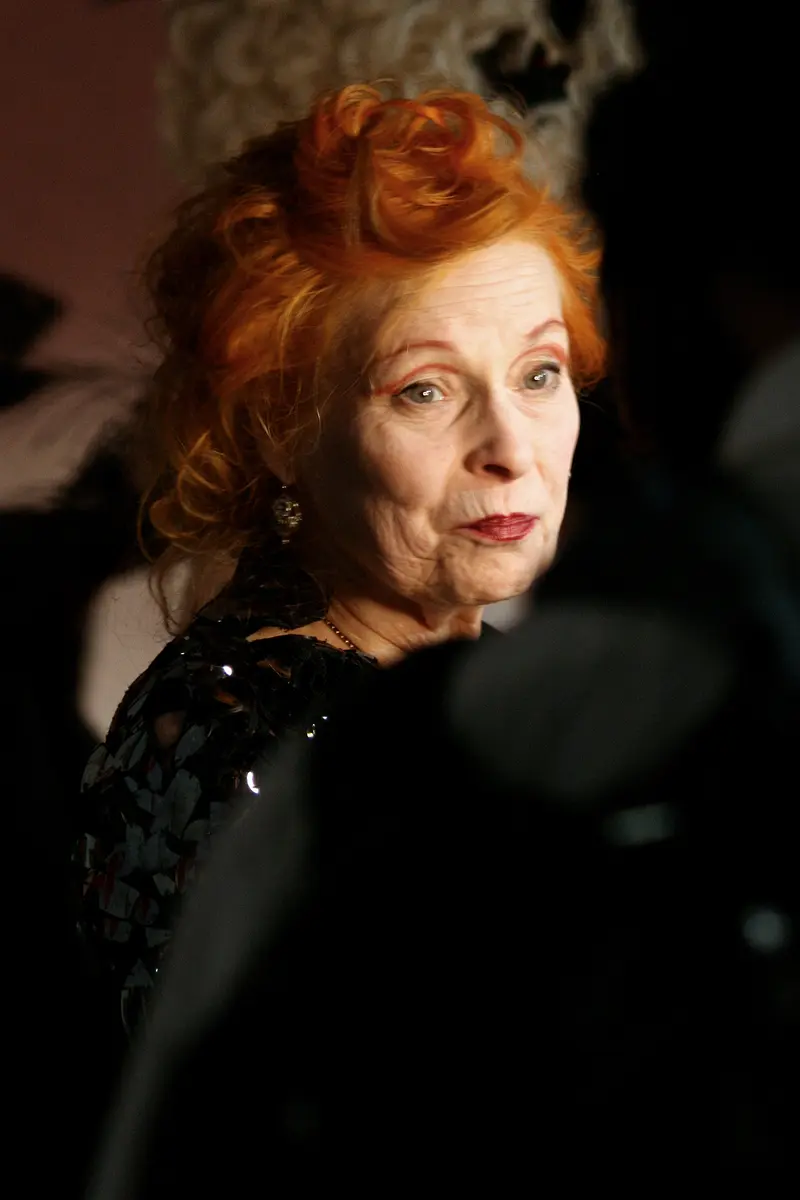
Dame Vivienne Westwood was an English fashion designer who dressed British punk and then spent forty years turning old clothes into new ones. She was born Vivienne Isabel Swire on 8 April 1941 in the Tintwistle area, Pennine village country on the old Cheshire and Derbyshire border, and she died at her home in Clapham, London, on 29 December 2022, aged 81. She is known for three things: the shop at 430 King's Road, Chelsea, where she and Malcolm McLaren made the clothes of punk; the Pirate collection of 1981, her first catwalk show; and a long career of research in museums, which gave the world the mini-crini, the corset as outerwear and the tartan and tweed of 'Anglomania'. From about 2005 she was as much a campaigner as a designer.
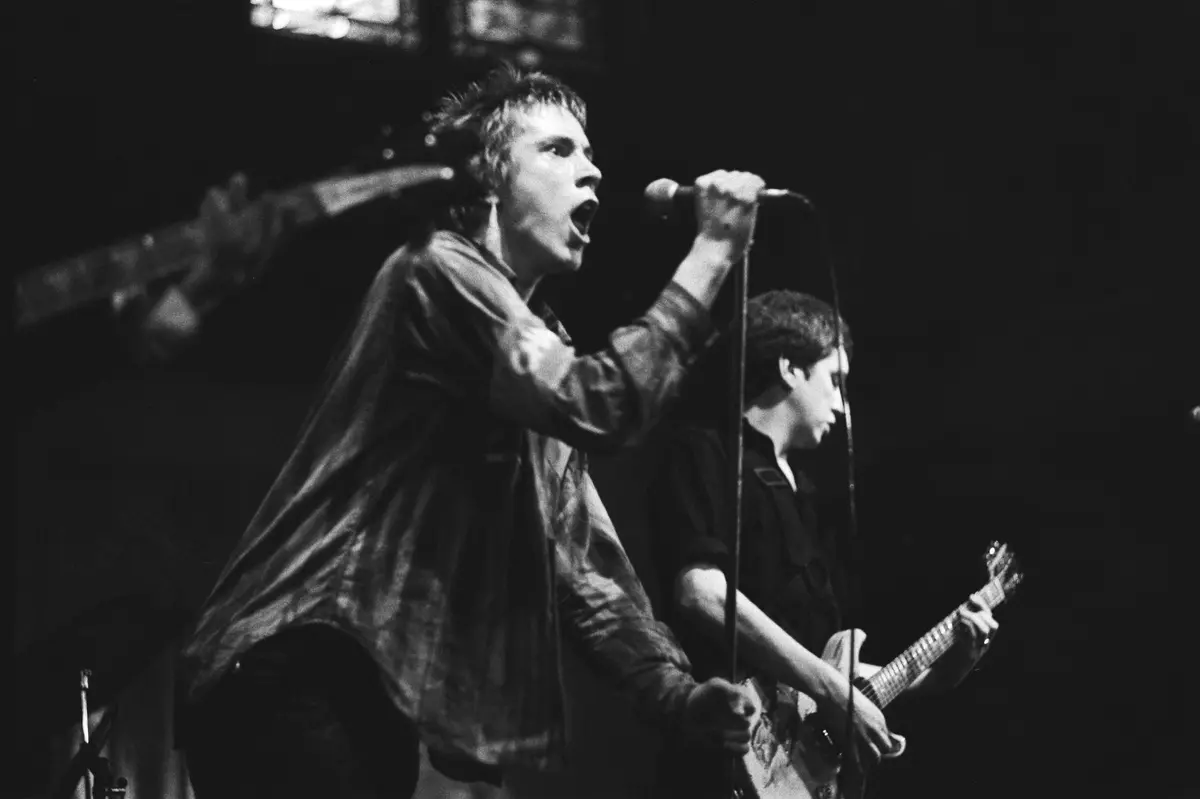
Her parents were a factory worker and a cotton weaver (the V&A's words); the family later ran the village post office, and she won a scholarship to Glossop Grammar School, where she was good at art. In 1958 they moved to Harrow, near London. She left Harrow Art School after one term, trained as a teacher, married in 1962 and taught in a primary school. In 1965 she met Malcolm McLaren, an art student five years younger, and left her husband. In 1971 they opened a shop at 430 King's Road, which they renamed again and again: Let It Rock (1971), Too Fast To Live Too Young To Die (1972), SEX (1974), Seditionaries (1976) and World's End (1980). McLaren managed the Sex Pistols, whose circle grew up round the shop, and the bondage trousers, slashed T-shirts and unravelling mohair jumpers sold there became the look of punk. Who deserves the credit for punk, and for its safety pins, has been argued ever since.
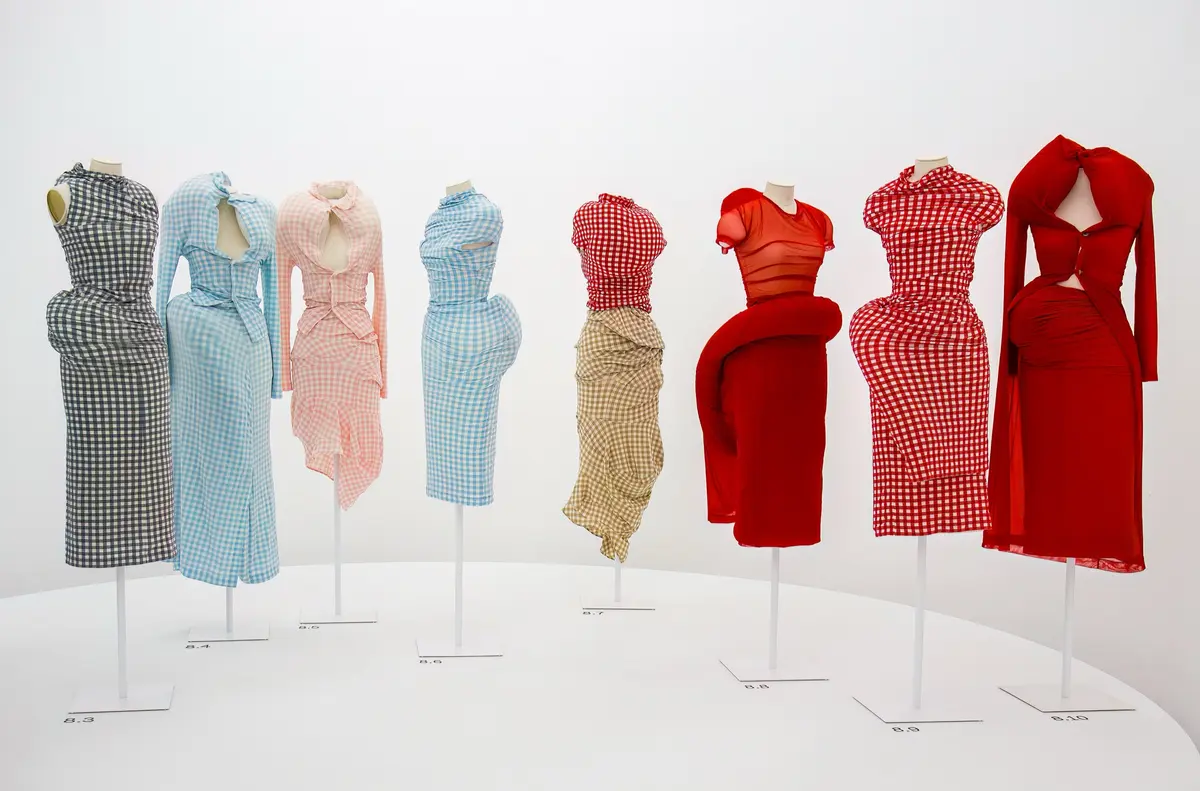
Punk's quick absorption by the mainstream left her disillusioned. Turning to history, she and McLaren showed Pirate at Olympia in 1981, the first of a run of collections (Savages, Buffalo, Witches) that ended their partnership in 1983 or 1984. Then she went her own way: the Mini-Crini of 1985, Harris Tweed in 1987, a professorship in Vienna from 1989, and a long series of collections built on Watteau, Boucher, Tudor portraits, Savile Row and Scottish cloth. She worked from 1989 with a former student, Andreas Kronthaler, who became her husband (1992 or 1993) and, from 2016, the designer of the Gold Label line under his own name. She won British Designer of the Year in 1990, 1991 and 2006, an OBE in 1992 and a damehood in 2006, and the V&A gave her a retrospective in 2004.
From about 2005 she used the catwalk as a platform. She backed Liberty's campaign for habeas corpus, wrote the manifesto 'Active Resistance to Propaganda', launched the Climate Revolution, campaigned against fracking (driving a tank towards David Cameron's home in 2015) and supported Julian Assange and Chelsea Manning, including in the clothes she made for Assange's wedding in 2022. Critics pointed out that a fashion house with many collections a year sat uneasily with her advice to 'buy less'; she answered that if you can afford her clothes you should buy them, but not too many.
She died peacefully, among her family, on 29 December 2022. Her funeral was held on 9 January 2023 in Christ Church, Tintwistle, hung with Harris Tweed, and she is buried in the village; a memorial service followed at Southwark Cathedral on 16 February 2023. Kronthaler showed the first collection after her death in Paris on 4 March 2023 and continues to design for the house. Her best claim to a place in history is the one the V&A makes: she kept the provocation of punk and joined it to respect for tradition, and her ideas reached the mainstream quickly, whether anyone liked them or not.
What happened
- 1941
Vivienne Isabel Swire is born. Her parents, Gordon and Dora Swire, were a factory worker and a cotton weaver; her first years were at Millbrook, between Hollingworth and Tintwistle, and the family later ran the sub-post office on Manchester Road in Tintwistle, then in Cheshire. She went to the village school, won a scholarship to Glossop Grammar School, where she excelled at art, and once made herself a Suzy Wong style dress for a school dance.
Tintwistle, Derbyshire (then Cheshire): where she was born and grew up, in the Millbrook area between Hollingworth and Tintwistle and later at the village post office; Christ Church held her funeral on 9 January 2023 and she is buried in the village- 1958
The family moves to Harrow, in north-west London, when she is 17. She enrols at Harrow Art School for a jewellery and silversmithing course but leaves after one term, later saying she did not see how a working-class girl could make a living in the art world.
Harrow, north-west London: the family home from 1958; Harrow Art School, her first marriage and her years as a primary-school teacher - 1962
She trains as a teacher and works as a primary-school teacher, and in 1962 marries Derek Westwood, an apprentice at the Hoover factory in Harrow; their son Benjamin is born in 1963.
Harrow, north-west London: the family home from 1958; Harrow Art School, her first marriage and her years as a primary-school teacher - 1965
She meets Malcolm McLaren, an art student born in London in 1946, and moves in with him, ending her marriage the same year. In the V&A's words he gave her restless idealism a focus and a chance to use her natural flair for dressmaking; they rejected the hippie ethos of the late 1960s.
- 1967
Her second son, Joseph Corré, is born; he later founds the lingerie brand Agent Provocateur. She goes on teaching until about 1971 while making clothes for McLaren and his friends.
- 1971
She and McLaren open a small boutique, Let It Rock, at 430 King's Road, Chelsea, selling 1950s clothes, records and memorabilia and the Teddy Boy suits she cuts: drape jackets, tight trousers, brothel creepers. The hippies are fashionable; they choose the rebels of the 1950s instead. The shop took over the premises of Paradise Garage in the autumn, McLaren starting with a stall at the back in October.
430 King's Road, Chelsea: the shop she and Malcolm McLaren ran as Let It Rock, Too Fast To Live Too Young To Die, SEX, Seditionaries and, from 1980, World's End, and still a Westwood shop - 1972
The shop is renamed Too Fast To Live Too Young To Die, with a skull and crossbones and a new range of biker and 'rocker' clothes: leather, chains, zips and sleeveless T-shirts with slogans such as 'PERV' and 'ROCK' made, it is said, with safety pins, chicken bones and glitter glue. The year is the house's and Gale's; other sources say 1973.
430 King's Road, Chelsea: the shop she and Malcolm McLaren ran as Let It Rock, Too Fast To Live Too Young To Die, SEX, Seditionaries and, from 1980, World's End, and still a Westwood shop - 1974
The shop becomes SEX: pink foam letters on the front, rubber curtains and graffiti inside, and stock of rubber, fetish and bondage wear made by specialist firms and by McLaren and Westwood themselves, sold, in the V&A's words, to prostitutes, people with underground tastes and young proto-punks. The house's slogan was 'rubberwear for the office'.
430 King's Road, Chelsea: the shop she and Malcolm McLaren ran as Let It Rock, Too Fast To Live Too Young To Die, SEX, Seditionaries and, from 1980, World's End, and still a Westwood shop - 1975
Westwood and McLaren are prosecuted for their T-shirt of two naked cowboys: under the obscenity law, says the London Museum; under the Obscene Publications Act of 1959, says the house. Valerie Steele's account says she was convicted; no source read gives the penalty.
The Sex Pistols come together round the shop. McLaren, who managed them, had 'brought them together', as the V&A says, to exploit what he saw as youth culture's readiness for a protest band; the shop's circle included its Saturday assistant Glen Matlock, later a founder member, and John Lydon is said to have auditioned for the band in the shop in August 1975. McLaren is said to have chosen the band's name partly to promote the shop. Many of the shop's clothes were worn by members of the band.
- 1976
The Bondage collection, Spring/Summer 1976: a black cotton suit with a zip under the crotch, a 'bum flap' and straps to hobble the wearer, mixing army combat gear, motorcyclists' Belstaff and fetish wear. The shop at 430 King's Road is refitted as Seditionaries: Clothes for Heroes, selling bondage trousers, unravelling mohair jumpers and muslin tops with screen-printed swastikas, the Queen with a safety pin through her lips and naked breasts. Sources differ on the date of the new name (see qa.uncertain).
430 King's Road, Chelsea: the shop she and Malcolm McLaren ran as Let It Rock, Too Fast To Live Too Young To Die, SEX, Seditionaries and, from 1980, World's End, and still a Westwood shop - 1978
The Sex Pistols break up and punk is quickly absorbed by the mainstream. Westwood, disillusioned, turns to 'high' culture; the shop is often shut and, she later said, apart from a few T-shirts they made no new designs in four years. Punk goes on in the street: this photograph of 1985 shows two punks in King's Road wearing studs and slogans.
- 1980
The shop is refitted as World's End, its interior designed by McLaren and Westwood and built by Roger Burton to look like a mixture of the Old Curiosity Shop and an 18th-century galleon, with a clock whose hands run backwards and a sloping floor. It has kept the name and, since the 2017 restoration, its look. Gale and the house give 1980; some sources say the renaming came in 1979.
430 King's Road, Chelsea: the shop she and Malcolm McLaren ran as Let It Rock, Too Fast To Live Too Young To Die, SEX, Seditionaries and, from 1980, World's End, and still a Westwood shop - 1981
Pirate, shown at Olympia: the first catwalk show by Westwood and McLaren and the first collection they took to the press and buyers. Billowing unisex shirts cut from a pattern used for 500 years, baggy trousers copied from a pirate engraving, sashes and felt hats, shown in spring 1981 to cannon fire and McLaren's rap music. The clothes were already on sale at World's End. She had begun her research in the V&A's National Art Library. The invitation showed a girl with a Sony Walkman. The name Pirate was added afterwards; it began the 'New Romantic' look and was on the cover of British Vogue in May 1981.
Olympia, Kensington: the exhibition hall where the Pirate collection, her first catwalk show, was presented in 1981 - 1982
Savages, then Buffalo Girls (Nostalgia of Mud), Autumn/Winter 1982-83: skirts and bowler hats from Peruvian women photographed in National Geographic, sheepskin and mud colours, and satin bras worn over dresses, the first underwear as outerwear. A second shop, Nostalgia of Mud, sells them in St Christopher's Place. By Punkature the V&A says she first thought of herself as a designer and no longer 'just an interpreter of Malcolm's ideas'.
- 1983
Witches, Autumn/Winter 1983-84, the last official collaboration with McLaren: after a visit to New York she prints Keith Haring's drawings, which she called a 'magical, esoteric sign language', on jackets with winged shoulders and on tube skirts.
- 1984
The partnership with McLaren ends. Her Hypnos collection, in synthetic sports fabrics, is shown in Tokyo at Hanae Mori's 'Best of Five' awards; her business partner, the Italian publicist Carlo D'Amario, helps her extricate herself from McLaren, the Nostalgia of Mud shop closes and she moves to Italy.
- 1985
The Mini-Crini, Spring/Summer 1985: a short bell-shaped skirt that she called a 'cardinal change', a move to tailoring and 'things that fitted', combining a child's party frock with a shortened Victorian crinoline and inspired by the ballet Petrushka. It marks the turn to historical dress that fills the rest of her career, and its puffball shape inspired skirts by designers such as Christian Lacroix.
- 1987
Harris Tweed, Autumn/Winter 1987-88, shown at Olympia in spring 1987 after two and a half years without a show: corsets as outerwear, fitted Savile-style jackets and twinsets in the Scottish cloth, after a girl she saw on the Tube with a plaited bun, a Harris Tweed jacket and ballet shoes. The collection is credited with reviving Harris Tweed as a fashion cloth and brought a long link with the Harris Tweed Authority; her orb logo, which echoes the Authority's, was first used in 1986 or with this collection.
- 1989
She is appointed Professor of Fashion at the Vienna Academy of Applied Arts (1989 to 1991). A student there, Andreas Kronthaler, born in Tyrol in 1966, moves to London to work for her firm; the house says they met in 1988, the British Fashion Council 1989.
Westwood appears on the cover of Tatler dressed as Margaret Thatcher, in a suit that had been ordered for Thatcher and not yet delivered, under the line 'This woman was once a punk'.
- 1990
Portrait, her Boucher-print collection: corsets, leggings and dresses printed with Rococo paintings by François Boucher and others, the corset again worn as outerwear. The 1990 corset reproduces the 1743 'Daphnis and Chloe, Shepherd Watching a Sleeping Shepherdess' on its front panel, cut like an 18th-century stay but in stretch fabric without the old boning. The season is given as Spring/Summer 1990 by the Museum at FIT and the V&A's catalogue and as Autumn/Winter 1990-91 by the National Gallery of Victoria.
The Davies Street boutique opens in Mayfair. The house's own timeline also puts a Davies Street opening in 1988 and the Gale entry a Mayfair shop in 1990.
- 1991
Cut and Slash, shown at Pitti Uomo in Florence: the first joint collection with Kronthaler, whose Renaissance gowns became the Sun Wheel dress, with slashed satin, cotton and denim after the 16th-century fashion for cutting and pricking revealed layers, and, in her version, bare skin. The British Fashion Council names her designer of the year in 1990 and again in 1991. The V&A's records date the same group autumn/winter 1990.
- 1992
She is appointed OBE in the Birthday Honours, for services to fashion design, and receives the medal from the Queen at Buckingham Palace; in the courtyard afterwards she twirls her skirt for the photographers, with sheer tights and a bikini top underneath, and the photograph becomes famous; she later said she had heard the picture amused the Queen. In the same year she introduces wedding gowns and becomes an Honorary Senior Fellow of the Royal College of Art.
She marries Andreas Kronthaler, her former student, twenty-five years her junior; the BBC and The Times give 1992, the house and Wikipedia's infobox 1993. They design together for more than thirty years and he becomes creative director of the house.
- 1993
Anglomania, Autumn/Winter 1993-94, shown in Paris: tartan in her own pattern, MacAndreas, for a clan she invented for Kronthaler and the Lochcarron mill had recognised; the corset as the base of an evening dress; and Naomi Campbell falling from 28 cm platform 'Super Elevated Gillie' shoes on the catwalk, which the V&A acquired the same year. The house says Gold Label 'was born' with this collection.
- 1994
On Liberty, Autumn/Winter 1994-95: her knitted and crocheted mini dress with floral motifs from the archives of the London store Liberty, founded about 120 years earlier, becomes one of her best-loved designs, one she owned and wore herself; a full-length metallic version with a ruffled train closed the show. The Met owns a dress from the collection too, a tulle evening dress with a bustle-like pad.
- 1996
'Les Femmes ne connaissant pas toute leur coquetterie', Spring/Summer 1996: sack-back gowns inspired by the clothes in Watteau's paintings; the designer gave the V&A the green and lilac 'Watteau' evening gown. The same year the house launches Vivienne Westwood MAN, shown in Milan, and her Channel 4 series 'Painted Ladies' looks at the clothes in old paintings.
- 1997
The house opens the flagship at 44 Conduit Street, Mayfair (after an earlier shop at No. 43); Anglomania becomes a denim diffusion line in 1998 and, by the house's account, Red Label follows in 1999 with a first New York boutique.
- 2004
'Vivienne Westwood: 34 Years in Fashion' opens at the V&A, the largest show the museum had given to a British designer; at the press call on 30 March she says she spent the last days helping to install it and tweaking the models. It travels to Australia in 2004-05. The house calls it the first solo exhibition of a fashion designer at the V&A.
- 2005
With the civil-rights group Liberty she launches T-shirts and baby clothes printed 'I AM NOT A TERRORIST, please don't arrest me' to defend habeas corpus, the 50-pound shirts raising money for the group. Her Spring/Summer 2008 collection is called '56', after the days of detention without trial then proposed.
- 2006
She becomes Dame Commander of the Order of the British Empire, appointed in the New Year Honours announced on 31 December 2005 for services to British fashion and invested by the Prince of Wales at Buckingham Palace; she is again named British Designer of the Year.
- 2007
She writes the manifesto 'Active Resistance to Propaganda', a play-like text on art, the human predicament and climate change, which she reads at venues including the London Transport Museum and hands out as a booklet; its symbols become her Autumn/Winter 2008 collection Chaos Point.
- 2008
On Easter Sunday she marches at the biggest Campaign for Nuclear Disarmament demonstration for ten years, at the Atomic Weapons Establishment, Aldermaston.
- 2012
At the closing ceremony of the London Paralympics she launches her Climate Revolution, a team and a website (which the house says began in 2010) to rally charities and campaigners against political and corporate inaction; in 2012 she gives a million pounds to the charity Cool Earth.
After visiting Julian Assange at the Ecuadorian Embassy in London, she designs a T-shirt whose proceeds go to him, on sale from the following Saturday.
- 2013
At her Red Label show at London Fashion Week she walks down the catwalk in a T-shirt printed with a giant picture of her own face and the slogan 'I'm Julian Assange'.
She speaks at the protest in London for Bradley (now Chelsea) Manning, wearing a badge of Manning marked 'Truth', and dedicates one of her collections to Manning, her models wearing the same badge.
- 2015
She drives a tank from Enstone towards David Cameron's home at Dean, Oxfordshire, to 'declare war' on fracking: Cameron's government had approved fracking licences in 27 places and none in his own constituency. The date is chosen as his first Friday in the constituency after the recess. He is away in Leeds.
- 2016
She hands the Gold Label line to Kronthaler: at Paris Fashion Week he shows his first collection under the name Andreas Kronthaler for Vivienne Westwood, replacing Gold Label, while she designs the main line and Unisex. She says that Andreas has taken on ever more responsibility and she wants that to be seen; the last physical main-line show follows in 2019.
- 2020
Dressed in canary yellow, she hangs in a giant birdcage outside the Old Bailey to protest against Assange's extradition to the United States, calling herself the canary in the coal mine.
- 2022
She and Kronthaler design the groom's kilt-style outfit and the graffiti-patterned dress for Assange's wedding to Stella Moris in Belmarsh prison.
Dame Vivienne Westwood dies 'peacefully and surrounded by her family' at her home in Clapham, aged 81, still at work; Kronthaler says, 'I will continue with Vivienne in my heart. We have been working until the end.' Flowers are left at her shop at 430 King's Road. After this episode, outside the entry's dates: the funeral at Christ Church, Tintwistle, on 9 January 2023, the church swathed in 45 metres of Harris Tweed; a memorial service at Southwark Cathedral on 16 February; and on 4 March 2023 Kronthaler's first show for the house since her death, in Paris, a tribute to her.
Clapham, south London: her home for over fifty years, where she died on 29 December 2022