Aimé Bonpland
“Humboldt's botanist on the five-year American journey, Josephine's gardener at Malmaison, and the man Paraguay's dictator Francia held for nearly ten years after he started a yerba mate settlement.”
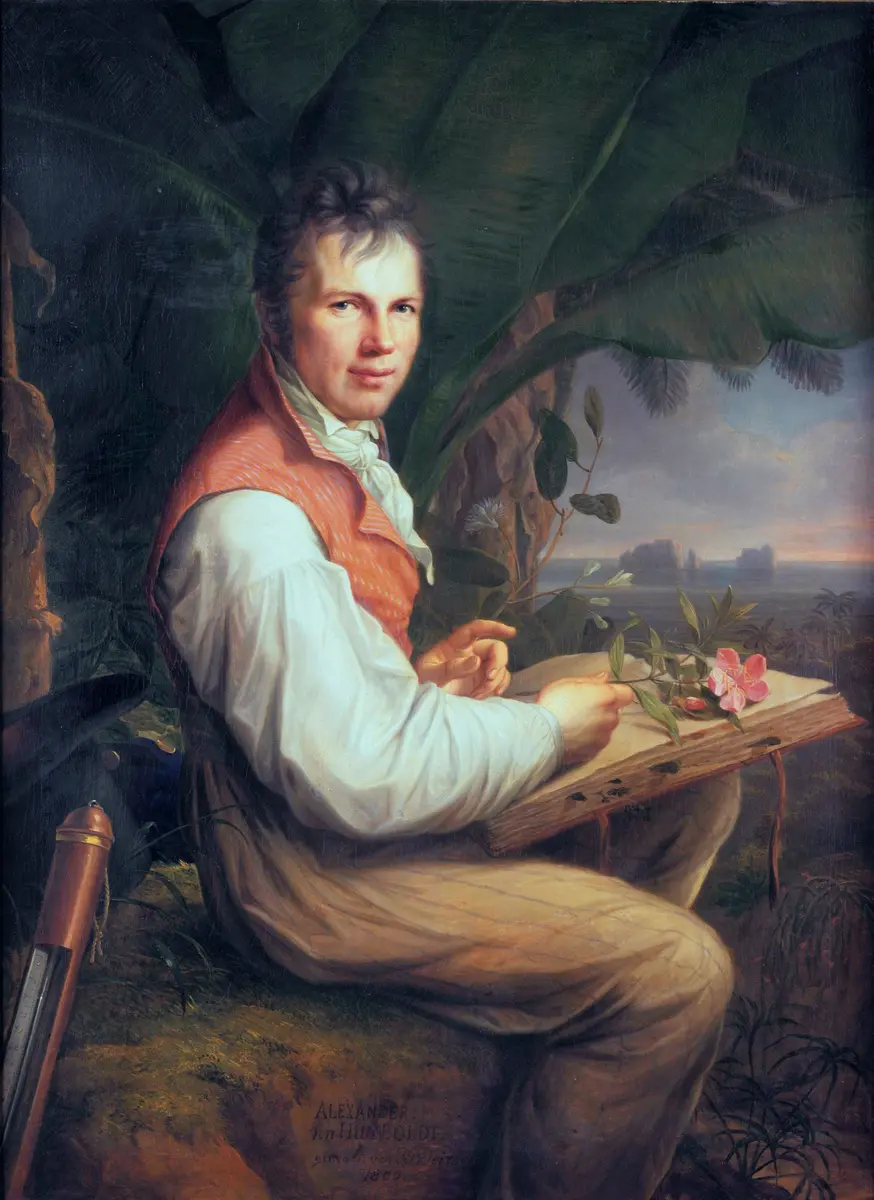
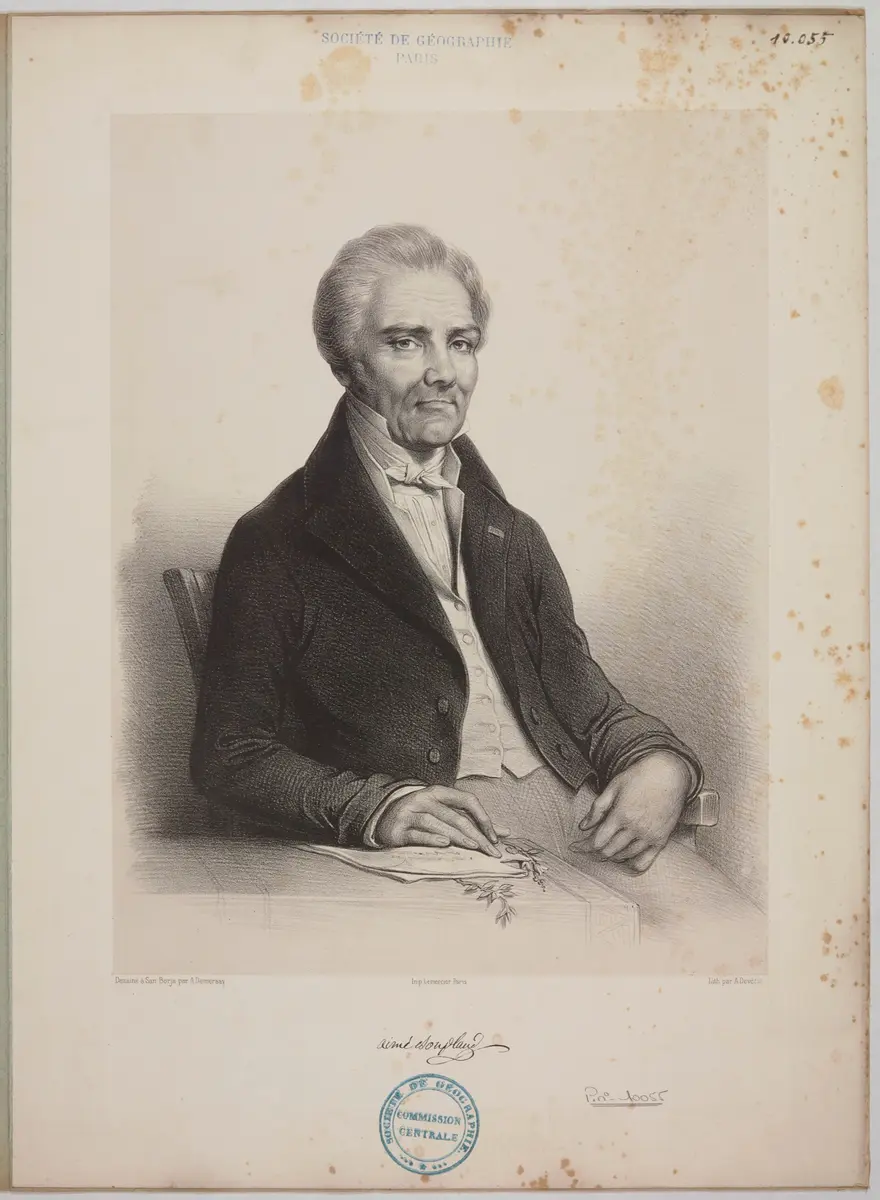
Aimé Bonpland was a French doctor and botanist, born in the port of La Rochelle on 29 August 1773 (some sources give 22 or 28 August). His real family name was Goujaud; Bonpland was a nickname that stuck. He trained in medicine in Paris, served as a surgeon in the revolutionary army, studied under the physician Jean-Nicolas Corvisart, and learned botany from the professors of the Museum of Natural History, among them Jussieu, Lamarck and Desfontaines. In Paris he met the young Prussian Alexander von Humboldt, who was looking for a companion who could name and collect plants.
From 1799 to 1804 the two men travelled through Spanish America: Venezuela and the Orinoco, Cuba, Colombia, Ecuador, Peru and Mexico, about 15,000 kilometres in all. Humboldt measured, mapped and wrote; Bonpland was the botanist who gathered, dried and described the plants, and in the Andes and on the rivers he looked after his friend in other ways too (one account says he pulled Humboldt out of the water when he nearly drowned). On Chimborazo in 1802 he was one of the party that reached a height no European was known to have climbed. Back in Paris the collection was divided: Humboldt took part, and Bonpland kept a private herbarium of his own. He then wrote or co-wrote the botanical volumes of the great Voyage, among them the Plantes équinoxiales, the Nova genera et species plantarum (edited by Karl Sigismund Kunth) and his own Monographie des Mélastomacées, but it was Humboldt, the author of the narrative, who became famous.
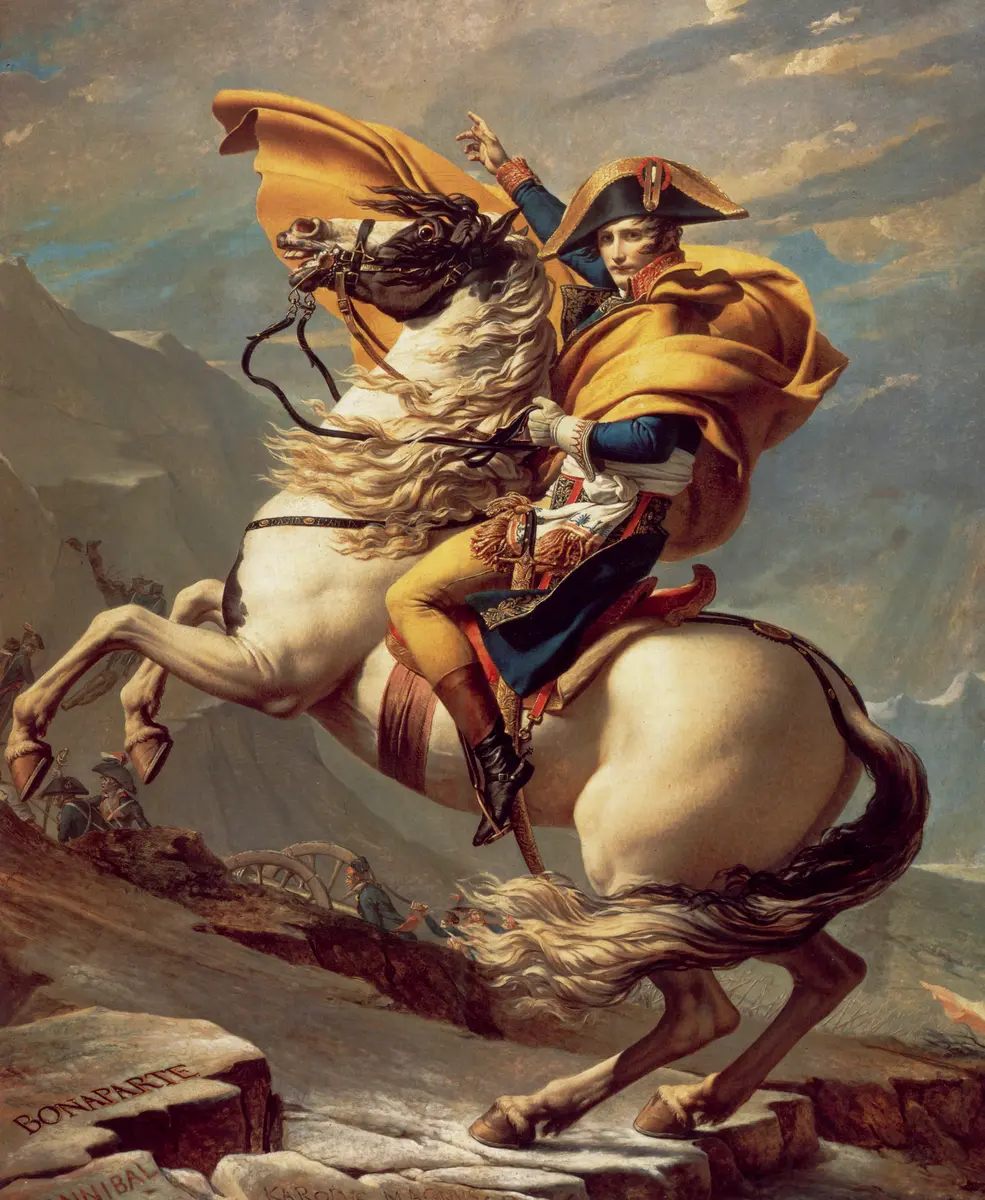
Bonpland then received a pension and a post he loved: he looked after the gardens of Empress Josephine, Napoleon's wife, at Malmaison near Paris, where seeds from three continents were raised. In 1813 he published the Description des plantes rares cultivées à Malmaison et à Navarre, a folio with 64 coloured plates, many by the flower painter Pierre-Joseph Redouté. Josephine died at Malmaison on 29 May 1814, Napoleon fell the same year, and the quiet life in Paris was over. In November 1816 Bonpland sailed from Le Havre for South America, with European plants and with his private herbarium on board, and he never saw France again.
In Buenos Aires, where he arrived in 1817, the statesman Bernardino Rivadavia welcomed him as a naturalist, but Bonpland soon went upriver to the old Jesuit mission country between the Paraná and Uruguay rivers. There he founded a settlement at Santa Ana to prepare yerba mate, the leaf used for the drink of the region, working with Guarani families. The dictator of Paraguay, José Gaspar Rodríguez de Francia, who guarded his own control of the mate trade and feared an invasion from the south, sent about 400 men across the Paraná. On 8 December 1821 they destroyed the settlement, wounded Bonpland and carried him off in irons. For nearly ten years he was kept in Paraguay, mostly at Santa María and later on a small farm, where he farmed and treated sick people. Letters from Simón Bolívar, the French Institute and others did not move Francia. In 1829 he was ordered out, and on 2 February 1831 he crossed the Paraná into freedom.
He spent the rest of his life in the borderlands of Argentina, Brazil and Uruguay: first at San Borja on the Uruguay river, then at a second Santa Ana farm near Restauración in Corrientes, where he grew orange trees, collected plants and was named head of the provincial museum. He sent boxes of specimens and his private herbarium to Paris, and many are still in the Paris herbarium. He died on 11 May 1858 at about eighty-four, a few months before a planned return to Europe, and was buried at Paso de los Libres. His reputation has long lived in Humboldt's shadow, yet it is Bonpland's plants, thousands of them new to science, that give the journey its lasting scientific record.
What happened
- 1773
Aimé Jacques Alexandre Goujaud, later called Bonpland, is born in La Rochelle. The day is disputed: sources give 22, 28 or 29 August.
La Rochelle, France: the Atlantic port where he was born on 29 August 1773- 1791
He goes to Paris to study medicine and attends the botany teaching of the Museum of Natural History; he later serves as an army surgeon and studies under Corvisart. The dates of these years differ between sources (see qa).
- 1799
The corvette Pizarro leaves La Coruña with Humboldt and Bonpland on board, bound first for the Spanish colonies in the Americas.
They land at Cumaná in what is now Venezuela; the journey of about five years and 15,000 kilometres begins.
- 1800
With Humboldt and a crew of local boatmen he sets out from San Fernando de Apure up the Orinoco; he keeps collecting plants through the heat and fevers of the river.
The party reaches Angostura (now Ciudad Bolívar), after about four months on the river system; Bonpland, seriously ill with fever, has to rest there before the journey goes on.
- 1802
With Humboldt and Carlos Montúfar he climbs Chimborazo to about 5,878 metres; a crevasse stops them below the top.
- 1804
Humboldt and Bonpland land at Bordeaux with crates of specimens and notes. Soon after, the collection is divided between them; Bonpland keeps a private herbarium and receives a pension.
- 1808
He is Josephine's botanist at Malmaison, in charge of her gardens and greenhouses; the same year the Plantes équinoxiales, the first botanical volumes of the Voyage, begin to appear. (Some sources put the start of his Malmaison post in 1804.)
Château de Malmaison, Rueil-Malmaison near Paris: Empress Josephine's country house, where he ran the gardens and where she died on 29 May 1814 - 1813
The Description des plantes rares cultivées à Malmaison et à Navarre appears, dedicated to Josephine, with 64 coloured plates, many painted by Redouté.
Château de Malmaison, Rueil-Malmaison near Paris: Empress Josephine's country house, where he ran the gardens and where she died on 29 May 1814 - 1814
Empress Josephine dies at Malmaison. With Napoleon's fall the same year, Bonpland's post and his peaceful Paris life come to an end.
Château de Malmaison, Rueil-Malmaison near Paris: Empress Josephine's country house, where he ran the gardens and where she died on 29 May 1814- 1815
The first volume of the Nova genera et species plantarum appears, the Latin descriptions of the plants of the journey, edited by Kunth from Bonpland's handwritten notes.
- 1816
The first volume of Bonpland's own Monographie des Mélastomacées appears (the second follows in 1823).
At Le Havre he boards a ship for South America with his private herbarium already stowed on it; Kunth tries in vain to reclaim the specimens, and gets only the field notes. Bonpland never returns to France.
- 1817
He reaches Buenos Aires, where Bernardino Rivadavia welcomes him; he becomes professor of natural history, then soon sets out for the interior.
- 1821
Some 400 of Francia's soldiers cross the Paraná, destroy his yerba mate settlement at Santa Ana, kill many of its Indian workers, strike Bonpland with a sabre, put him in irons and take him to Santa María in Paraguay. The date is Wikipedia's and Hamy's.
Santa Ana, Misiones, Argentina: the old Jesuit-Guarani mission where he founded his yerba mate settlement, destroyed on 8 December 1821Rengger, back from a journey to Villa Real, hands in his passport at the government house; Francia tells him that Bonpland is 'his prisoner' because of the mate settlement and an alliance with the Indians of Entre Ríos; Rengger finds the charge absurd.
- 1822
Francia has the irons taken off and gives him a residence at Santa María, with leave to walk only a few leagues round; Bonpland farms, treats the poor and wounded soldiers, and later moves to a small farm at Cerrito, between Santa María and Santa Rosa. (Rengger gives no date for this change.)
Santa María de Fe, Paraguay: the mission town where Francia's men took him and where he was confined from 1822 - 1823
From his headquarters in Lima, Simón Bolívar writes to Francia to ask for the release of his 'adored friend' Bonpland; the letter has no effect.
- 1824
The naturalist Richard Grandsire, sent by the French Institute, comes to the Paraná to obtain Bonpland's release; Francia, who suspects the French, grows harder, and the attempt does more harm than good.
- 1829
Francia's officials order him to leave Paraguay within five days; he moves to Itapúa on the river, where he waits for the paper of release for twenty months.
- 1831
He crosses the Paraná to the Argentine side with leave to go where he likes, and goes down the Uruguay river to San Borja, where he settles.
- 1832
He sends his private herbarium from Argentina to Paris; it is added to the general herbarium of the Museum in 1833.
- 1853
He moves from San Borja to a farm at Santa Ana on the Uruguay river (near Restauración, Corrientes), where he grows the orange trees he had brought and goes on collecting.
Paso de los Libres, Corrientes, Argentina: his last farm, Santa Ana, near Restauración (now part of the city); he died there on 11 May 1858 and was buried in the town - 1854
He is named head of the provincial museum in Corrientes. (Another source dates this to 1853.)
- 1858
Bonpland dies at his farm near Restauración, Corrientes, a few months before a planned return to Paris with his collections; he is buried at Paso de los Libres. One older source gives 4 May.
Paso de los Libres, Corrientes, Argentina: his last farm, Santa Ana, near Restauración (now part of the city); he died there on 11 May 1858 and was buried in the town