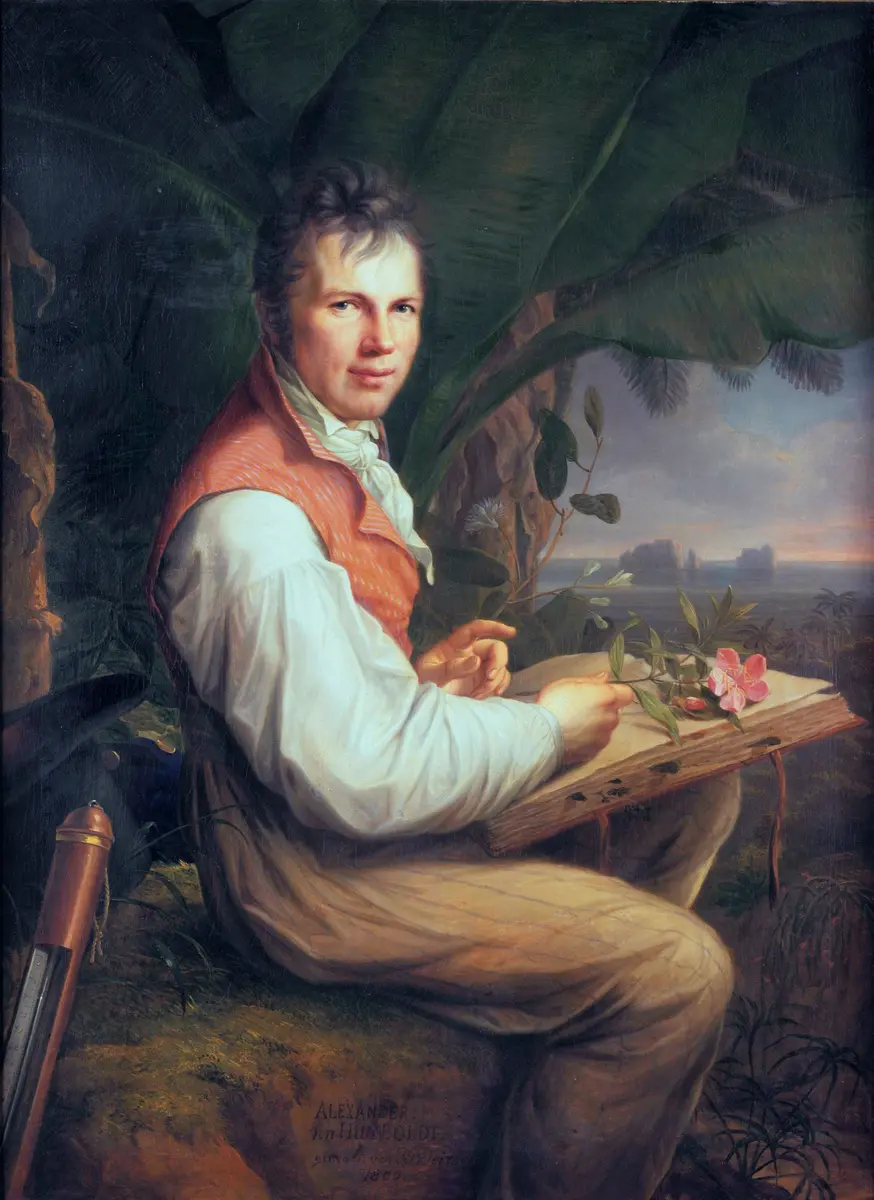
Alexander von Humboldt
“The Prussian explorer who mapped the Orinoco and the Andes, drew nature as one linked web (Naturgemälde, isotherms) and wrote Kosmos, helped by Spanish permits and by guides he rarely named.”
Alexander von Humboldt was a Prussian naturalist who spent his life measuring the world and then drawing how its parts fit together. He was born in Berlin on 14 September 1769 into a wealthy noble family and was raised with his older brother Wilhelm by private tutors, partly at the family's country house at Tegel. A weak, restless boy, he trained in mining at Freiberg and worked from 1792 as a Prussian mining official in the Fichtel Mountains, where he reorganised mines, invented a safety lamp and paid for a school for young miners. When his mother died in 1796 he inherited enough money to leave the civil service in 1797 and prepare for the journey he had long wanted.
That journey was the expedition to Spanish America from 1799 to 1804, made with the French botanist Aimé Bonpland. It was possible only because King Charles IV of Spain, through his minister Urquijo, gave Humboldt royal papers that opened colonies normally closed to foreigners; Spain also hoped he would report on its colonial mines. Humboldt paid for the trip from his inheritance and carried some fifty instruments, more than any earlier explorer. They crossed Venezuela, travelled up the Orinoco and through the Casiquiare channel to the Rio Negro, visited Cuba, went up the Magdalena river to Bogotá and Quito, and on 23 June 1802 climbed Chimborazo to about 5,878 metres, a height no European was known to have reached before. They then spent a year in Mexico, and in 1804 Humboldt met President Thomas Jefferson in Washington before sailing home to Bordeaux.
The facts of the journey are mixed, and Humboldt's own books hide some of them. The journey rested on the Spanish empire, and on Indigenous guides, porters, boatmen, missionaries and servants who knew the ground; a painting made for the Prussian king shows his servant José de la Cruz handing him a sextant, yet Humboldt's books rarely name such people, so readers long believed he walked into empty wilderness. The Casiquiare, for example, was already known to the people who lived there and to Spanish missionaries; Humboldt's contribution was to fix its position by astronomy and make Europe believe it. He was also shocked by the slave market at Cumaná and by the plantations of Cuba, and his later essay on Cuba (1826) condemns slavery, though translators and censors cut or softened it. In the cave at Ataruipe he took away the bones of the dead, a practice we now see as grave robbing.
Back in Europe he lived mostly in Paris from 1808, turning his notes into about thirty volumes of the Voyage, with an atlas of maps and plates. His best-known pictures are the Naturgemälde of 1807, a cross-section of the Andes that shows plants, temperature and height as one linked system, and the isothermal lines of 1817, the first simple chart of the world's average temperatures. In 1827 he returned to Berlin as the king's chamberlain, lectured on the physical world, and in 1829 made a rushed trip across Russia to the Urals and the Altai, paid for by the Tsar, whose officials wanted gold and platinum and discouraged Humboldt from questioning serfdom. He organised a network of magnetic stations across Europe and Asia.
In his seventies he began to write Kosmos, his attempt to describe the whole physical universe in one work; the first volume appeared in 1845, the fourth in 1858, and a part of a fifth after his death. He died in Berlin on 6 May 1859, aged 89, and was carried through the city in a state funeral and buried at Tegel. His idea of nature as a web of connections, his careful measuring and his habit of putting numbers on a map shaped geography, ecology and the study of climate, and more places, plants and animals carry his name than any other person's.
What happened
- 1769
Alexander von Humboldt is born in Berlin, the second son of Alexander Georg von Humboldt, a retired Prussian major and court chamberlain, and Marie-Elisabeth, born Colomb, from a Huguenot family. The Staatsbibliothek gives two addresses for his birthplace, Jägerstraße 22 in Berlin and the family's summer house at Tegel.
- 1779
His father dies. Alexander and his brother Wilhelm, two years older, are brought up by their strict mother and by private tutors, in Berlin and at Tegel; the child is known in the family as 'the little apothecary' for his plant collecting.
Schloss Tegel, north of Berlin: the family's country house, where he and Wilhelm grew up with their tutors; he is buried in the family ground in its park - 1790
After a year at Göttingen he travels with Georg Forster, who had sailed with Captain Cook, down the Rhine to Holland, England and Paris, and publishes his first scientific work, on the basalts of the Rhine.
- 1791
He enters the Freiberg School of Mines in Saxony under Abraham Gottlob Werner and works underground in the mornings, in lectures in the afternoons and collecting plants in the evenings; he leaves in 1792 without a degree.
- 1792
A month after leaving Freiberg he becomes a Prussian mining official in the Franconian principalities of Ansbach and Bayreuth, based in the Fichtel Mountains, where he reorganises neglected gold and copper pits and invents a safety lamp.
- 1793
He founds, with his own money, a mining school for young miners at Steben, to improve their training and working conditions.
- 1794
In late 1794, at his brother's house in Jena, he meets Johann Wolfgang von Goethe; the two exchange ideas on natural science for years.
- 1797
He resigns from the mining service, free to travel and well off from the estate his mother left when she died in November 1796, and spends the next two years learning the instruments of surveying, weather and magnetism.
- 1799
In Madrid, with the help of the Spanish minister Mariano Luis de Urquijo, he is received by King Charles IV and gets royal papers for himself and Bonpland that allow free movement, instruments and the help of viceroys and officials in the Spanish colonies, which were normally closed to foreigners. Spain hoped for a report on its colonial mines.
The corvette Pizarro leaves La Coruña with Humboldt, Bonpland and about fifty instruments (sextants, a chronometer, barometers, a dip circle, telescopes) on board; the passage is dark because Britain and Spain are at war and the ship may show no lights.
From Tenerife he climbs the Pico del Teide with the French vice-consul at La Orotava and local guides, measuring temperatures and sampling the air at the summit; he later draws the plants of the peak by height.
The Pizarro anchors at Cumaná in what is now Venezuela, the first stop in the Americas. Humboldt sets up house on the main square, where he watches enslaved Africans oiled and inspected for sale, an abhorrence he never lost.
On the night of 12-13 November he watches a great meteor shower from Cumaná and records it so carefully that it becomes the starting point for the study of the Leonid storms' regular return.
- 1800
At Calabozo in the Llanos he studies electric eels, famous for the story of eels and horses; he reports the experiment in 1807.
At 4 a.m. he sets out from San Fernando de Apure for the upper Orinoco with a local officer, a pilot and Indigenous rowers, in a dug-out canoe, going up past the cataracts of Atures and Maipures.
The party enters the Casiquiare, the natural channel that links the Orinoco to the Rio Negro and so to the Amazon; the next day he fixes its position by astronomy at the rock of Culimacari. Geographers in Europe had doubted it; local people and Spanish missionaries already knew it. They rejoin the Orinoco on 21 May.
The Casiquiare channel, Venezuela: the natural link between the Orinoco and the Amazon system, which he surveyed in May 1800They reach Angostura (now Ciudad Bolivar), ending about four months and some 1,700 miles (2,700 km) in the Orinoco country with astronomical positions for more than fifty places, magnetic readings and thousands of plant specimens.
After a stormy 25-day voyage from the Venezuelan coast they reach Havana. Humboldt surveys the harbour, visits sugar plantations and sees how the enslaved work; his Political Essay on the Island of Cuba (1826) records the numbers and condemns slavery.
- 1801
From the Caribbean coast they spend weeks in canoes going up the Rio Magdalena to Honda; Humboldt records the river's course in his diary and sketches its first map.
- 1802
After crossing the Andes by the Quindio pass they reach Quito, where they spend about six months, climb Pichincha and other volcanoes and make a friend of Carlos Montúfar, who joins them.
With Bonpland, Carlos Montúfar and Indigenous guides and porters, Humboldt climbs Chimborazo from the plain of Tapia without ropes or crampons. A deep crevasse stops them at 5,878 m (19,286 ft), about 400 m below the top, in thin air that makes them ill; it is the highest point reached by Europeans, an altitude record for nearly thirty years. Humboldt later says that the vegetation zones he saw on the way up gave him his picture of nature.
Chimborazo, Ecuador: the volcano he climbed to about 5,878 m on 23 June 1802At Callao, the port of Lima, he observes the transit of Mercury across the Sun to fix the longitude of Lima, and studies guano; on the voyage to Guayaquil he measures the cold current along the Peruvian coast, which fishermen already knew and which is later named for him.
- 1803
The ship from Guayaquil anchors at Acapulco; his observations show the port lies up to five miles west of where the charts put it.
He travels from Acapulco through Taxco to Mexico City and spends the rest of the year in New Spain, using his royal passport to study mines, archives and the economy, and seeing the Aztec calendar stone newly dug up in the main square.
- 1804
Humboldt and Bonpland land in Philadelphia, where Charles Willson Peale asks Humboldt to sit for a portrait for his museum; on 24 May Humboldt writes to Jefferson to offer what he knows of New Spain.
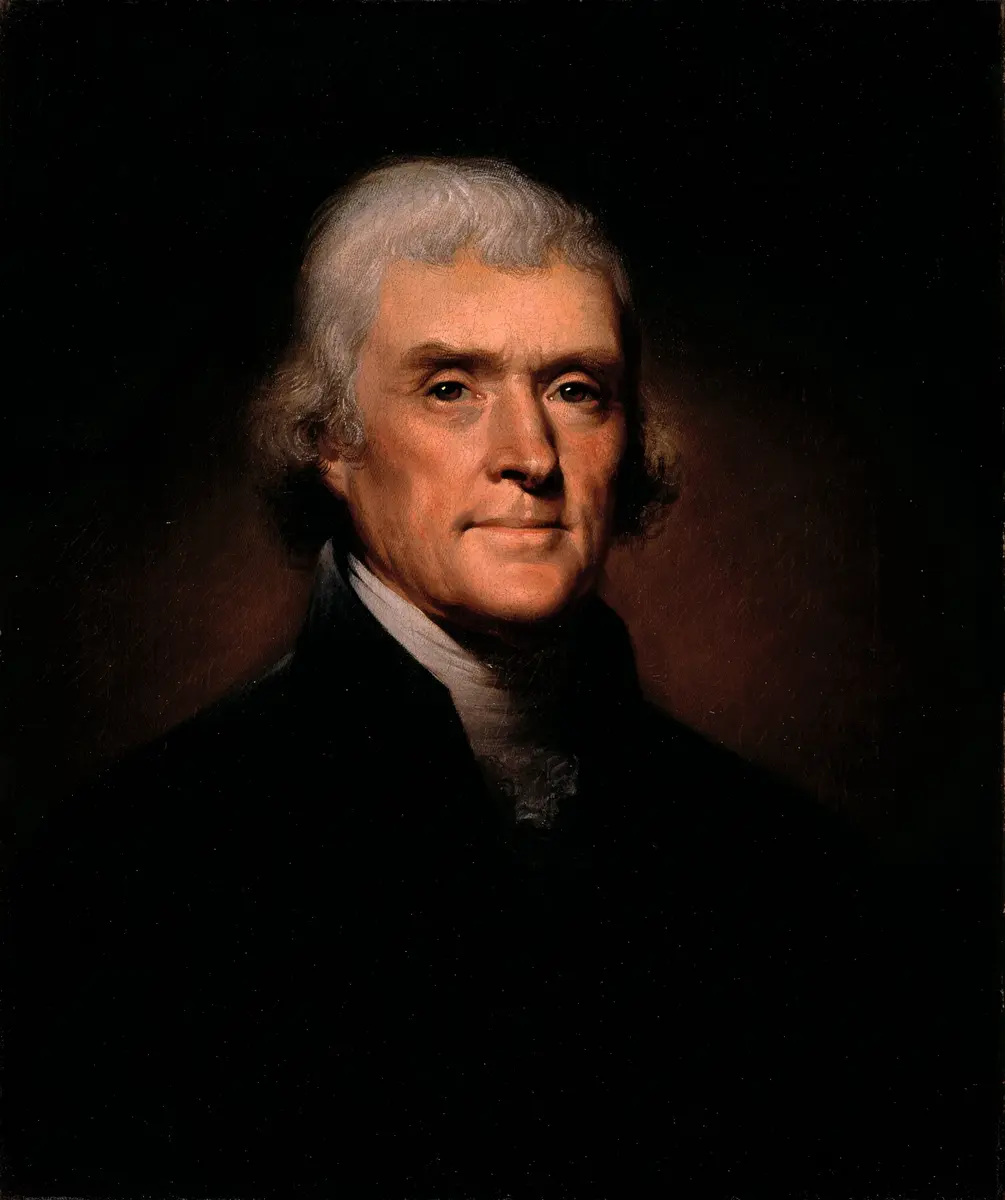
In Washington he meets President Thomas Jefferson, whose knowledge of natural history he admires, and they talk about Mexico and the limits of Louisiana; the two write to each other for over twenty years. Jefferson, a slave owner, and Humboldt, an opponent of slavery, differ on the matter, as their letters show.
The frigate La Favorite, with Humboldt, Bonpland and forty crates of notes and specimens, anchors at Bordeaux; he had been reported dead by some newspapers and is the hero of the day in Paris.
- 1807
He publishes 'Ideen zu einer Geographie der Pflanzen' (and, in French, the Essay on the Geography of Plants) with the Naturgemälde, his cross-section of the Andes, the first picture of vegetation, climate and height as one system. The book is dedicated to Goethe, who gets his copy in Weimar in March.
- 1808
In spring he settles in Paris, which he calls his true home, to bring out the results of the journey with the help of French scientists; the work he expected to take two years takes twenty-one, with about thirty volumes in all.
Paris, where he lived from 1808 until 1827 while writing up the American journey - 1809
His 'Carte generale du royaume de la Nouvelle Espagne' is published in Paris, the best map of Mexico of its day.
- 1814
The Atlas of the Voyage begins to appear from Gide in Paris, with his maps of the Orinoco, the Magdalena and Cuba and profiles of the Andes.
- 1817
He starts to read his memoir on isothermal lines to the Academie des sciences in Paris, and publishes a short account with the first isotherm chart in the Annales de chimie et de physique. It joins places of equal yearly temperature, and shows that they do not follow lines of latitude.
Paris, where he lived from 1808 until 1827 while writing up the American journey- 1827
At the king's order he leaves Paris and settles for good in Berlin as chamberlain to Frederick William III.
Oranienburger Straße, Berlin-Mitte: he lived at number 67 in his last years and died there on 6 May 1859; he was born in the city on 14 September 1769 (the point marks the street)After 61 lectures at the university that winter, he begins a series of 16 public lectures at the Berlin Sing-Akademie on the physical description of the world, the first outline of Kosmos.
Oranienburger Straße, Berlin-Mitte: he lived at number 67 in his last years and died there on 6 May 1859; he was born in the city on 14 September 1769 (the point marks the street)- 1829
He leaves Berlin for Russia, in formal dress, with the botanist Christian Gottfried Ehrenberg and the chemist Gustav Rose, at the invitation of Tsar Nicholas I, who pays; the Russian finance minister wants gold and platinum.
After the Urals and Tobolsk, Humboldt pushes on to the Altai and the Chinese border, farther east than planned and farther than he ever went; officials follow him everywhere, and as an opponent of serfdom he keeps quiet.
Shortly before Christmas he is back in Berlin after about eight months and 15,000 km in the Russian empire; diamonds, which he had predicted, have been found in the Urals, and he uses the trip to start a network of magnetic and weather stations across northern Asia.
- 1843
His map of the mountain chains and volcanoes of central Asia, drawn in Berlin in 1839-40 and finished in 1841, is published in Paris, where his book 'Asie centrale' follows on the results of the Russian journey.
- 1845
The first volume of Kosmos appears in Stuttgart and Tübingen from Cotta; it is a general account of the physical universe from the stars to the plants, and sells out in about two months.
- 1847
The second volume of Kosmos is published; Humboldt, who writes late at night in his library at Oranienburger Straße 67, vouches in writing for the lithograph of that room.
Oranienburger Straße, Berlin-Mitte: he lived at number 67 in his last years and died there on 6 May 1859; he was born in the city on 14 September 1769 (the point marks the street)Hermann Biow, a Hamburg photographer, takes Humboldt's daguerreotype in Berlin.
- 1850
The third volume of Kosmos is published.
- 1852
The Royal Society of London awards him its Copley Medal.
- 1858
At 89 he finishes the fourth volume of Kosmos and begins a fifth.
- 1859
After a slight stroke in 1857 and a slow decline over the winter, Humboldt dies in his Berlin apartment, six months short of his ninetieth birthday. Four days later, on the 10th, his coffin is taken in state through Berlin, met at the cathedral door by the Prince Regent bareheaded, and he is buried in the family ground at Tegel; the fifth volume of Kosmos follows in 1862.
Oranienburger Straße, Berlin-Mitte: he lived at number 67 in his last years and died there on 6 May 1859; he was born in the city on 14 September 1769 (the point marks the street)