Atlantic slave trade
“Twelve and a half million Africans shipped in chains to the Americas over three centuries, for sugar first of all; the biggest forced migration in history.”
The Atlantic slave trade was the forced shipping of about 12.5 million Africans across the ocean to the Americas between the 1520s and the 1860s, the largest forced migration in history. Some 10.7 million survived the crossing; the rest died at sea. The ships were Portuguese, British, Spanish, French, Dutch, American and Danish, roughly in that order of volume, and most of the captives came from West and West-Central Africa, from Senegal down to Angola. They were sold on the African coast by African and Afro-European traders, usually as prisoners of war or as the proceeds of raids, in exchange for cloth, guns, iron, rum and cowrie shells.
It began because the Europeans who had conquered the Americas needed workers. The native population was collapsing from European diseases, and few Europeans would emigrate to cut cane. The Portuguese had already used African slaves on the sugar islands off Africa, and in 1518 the Spanish crown licensed shipments straight from Africa to its colonies; the first such voyages, from the Cape Verde Islands and São Tomé to Hispaniola, Puerto Rico and Cuba, sailed in the mid-1520s. Sugar in Brazil and the Caribbean drove the trade for three centuries; tobacco, rice, coffee, gold mines and, in the nineteenth century, cotton added to it. Brazil took the most people of all, almost half; the British Caribbean and Spanish America most of the rest. Only about 388,000 were landed in what is now the United States.
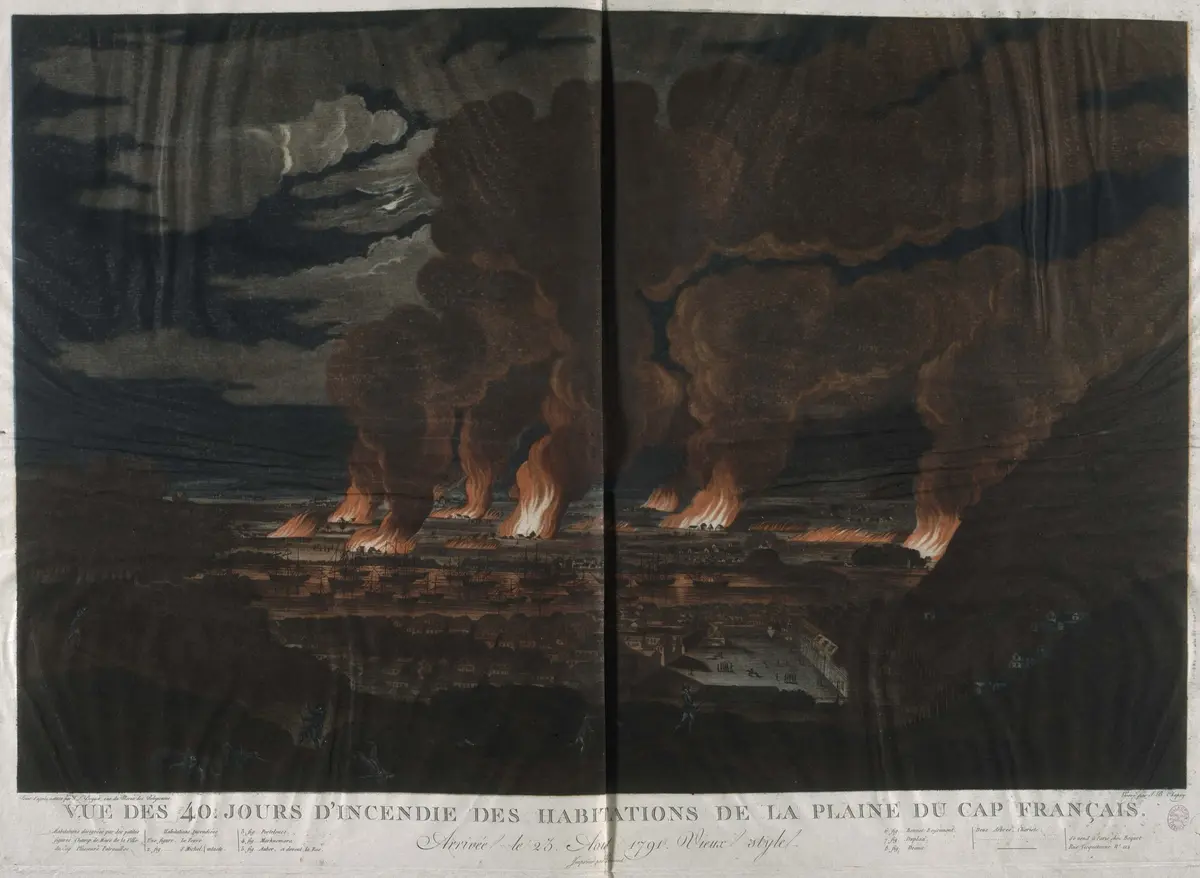
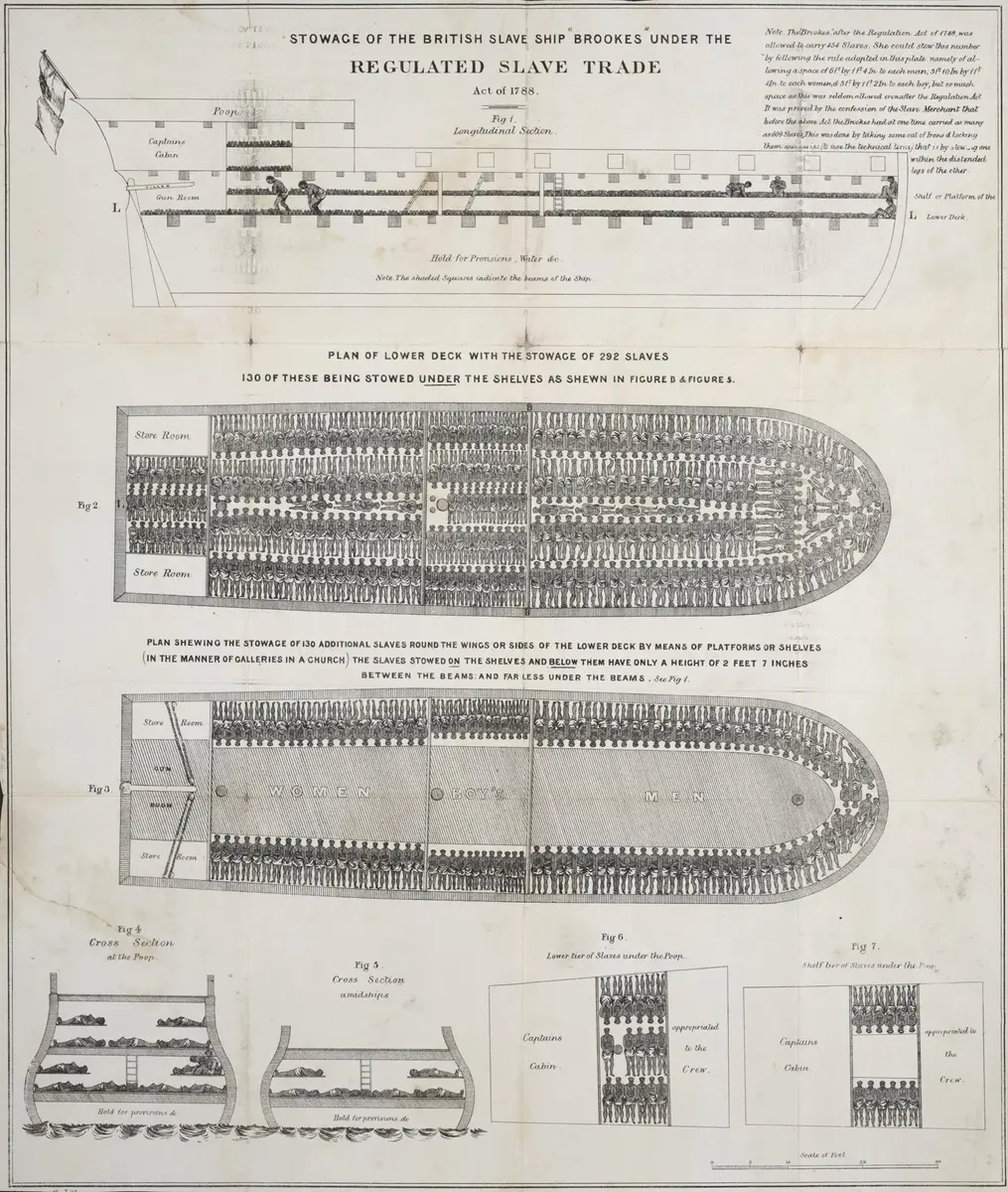
The crossing, the Middle Passage, took one to three months. People were chained below decks in spaces too low to sit up in, as the famous 1788 diagram of the Liverpool ship Brookes showed to the British public: 454 bodies drawn into its hold. Dysentery, smallpox and despair killed about one in seven on the way. On the Zong in 1781 the crew threw more than 130 living people into the sea and the owners claimed them on insurance; the case helped turn British opinion. Resistance was constant, on the ships and on the plantations, and in 1791 the enslaved people of Saint-Domingue rose and made Haiti the first free Black republic.
The trade peaked in the 1780s, when about 80,000 people a year were carried across, and was abolished while it was still enormously profitable. Quaker and evangelical campaigners in Britain, Josiah Wedgwood's medallion asking "Am I not a man and a brother?", Olaudah Equiano's memoir and petitions signed by hundreds of thousands brought Parliament to ban British ships from the trade in 1807; the United States banned imports from 1808. A quarter of all the people ever shipped were still carried after 1807, mostly to Cuba and Brazil, until British and finally American naval patrols closed the sea lanes; the last known voyage reached Cuba in 1867. Slavery itself outlived the trade: ended in the British colonies in 1833 to 1838, in the United States in 1865, in Cuba in 1886 and in Brazil in 1888.
Its legacy is the African diaspora of the Americas, tens of millions of people from Bahia to Harlem whose ancestors were carried in these ships, and the cultures, music and religions they made. It is also the wealth of the ports that organised it, Liverpool, Nantes, Lisbon, Rio de Janeiro and Charleston, the depopulation and wars it fed in Africa, and the racial ideas invented to justify it, which outlived it by a long way. The forts on the Gold Coast, the House of Slaves on Gorée and the Valongo Wharf in Rio are World Heritage sites, kept as places of memory.
What happened
- 1526
The first ships known to carry captives straight from Africa to the Americas sail from the Cape Verde Islands and São Tomé to Hispaniola, Puerto Rico and Cuba, under a licence the Spanish crown granted in 1518.
House of Slaves, Gorée Island, Senegal: the island was the largest slave-trading centre on the coast - 1619
An English privateer, the White Lion, lands '20 and odd' Africans taken from a Portuguese slave ship at Point Comfort, Virginia: the beginning of African slavery in English North America.
- 1637
The Dutch West India Company takes Elmina Castle from the Portuguese; the Gold Coast forts change hands between the European powers for the next two centuries.
Elmina Castle, Gold Coast (Ghana): built by the Portuguese in 1482, the oldest European fort on the coast - 1747
Emanuel Bowen's map of 'Negroland' is printed in London, marking which nation holds each fort on the Gold and Slave Coasts: the trade is an ordinary part of European geography.
- 1781
The crew of the Liverpool ship Zong, short of water after missing Jamaica, begin throwing living captives into the sea; more than 130 are drowned, and the owners sue the insurers for their value.
- 1787
The Society for Effecting the Abolition of the Slave Trade is founded in London; Josiah Wedgwood makes its medallion, a kneeling man in chains asking 'Am I not a man and a brother?'.
- 1788
The Plymouth abolitionists print the plan of the slave ship Brookes with 454 people drawn into its hold; it becomes the campaign's most powerful image.
Liverpool: the biggest slaving port in Europe in the trade's last century- 1789
Olaudah Equiano publishes his Interesting Narrative, the story of his kidnapping in Africa, the crossing and his purchase of his own freedom; it runs through nine editions in his lifetime.
- 1807
Parliament bans British ships from the slave trade; a quarter of all the people ever carried across the Atlantic will still be shipped after this date, by others.
Liverpool: the biggest slaving port in Europe in the trade's last century - 1808
The United States' ban on importing slaves takes effect, the earliest day the Constitution allowed; slavery inside the country goes on, and smuggling continues.
Gadsden's Wharf, Charleston: the main landing place in North America- 1833
Parliament passes the Slavery Abolition Act for the British colonies; full freedom comes in 1838, when 800,000 people are freed across the Caribbean and the planters are paid 20 million pounds.
- 1840
Turner exhibits The Slave Ship at the Royal Academy, with the dead and dying thrown overboard under a coming typhoon.
- 1865
The 13th Amendment is ratified and slavery ends in the United States.
- 1867
The last known slave ship from Africa lands its captives in Cuba; the Atlantic trade is over, though slavery itself lasts in Cuba until 1886 and in Brazil until 1888.
Valongo Wharf, Rio de Janeiro: where the captives bound for Brazil were landed