The Haitian Revolution
“From the rising of August 1791 to January 1, 1804: the enslaved people of France's richest colony freed themselves, beat Napoleon's army and founded Haiti, the only successful slave revolution in history.”
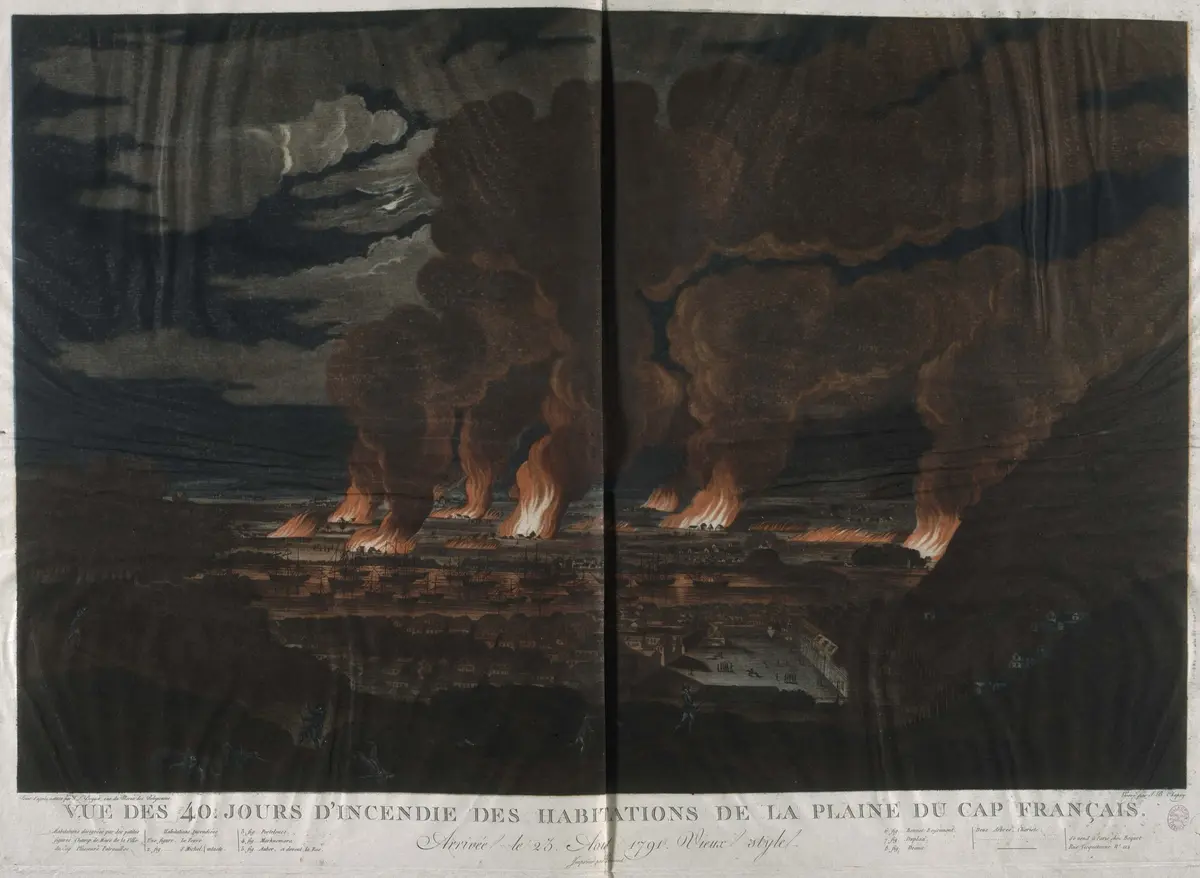
In 1789 Saint-Domingue, the western third of the island of Hispaniola, was France's richest colony and the most profitable in the Americas. Its sugar and coffee plantations were worked by about 500,000 enslaved Africans and ruled by some 32,000 white colonists, while 24,000 to 28,000 free people of colour owned land and slaves of their own but were barred from office and equal rights. The French Revolution's talk of the rights of man set all of them against each other. In August 1791 the enslaved of the northern plain around Cap-Français, after secret meetings and, tradition says, a Vodou ceremony in the woods of Bois Caïman, rose on the night of August 22. They burned the cane fields and sugar works and killed their masters, and the richest plain of the colony burned for weeks.
Twelve years of war on many sides followed. Spain, from the eastern part of the island, and Britain, from Jamaica, invaded to take the colony from a weakened France, and both recruited the rebels with promises of freedom. To win the Black fighters for the Republic, the French commissioner Léger-Félicité Sonthonax freed those who fought for it and in August 1793 abolished slavery in the north; on February 4, 1794 the National Convention in Paris abolished slavery in all French colonies. Toussaint, born a slave on the Bréda plantation and freed by 1776, had joined the rising as a healer and become a general on the Spanish side, signing himself Louverture from 1793. In May 1794 he went over to France with his army. In the next seven years he drove out the Spanish and, in 1798, the British, crushed his rival André Rigaud in the south, took Spanish Santo Domingo in January 1801 and gave the colony a constitution that made him governor for life, while it stayed French on paper.
Napoleon Bonaparte, now First Consul, meant to restore the old colonial order. Early in 1802 his brother-in-law Charles Leclerc landed with some 23,000 soldiers, and Cap-Français was burned in the fighting. After months of war Toussaint agreed to an armistice in May; the French then seized him by a trick and shipped him to France, where he died in a cell of the Fort de Joux in the Jura mountains on April 7, 1803. By then the war had begun again: news that Napoleon had restored slavery in Guadeloupe brought Toussaint's generals Jean-Jacques Dessalines and Henry Christophe, and the mixed-race leader Alexandre Pétion, back into the field, while yellow fever destroyed the French army and killed Leclerc himself in November 1802. The war was fought with terror on both sides. On November 18, 1803 Dessalines's Indigenous Army beat the French at Vertières outside Cap-Français, the last French garrison sailed away as prisoners of the British navy, and on January 1, 1804, at Gonaïves, Dessalines declared the whole island independent under its old Arawak name, Haiti.
It is the only revolution in history in which enslaved people freed themselves and kept their freedom by founding a state: Haiti was the second independent country in the Americas, after the United States, and the first founded by former slaves. Its victory ended Napoleon's hopes of an empire in the Americas and, Britannica argues, helped him decide to sell Louisiana to the United States. It frightened slaveholders from Virginia to Brazil, gave the enslaved a hero to sing about and the abolitionists an argument, and it was punished for it: France recognised Haiti only in 1825, in return for an indemnity of about 100 million francs paid until 1887, and the United States only in 1862. The printed Declaration of Independence was lost for two centuries, until a Duke University graduate student, Julia Gaffield, found copies in the British National Archives in London in 2010 and 2011.
What happened
- 1791
Delegates from the plantations of the northern plain meet on the Lenormand de Mézy estate to plan a rising. Tradition sets the Vodou ceremony at Bois Caïman, led by the priest Dutty Boukman, on the same night; the historian David Geggus places it a week later.
Bois Caïman, near Morne-Rouge in the northern plain: by tradition the wood where the rising was sworn in August 1791On the night of August 22 the enslaved of the northern plain rise. They burn the cane fields and sugar works and kill their masters, and the fires across the plain behind Cap-Français burn for weeks. Toussaint, a freed coachman of the Bréda estate, joins the rebels after a few weeks.
Bois Caïman, near Morne-Rouge in the northern plain: by tradition the wood where the rising was sworn in August 1791- 1792
In Paris the Legislative Assembly votes full political rights to all free people of colour, made law in April; the white colonists resist, and the Republic sends civil commissioners, Sonthonax among them, to enforce it and put down the slave revolt.
- 1793
French factions fight for Cap-Français; Sonthonax offers freedom to the insurgents who fight for the Republic, and in four days of fighting and fire most of the city burns while thousands of white refugees flee on the ships in the harbour to the United States.
Cap-Français, today Cap-Haïtien: the 'Paris of the Antilles', burned in 1793 and again in 1802, and the French army's last strongholdAt Cap-Français Sonthonax proclaims the end of slavery in the north, printed in French and in Creole. That summer Toussaint, by now the third man among the insurgent leaders fighting for Spain, begins to sign himself Louverture.
Cap-Français, today Cap-Haïtien: the 'Paris of the Antilles', burned in 1793 and again in 1802, and the French army's last stronghold- 1794
The National Convention in Paris abolishes slavery in all French colonies, confirming what its commissioners had done in Saint-Domingue: 16 Pluviôse, Year II.
Toussaint Louverture turns on his Spanish allies and goes over to the French Republic with his army, saying that France has freed the slaves while Spain and Britain have not; his switch turns the war against the invaders.
- 1796
The governor, Étienne Laveaux, makes Toussaint his deputy; Paris confirms him as deputy governor and, from late in the year, commander of the French forces in the colony.
- 1797
Toussaint forces out Sonthonax, the commissioner who had freed the slaves, and sends him back to France; from now on the officials Paris sends are sidelined and driven out.
- 1798
Worn down by their losses, the British, who had held the coasts since 1793, agree with Toussaint to leave; their general Thomas Maitland signs, and Britain even offers to recognise Toussaint as king, which he refuses.
- 1799
Toussaint's army crushes his rival André Rigaud, the mixed-race general who ruled the south; the purge Dessalines carries out there is so brutal that it leaves no reconciliation with the mixed-race elite.
- 1801
Toussaint marches into Spanish Santo Domingo, ceded to France in 1795 but never handed over, and rules the whole island of Hispaniola.
Toussaint proclaims a constitution for the colony that names him governor for life while keeping it French; Napoleon, now First Consul, takes it as defiance.
- 1802
Early in the year Leclerc's fleet arrives with some 23,000 men, among them exiled mixed-race officers such as Pétion; Cap-Français is burned in the fighting, and months of war follow in the mountains.
Cap-Français, today Cap-Haïtien: the 'Paris of the Antilles', burned in 1793 and again in 1802, and the French army's last strongholdToussaint agrees to an armistice. Within weeks the French break it: he is lured to a meeting, arrested and shipped to France.
Leclerc dies of yellow fever at Cap-Français, his army wasted by the disease. News that Napoleon has restored slavery in Guadeloupe has brought Dessalines, Christophe and Pétion back to the rebels' side, and the war is on again.
Cap-Français, today Cap-Haïtien: the 'Paris of the Antilles', burned in 1793 and again in 1802, and the French army's last stronghold- 1803
Toussaint Louverture dies of pneumonia and hunger in his cell in the Fort de Joux, in the Jura near the Swiss border, after months of solitary confinement and interrogation.
The Fort de Joux in the Jura mountains, France: Toussaint Louverture's prison, where he died on April 7, 1803Britain and France go to war again and the Royal Navy blockades the colony; three weeks after selling Louisiana, Napoleon cannot send help. The war is fought with terror on both sides: the French drown and hang prisoners, the rebels take revenge.
At Vertières, outside Cap-Français, Dessalines's Indigenous Army defeats the French; Rochambeau surrenders the city and, given ten days to leave, his garrison finally sails as prisoners of the British navy.
Vertières, outside Cap-Français: where Dessalines's army won the last battle on November 18, 1803Dessalines, Christophe and Clervaux proclaim the independence of Saint-Domingue 'in the name of the Black people and men of colour', inviting planters who accept it to come back.
- 1804
At Gonaïves Dessalines and his generals swear to renounce France for ever and to die rather than live under its rule; his secretary Boisrond-Tonnerre reads the Act of Independence he wrote overnight, the new state takes the island's old Arawak name, Haiti, and the generals name Dessalines governor-general for life.
Gonaïves: where Dessalines proclaimed Haiti's independence on January 1, 1804