Baruch Spinoza
“The Amsterdam Jewish heretic and lens grinder whose Ethics identified God with Nature and whose Theological-Political Treatise argued for the freedom to think.”
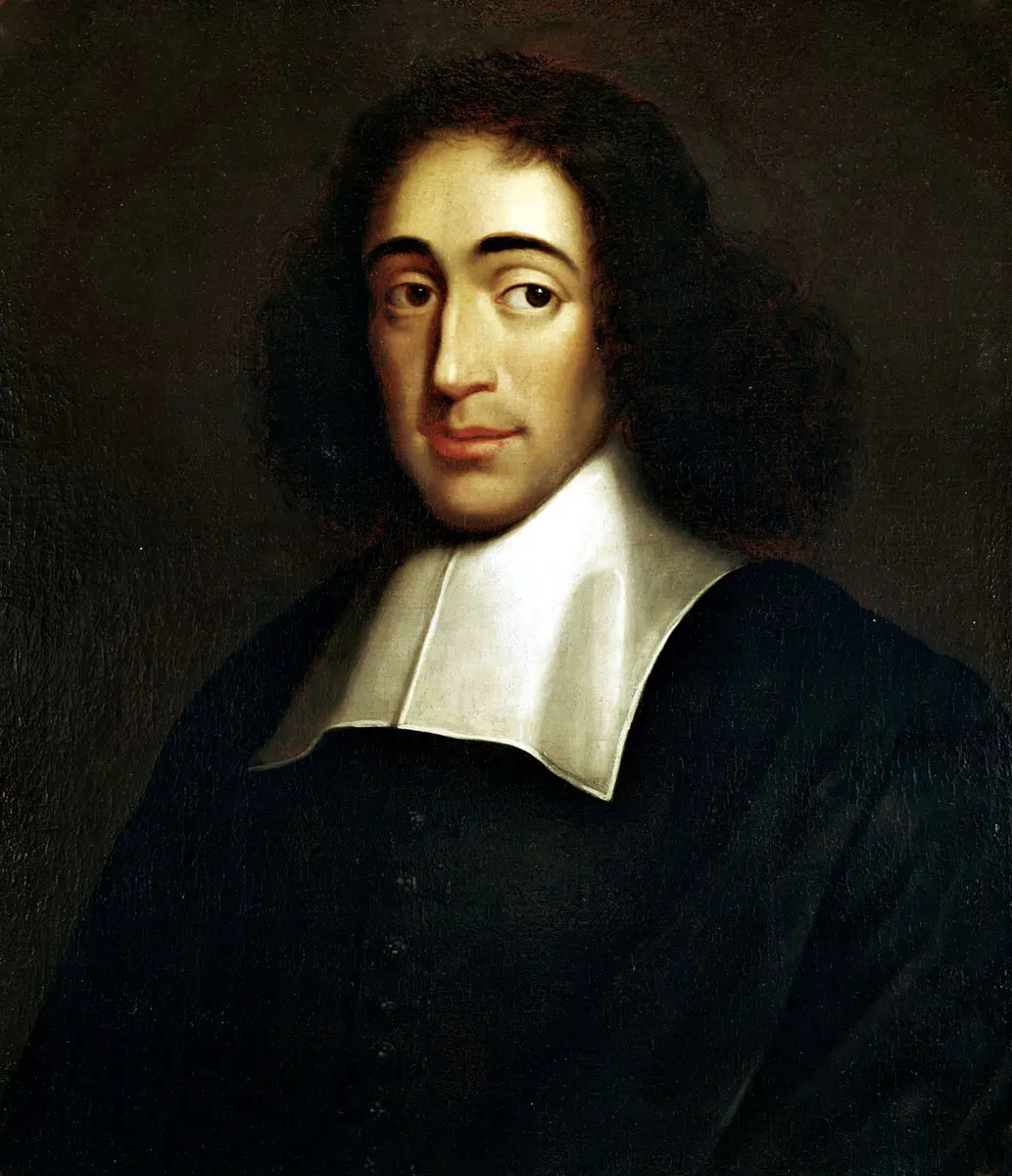
Baruch Spinoza (Bento in Portuguese, Benedictus in Latin; all three names mean 'blessed') was born in Amsterdam on 24 November 1632 into the city's Portuguese-Jewish community: families who had fled the Inquisition in Portugal and could live openly as Jews in the Dutch Republic. His father Michael was a merchant and one of the community's governors, and the family lived on Vlooienburg, an island in the Amstel a few doors from the synagogue and its school. In his teens Bento left his studies for the family's importing business, which he and his brother took over, deep in debt, when their father died in 1654. Then on 27 July 1656 the community's governors expelled him, at 23, with the harshest ban (herem) they ever pronounced, for 'abominable heresies' and 'monstrous deeds' that the text never names. It was never lifted.
Spinoza did not join another church. He learned Latin with the free-thinking schoolmaster Franciscus van den Enden, read Descartes, and lived quietly in rented rooms: at Rijnsburg near Leiden from 1661, at Voorburg from 1663, and in The Hague from about 1670. He earned part of his living grinding lenses for telescopes and microscopes, and wrote to scientists such as Henry Oldenburg of the Royal Society and Christiaan Huygens. The only book he signed was a geometrical exposition of Descartes's Principles of Philosophy (1663). In 1670 he published the Theological-Political Treatise without his name and with a false 'Hamburg' imprint. It read the Bible as a human, historical text, denied that miracles happen, and argued that the freedom to philosophise is no danger to piety or to the peace of the state, but that both are endangered when it is suppressed. One critic called it a book forged in hell; the Court of Holland banned it in 1674.
His masterpiece, the Ethics, is set out like Euclid, in definitions, axioms and proofs. It argues that there is only one substance, which he calls 'God, or Nature' (Deus, sive Natura): God is not a person who judges, rewards and works miracles, but the infinite, necessary being of which everything, people included, is a part, and everything follows from its nature by necessity. Human beings are not free by an act of will; they become free by understanding, which turns the passions, hope and fear into clear knowledge and brings peace of mind. Spinoza meant to print it in 1675, but rumours that he was about to publish a book proving that God does not exist made him put it away.
His world was the Dutch Golden Age at its peak and at its breaking point. In 1672, the Disaster Year, a mob in The Hague lynched Johan de Witt, the republic's leading statesman, and his brother Cornelis; Leibniz later reported that Spinoza wanted to post a sign at the scene reading 'ultimi barbarorum', the very worst of barbarians. In 1673 he turned down a chair of philosophy at Heidelberg to keep his quiet and his freedom, and in November 1676 Leibniz came to see him. He died in The Hague on 21 February 1677, aged 44, and was buried in the Nieuwe Kerk; his friends published the Ethics and his other papers at the end of the year as the Opera Posthuma.
Long denounced as an atheist, he saw his books banned in the Republic and put on the Catholic Index soon after his death. Yet his naturalism, his reading of scripture as history and his defence of a tolerant, secular and democratic state made him one of the seminal figures of the Enlightenment, and the Stanford Encyclopedia of Philosophy counts him among the most relevant of all the philosophers of his century today.
What happened
- 1632
Born on a Wednesday in Amsterdam, in the Vlooienburg quarter, to the merchant Michael d'Espinosa and his second wife Hanna Deborah; his parents' families had fled the Inquisition in Portugal.
Vlooienburg, Amsterdam: born and raised in the family's house at the corner of the Houtgracht and the Leprozengracht, where the Mozes en Aaronkerk now stands; the synagogue where the ban was proclaimed and the community's school were a few doors along the Houtgracht- 1637
He and his elder brother Isaac start at the community's elementary school on the Houtgracht.
Vlooienburg, Amsterdam: born and raised in the family's house at the corner of the Houtgracht and the Leprozengracht, where the Mozes en Aaronkerk now stands; the synagogue where the ban was proclaimed and the community's school were a few doors along the Houtgracht - 1638
His mother Hanna Deborah dies, a few weeks before his sixth birthday.
- 1639
Amsterdam's three Portuguese-Jewish congregations unite as Talmud Torah and build their synagogue on the Houtgracht, a few doors from the Spinoza house.
Vlooienburg, Amsterdam: born and raised in the family's house at the corner of the Houtgracht and the Leprozengracht, where the Mozes en Aaronkerk now stands; the synagogue where the ban was proclaimed and the community's school were a few doors along the Houtgracht- 1649
By about seventeen he has left his studies to help run the family's importing business.
- 1654
His father dies; that September Bento and his brother Gabriel take over the firm, burdened with debt.
Vlooienburg, Amsterdam: born and raised in the family's house at the corner of the Houtgracht and the Leprozengracht, where the Mozes en Aaronkerk now stands; the synagogue where the ban was proclaimed and the community's school were a few doors along the Houtgracht- 1656
The community's governors proclaim a herem against him, at 23, from the reader's platform of the synagogue: the harshest ban they ever issued, for 'abominable heresies' and 'monstrous deeds'. It is never lifted.
Vlooienburg, Amsterdam: born and raised in the family's house at the corner of the Houtgracht and the Leprozengracht, where the Mozes en Aaronkerk now stands; the synagogue where the ban was proclaimed and the community's school were a few doors along the Houtgracht- 1657
In these years, probably 1656 to 1658, he learns Latin at the school of the free-thinking former Jesuit Franciscus van den Enden, and begins his first philosophical writing.
- 1661
By late July he has left Amsterdam for Rijnsburg, near Leiden, where he rents rooms in the house of the surgeon Herman Homan.
Rijnsburg, near Leiden: his lodgings in the surgeon Herman Homan's house from 1661 to 1663, now the Spinozahuis museumHenry Oldenburg, soon the Royal Society's secretary, who visited him at Rijnsburg that summer, writes the first letter of a correspondence that lasts until 1676.
Rijnsburg, near Leiden: his lodgings in the surgeon Herman Homan's house from 1661 to 1663, now the Spinozahuis museum- 1663
He moves to Voorburg, near The Hague, lodging with the painter Daniel Tydeman.
Voorburg, near The Hague: lodged with the painter Daniel Tydeman on the Kerklaan from 1663 to about 1670; the point marks the village's Old Church, as the house is not securely identifiedHis first book appears: Descartes's Principles of Philosophy set out in geometrical order, with his Metaphysical Thoughts, the only book he ever signs.
- 1664
He meets the physicist Christiaan Huygens; they talk about optics and lens grinding.
- 1665
In the summer he begins the Theological-Political Treatise, putting the Ethics aside.
By June the first parts of the Ethics, on God and on the human mind, circulate among his friends in Latin and Dutch.
- 1670
The Treatise appears without his name and with a false imprint, 'Hamburg, Henricus Kunrath'; it was printed in Amsterdam for Jan Rieuwertsz. Within months he is known as its author.
He settles in The Hague, first at the Stille Veerkade and then around the corner in Hendrick van der Spijck's house on the Paviljoensgracht.
Paviljoensgracht 72-74, The Hague: his room in the painter Hendrick van der Spijck's house from the early 1670s; he died here on 21 February 1677- 1671
Leibniz, troubled and fascinated by the Treatise, writes to him on a safe subject, optics.
- 1672
In the Disaster Year an Orangist mob in The Hague lynches Johan de Witt and his brother Cornelis; Spinoza, Leibniz later reports, wanted to post a sign at the scene: 'ultimi barbarorum'.
- 1673
Johann Ludwig Fabritius writes from Heidelberg offering him, in the Elector Palatine's name, a chair of philosophy with 'the most ample freedom in philosophical teaching', so long as he does not disturb the established religion.
He declines, out of 'love of quietness' and not knowing how far that freedom would reach.
Paviljoensgracht 72-74, The Hague: his room in the painter Hendrick van der Spijck's house from the early 1670s; he died here on 21 February 1677With safe conducts from the Prince of Conde and the Prince of Orange he travels to French-occupied Utrecht and stays about a month; why is still a mystery.
- 1674
The Court of Holland bans the Treatise in an official placard.
- 1675
Around the turn of the year his friend Pieter van Gent copies out the finished Ethics; Tschirnhaus takes the copy on his travels, and it ends up in the Vatican.
In the summer he goes to Amsterdam to have the Ethics printed, but rumours that he is about to publish a book proving that God does not exist make him put it off.
In the autumn he begins the Political Treatise, on monarchy, aristocracy and democracy; he will not finish it.
- 1676
Leibniz, on his way to Hanover, spends several days with him, between 18 and 21 November, talking about the Ethics and Descartes's physics; Spinoza shows him his proof of God's existence.
Paviljoensgracht 72-74, The Hague: his room in the painter Hendrick van der Spijck's house from the early 1670s; he died here on 21 February 1677- 1677
He dies on a Sunday in his room on the Paviljoensgracht, aged 44, after his health failed in the winter. On 25 February he is buried in a rented vault in the Nieuwe Kerk; as he is said to have arranged, his landlord sends his desk with the manuscripts to his publisher in Amsterdam.
Paviljoensgracht 72-74, The Hague: his room in the painter Hendrick van der Spijck's house from the early 1670s; he died here on 21 February 1677