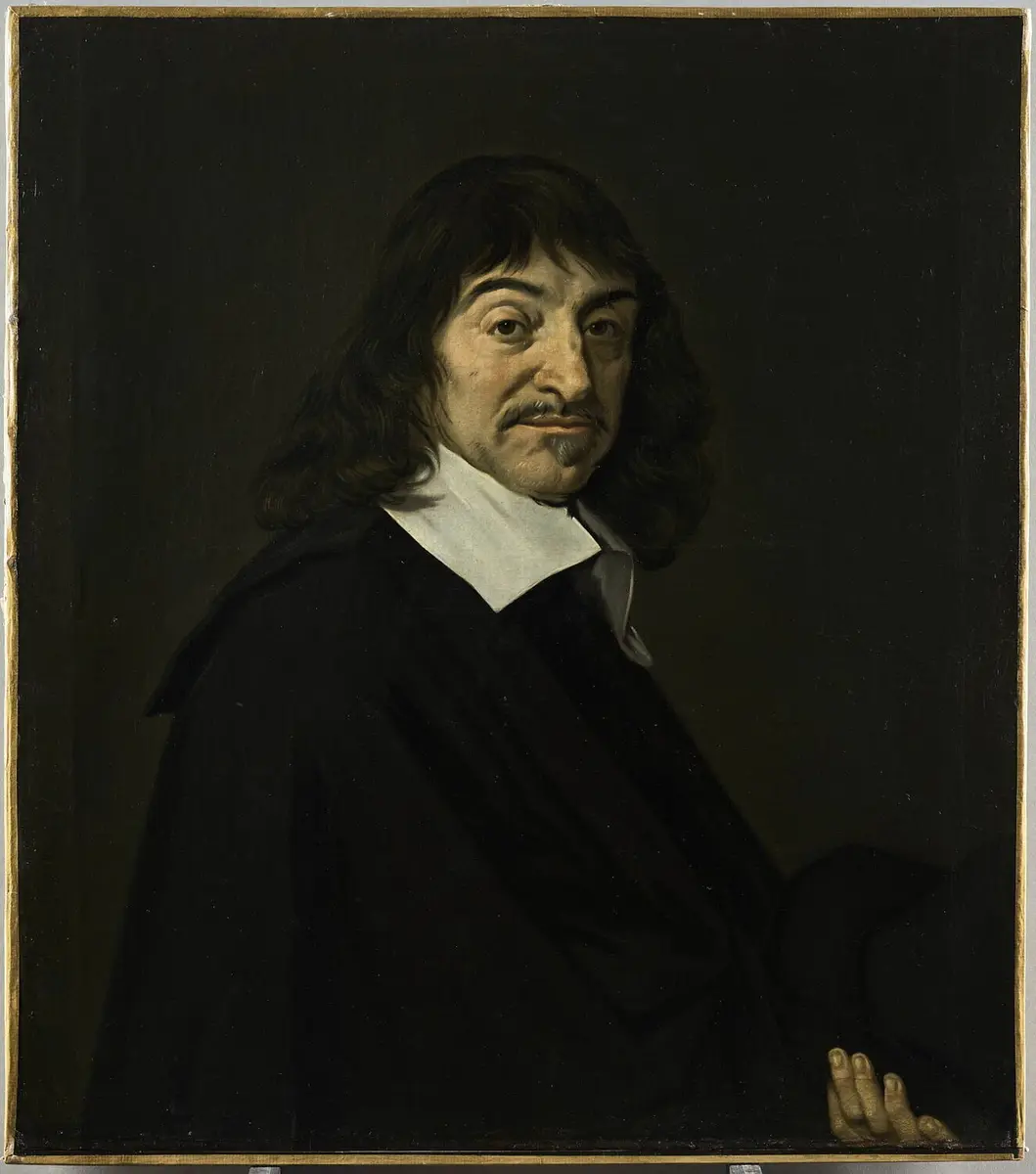
Descartes
“The French thinker of 'I think, therefore I am', who began modern philosophy by doubting everything, joined algebra to geometry, and split the world into mind and matter.”
René Descartes was a French philosopher, mathematician and scientist, often called the founder of modern philosophy. He was born on 31 March 1596 at La Haye in Touraine, a small town that now bears his name; his mother died when he was a year old, and his grandmother brought him up. From about 1607 he studied at the new Jesuit college of La Flèche, where Aristotle was the master and mathematics was the only subject that fully satisfied him, and in 1616 he took a law degree at Poitiers. He never practised. He became a gentleman soldier instead, and at Breda in 1618 he met the Dutch scientist Isaac Beeckman, who turned him towards mathematical physics. On the night of 10 November 1619, in winter quarters near Ulm, three dreams convinced him that his task in life was to rebuild all knowledge on certain foundations.
After years of travel and of life in Paris among the friends of Father Marin Mersenne, he moved to the Dutch Republic in 1628 and lived there for twenty years, often changing his address to protect his quiet. He was finishing The World, a physics of matter in motion, when he heard in 1633 that Galileo had been condemned in Rome, and he put it away. In 1637 he published at Leiden, without his name, the Discourse on the Method, with three essays on optics, weather and geometry. There he wrote 'I think, therefore I am', and in the Geometry he showed how to solve problems of geometry with algebra, the work that later gave its name to Cartesian coordinates.
The Meditations on First Philosophy (1641) and the Principles of Philosophy (1644) set out his whole system: doubt everything that can be doubted, find one certainty in the thinking self, prove that God exists and does not deceive us, and rebuild the world as extended matter that moves by a few laws, with the planets carried round the Sun in great whirlpools of matter. Mind and body, he held, are two different substances, joined in human beings. The new philosophy brought fame and quarrels: Protestant theologians at Utrecht had it condemned in 1642, and Princess Elisabeth of Bohemia pressed him in letters on how an immaterial mind can move a body, questions that led to his Passions of the Soul (1649).
In 1649 Queen Christina of Sweden invited him to Stockholm. That winter she had him teach her philosophy at five in the morning, against his lifelong habit of staying in bed until late. On 1 February 1650 he caught a chill, and he died of pneumonia on 11 February, aged fifty-three. His bones were brought back to Paris and buried with ceremony in 1667; since 1819 they have lain in the church of Saint-Germain-des-Prés.
He swept away Aristotle's world of forms and qualities and put in its place a machine of matter and motion. His physics of vortices ruled in France for decades even after Newton showed it could not work, his mathematics opened the way to the calculus, and his search for certainty inside one's own mind made the question of what we can know the centre of philosophy, from Spinoza and Leibniz to Locke, Hume and Kant. His sharp division between mind and body left the 'mind–body problem' that philosophers and brain scientists still argue over.
What happened
- 1596
Born at La Haye in Touraine, in his grandmother's house, while his father Joachim, a councillor in the Parlement of Brittany, is away at Rennes.
La Haye, now Descartes, in Touraine: born here on 31 March 1596, by tradition in this house, his grandmother's, now the Musée Descartes- 1597
His mother, Jeanne Brochard, dies after giving birth to another child; the little René stays at La Haye with his grandmother, a pale child with a persistent cough.
La Haye, now Descartes, in Touraine: born here on 31 March 1596, by tradition in this house, his grandmother's, now the Musée Descartes - 1607
He goes as a boarder to the Jesuit college of La Flèche, founded by Henry IV three years before; because of his health he is allowed to stay in bed in the mornings, a habit he keeps for life.
The Jesuit college of La Flèche, today the Prytanée national militaire: his school from about 1607 to 1614 - 1610
The murdered King Henry IV's heart is brought to La Flèche, the college he founded, and Descartes takes part in the ceremony; the same year the school celebrates Galileo's discovery of the moons of Jupiter.
The Jesuit college of La Flèche, today the Prytanée national militaire: his school from about 1607 to 1614 - 1616
To please his father he takes a degree in law at the University of Poitiers, but never practises.
- 1618
He goes to Breda as a gentleman volunteer in the army of Prince Maurice of Nassau. There he meets the Dutch scientist Isaac Beeckman, who sets him problems in physics and mathematics; he writes him a Compendium of Music as a New Year's gift.
- 1619
Back from the coronation of Emperor Ferdinand II at Frankfurt, he is held by winter in a heated room near Ulm. That night he has three dreams, which he takes as a call to rebuild all knowledge, starting with philosophy.
- 1625
After travels that took him to Italy, he settles in Paris, in the circle of the Minim friar Marin Mersenne, his lifelong correspondent; he works on optics and on the Rules for the Direction of the Mind.
- 1628
At a gathering in Paris before Cardinal de Bérulle he demolishes the alchemist Chandoux's claim that probability is enough in science and shows his own method for certainty. Within weeks he leaves for the Dutch Republic, where he will live for twenty years.
- 1629
He registers at the University of Franeker in Friesland and spends his first nine months in the country on a little treatise of metaphysics, the seed of the Meditations.
From his new lodging in Amsterdam he writes to Mersenne that he means to explain not one phenomenon but the whole of nature: the plan of The World.
- 1632
He moves to Deventer to teach his physics to his friend Henricus Reneri, and works on the Treatise on Man, on the body as a machine.
- 1633
Hearing that Galileo has been condemned in Rome for teaching that the Earth moves, he decides not to publish The World and the Treatise on Man, which assume the same.
- 1634
In Amsterdam he lodges with the bookseller Thomas Sergeant in the Westerkerkstraat, today the Westermarkt; Helena Jans, a servant in the house, becomes the mother of his child.
Westermarkt 6, Amsterdam: the house where, by its plaque and the address on his letters, he lodged in 1634; he lived in the Dutch Republic from 1628 to 1649 - 1635
Helena gives birth to his daughter Francine; he acknowledges her as his child, though in letters he calls her his niece.
- 1637
At Leiden, Jan Maire finishes printing the Discourse on the Method, published without the author's name, with essays on optics, meteors and geometry: the first book of the new philosophy, and the book of 'I think, therefore I am'.
- 1640
Francine dies of a fever at the age of five, as he is arranging for her schooling in France, a loss that grieves him deeply. His father and his sister die the same year.
- 1641
The Meditations on First Philosophy appear in Paris in Latin, with objections gathered by Mersenne from Hobbes, Gassendi, Arnauld and others, and his replies; a second edition follows at Amsterdam in 1642.
- 1642
At Utrecht, where the professor of medicine Regius teaches his ideas, the theologian Gisbertus Voetius has the university condemn the new philosophy; the quarrel grows until Descartes fears expulsion and the burning of his books, and asks the Prince of Orange for help.
- 1643
He settles at Egmond, in the dunes of North Holland, his home until he leaves for Sweden and the longest he lives anywhere.
Princess Elisabeth of Bohemia, living in exile in the Netherlands, asks him how a mind that has no extension can move a body. Their long correspondence, on the soul, the passions and how to live, leads to his last book.
- 1644
The Principles of Philosophy, his physics written in Latin for the schools, is printed by Louis Elzevir in Amsterdam and dedicated to Elisabeth: a universe of matter in motion, with the planets swept round the Sun in vortices.
- 1647
On a visit to Paris, where French translations of his Principles and Meditations are published, he meets Gassendi and Hobbes, and suggests to Blaise Pascal the experiment of carrying a barometer up the Puy de Dôme.
- 1648
He leaves Paris in haste as the revolt of the Fronde breaks out, a few days before the death of his friend Mersenne.
- 1649
Invited by Queen Christina of Sweden, he leaves the Netherlands for Stockholm; just before, Frans Hals paints him in Haarlem, probably for his friend Father Bloemaert. The Passions of the Soul comes out the same year.
He arrives in Stockholm; the French resident there, Hector Pierre Chanut, had arranged the invitation.
Tre Kronor, the royal castle of Stockholm (burned in 1697; the Royal Palace stands on its site): where he came at five in the morning to teach Queen Christina; he died in the city on 11 February 1650- 1650
Christina has him give her philosophy lessons three mornings a week, starting at five o'clock, at the castle; on 15 January he writes that 'men's thoughts are frozen here, like the water'.
Tre Kronor, the royal castle of Stockholm (burned in 1697; the Royal Palace stands on its site): where he came at five in the morning to teach Queen Christina; he died in the city on 11 February 1650Bringing the queen at five in the morning the statutes he has drafted for a Swedish academy of sciences, he catches a chill, which turns to pneumonia.
Tre Kronor, the royal castle of Stockholm (burned in 1697; the Royal Palace stands on its site): where he came at five in the morning to teach Queen Christina; he died in the city on 11 February 1650He dies in Stockholm in the early morning, aged fifty-three. His bones go back to France: buried with ceremony in Paris in 1667, and since 1819 in Saint-Germain-des-Prés.
Tre Kronor, the royal castle of Stockholm (burned in 1697; the Royal Palace stands on its site): where he came at five in the morning to teach Queen Christina; he died in the city on 11 February 1650