The Enlightenment
“Europe's age of reason, roughly 1685 to 1800: Voltaire, Diderot's Encyclopédie, Hume, Rousseau, Smith and Kant taught people to think for themselves, and the American and French revolutions wrote it into law.”
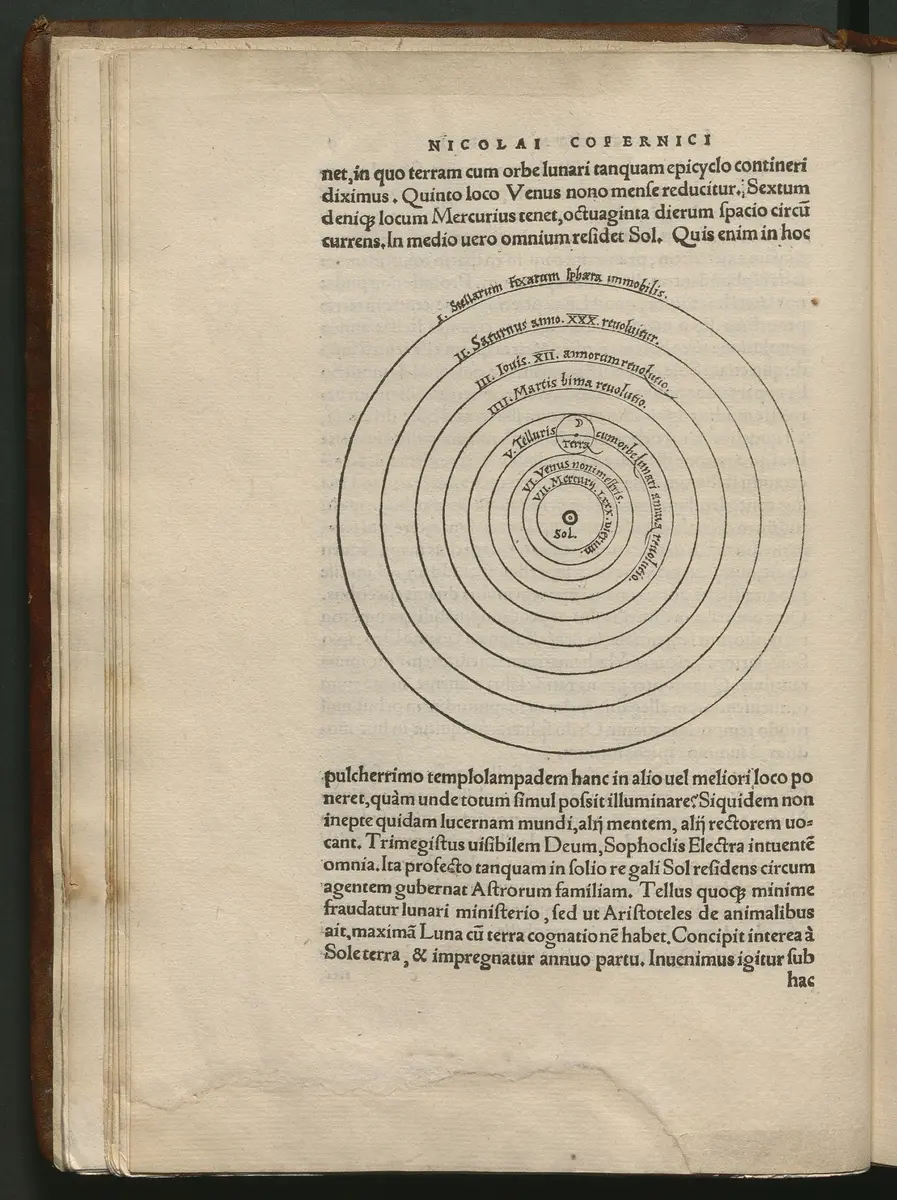
The Enlightenment is the name for the movement of ideas, centred on the eighteenth century, in which Europe's writers, scientists and reformers set out to test everything, from religion and government to law, trade and human nature, by reason and experience instead of tradition and authority. One of its leaders, d'Alembert, called his age 'the century of philosophy', and in 1784 Immanuel Kant gave the definition still quoted today: enlightenment is humanity leaving behind an immaturity it has brought on itself, by finding the courage to think for itself. It grew out of the Scientific Revolution. Newton's Principia of 1687 showed that nature follows laws the human mind can discover, and Locke's Essay Concerning Human Understanding of 1689 argued that all our ideas come from experience. Where it begins and ends is a convention: this calendar runs it from 1685, when Louis XIV revoked the Edict of Nantes and between 160,000 and 200,000 French Protestants went into exile, about 70,000 of them through the tolerant Dutch Republic, to 1800.
Its centre was Paris. The philosophes, Voltaire, Montesquieu, Diderot, d'Alembert and Rousseau among them, wrote for a fast-growing reading public, and their ideas travelled through salons run by hostesses such as Madame Geoffrin, through learned academies, Masonic lodges and, in Britain, coffee houses; what the French censors banned was printed in Amsterdam or Switzerland and smuggled back. Their great common work was the Encyclopédie edited by Diderot and d'Alembert: 28 volumes, 17 of text and 11 of plates, published between 1751 and 1772, with more than 70,000 articles by over 140 contributors, meant to gather all human knowledge and to 'change the common way of thinking'. The Jesuits attacked it, the crown suspended it and in 1759 withdrew its licence, and it was finished all the same. There were other centres too: Edinburgh and Glasgow, where David Hume and Adam Smith built a science of human nature and of society; the German Enlightenment of Lessing, Moses Mendelssohn and Kant; and Philadelphia, where the Declaration of Independence of 1776 named life, liberty and the pursuit of happiness as rights no government may take away.
Voltaire turned the philosopher into a public campaigner. After the Lisbon earthquake of 1 November 1755 killed tens of thousands of people, he asked in a poem, and then in Candide (1759), how a good God could allow it, and mocked through Doctor Pangloss the optimism that called this the best of all possible worlds. From his house at Ferney he spent three years clearing the name of Jean Calas, a Protestant merchant broken on the wheel in Toulouse in 1762. Montesquieu's Spirit of the Laws (1748) compared the governments of the world, warned against despotism and argued for separating the legislative, executive and judicial powers; Rousseau's Social Contract (1762), which opens with 'Man is born free, but is everywhere in chains', placed legitimate power in the general will of the people; Smith's Wealth of Nations (1776) made the case for free trade and founded economics. Women ran the salons, and some did the thinking as well: Émilie du Châtelet translated Newton's Principia into French, and Mary Wollstonecraft claimed the rights of man for women in 1792, although the age as a whole, as the Stanford Encyclopedia puts it, generally overlooked the rights of women and of non-white people.
No single event ended it. Voltaire and Rousseau both died in 1778, the textbook end of the 'high' Enlightenment, and Kant's Critiques of the 1780s both crowned its trust in reason and drew limits around what reason can know. In 1789 the French Revolution tried to build a state on its principles: the Declaration of the Rights of Man and of the Citizen, voted that August, was inspired, in the words of the French presidency, by the American Declaration and the spirit of the Enlightenment, and the revolutionaries carried Voltaire's remains to the Panthéon in 1791 and Rousseau's in 1794, making the philosophes the founders of a revolution that neither man would have recognised as his own. The Terror also turned on them: Condorcet, called the last of the philosophes, was arrested after months in hiding and found dead in his cell in March 1794. By 1800 the age of salons and encyclopedias had given way to an age of revolutions and of Napoleon's wars.
Much of the political language of the modern world comes from it: human rights and the rule of law, religious toleration, freedom of thought and of the press, government by the consent of the governed, the separation of powers, free trade, and the belief that science and reason can make human life better. Liberal democracy, modern economics and the idea of progress all claim it as an ancestor. It has had critics from the start, Rousseau among them, and later ones have charged it with overconfidence in reason and with the European prejudice about race and sex that runs through many of its own writings; its defenders answer that its ideals are still the best tools for correcting those faults. The argument about what the Enlightenment was, and whether it still matters, has never stopped.
What happened
- 1685
Louis XIV signs the Edict of Fontainebleau, revoking the Edict of Nantes of 1598: Protestant worship is banned in France, pastors are banished and Protestant churches, like the great temple of Charenton outside Paris, are pulled down. Between 160,000 and 200,000 Huguenots leave France in the following decades, about 70,000 of them through the Dutch Republic, where exiles such as Pierre Bayle write for the whole of Europe.
- 1687
Isaac Newton's Mathematical Principles of Natural Philosophy is published in London: one set of laws for the heavens and the Earth. Its success makes it the model for the Enlightenment, which looks for a 'Newton' of every field, from the mind to society.
London: Newton's Principia (1687), Voltaire's English exile (1726–1729), Smith's Wealth of Nations (1776) and Wollstonecraft's Vindication (1792) - 1689
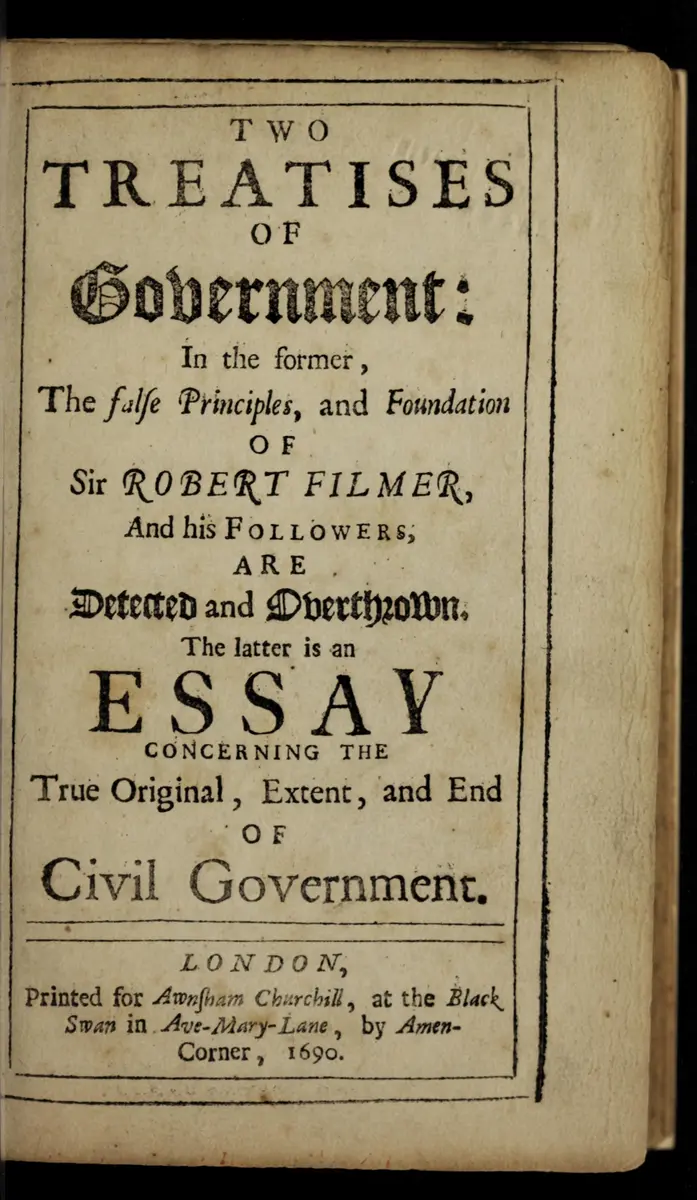
Back in England after the revolution of 1688, John Locke, who had read the Principia in his Dutch exile, publishes An Essay Concerning Human Understanding: all our ideas come from experience. His Two Treatises of Government and Letter Concerning Toleration follow.
London: Newton's Principia (1687), Voltaire's English exile (1726–1729), Smith's Wealth of Nations (1776) and Wollstonecraft's Vindication (1792) - 1697
In Rotterdam the Huguenot exile Pierre Bayle publishes his Historical and Critical Dictionary, millions of words of learned doubt aimed at superstition and intolerance; it becomes one of the best-sellers of its age and, in the philosopher Ernst Cassirer's phrase, 'the arsenal of the Enlightenment'.
Rotterdam: home in exile of the Huguenot Pierre Bayle, 'the Philosopher of Rotterdam', from 1681 - 1721
Montesquieu, a magistrate of Bordeaux, publishes the Persian Letters anonymously: two Persian travellers write home about the oddities of French church, court and manners. The book is an instant success and makes him famous.
- 1726
In the spring, after a quarrel with the powerful Duc de Rohan, Voltaire leaves Paris for England. In three years there he meets Pope, Swift and Gay and discovers English philosophy, science and toleration.
London: Newton's Principia (1687), Voltaire's English exile (1726–1729), Smith's Wealth of Nations (1776) and Wollstonecraft's Vindication (1792) - 1734
Voltaire's Philosophical Letters, praising Locke, Newton, smallpox inoculation and English liberty, come out in France without the censors' approval and cause a scandal. He escapes arrest by moving to Cirey, Émilie du Châtelet's family estate, where the two live and work together until 1749.
The Château de Cirey (Haute-Marne), Émilie du Châtelet's family estate: Voltaire's refuge and the couple's shared workplace from 1734 to 1749 - 1738
Voltaire's Elements of Newton's Philosophy, 'put within everyone's reach', is printed in Amsterdam and makes Newton's physics French reading; two years later Du Châtelet publishes her own Foundations of Physics.
The Château de Cirey (Haute-Marne), Émilie du Châtelet's family estate: Voltaire's refuge and the couple's shared workplace from 1734 to 1749 - 1739
David Hume publishes the first two books of A Treatise of Human Nature anonymously, an attempt to found a science of man on experience. It 'fell deadborn from the press', he said later, but its doubts about cause and effect would later set Kant to work.
Edinburgh: David Hume's birthplace and home, a centre of the Scottish Enlightenment - 1748
Montesquieu publishes The Spirit of the Laws, which compares republics, monarchies and despotisms, shows how climate, religion and trade shape laws, and argues for separating the powers of government; the Church puts it on the Index of forbidden books in 1751. The same year Hume's Enquiry Concerning Human Understanding appears.
- 1749
Diderot is locked up in the prison of Vincennes, outside Paris, until November, for his subversive Letter on the Blind. Walking out to visit him, Rousseau reads the Dijon academy's prize question, whether the arts and sciences have improved morals, and decides that they have corrupted them; his prize-winning First Discourse makes him famous.
Paris: the city of the philosophes and the salons, where the Encyclopédie was edited and published from 1751 to 1772Émilie du Châtelet dies six days after giving birth to a daughter, having just finished her French translation of Newton's Principia with a commentary; it is published in 1759 and is still the leading French translation.
- 1751
The first volume of the Encyclopédie, or Reasoned Dictionary of the Sciences, Arts and Trades, edited by Diderot and d'Alembert, comes out in Paris. The Jesuits attack it from the start, and a theology scandal soon makes the crown suspend its licence for a time.
Paris: the city of the philosophes and the salons, where the Encyclopédie was edited and published from 1751 to 1772 - 1752
At the court of Frederick the Great, which he had joined after Du Châtelet's death, Voltaire publishes a satire of Maupertuis, president of the king's Academy of Sciences in Berlin. Frederick sides with Maupertuis, and Voltaire chooses to leave Prussia rather than take it back.
Berlin and Potsdam: the court of Frederick the Great and his Academy of Sciences, where Voltaire lived after 1749 until his break with the king; Moses Mendelssohn's city - 1755
On the morning of All Saints' Day an earthquake of about magnitude 8.5, followed by fire, destroys much of Lisbon and kills perhaps 50,000 people. The news takes three weeks to reach Geneva.
Lisbon: destroyed by the earthquake and fire of 1 November 1755, which set Voltaire, Rousseau and Kant arguing about providence- 1756
Voltaire's Poem on the Lisbon Disaster appears in its approved edition: why would a good God crush the innocent? Rousseau answers him in a Letter on Providence of 18 August, and the young Kant publishes three pieces on the earthquake. The disaster becomes the century's great argument about evil and optimism.
Geneva: Rousseau's birthplace (1712); Voltaire settled here after Prussia, and Candide was printed here in 1759; in 1762 the city condemned the Social Contract and Emile- 1759
Candide, or Optimism appears, 'translated from the German of Doctor Ralph': Voltaire's comic tale of disasters, the Lisbon earthquake among them, in which the tutor Pangloss keeps insisting that this is the best of all possible worlds, a caricature of Leibniz. Banned in France, it circulates anyway.
Geneva: Rousseau's birthplace (1712); Voltaire settled here after Prussia, and Candide was printed here in 1759; in 1762 the city condemned the Social Contract and EmileThe French government withdraws the Encyclopédie's licence after new scandals; d'Alembert has already resigned, and Diderot carries on alone and in secret.
Paris: the city of the philosophes and the salons, where the Encyclopédie was edited and published from 1751 to 1772Voltaire settles for good at Ferney, the château he has bought just across the French border from Geneva, and makes it for almost twenty years the headquarters of what he calls the 'party of humanity', under his motto 'Écrasez l'infâme', crush the infamy.
Voltaire's château at Ferney, just inside France near Geneva: his home and headquarters from 1759 to 1778- 1762
Rousseau publishes The Social Contract, which opens 'Man is born free, but is everywhere in chains', and the education novel Emile, both printed in Amsterdam. Paris condemns Emile, Geneva condemns both, and Rousseau has to flee.
Amsterdam: the Dutch Republic's printing house for books the French censors banned; Rey printed Rousseau's Social Contract here in 1762, Ledet Voltaire's Elements of Newton in 1738In Toulouse the Protestant merchant Jean Calas, convicted of murdering his son over the son's conversion to Catholicism, is executed on the wheel. Voltaire, at Ferney, takes up the case in letter after letter and in his Treatise on Tolerance of 1763.
Voltaire's château at Ferney, just inside France near Geneva: his home and headquarters from 1759 to 1778- 1765
The king's council declares Jean Calas innocent: the Toulouse verdict is quashed and his name restored after three years of Voltaire's campaign.
Voltaire's château at Ferney, just inside France near Geneva: his home and headquarters from 1759 to 1778The last ten volumes of the Encyclopédie's text are issued together, with a false Neuchâtel imprint to get round the ban: the seventeen volumes of text are complete.
Paris: the city of the philosophes and the salons, where the Encyclopédie was edited and published from 1751 to 1772- 1766
Rousseau, hunted since Emile, crosses to England at David Hume's invitation; Allan Ramsay paints both men that year. Within months Rousseau convinces himself that Hume is at the centre of a plot against him, and the friendship ends.
London: Newton's Principia (1687), Voltaire's English exile (1726–1729), Smith's Wealth of Nations (1776) and Wollstonecraft's Vindication (1792)- 1772
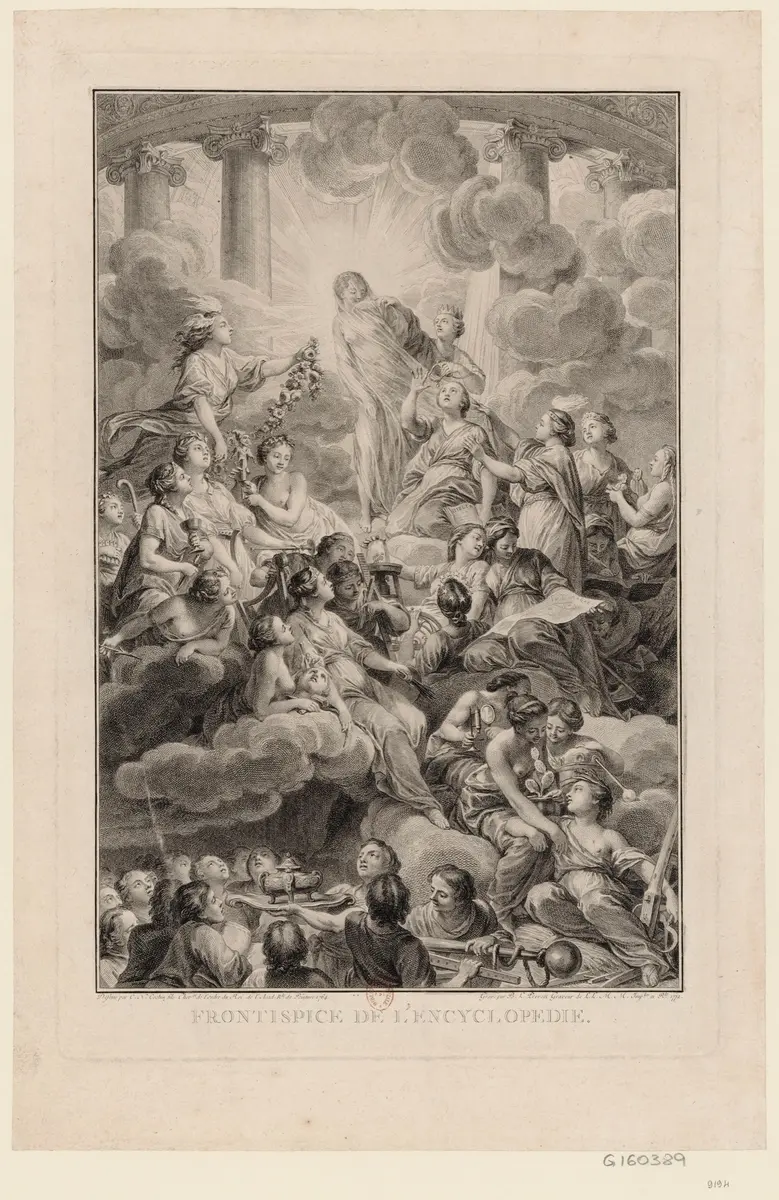
The last volume of plates comes out and the Encyclopédie is complete: 28 volumes, 17 of text and 11 of plates, after 21 years. Its frontispiece, drawn by Cochin in 1764, is engraved by Prévost this year.
Paris: the city of the philosophes and the salons, where the Encyclopédie was edited and published from 1751 to 1772 - 1776
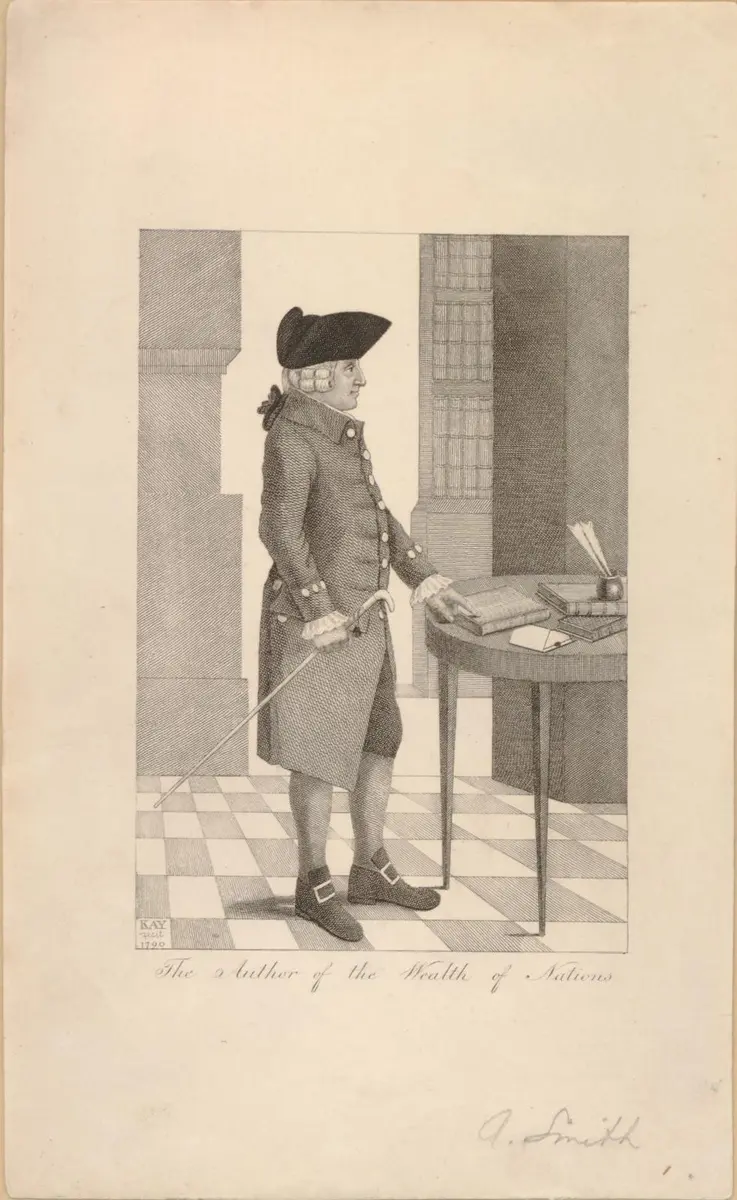
Adam Smith, formerly professor of moral philosophy at Glasgow, publishes An Inquiry into the Nature and Causes of the Wealth of Nations in London: the founding book of economics and the classic case for free trade.
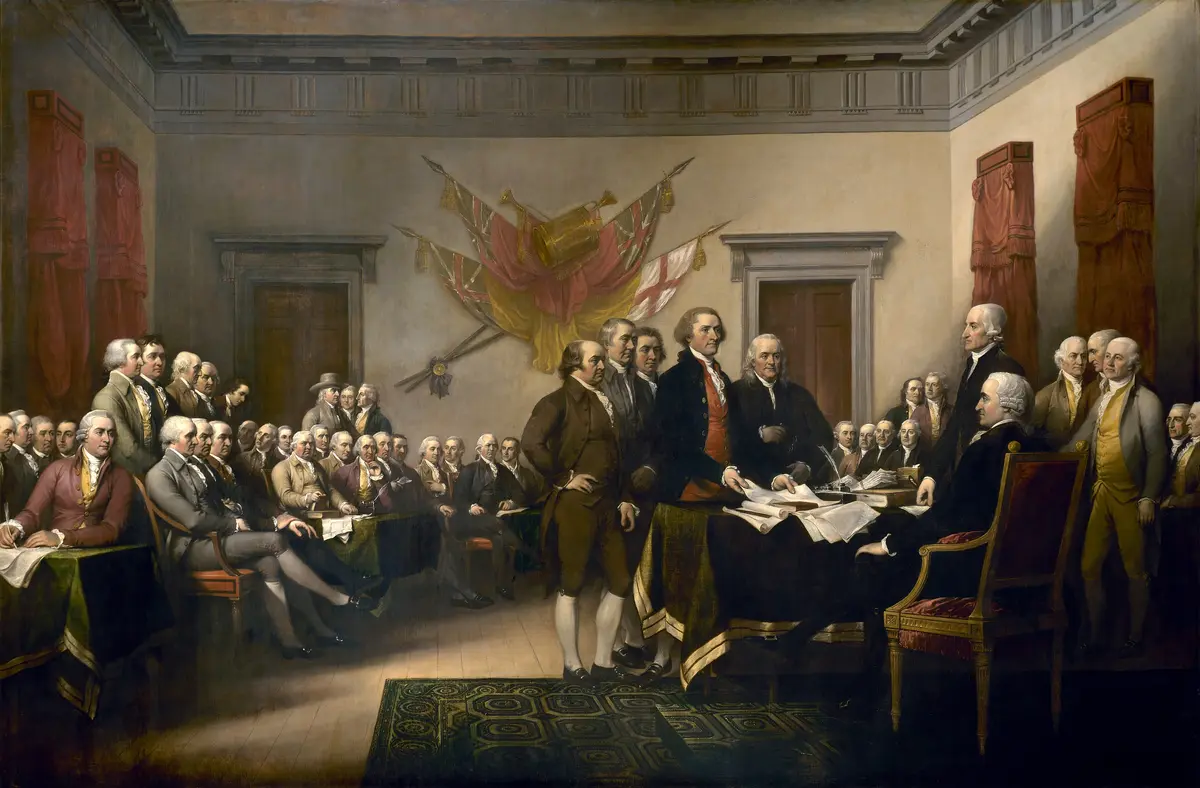
London: Newton's Principia (1687), Voltaire's English exile (1726–1729), Smith's Wealth of Nations (1776) and Wollstonecraft's Vindication (1792)In Philadelphia the Continental Congress adopts the Declaration of Independence: all men are created equal, with unalienable rights to life, liberty and the pursuit of happiness, and governments draw their just powers from the consent of the governed.
Independence Hall, Philadelphia: where Congress adopted the Declaration of Independence on 4 July 1776- 1778
Voltaire, back in Paris since the start of the year after nearly thirty years away and celebrated as the hero of the Enlightenment at a performance of his play Irène, dies in the city.
Paris: the city of the philosophes and the salons, where the Encyclopédie was edited and published from 1751 to 1772Rousseau dies at Ermenonville, north of Paris. With Voltaire gone five weeks earlier, textbooks often take 1778 as the end of the 'high' Enlightenment.
- 1781
In Königsberg, after a decade's work, Kant publishes the Critique of Pure Reason, which puts reason itself on trial to find what it can and cannot know.
Königsberg (today Kaliningrad), capital of East Prussia: Kant was born here in 1724 and taught at its university, the Albertina - 1784
Kant's essay 'An Answer to the Question: What is Enlightenment?' defines it as humanity's release from its self-incurred immaturity, the courage to use one's own understanding without another's guidance. In Berlin, Moses Mendelssohn answers the same question the same year.
Königsberg (today Kaliningrad), capital of East Prussia: Kant was born here in 1724 and taught at its university, the Albertina - 1789
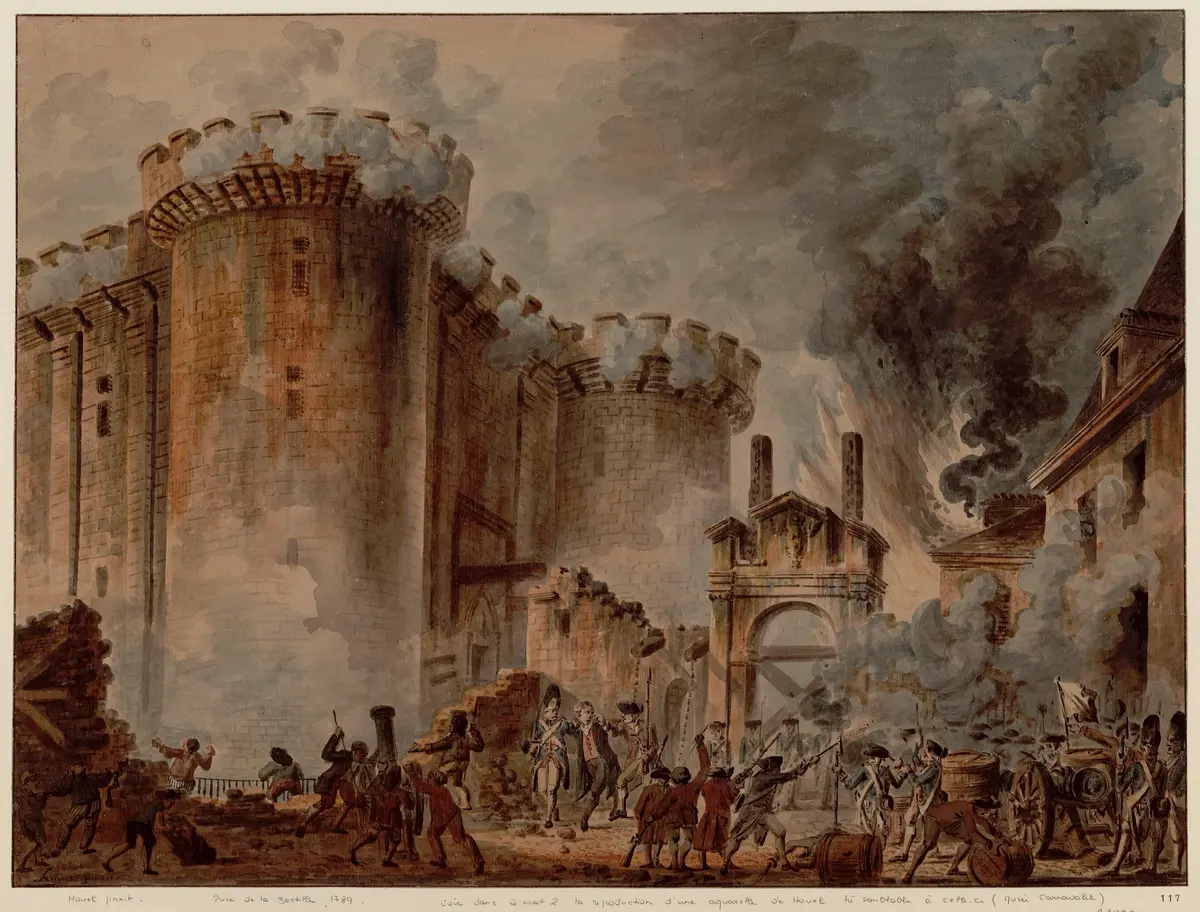
The National Assembly finishes voting the Declaration of the Rights of Man and of the Citizen, article by article since 20 August: a text inspired, says the French presidency, by the American Declaration and the spirit of the Enlightenment.
- 1791
Voltaire's remains are drawn across Paris on a triumphal chariot and laid in the Panthéon, the church of Sainte-Geneviève turned into a temple for great men, which the orator Mirabeau had been the first to enter in April.
The Panthéon, Paris: the church of Sainte-Geneviève made a temple for great men, where the Revolution laid Voltaire in 1791 and Rousseau in 1794- 1792
Mary Wollstonecraft publishes A Vindication of the Rights of Woman in London, claiming for women the education and the use of reason the age had claimed for men.
London: Newton's Principia (1687), Voltaire's English exile (1726–1729), Smith's Wealth of Nations (1776) and Wollstonecraft's Vindication (1792) - 1794
Condorcet, mathematician and 'the last of the philosophes', is found dead in his cell at Bourg-la-Reine two days after his arrest. Hiding from the Terror, he had written a Sketch of the progress of the human mind, published in 1795.
Rousseau's remains are brought to the Panthéon, near those of his old enemy Voltaire: the Revolution makes the two philosophes its founding fathers, a role neither would have chosen.
The Panthéon, Paris: the church of Sainte-Geneviève made a temple for great men, where the Revolution laid Voltaire in 1791 and Rousseau in 1794