Adam Smith
“The Scottish moral philosopher whose Wealth of Nations (1776), with its pin factory and 'invisible hand', founded modern economics and made the case for free trade and the division of labour.”
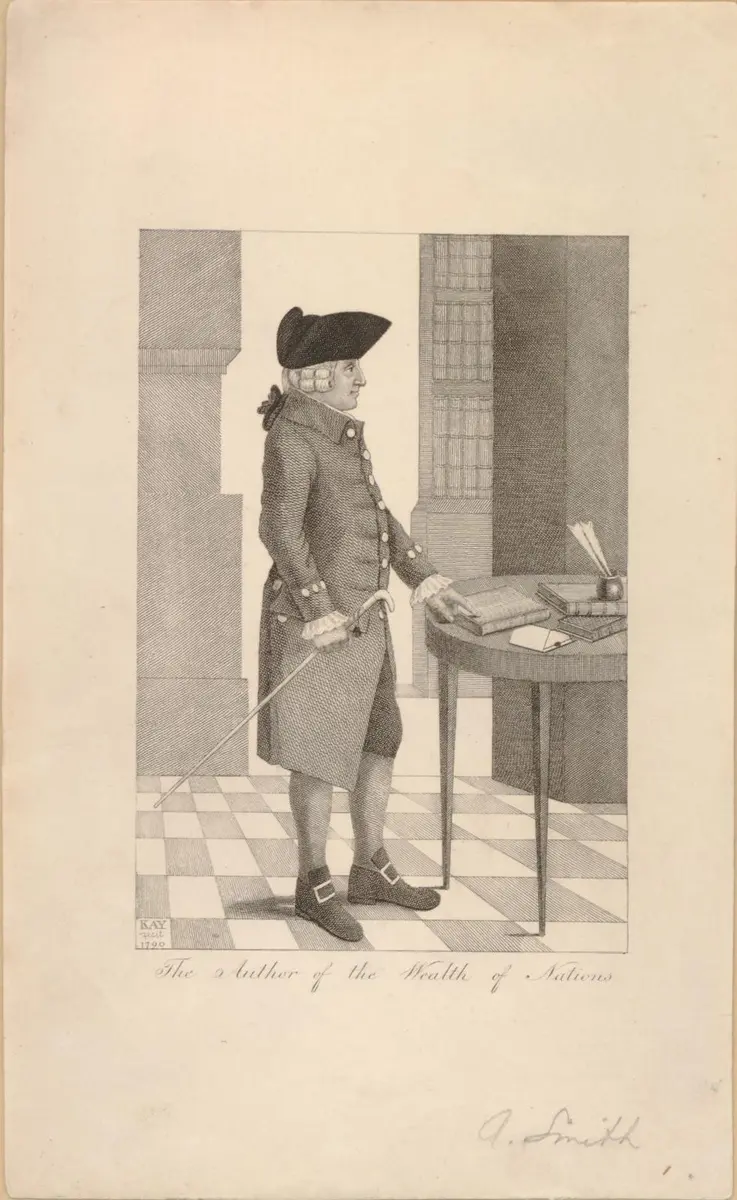
Adam Smith was the Scottish moral philosopher whose Inquiry into the Nature and Causes of the Wealth of Nations (1776) is usually called the founding book of modern economics. It opens in a pin workshop, where ten men who split the job into about eighteen separate steps make some forty-eight thousand pins a day, and it argues that the wealth of a nation is not the gold in its treasury but the yearly produce of its people's labour, which grows as work is divided and markets widen. People who follow their own gain under fair laws and real competition are, in his phrase, 'led by an invisible hand' to serve a public good they never intended; so Smith attacked the 'mercantile system' of tariffs, bounties, monopolies and colonial trade rules by which governments tried to pile up gold. He saw himself first as a moral philosopher: his earlier book, The Theory of Moral Sentiments (1759), explains how sympathy with others and an inner 'impartial spectator' teach us to judge our own conduct.
He was baptised in Kirkcaldy, a small port on the Firth of Forth in Fife, on 5 June 1723; the day of his birth is not recorded. His father, the town's comptroller of customs, had died a few months before, and he was brought up by his mother, Margaret Douglas, who stayed at the centre of his life until her death in 1784. At fourteen he went to the University of Glasgow, where the moral philosopher Francis Hutcheson, 'the never-to-be-forgotten Hutcheson' as he later called him, shaped his thinking. In 1740 a Snell scholarship sent him on horseback to Balliol College, Oxford, where he found the teaching idle and spent six years mostly educating himself. Back in Scotland he gave public lectures in Edinburgh from 1748 with the support of the judge Lord Kames, came to know the philosopher David Hume, who became his closest friend, and in 1751 was elected professor of logic at Glasgow, moving the next year to the chair of moral philosophy that Hutcheson had made famous.
He later called his thirteen years as a Glasgow professor by far the happiest of his life. He lectured every morning, in English rather than Latin, to students of fourteen to sixteen, helped run the college, and learned how trade really worked from the merchants of Glasgow's colonial commerce. The Theory of Moral Sentiments made his name, and the politician Charles Townshend offered him £300 a year and a pension of £300 for life, far more than his chair paid, to take his stepson, the young Duke of Buccleuch, abroad. Early in 1764 they left for France. In eighteen months at Toulouse Smith began a book to fill the empty days; in Geneva he met Voltaire several times; in Paris he joined the circle of François Quesnay and the reformers later called the physiocrats, whom he admired so much that he would have dedicated The Wealth of Nations to Quesnay had he lived. The tour ended when the duke's younger brother died in Paris in October 1766.
Smith then spent six years at his mother's house in Kirkcaldy and three more in London writing and rewriting The Wealth of Nations, which William Strahan and Thomas Cadell published in London on 9 March 1776. That August Hume died in Edinburgh, and Smith's published letter calling his unbelieving friend as close to 'a perfectly wise and virtuous man' as human frailty allows brought him a storm of abuse. In 1778 he became a commissioner of customs for Scotland, a strange post for the great critic of tariffs, and settled with his mother at Panmure House in Edinburgh's Canongate, where he kept open house for supper on Sundays and dined weekly with the chemist Joseph Black and the geologist James Hutton. In 1787 the students of Glasgow elected him rector of their university. A week before he died he had Black and Hutton burn sixteen volumes of his unfinished manuscripts. He died at Panmure House on 17 July 1790 and was buried in the Canongate kirkyard.
The Wealth of Nations went through four editions in his lifetime and became the starting point of classical economics, the book that David Ricardo and later Karl Marx built on and argued against. Its case for free trade and for what Smith called 'the system of natural liberty' made him the patron saint of the free market, yet he was no simple preacher of greed: the same book warns that 'people of the same trade seldom meet together' without a conspiracy against the public, and gives the state three plain duties, defence, justice, and the public works and institutions that no private person would ever pay for. Read together with his moral philosophy, his work asks how a society of self-interested people can also be decent and free, which is why economists and philosophers of very different views still read him.
What happened
- 1723
Adam Smith is baptised in Kirkcaldy, Fife (the day of his birth is not recorded). His father, comptroller of customs in the town, has died a few months before, and his mother Margaret Douglas brings him up.
Kirkcaldy, Fife: baptised here on 5 June 1723, and here at his mother's house from 1767 to 1773 he wrote most of The Wealth of Nations- 1737
At fourteen he enters the University of Glasgow, where Francis Hutcheson's lectures on moral philosophy become the strongest influence of his youth.
The Old College of Glasgow University on the High Street: his college as a student (1737 to 1740) and as professor (1751 to 1764); the university left it in 1870 - 1740
With a Snell scholarship he rides on horseback to Oxford and Balliol College, where he stays six years and largely teaches himself.
Balliol College, Oxford: his college as a Snell exhibitioner from 1740 to 1746- 1746
He comes home to Scotland and lives with his mother in Kirkcaldy for two years, looking for a post.
Kirkcaldy, Fife: baptised here on 5 June 1723, and here at his mother's house from 1767 to 1773 he wrote most of The Wealth of Nations- 1748
With Lord Kames's backing he begins a course of public lectures in Edinburgh in the winter of 1748 to 1749, on rhetoric and literature and later on law and government; it makes his reputation, and in these years he comes to know David Hume.
- 1751
The Glasgow professors elect him to the chair of logic; he is admitted a week later.
The Old College of Glasgow University on the High Street: his college as a student (1737 to 1740) and as professor (1751 to 1764); the university left it in 1870- 1752
He moves to the chair of moral philosophy, Hutcheson's old subject, which covers ethics, law and political economy. He will call his Glasgow years the happiest of his life.
The Old College of Glasgow University on the High Street: his college as a student (1737 to 1740) and as professor (1751 to 1764); the university left it in 1870- 1759
The Theory of Moral Sentiments comes out in London; on 12 April Hume writes from London about its warm reception there.
The Old College of Glasgow University on the High Street: his college as a student (1737 to 1740) and as professor (1751 to 1764); the university left it in 1870- 1764
Hired by Charles Townshend as travelling tutor to the young Duke of Buccleuch, he reaches Paris with his pupil and resigns his Glasgow chair by letter the next day.
They settle at Toulouse for eighteen months. Bored, Smith begins writing a book to pass the time: the start of The Wealth of Nations.
- 1765
After a tour of the south of France they spend two months in Geneva, where Smith meets Voltaire five or six times.
In Paris, from about Christmas, he goes to the salons, meets Turgot, and attends the gatherings of the economists around François Quesnay.
- 1766
The duke's younger brother, Hew Campbell Scott, dies in Paris. The tour ends, and Smith brings the duke and the body home, landing at Dover on 1 November.
- 1767
He settles at his mother's house in Kirkcaldy, where he will spend six years writing The Wealth of Nations; on 21 May the Royal Society of London elects him a Fellow.
Kirkcaldy, Fife: baptised here on 5 June 1723, and here at his mother's house from 1767 to 1773 he wrote most of The Wealth of Nations- 1773
Before leaving for London with his manuscript, he writes to Hume naming him his literary executor and asking him to destroy his loose papers if he dies.
- 1776
An Inquiry into the Nature and Causes of the Wealth of Nations is published in London by William Strahan and Thomas Cadell, in two volumes.
David Hume dies in Edinburgh. Smith's public letter on his calm last days, praising him as near 'a perfectly wise and virtuous man', brings him a storm of abuse.
- 1778
His commission as one of the commissioners of customs for Scotland arrives. He moves to Edinburgh with his mother and settles at Panmure House in the Canongate.
Panmure House, Canongate, Edinburgh: his home from 1778 with his mother, and where he died on 17 July 1790- 1784
His mother dies in her ninetieth year, the deepest grief of his life.
Panmure House, Canongate, Edinburgh: his home from 1778 with his mother, and where he died on 17 July 1790- 1787
Glasgow University elects him its rector. In his letter of thanks he recalls 'the never-to-be-forgotten Dr. Hutcheson' and his thirteen happiest years.
The Old College of Glasgow University on the High Street: his college as a student (1737 to 1740) and as professor (1751 to 1764); the university left it in 1870- 1790
A week before his death, at his insistence, Joseph Black and James Hutton burn sixteen volumes of his manuscripts unread.
Panmure House, Canongate, Edinburgh: his home from 1778 with his mother, and where he died on 17 July 1790Adam Smith dies at Panmure House, aged 67. He is buried a few days later in the Canongate kirkyard.
Canongate Kirkyard, Edinburgh: his grave