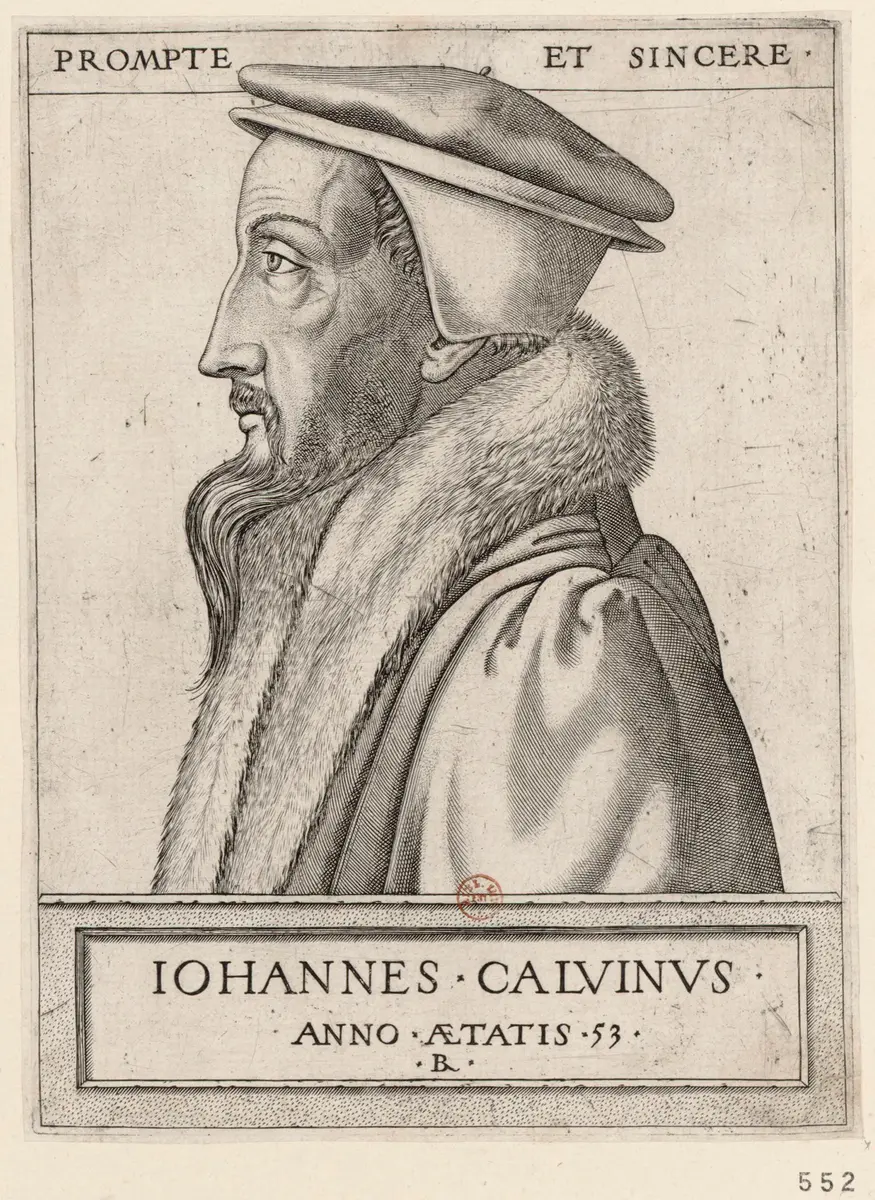
John Calvin
“The French reformer whose Institutes of the Christian Religion and church in Geneva founded Calvinism, the Reformation's second great branch.”
John Calvin was the French theologian and church leader who became the most important figure of the second generation of the Protestant Reformation. His Institutes of the Christian Religion, first printed at Basel in 1536 and rewritten until 1559, became the most influential statement of Protestant belief, and the church he built in Geneva became the pattern for the Reformed and Presbyterian churches of Europe and North America. The faith named after him, Calvinism, stresses the authority of the Bible alone, salvation by God's grace through faith, and predestination, the teaching that God has chosen from eternity those who will be saved.
He was born Jean Cauvin at Noyon in Picardy on 10 July 1509, the son of Gérard Cauvin, who looked after the business of the cathedral clergy. At twelve he was given part of the income of a cathedral chaplaincy to pay for his education, and in 1523 he went to Paris, to the Collège de la Marche and then the Collège de Montaigu, to prepare for the priesthood. His father then switched him to law, which he studied at Orléans and Bourges from 1528; there he also learned Greek and took in the humanism of Erasmus and Lefèvre d'Étaples, and in 1532 he published his first book, a commentary on Seneca's essay On Clemency. Around 1533 came what he later called a sudden conversion. When his friend Nicolas Cop, the university's rector, gave an evangelical address on 1 November 1533, Calvin had to slip out of Paris; in May 1534 he gave up his church incomes, and when placards attacking the Mass appeared in Paris that October and the burnings began, he left France for good.
In Basel, a Protestant city that tolerated many opinions, he wrote the first Institutes, a short handbook of the faith opening with a bold letter to King Francis I in defence of the persecuted French evangelicals. Passing through Geneva in July 1536, two months after the city had voted for the Reformation, he meant to stay one night; the fiery preacher Guillaume Farel told him that God would curse his quiet life of study if he refused to help, and he stayed. The two men tried to force a confession of faith and strict discipline on a reluctant town, and in April 1538 the councils threw them out. Calvin spent three happy years in Strasbourg as pastor to French refugees, learning how to run a city church from Martin Bucer, writing his commentary on Romans and a famous reply to Cardinal Sadoleto, and in 1540 marrying Idelette de Bure, a widow. Their only child died in infancy in 1542, and she died in 1549.
Geneva called him back, and on 13 September 1541 he returned for good. His Ecclesiastical Ordinances, approved that November, gave the church four kinds of officers, pastors, teachers, elders and deacons, and a consistory of pastors and elders that disciplined citizens for everything from Catholic 'superstition' and adultery to tavern life, dancing, gambling and swearing. He preached twice every Sunday and every weekday in alternate weeks, commented on almost every book of the Bible and wrote thousands of letters to Protestants across Europe. Many Genevans resented the discipline and the flood of French refugees, and his position was safe only after his opponents' failed rising of May 1555. The darkest episode came in 1553: the Spanish physician Michael Servetus, who denied the Trinity, was recognised in Geneva, tried with Calvin as his chief accuser and burned alive at Champel on 27 October; Calvin had asked for the sword rather than the fire, but the burning has stained his name ever since. In 1559 he opened the Geneva Academy, with Theodore Beza as its first rector, finished the last Latin edition of the Institutes and was at last made a citizen of the city.
Worn out by work and illness, he preached for the last time on 6 February 1564, said goodbye to the city council and the ministers at his house at the end of April, and died on the evening of 27 May 1564, aged 54. As he had asked, he was buried without a monument in the common cemetery of Plainpalais, and the exact spot is unknown. By then Geneva, whose population doubled between 1545 and 1560, had become a refuge and a school for Protestants from all over Europe, and the pastors it trained carried his teaching to the Huguenots of France, the Dutch, the Scots of John Knox, who called Geneva the most perfect school of Christ since the apostles, and the English Puritans, and through them to North America. His French prose helped shape the written language, and in 1904–05 the sociologist Max Weber famously tied the 'Protestant ethic' to the rise of modern capitalism.
What happened
- 1509
Jean Cauvin is born at Noyon in Picardy, the son of Gérard Cauvin, who looks after the business of the cathedral chapter, and Jeanne Le Franc.
Noyon: the site of the house where he was born in 1509, now the Musée Jean-Calvin- 1521
Aged twelve, he is given part of the income of a chaplaincy in Noyon cathedral to pay for his studies, a benefice for which, as far as is known, he did no work.
Noyon: the site of the house where he was born in 1509, now the Musée Jean-Calvin - 1523
He goes to Paris and enters the Collège de la Marche, where the grammarian Mathurin Cordier teaches him, then the strict Collège de Montaigu, to prepare for the priesthood.
Paris: the Collège de Montaigu on the Montagne Sainte-Geneviève, where he studied in the 1520s (the site of the Bibliothèque Sainte-Geneviève today)- 1528
At his father's wish he turns to law, first at Orléans, then at Bourges, where he also learns Greek and meets the new humanist learning.
- 1531
His father dies, excommunicated by the cathedral chapter after a quarrel over his accounts; Calvin, now free to choose, goes back to the humanities in Paris.
Noyon: the site of the house where he was born in 1509, now the Musée Jean-Calvin- 1532
He publishes his first book, at his own cost: a learned commentary on Seneca's essay On Clemency, signed with the Latin name Calvinus.
- 1533
His friend Nicolas Cop, the new rector of the University of Paris, gives an evangelical All Saints' Day address; in the uproar that follows, Calvin, thought to have had a hand in it, slips out of Paris.
Paris: the Collège de Montaigu on the Montagne Sainte-Geneviève, where he studied in the 1520s (the site of the Bibliothèque Sainte-Geneviève today)- 1534
Back in Noyon, he resigns his church benefices there and at Pont-l'Évêque, his last tie to the Roman Church.
Noyon: the site of the house where he was born in 1509, now the Musée Jean-CalvinOvernight, placards attacking the Mass are posted in Paris and at the royal château; Francis I answers with arrests and burnings, and Calvin leaves France.
- 1535
By way of Strasbourg he reaches Basel, a Protestant city that tolerates many opinions, and lives there quietly, studying theology.
Basel: his refuge in 1535–36, where he wrote and printed the first InstitutesHe dates at Basel his preface to King Francis I, defending the persecuted French evangelicals against the charge of rebellion.
Basel: his refuge in 1535–36, where he wrote and printed the first Institutes- 1536
The Institutes of the Christian Religion comes off the Basel press of Thomas Platter and Balthasar Lasius: a short Latin handbook of the faith that makes his name among Protestant leaders.
Basel: his refuge in 1535–36, where he wrote and printed the first InstitutesPassing through Geneva, which voted for the Reformation in May, he means to stay one night; Guillaume Farel tells him God will curse his quiet studies if he refuses to help, and he stays to lecture on the Bible.
Geneva: the cathedral of Saint-Pierre, where he preached from 1536 to 1538 and from 1541 until 1564; he died in the city and lies in the Plainpalais cemetery- 1538
After he and Farel refuse to give communion to the divided city at Easter, the Council of Two Hundred deposes them and orders them to leave Geneva within three days.
Geneva: the cathedral of Saint-Pierre, where he preached from 1536 to 1538 and from 1541 until 1564; he died in the city and lies in the Plainpalais cemeteryAt Martin Bucer's invitation he preaches his first sermon in Strasbourg as pastor of the French refugee church; he also lectures on the Bible and learns from Bucer how to run a city church.
Strasbourg: pastor of the French refugee church, 1538–41- 1539
His reply to Cardinal Sadoleto, who had urged Geneva to return to Rome, is printed in Strasbourg; the same year brings a much enlarged second Latin edition of the Institutes.
Strasbourg: pastor of the French refugee church, 1538–41- 1540
He marries Idelette de Bure, the widow of an Anabaptist he had won over to his church.
Strasbourg: pastor of the French refugee church, 1538–41- 1541
His own French translation of the Institutes is printed in Geneva, one of the first works of theology in French and a landmark of French prose.
Recalled by a Geneva in disarray, he returns and goes straight to the council to demand a church order based on the Word of God; he will stay for the rest of his life.
Geneva: the cathedral of Saint-Pierre, where he preached from 1536 to 1538 and from 1541 until 1564; he died in the city and lies in the Plainpalais cemeteryThe citizens, assembled in Saint-Pierre, approve his Ecclesiastical Ordinances: pastors, teachers, elders and deacons, and a consistory to oversee the city's morals.
Geneva: the cathedral of Saint-Pierre, where he preached from 1536 to 1538 and from 1541 until 1564; he died in the city and lies in the Plainpalais cemetery- 1542
Idelette gives birth to a son, their only child, who dies in infancy; the Lord, Calvin writes to his friend Pierre Viret, has dealt them a heavy blow, but the Father knows what is best for his children.
Geneva: the cathedral of Saint-Pierre, where he preached from 1536 to 1538 and from 1541 until 1564; he died in the city and lies in the Plainpalais cemetery - 1549
Idelette dies; he calls her the excellent companion of his life.
Geneva: the cathedral of Saint-Pierre, where he preached from 1536 to 1538 and from 1541 until 1564; he died in the city and lies in the Plainpalais cemetery - 1553
The Spanish physician Michael Servetus, condemned by the Catholic Inquisition for denying the Trinity, is recognised at a Sunday sermon in Geneva and arrested; Calvin draws up the charges.
Geneva: the cathedral of Saint-Pierre, where he preached from 1536 to 1538 and from 1541 until 1564; he died in the city and lies in the Plainpalais cemeteryCondemned for heresy, Servetus is burned alive at Champel, outside the walls; Calvin had asked for beheading instead of fire.
Geneva: the cathedral of Saint-Pierre, where he preached from 1536 to 1538 and from 1541 until 1564; he died in the city and lies in the Plainpalais cemetery- 1554
He publishes his Defence of the Orthodox Faith, arguing that heretics may rightly be put to death; Sebastian Castellio answers with a plea for tolerance.
- 1555
A failed rising by the party of Ami Perrin ends the old Genevan families' resistance; from now on his authority in the city is secure.
Geneva: the cathedral of Saint-Pierre, where he preached from 1536 to 1538 and from 1541 until 1564; he died in the city and lies in the Plainpalais cemetery- 1558
He walks the chosen site with the city's magistrates, and building begins on a college for Geneva's new school and academy.
Geneva: the cathedral of Saint-Pierre, where he preached from 1536 to 1538 and from 1541 until 1564; he died in the city and lies in the Plainpalais cemetery- 1559
The final Latin Institutes appears, rebuilt in four books and eighty chapters, and Geneva, where he had long counted as a foreigner, at last makes him a burgher of the city.
Geneva: the cathedral of Saint-Pierre, where he preached from 1536 to 1538 and from 1541 until 1564; he died in the city and lies in the Plainpalais cemeteryThe Geneva Academy is opened in Saint-Pierre before the council, the ministers and some six hundred students; its statutes are read out and Theodore Beza becomes its first rector.
Geneva: the cathedral of Saint-Pierre, where he preached from 1536 to 1538 and from 1541 until 1564; he died in the city and lies in the Plainpalais cemetery- 1562
The full Genevan Psalter, all 150 psalms in French verse by Marot and Beza with tunes for singing, is published and spreads through Protestant France.
- 1564
Worn out and unable to walk, he preaches his last sermon; on Easter Day, 2 April, he is carried to church in a chair for the last time.
Geneva: the cathedral of Saint-Pierre, where he preached from 1536 to 1538 and from 1541 until 1564; he died in the city and lies in the Plainpalais cemeteryHe dictates his will, leaving his small estate to the college, the poor and his nephews and nieces.
At his house he takes leave of the city's Small Council, and the next day of the ministers of Geneva.
Geneva: the cathedral of Saint-Pierre, where he preached from 1536 to 1538 and from 1541 until 1564; he died in the city and lies in the Plainpalais cemeteryHe dies in Geneva towards eight in the evening, aged 54; the next day he is buried, as he asked, without pomp or monument in the common cemetery of Plainpalais.
Geneva: the cathedral of Saint-Pierre, where he preached from 1536 to 1538 and from 1541 until 1564; he died in the city and lies in the Plainpalais cemetery