Joseph Marie Jacquard
“The Lyon silk weaver whose punched-card loom attachment of 1804 let one person weave complex patterns, and whose cards inspired Babbage and the first computers.”
Joseph Marie Jacquard was a silk weaver from Lyon whose name became an ordinary word in fashion. The attachment he completed for the loom in 1804 let one weaver make the richest patterned silks on his own: a chain of punched cards chose, row by row, which threads to lift, a job that had needed a second worker, the drawboy. It helped Lyon's silk trade recover after the French Revolution and win back the lead in Europe, and its idea, a machine that follows instructions stored on cards, ran on to Charles Babbage's Analytical Engine and the punched cards of early computers. Today 'jacquard' still names any fabric or knit with a pattern woven into it.
He was born in Lyon on 7 July 1752 as Joseph Marie Charles; 'Jacquard' was the nickname of his branch of a large Charles family. His father was a master weaver of figured silks, and the boy grew up helping at the loom. When his father died in 1772 he inherited a house and two looms, but his own business failed. For years he lived on odd trades, burning lime and making straw hats, while his wife, Claudine Boichon, plaited straw. In 1793, when Lyon rose against the revolutionary government in Paris, he and his teenage son fought in the defence of the city; after it fell they served in the army of the Republic, and his son was killed.
Back in Lyon he worked on machines to replace the drawboy. He patented a loom in December 1800 and showed it at the national exhibition in the courtyard of the Louvre in September 1801, where it won a bronze medal. In 1803 he was called to the Conservatoire des Arts et Métiers in Paris and studied the automatic loom that Jacques de Vaucanson had built in the 1740s; combining the best of his predecessors' ideas, he had his card-driven mechanism working in Lyon by 1804–05. Napoleon saw it there in April 1805, and in 1806 the invention was made public property: the city of Lyon took it over and paid Jacquard a pension of 3,000 francs a year and a fee on every loom put to work. The silk weavers, afraid for their jobs, broke his machines in public and attacked him, but the new looms won. Napoleon's orders for his palaces filled Lyon's workshops, the attachment reached Britain in the 1820s, and in 1819 Jacquard received a gold medal and the Legion of Honour.
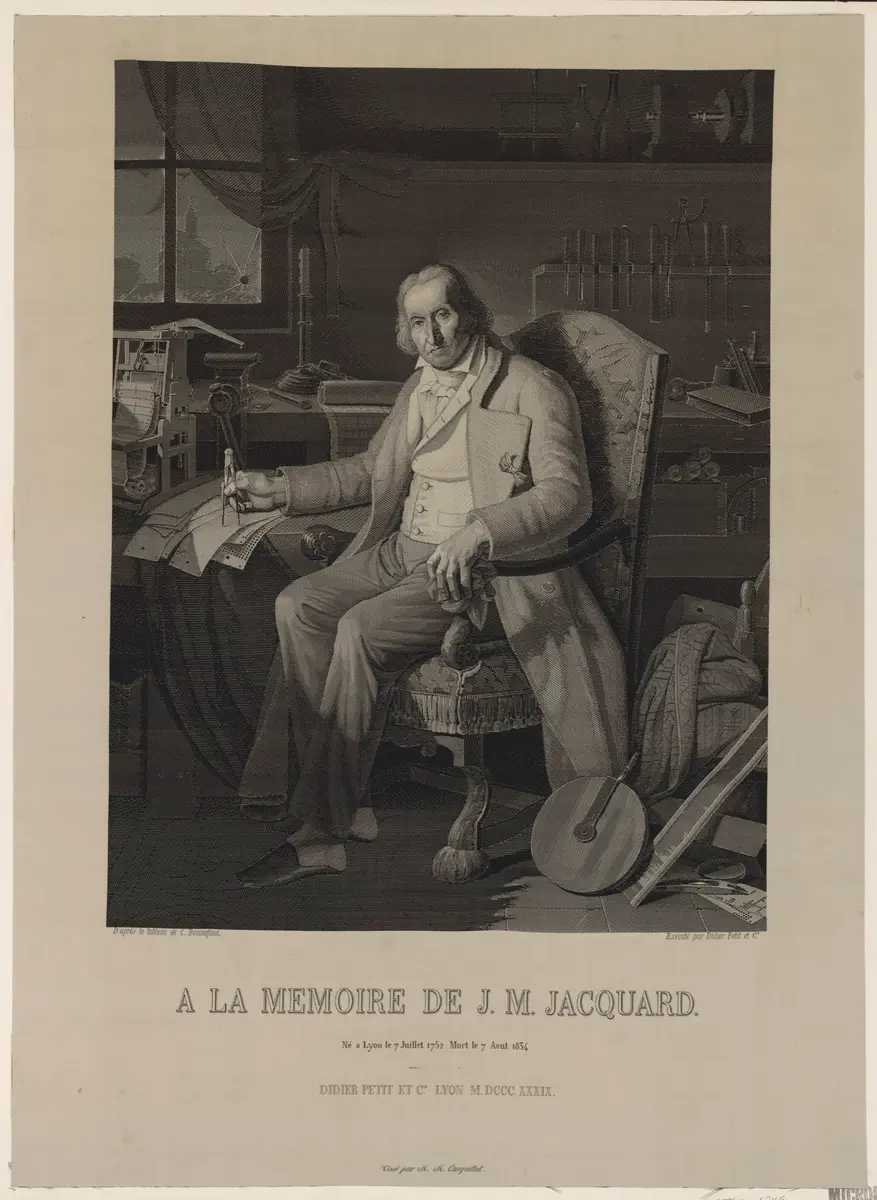
He spent his last years at Oullins, just south of Lyon, and died there on 7 August 1834, aged 82. The city had commissioned his portrait from the Lyon painter Claude Bonnefond in 1831. In 1839 the firm of Didier, Petit et Cie had it woven in black and white silk by Michel-Marie Carquillat on a Jacquard loom, from some 24,000 punched cards; Babbage hung a copy in his London house, and two members of the Royal Academy took it for an engraving. Ada Lovelace wrote that the Analytical Engine 'weaves algebraical patterns just as the Jacquard-loom weaves flowers and leaves'. Lyon raised a statue to him in 1840; its successor stands on the Place de la Croix-Rousse, the hill of the silk weavers, whose tall workshops were built to take his looms.
What happened
- 1752
Joseph Marie Charles, called Jacquard, is born in Lyon into the silk trade: his father is a master weaver of figured silks and his mother works on the patterns.
Lyon: born here on 7 July 1752 into the silk trade; he worked here, fought in the siege of 1793, built his mechanism here from 1804 and faced the weavers' anger- 1772
His father dies and he inherits a small house and two looms; the business he starts on his own account fails and leaves him in debt.
- 1778
He marries Claudine Boichon. In the hard years that follow he works as a lime-burner and a maker of straw hats while she plaits straw.
- 1793
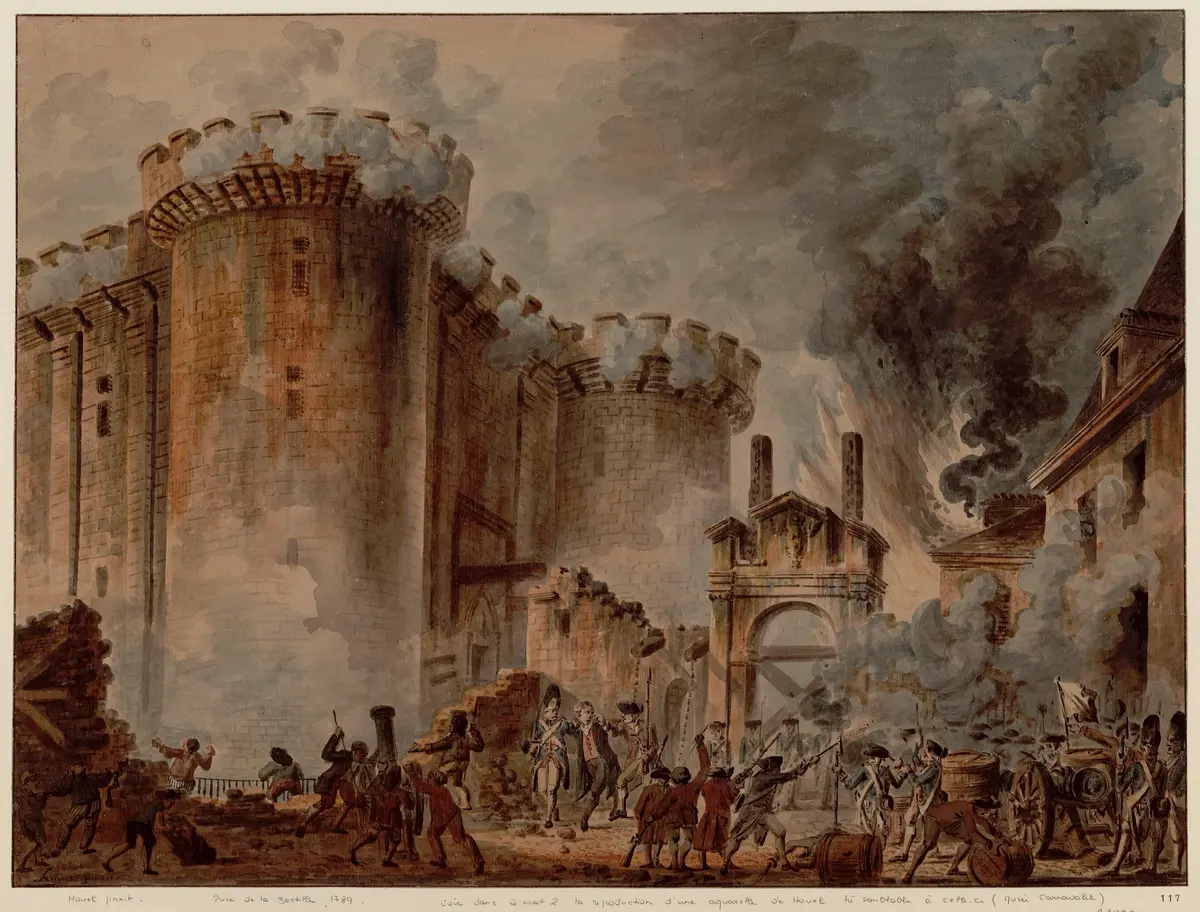
Lyon, which rose against the Convention in Paris, surrenders after a siege of about two months. Jacquard and his teenage son had fought in its defence; to escape the reprisals they join the army of the Republic.
Lyon: born here on 7 July 1752 into the silk trade; he worked here, fought in the siege of 1793, built his mechanism here from 1804 and faced the weavers' anger- 1795
His son is killed beside him while they serve in the army, and Jacquard returns to Lyon to work in a silk workshop.
- 1800
He takes out his first patent, for a loom that does away with the drawboy who pulled the cords of the pattern.
- 1801
He shows his loom at the national exhibition of French industry in the courtyard of the Louvre (19–25 September) and wins a bronze medal; the jury notes only that it 'replaces a worker in the weaving of brocades'.
The courtyard of the Louvre, Paris: the national exhibition of September 1801, where his loom won a bronze medal- 1803
Called to Paris with a machine for knotting fishing nets, he is attached to the Conservatoire des Arts et Métiers, where Vaucanson's automatic loom suggests the improvements he needs.
Conservatoire des Arts et Métiers, Paris (today's Musée des Arts et Métiers): attached here in 1803, he studied Vaucanson's automatic loom - 1804
Lodged by the city in Lyon, he works on the attachment that bears his name: a chain of punched cards that chooses, for each pass of the shuttle, which warp threads to lift.
Lyon: born here on 7 July 1752 into the silk trade; he worked here, fought in the siege of 1793, built his mechanism here from 1804 and faced the weavers' angerHe is given a gold medal and 3,000 francs for the net-making machine he showed in Paris.
- 1805
Napoleon and Josephine, on their way to his coronation as King of Italy, stop in Lyon and see Jacquard and his looms at the Palais Saint-Pierre.
Palais Saint-Pierre, Lyon: the city gave him a room to work in this former abbey; Napoleon saw his looms here in April 1805An imperial decree signed at Lyon grants him a fee of 50 francs for every loom he delivers into use over the next six years.
- 1806
A decree signed by Napoleon in Berlin confirms the pension of 3,000 francs a year voted by the city of Lyon: the invention becomes public property, and Jacquard must work for the city.
- 1811
Napoleon orders 80,000 metres of silk from Lyon to furnish Versailles, part of the imperial orders that revive the city's looms after the Revolution.
- 1812
About 11,000 Jacquard looms are said to be at work in France, despite the weavers who broke his machines in public and threatened his life.
- 1819
He is awarded a gold medal and made a knight of the Legion of Honour.
- 1823
In London a design is squared up on point paper for what is probably the first jacquard-woven textile in Britain, for the Spitalfields silk weaver Stephen Wilson, who had sent a spy to France to study the loom.
- 1831
The city of Lyon commissions his portrait from the painter Claude Bonnefond, who paints him in his workshop among his tools and cards.
Lyon's silk weavers, the canuts, rise up; on 21 and 22 November they fight the troops at the barrier of the Croix-Rousse.
Lyon: born here on 7 July 1752 into the silk trade; he worked here, fought in the siege of 1793, built his mechanism here from 1804 and faced the weavers' anger- 1834
Jacquard dies at Oullins, south of Lyon, aged 82, and is buried in the town's cemetery.
Cemetery of Oullins: he died at Oullins, south of Lyon, on 7 August 1834 and is buried here