China joins the World Trade Organization
“After fifteen years of talks, China joined the WTO on December 11, 2001; its cheap exports then flooded the world, cutting prices and remaking manufacturing, at the cost of the 'China shock' to factory towns.”
On December 11, 2001, China became the 143rd member of the World Trade Organization (WTO), the body that sets the rules of trade between its members. It was the end of the longest negotiation of its kind. China had been one of the 23 countries that founded the WTO's forerunner, the General Agreement on Tariffs and Trade (GATT), in 1947, but its Nationalist government had left after the Communist victory. On July 10, 1986, Beijing asked to get its seat back. It took fifteen years of talks in a special working party in Geneva, and some 900 pages of legal text, before the deal was done.
Talks moved with politics. After the army crushed the protests in Beijing in June 1989, the United States imposed sanctions and the talks stalled; they picked up again in 1992, when Deng Xiaoping pushed the country back toward market reform. China failed to finish in time to be a founding member when the WTO opened on January 1, 1995, and had to apply again. The key was a deal with the United States, China's largest export market. Premier Zhu Rongji brought a far-reaching offer to Washington in April 1999, but President Bill Clinton held back; a month later NATO bombed the Chinese embassy in Belgrade, and the talks froze. They resumed in the autumn, and on November 15, 1999, after six days and nights of bargaining in Beijing, US Trade Representative Charlene Barshefsky and China's trade minister Shi Guangsheng signed the agreement. The European Union followed in May 2000.
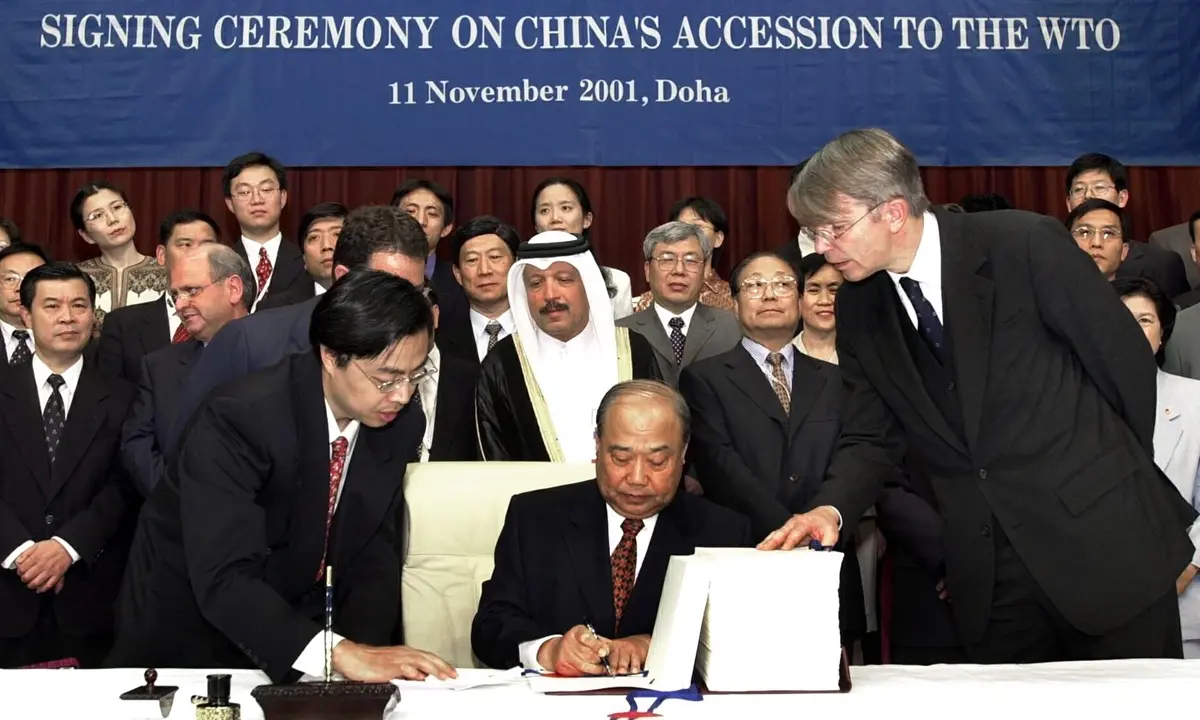
For America the price was a vote in Congress. China's ordinary trading rights in the United States, the 'most-favoured-nation' terms most countries enjoyed, had to be renewed one year at a time, and every year Congress could fight over them. Clinton asked lawmakers to make them permanent, with former Presidents Ford and Carter at his side. The House agreed on May 24, 2000 by 237 votes to 197, the Senate by 83 to 15, and Clinton signed the law on the White House lawn on October 10, 2000. A year later trade ministers meeting in Doha, Qatar, approved China's entry on November 10, 2001; the next evening Shi Guangsheng signed the papers, and thirty days later China was a member. Taiwan joined on January 1, 2002 as 'Chinese Taipei'.
In return China cut its tariffs, opened banking, insurance and telecoms to foreign firms, and promised to follow the same rules as everyone else. What followed changed the world economy. American imports from China, $102 billion in 2001, passed $320 billion by 2007, and in 2009 China overtook Germany as the world's largest exporter of goods. Factories in Shenzhen and along the coast filled container ships with clothes, toys, furniture and electronics for the world, and shoppers in rich countries paid less for many everyday goods.
The economists David Autor, David Dorn and Gordon Hanson named the other side of the story 'the China shock'. American manufacturing lost about a third of its jobs between 2000 and 2010, and their research found that Chinese import competition caused a large part of the fall, with between 2.0 and 2.4 million American jobs lost by 2011. The hardest-hit towns stayed poorer for more than a decade, and their voters drifted toward more extreme politicians. That backlash, and the hope voiced by Clinton and George W. Bush that trade would open up China's politics too, are why the entry is still argued about in every debate on tariffs and on how to deal with China.
What happened
- 1986
China asks the GATT to restore its status as a contracting party. Its ambassador, Qian Jiadong, reminds the GATT Council that China was one of the agreement's original members; the seat was given up by the Nationalist government after the Communist victory.
Centre William Rappard, Geneva: the GATT's and then the WTO's headquarters, where China's request arrived in 1986 and its working party finished in 2001- 1987
The GATT Council sets up a working party to examine China's trade system and draft the terms of its return. Its chairman from June 1987, the Swiss ambassador Pierre-Louis Girard, will lead it for thirteen years.
Centre William Rappard, Geneva: the GATT's and then the WTO's headquarters, where China's request arrived in 1986 and its working party finished in 2001- 1989
On the night of June 3–4 the army clears Tiananmen Square in Beijing. The United States imposes sanctions; the working party meets in July and December, and then not again until September 1990.
Zhongguancun Street, Beijing: a burned-out vehicle days after the crackdown of June 1989- 1992
After 17 months without a meeting, the working party on China sits again in Geneva, as Deng Xiaoping calls on the country to renew its market reforms.
Centre William Rappard, Geneva: the GATT's and then the WTO's headquarters, where China's request arrived in 1986 and its working party finished in 2001- 1994
Ministers meeting in Marrakesh sign the Uruguay Round agreements, which create the World Trade Organization to replace the GATT.
Marrakesh: ministers sign the Uruguay Round deal that creates the WTO, April 15, 1994The last GATT session on China ends without an agreement. When the WTO opens on January 1, 1995, China is not among its founding members.
Centre William Rappard, Geneva: the GATT's and then the WTO's headquarters, where China's request arrived in 1986 and its working party finished in 2001- 1995
China applies to join the WTO, and its GATT working party becomes a WTO accession working party; it first meets as such on March 22, 1996.
Centre William Rappard, Geneva: the GATT's and then the WTO's headquarters, where China's request arrived in 1986 and its working party finished in 2001- 1998
China's trade minister Shi Guangsheng meets the European Commission's Sir Leon Brittan in Brussels for the annual EU–China Joint Committee; they discuss China's WTO entry in depth.
The European Commission's Breydel building, Brussels: Shi Guangsheng's talks with Leon Brittan (1998) and Pascal Lamy (2001)- 1999
- 3:51 p.m.
Premier Zhu Rongji, on his first official visit to the United States, holds a news conference with President Clinton. Their joint statement records 'significant progress' on China's WTO entry, but no deal: banking, securities and film and music services are still open.
The White House, Washington: Zhu Rongji's visit (1999), the campaign for permanent normal trade relations and the signing on the South Lawn (2000) In the night, NATO bombs hit the Chinese embassy in Belgrade during the Kosovo war, killing Chinese citizens. Washington calls it a mistake, but anger in China halts the WTO talks for about four months.
Site of the Chinese embassy in Belgrade, hit by NATO bombs on the night of May 7, 1999US Trade Representative Charlene Barshefsky and economic adviser Gene Sperling open talks at China's Foreign Trade Ministry in Beijing, planned for two days.
China's Ministry of Foreign Trade and Economic Cooperation (today the Ministry of Commerce), 2 East Chang'an Avenue, Beijing: the US–China talks of November 1999With the American team due to fly home, Premier Zhu Rongji meets Barshefsky himself, and the talks start moving again.
After six days and nights, Barshefsky and Shi Guangsheng sign the US–China agreement on China's entry into the WTO. President Jiang Zemin then receives Barshefsky at Zhongnanhai.
Zhongnanhai, Beijing: President Jiang Zemin receives Charlene Barshefsky after the signing, November 15, 1999- 2000
- 10:55 a.m.
In the East Room of the White House, Clinton, former Presidents Ford and Carter and former Secretaries of State Kissinger and Baker urge Congress to give China permanent normal trade relations.
The White House, Washington: Zhu Rongji's visit (1999), the campaign for permanent normal trade relations and the signing on the South Lawn (2000) The European Union and China reach their own agreement on China's WTO entry, negotiated by the EU's trade commissioner Pascal Lamy and Shi Guangsheng.
- 5:41 p.m.
The House of Representatives passes the China trade bill, H.R. 4444, by 237 votes to 197.
The US Capitol: the House (May 24, 2000) and the Senate (September 19, 2000) vote for permanent normal trade relations - 2:21 p.m.
The Senate passes the bill by 83 votes to 15.
The US Capitol: the House (May 24, 2000) and the Senate (September 19, 2000) vote for permanent normal trade relations - 4:52 p.m.
On the South Lawn of the White House, Clinton signs the bill, which becomes Public Law 106-286. China's trading rights in America no longer need a vote every year.
The White House, Washington: Zhu Rongji's visit (1999), the campaign for permanent normal trade relations and the signing on the South Lawn (2000) - 2001
After two days of talks in Brussels, Pascal Lamy and Shi Guangsheng announce that the last open questions between the EU and China are settled.
The European Commission's Breydel building, Brussels: Shi Guangsheng's talks with Leon Brittan (1998) and Pascal Lamy (2001)In Geneva the working party on China holds its 18th and last session and approves some 900 pages of legal text, ending almost 15 years of negotiation. China's chief negotiator, Vice Minister Long Yongtu, calls it 'a memorable day'.
Centre William Rappard, Geneva: the GATT's and then the WTO's headquarters, where China's request arrived in 1986 and its working party finished in 2001At the WTO's fourth Ministerial Conference in Doha, ministers of the 142 members approve China's entry by consensus.
Sheraton Doha hotel, Qatar: the WTO's fourth Ministerial Conference approves China's entry, November 10–11, 2001In the evening, just after ministers approve Taiwan's membership as 'Chinese Taipei', Shi Guangsheng signs China's agreement, 1,500 pages weighing 13 kilograms, and hands the WTO's Director-General Mike Moore China's instrument of ratification.
Sheraton Doha hotel, Qatar: the WTO's fourth Ministerial Conference approves China's entry, November 10–11, 2001Thirty days later China becomes the 143rd member of the World Trade Organization.