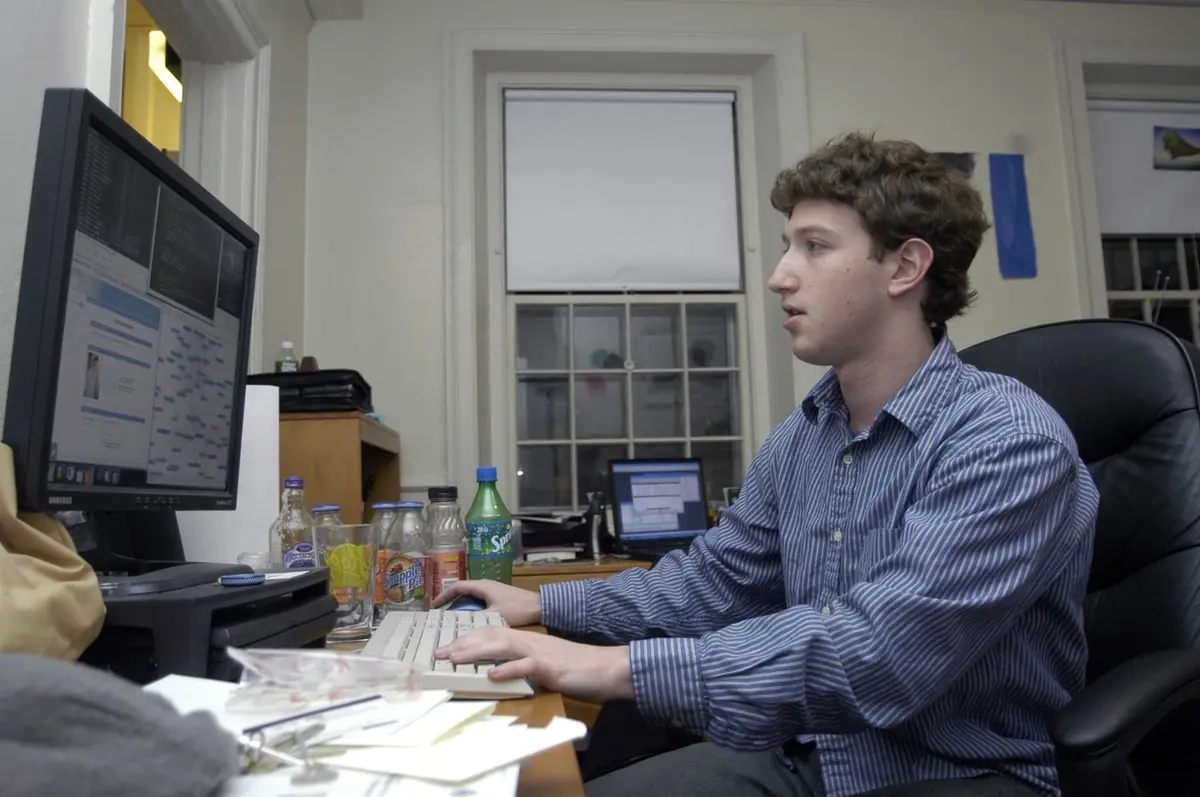
Facebook is founded
“Launched as thefacebook.com from a Harvard dorm on 4 February 2004, Facebook moved to Palo Alto, opened to everyone in 2006 and went public on 18 May 2012, raising $16 billion.”
Facebook began on 4 February 2004 as thefacebook.com, an online directory for Harvard students. Mark Zuckerberg, a 19-year-old sophomore, wrote it in about a week in his room in Kirkland House; his roommates Dustin Moskovitz and Chris Hughes and his friend Eduardo Saverin, who put up the first $1,000, joined him. Students with a Harvard e-mail address posted a photo, their classes and their interests, and linked to their friends. Within a month the site had opened at Columbia, Stanford and Yale. Eight years later, on 18 May 2012, Facebook began trading on the Nasdaq stock market: with 901 million monthly users it raised $16 billion, one of the largest share offerings in history.
The company was built in California. In June 2004 the team moved into a rented house in Palo Alto for the summer and never went back to school. Peter Thiel, a co-founder of PayPal, made the first outside investment, $500,000, followed by the venture firms Accel Partners ($12.7 million in 2005) and Greylock Partners (2006). Facebook opened step by step: to high schools and universities abroad in 2005, to workplaces and then, on 26 September 2006, to anyone with an e-mail address. News Feed (2006) angered users at first but became the heart of the site; Platform (2007) let outside programmers build on it; the Like button (2009) and its spread to other websites (2010) made Facebook the hub of social life online. Advertising paid for it all, and Sheryl Sandberg, hired from Google in 2008, turned it into a business; Microsoft paid $240 million for a small stake in 2007, valuing the young company at $15 billion.
The founding was also fought over in court. The Winklevoss twins, Cameron and Tyler, and Divya Narendra, three Harvard seniors, had asked Zuckerberg in late 2003 to finish the code of their own site, Harvard Connection, later ConnectU. They said he strung them along and took their idea; he said their site was a dating site, far from finished, and that his was different. They sued in September 2004. In 2008 both sides signed a settlement that gave the twins and Narendra cash and Facebook shares, later reported at $65 million; when they tried to undo it, the courts held them to it, and in April 2011 an appeals court said that 'at some point, litigation must come to an end'. Saverin, the first money behind the site, saw his share cut sharply when new shares were issued in 2005; he went to court too, and the case ended in a confidential settlement, after which Facebook's own history named him a co-founder. The 2010 film The Social Network, based on a book told largely from Saverin's side, made these quarrels famous, but it is a drama, not a record.
Facebook was not the first social network: Friendster (2002) and MySpace (2003) came earlier and were bigger at first. What set it apart was that people used their real names inside closed, trusted networks of schools and workplaces, and that it kept adding features that turned friendship into a daily stream of news. By its stock offering it had changed how people share photos and news, how companies advertise and how politicians campaign, and its founder kept control: through shares with ten votes each, Zuckerberg held about 56 percent of the votes. The offering itself stumbled when a computer fault at Nasdaq delayed the first trades, and the arguments about privacy that began with News Feed in 2006 grew into the scandals of later years, above all Cambridge Analytica in 2018.
What happened
- 2003
- 8:13 p.m.
On a Tuesday evening in his Kirkland House room, the sophomore Mark Zuckerberg starts Facemash, copying ID photos from the Houses' online facebooks so that visitors can vote on who is 'hotter'; he logs his progress in a journal on the site.
Kirkland House, Harvard University, Cambridge, Massachusetts: where Zuckerberg wrote Facemash in October 2003 and launched thefacebook.com on 4 February 2004, and where he met the Harvard Connection team Three seniors, Divya Narendra and the twins Cameron and Tyler Winklevoss, ask him to finish the code of their site, Harvard Connection. Over about three months they meet him in Kirkland House and exchange 52 e-mails; he later calls the work informal and the site 'a dating site'.
Kirkland House, Harvard University, Cambridge, Massachusetts: where Zuckerberg wrote Facemash in October 2003 and launched thefacebook.com on 4 February 2004, and where he met the Harvard Connection team- 10:30 p.m.
After a weekend in which some 450 visitors cast at least 22,000 votes and student groups protest, he shuts Facemash down for good; the College's Administrative Board hears the case on 18 November and lets him stay.
Kirkland House, Harvard University, Cambridge, Massachusetts: where Zuckerberg wrote Facemash in October 2003 and launched thefacebook.com on 4 February 2004, and where he met the Harvard Connection team - 2004
Zuckerberg registers the domain thefacebook.com.
He holds a last meeting with the Harvard Connection team in the Kirkland dining hall, saying only that he is busy with other projects; no further work is done on their site.
Kirkland House, Harvard University, Cambridge, Massachusetts: where Zuckerberg wrote Facemash in October 2003 and launched thefacebook.com on 4 February 2004, and where he met the Harvard Connection teamOn a Wednesday afternoon, after about a week of coding, he launches thefacebook.com: anyone with a Harvard e-mail address can post a profile, find classmates by course and House and link to friends. His friend Eduardo Saverin has put in $1,000 to keep the servers running.
Kirkland House, Harvard University, Cambridge, Massachusetts: where Zuckerberg wrote Facemash in October 2003 and launched thefacebook.com on 4 February 2004, and where he met the Harvard Connection teamMore than 650 students have registered after four days, and he expects 900 by the next morning.
Kirkland House, Harvard University, Cambridge, Massachusetts: where Zuckerberg wrote Facemash in October 2003 and launched thefacebook.com on 4 February 2004, and where he met the Harvard Connection teamThefacebook opens at Columbia, at Stanford the next day and at Yale on 1 March; it has just under 7,500 users, each able to see only their own school.
Narendra and the Winklevosses release their own site, ConnectU, and accuse Zuckerberg of stealing their idea; he calls the claim 'completely false'. Harvard's Administrative Board and President Lawrence Summers decline to rule, finding the matter outside the College's rules.
At the end of term Zuckerberg, Moskovitz and friends move to a rented house in Palo Alto for the summer, while Saverin sells advertising from New York. Sean Parker, co-founder of Napster, moves in and joins them; by autumn they decide not to return to Harvard.
819 La Jennifer Way, Palo Alto: the rented house where the team spent the summer of 2004 after leaving HarvardTheFacebook is incorporated in Delaware, with Zuckerberg as chief executive and a director.
Peter Thiel, co-founder of PayPal, makes the first outside investment in the company: $500,000.
Facebook adds the Wall, a space on each profile where friends can post messages. The team moves into a house in Los Altos they call 'Casa Facebook'.
ConnectU sues Zuckerberg, the company and its officers in the federal court in Massachusetts for breach of contract, theft of trade secrets and fraud, and asks for the site to be shut down; Chris Hughes, the company's spokesman and one of the five defendants, answers for it.
Thefacebook reaches one million users; its revenue for 2004 is $382,000.
- 2005
The company leases its first office, at 471 Emerson Street in downtown Palo Alto, under the name 'The Face Book'.
471 Emerson Street, downtown Palo Alto: the company's first office, leased from January 2005; its offices then spread around University Avenue until 2009Accel Partners invests $12.7 million, the first venture round; Accel's Jim Breyer and Peter Thiel have joined the board in April. Facebook now supports more than 800 college networks.
Thefacebook.com drops 'the' and becomes Facebook; in September it also opens to high schools, and in October to universities abroad, and adds Photos.
- 2006
Greylock Partners leads a new investment of $25 million, with Meritech, Accel and Thiel; Facebook has more than seven million users.
Facebook opens to workplace networks.
- 1:03 a.m.
Facebook launches News Feed and Mini-Feed, a running stream of what friends are doing. Many users protest that it exposes them; three days later Facebook adds privacy controls for the feeds.
Facebook opens to anyone with a valid e-mail address, through more than 500 regional networks.
- 2007
At its first f8 conference Facebook opens Facebook Platform to outside developers, with 65 partners and more than 85 applications.
Microsoft takes a $240 million stake at a valuation of $15 billion and becomes Facebook's exclusive partner for advertising sold by others.
Facebook launches its self-service advertising system, Pages for businesses and Beacon, which reports purchases on partner sites to friends; after protests users can turn Beacon off from 6 December.
- 2008
Facebook names Sheryl Sandberg, a vice-president of Google, its chief operating officer, from 24 March.
Judge James Ware in San Jose enforces the settlement that Facebook, ConnectU and the Winklevosses signed at a mediation earlier in the year: Facebook takes over ConnectU, and the founders receive cash and Facebook shares, later reported at $65 million. They appeal.
At f8 in San Francisco Facebook unveils Facebook Connect, which lets people use their Facebook identity on other websites; it has more than 90 million active users and 400,000 developers.
Facebook's own timeline, which until September named only Moskovitz and Hughes as Zuckerberg's co-founders, now also names Eduardo Saverin, whose dispute over his diluted share is settled out of court.
- 2009
- 6:00 p.m.
Facebook introduces the Like button: 'one easy click' to tell friends you like what they shared.
Digital Sky Technologies of Russia invests $200 million for 1.96 percent, valuing Facebook at $10 billion; it has more than 200 million users, 70 percent outside the United States.
Facebook moves its headquarters to 1601 South California Avenue in Stanford Research Park, Palo Alto.
1601 South California Avenue, Stanford Research Park, Palo Alto: Facebook's headquarters from May 2009 to December 2011- 2010
- 10:44 a.m.
At f8 Facebook offers the Like button and other 'social plugins' to every website; many news and shopping sites add them that day.
- 9:23 a.m.
Facebook reaches 500 million active users.
The Social Network, David Fincher's film written by Aaron Sorkin from Ben Mezrich's book, opens in American cinemas and makes the founding disputes world-famous.
- 8:54 p.m.
The Facebook intern Paul Butler publishes a map of the world drawn only from friendships between cities.
- 2011
Investors led by Goldman Sachs put in money at a valuation of $50 billion.
The federal appeals court in San Francisco refuses to let the Winklevosses undo their settlement: 'At some point, litigation must come to an end. That point has now been reached.'
Facebook opens its first self-built data centre, in Prineville, Oregon.
Prineville, Oregon: Facebook's first self-built data centre, opened on 15 April 2011Facebook moves to a new campus in Menlo Park, at 1 Hacker Way.
1 Hacker Way, Menlo Park: Facebook's campus from 19 December 2011, where it filed to go public and where Zuckerberg rang the Nasdaq bell on 18 May 2012- 2012
Facebook files to go public. Its S-1 reports 845 million monthly users, 483 million daily users and, for 2011, revenue of $3.7 billion and a profit of $1 billion.
1 Hacker Way, Menlo Park: Facebook's campus from 19 December 2011, where it filed to go public and where Zuckerberg rang the Nasdaq bell on 18 May 2012Facebook agrees to buy Instagram, a small photo-sharing app, for about $1 billion.
The shares are priced at $38: 421 million shares for $16 billion, one of the largest offerings ever. Facebook has 901 million monthly users, and through his ten-vote shares Zuckerberg will control about 56 percent of the votes.
- 11:30 a.m.
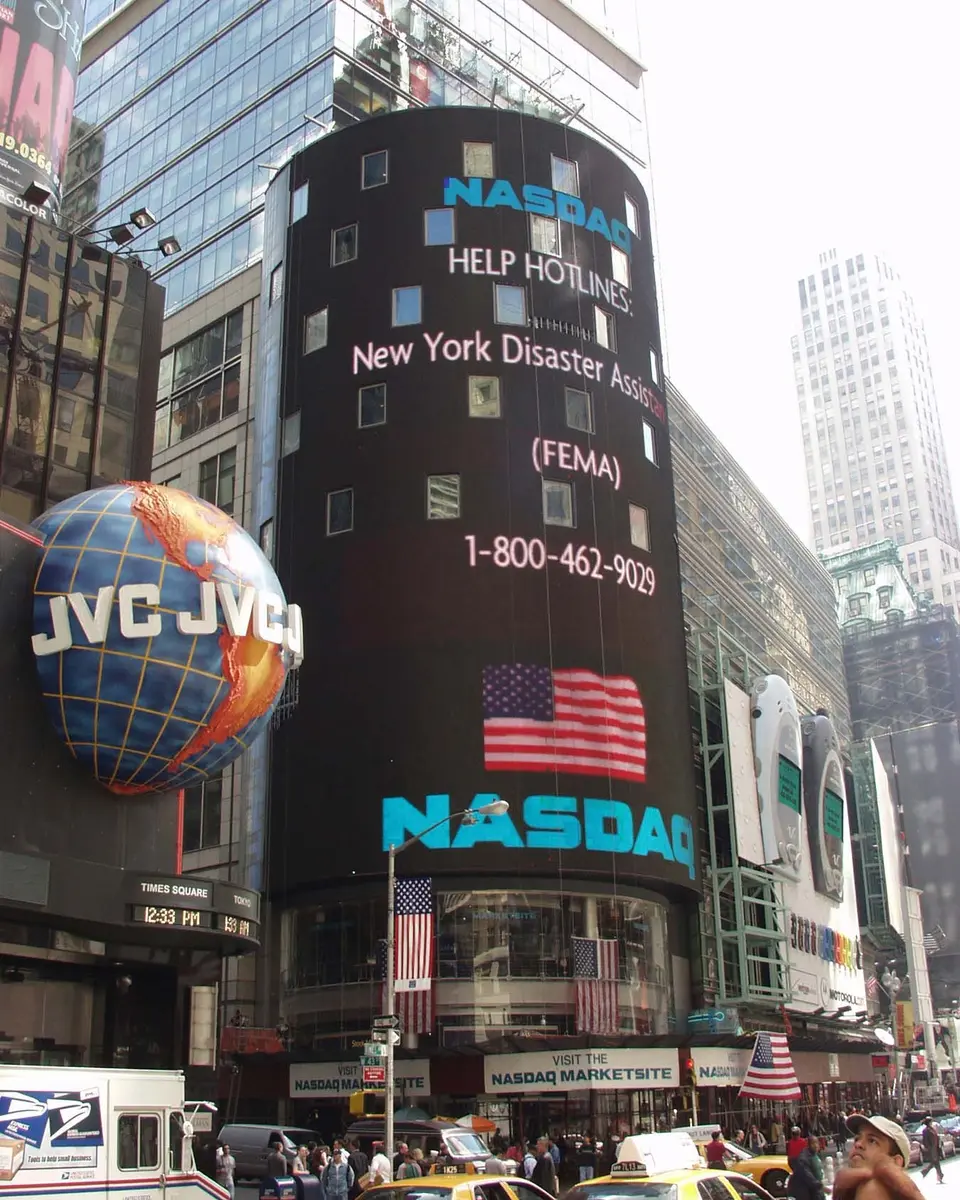
Zuckerberg rings the Nasdaq opening bell from the Menlo Park campus, but a fault in Nasdaq's systems delays the first trade until 11:30 a.m. New York time, when 75.7 million shares change hands at $42. They close the day at $38.23.
1 Hacker Way, Menlo Park: Facebook's campus from 19 December 2011, where it filed to go public and where Zuckerberg rang the Nasdaq bell on 18 May 2012