Google is founded
“Two Stanford students turned a link-ranking research project into Google, incorporated on 4 September 1998 in a Menlo Park garage; search ads made it rich, and its 2004 auction IPO valued it at $23 billion.”
Google began as a student research project at Stanford University. Larry Page, a computer science doctoral student from Michigan, wanted to study the links between web pages: not where a page points, but which pages point to it. With Sergey Brin, a fellow doctoral student, he worked on Stanford's Digital Library Project, which the National Science Foundation paid for together with DARPA and NASA. By early 1996 the two had a program that copied the web and mapped its links. They called it BackRub, after the 'back links' it read. It ran on borrowed machines in the basement of Stanford's new Gates Computer Science Building, with ten 4-gigabyte disks in a cabinet made of Lego bricks.
Their key idea, PageRank, treats a link as a vote and gives more weight to votes from pages that are themselves important. The search engines of the day mostly counted keywords and were easy to fool; ranking by links gave far better results. Stanford, which owned the work, filed a patent with Page as inventor and tried to sell a licence, but no company offered enough. The project was renamed Google, a play on 'googol', the number 1 followed by 100 zeros, and google.com was registered on 15 September 1997. In April 1998 Brin and Page described their prototype, with 24 million pages, in the paper 'The Anatomy of a Large-Scale Hypertextual Web Search Engine'. In an appendix they warned that search engines paid for by advertising would lean towards their advertisers.
In August 1998 Andy Bechtolsheim, a co-founder of Sun Microsystems, watched a short demonstration on a Stanford professor's porch and wrote a cheque for $100,000 to 'Google Inc.', a company that did not yet exist. Page and Brin incorporated it in California on 4 September 1998, raised almost $1 million from family, friends and a few investors, and rented the garage of Susan Wojcicki's house in Menlo Park. Google answered 10,000 searches a day then, and half a million a day by February 1999, when it moved to an office in Palo Alto. In June 1999 the venture firms Sequoia Capital and Kleiner Perkins invested $25 million, and the company moved to Mountain View. It ran on racks of cheap PCs that it built itself, some of them set on sheets of cork.
For two years Google earned little. Its money came from AdWords, launched in October 2000: short text ads shown next to the results for the words an advertiser had chosen. From 2002 advertisers paid only when someone clicked, and the ads were ranked by how often people clicked them as well as by price. Google made its first profit in 2001 and earned $106 million on $962 million of revenue in 2003. Eric Schmidt, the former head of Novell, became chief executive in 2001, with Page and Brin as presidents. On 29 April 2004 the company filed to go public. Its founders' letter began 'Google is not a conventional company', and its two classes of shares, with ten votes for each share held by the founders and other insiders, kept control in their hands.
The shares were sold by an auction instead of the usual allocation by banks: 19.6 million shares at $85 each. Trading began on the Nasdaq on 19 August 2004 under the symbol GOOG, and the offer price valued Google at about $23 billion, four years after the dot-com crash. Google proved that a web company could earn large, steady profits from advertising, and for many people its search box became the front door to the web. Its researchers later wrote the Transformer paper, and its DeepMind lab built AlphaGo, two roots of today's AI boom.
What happened
- 1996
By January 1996 Larry Page and Sergey Brin, doctoral students in Stanford's computer science department, are working together on BackRub, a search engine named for the 'back links' it analyses, inside the NSF-funded Digital Library Project in the new Gates building.
Gates Computer Science Building, Stanford University: home of the Digital Library Project, where BackRub and the first Google machines ran in a basement room from 1996BackRub runs on Stanford's servers and network for more than a year, until it takes up too much of the university's bandwidth; short of money, Page and Brin borrow newly delivered computers from the department's loading docks.
Gates Computer Science Building, Stanford University: home of the Digital Library Project, where BackRub and the first Google machines ran in a basement room from 1996To store their copy of the web they put ten 4-gigabyte disks, the largest then sold, 40 GB in all, into a cheap cabinet built of Lego bricks.
Gates Computer Science Building, Stanford University: home of the Digital Library Project, where BackRub and the first Google machines ran in a basement room from 1996Page and Brin disclose their ranking method to Stanford's Office of Technology Licensing, which offers it to internet companies; some negotiate, but none bids enough.
- 1997
Stanford files the provisional patent application for Page's ranking method (no. 60/035,205).
The domain google.com is registered. The new name plays on 'googol', the number written as 1 followed by 100 zeros.
- 1998
In the first half of 1998 the founders buy a terabyte of disks on their credit cards and build the housings in Page's dorm room, Google's first data centre; they try to license the engine to the big portals, and Yahoo's David Filo advises them to build a company of their own.
Stanford files the full patent application, 'Method for node ranking in a linked database', with Lawrence Page as the inventor: the patent for PageRank.
Brin and Page's paper 'The Anatomy of a Large-Scale Hypertextual Web Search Engine' appears in the proceedings of the Seventh World Wide Web Conference (Brisbane, 14-18 April), describing a prototype with at least 24 million pages at google.stanford.edu.
Andy Bechtolsheim, a co-founder of Sun Microsystems, sees a quick demonstration early one morning on the porch of a Stanford faculty member's home in Palo Alto (David Cheriton's, Stanford says) and writes a cheque for $100,000 to 'Google Inc.', a company that does not yet exist.
Before leaving for the Burning Man festival in Nevada, Page and Brin put the festival's man figure into the logo to tell users they are away: the first Google doodle.
Google sets up in the garage and a spare room of Susan Wojcicki's house at 232 Santa Margarita Avenue, Menlo Park, and hires its first employee, Craig Silverstein, a fellow Stanford graduate student. The beta site already answers about 10,000 searches a day.
232 Santa Margarita Avenue, Menlo Park: Susan Wojcicki's house, whose garage and a spare room were Google's first office from September 1998Google files for incorporation in California. The founders open a bank account in the company's name and deposit Bechtolsheim's cheque; with money from family, friends and other investors they raise almost $1 million.
PC Magazine names Google one of its Top 100 Web Sites and search engines of 1998.
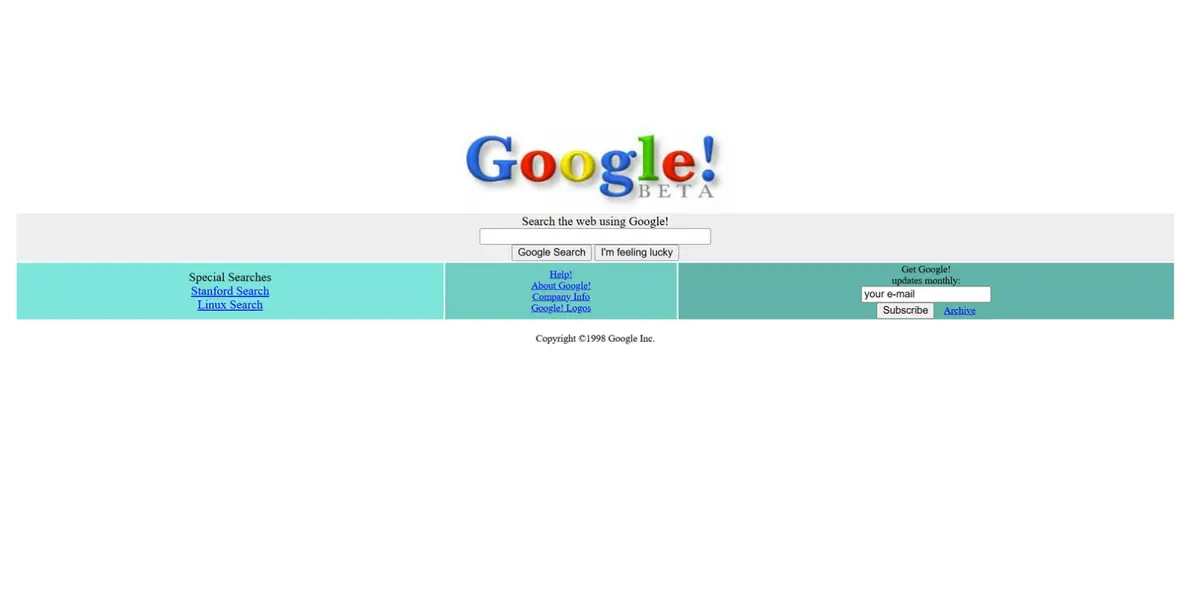
The Internet Archive saves www.google.com as the 'Google!' beta home page, signed 'Copyright ©1998 Google Inc.'; a month earlier google.stanford.edu still said 'Index contains ~25 million pages'.
- 1999
Google outgrows the garage and moves to 165 University Avenue in Palo Alto with eight employees; it now answers more than 500,000 searches a day.
165 University Avenue, Palo Alto: Google's office from February 1999, with eight employeesGoogle announces a $25 million round led by Sequoia Capital and Kleiner Perkins Caufield & Byers, normally rivals; Michael Moritz and John Doerr join the board.
Google moves to its first Mountain View office, at 2400 Bayshore Parkway.
2400 Bayshore Parkway, Mountain View: Google's first Mountain View office, from August 1999The 'beta' label comes off the site. AOL and Netscape have chosen Google for web search, and traffic passes 3 million searches a day, served by racks of cheap PCs that Google builds itself.
- 2000
Google introduces an index of a billion pages, the largest of any search engine; by September it runs about 5,000 PCs for searching and crawling, on racks like the 'corkboard' ones of its first data centre.
Google and Yahoo announce a partnership: Google will answer Yahoo's searches. Google already handles 18 million queries a day.
Google launches AdWords, a self-service programme for keyword ads beside the search results, paid for with a credit card; about 350 advertisers signed up during its beta that month.
- 2001
Eric Schmidt, chief executive of Novell and before that Sun's chief technology officer, becomes chairman of Google's board.
Schmidt becomes chief executive; Page becomes president of products and Brin president of technology, and the three run the company together.
The PageRank patent is granted to Stanford University. Google holds a perpetual licence, exclusive until 2011.
Google ends 2001 with its first profit, $7.0 million on revenue of $86.4 million, after losses in 1999 and 2000.
- 2002
AdWords is rebuilt: advertisers now pay per click, and ads are ranked by how often people click them as well as by the price bid.
- 2003
Google announces AdSense, which places its advertisers' ads on other websites and shares the money with them.
Google reincorporates in Delaware.
Google closes 2003 with revenue of $961.9 million and net income of $105.6 million, and 1,628 employees.
- 2004
Google moves its headquarters, more than 800 employees, to the 'Googleplex' at 1600 Amphitheatre Parkway, Mountain View.
The Googleplex, 1600 Amphitheatre Parkway, Mountain View: Google's headquarters from March 2004, in the former Silicon Graphics campusGoogle announces Gmail, a free web mail service with a gigabyte of storage per user, on April Fools' Day.
- 1:53 p.m.
Google files its registration statement for an initial public offering. Page's letter to future shareholders, 'An Owner's Manual', opens 'Google is not a conventional company' and explains the dual-class shares and the auction.
The auction sets the price at $85: 19,605,052 Class A shares, 14,142,135 sold by Google and the rest by existing holders, $1.67 billion in all, $1.17 billion of it to Google after the underwriters' fees.
- 6:19 a.m.
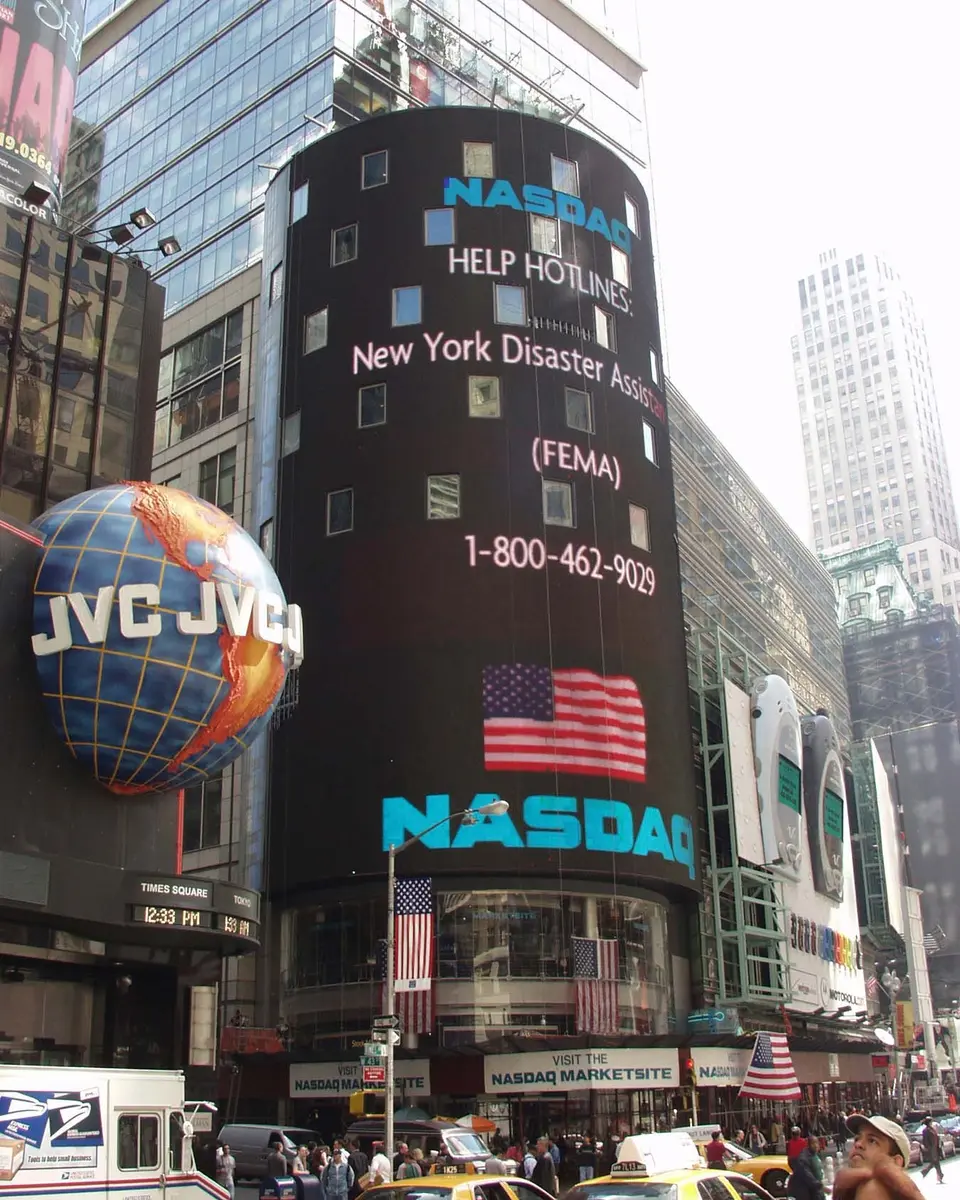
EDGAR accepts the final prospectus at 06:19, and Google's shares begin trading on the Nasdaq National Market under the symbol GOOG; at $85 the 271 million shares are worth about $23 billion.