Tim Berners-Lee
“The English scientist who invented the World Wide Web at CERN in 1989–90 (URLs, HTTP, HTML, the first browser and server) and gave it to the world for free.”
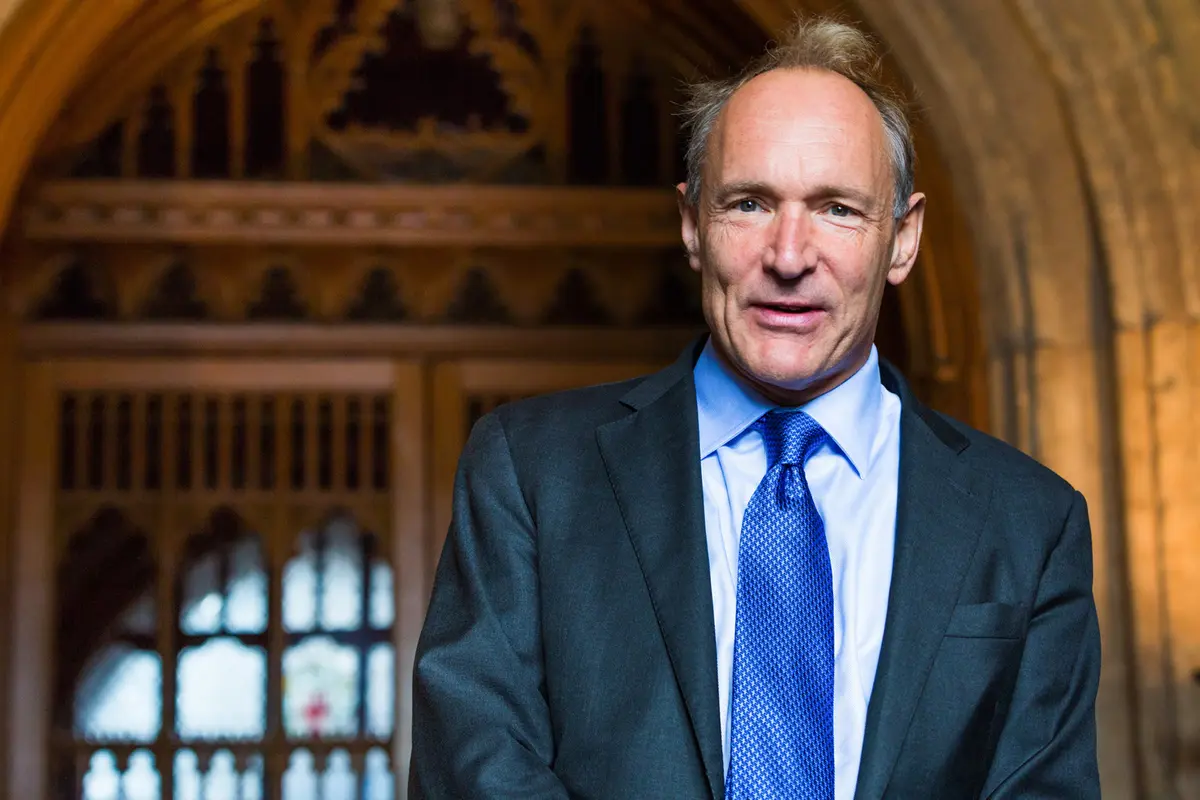
Tim Berners-Lee is the English computer scientist who invented the World Wide Web. Working at CERN, the European particle physics laboratory near Geneva, he proposed in March 1989 a system of linked documents spread over the internet, and by Christmas 1990 he had written everything it needed: the addresses we now call URLs, the HTTP protocol by which a browser asks a server for a page, the HTML language in which pages are written, the first web server and the first browser, which could also edit pages. The web is not the internet: the internet is the network of computers and cables that grew out of ARPANET; the web is the space of pages and links that runs on top of it.
He was born in London on 8 June 1955. Both his parents, Conway Berners-Lee and Mary Lee Woods, were mathematicians who had met while working on the Ferranti Mark 1, the first computer sold commercially, and he grew up with paper tape and electronics in East Sheen in south-west London. He went to Emanuel School and read physics at Queen's College, Oxford, where he built a computer out of an old television set, logic chips and an early microprocessor, and graduated in 1976. He then wrote software for Plessey Telecommunications in Poole and for D. G. Nash in Ferndown, and in the second half of 1980, as a consultant at CERN, wrote for his own use a note-keeping program called Enquire, in which any note could be linked to any other: the seed of the web. In 1984 he returned to CERN with a fellowship to work on the laboratory's computer systems.
CERN had thousands of visiting scientists, many kinds of incompatible computers, and information that was easily lost. In March 1989 he wrote 'Information Management: A Proposal'; his manager, Mike Sendall, scribbled 'Vague but exciting' on the cover and in 1990 let him buy a NeXT computer and try. With the Belgian engineer Robert Cailliau he rewrote the plan in November 1990, named the project the World Wide Web, and before the year was out had the first website running on the NeXT in his office in Building 31, with a hand-written label warning everyone not to switch it off. In August 1991 he announced the software on internet newsgroups, and servers followed: at SLAC in California that December, around 50 by the start of 1993. When the Mosaic browser of 1993 made the web easy to use on ordinary computers it spread explosively, and on 30 April 1993 CERN gave up all rights to the code so that anyone could use it free. He never patented it.
In 1994 he left CERN for the Massachusetts Institute of Technology, where on 1 October he founded the World Wide Web Consortium (W3C) to keep the web's standards open and shared, and directed it for many years. Honours followed: a knighthood in 2004, the Order of Merit in 2007, the Queen Elizabeth Prize for Engineering in 2013 and the Turing Award, computing's highest prize, for 2016. At the opening of the London Olympics in 2012 he sat at a NeXT computer in the stadium while the words 'This is for everyone' lit up the stands.
In later life he became the web's critic as well as its father, warning about the loss of privacy, the spread of lies and the power of a few large companies. His World Wide Web Foundation, set up in 2008–09, campaigns for an open web; in 2018 he launched Solid, a way for people to keep their own data, and a company, Inrupt, to build it. He has taught at MIT, Southampton and, since 2016, Oxford, and in September 2025 told his story in the memoir 'This Is for Everyone'. His most lasting decision was the simplest: to give the web away.
What happened
- 1955
Timothy Berners-Lee is born in London, the son of Conway Berners-Lee and Mary Lee Woods, mathematicians who met while working on the Ferranti Mark 1, the first computer sold commercially. He grows up in East Sheen, playing with paper tape and electronics.
East Sheen, south-west London: the family home where he grew up; a mosaic unveiled in 2013 at the Sheen Lane Centre honours him- 1976
He graduates in physics from Queen's College, Oxford, where he has built his own computer from an old television, logic chips and an M6800 microprocessor kit, and joins Plessey Telecommunications at Poole in Dorset.
The Queen's College, Oxford: he read physics here and graduated in 1976 - 1978
He moves to D. G. Nash in Ferndown, Dorset, writing typesetting software for printers and a multitasking operating system.
- 1980
As a consultant at CERN from June to December, he writes for his own use 'Enquire', a program in which any note can be linked to any other: the idea behind the web.
CERN Building 31, Meyrin site: where he wrote the 1989 proposal and in 1990 ran the first web server and browser on his NeXT- 1984
After three years at Image Computer Systems, he returns to CERN on a fellowship, working on software for collecting experimental data and controlling the laboratory's systems.
CERN Building 31, Meyrin site: where he wrote the 1989 proposal and in 1990 ran the first web server and browser on his NeXT - 1989
In Building 31 he writes 'Information Management: A Proposal' for a linked system of documents across CERN's computers. His manager, Mike Sendall, writes on his copy: 'Vague but exciting'.
CERN Building 31, Meyrin site: where he wrote the 1989 proposal and in 1990 ran the first web server and browser on his NeXT- 1990
After the proposal goes round again in May, Sendall lets him buy a NeXT computer and start building a global hypertext system. He moves into the larger of his two offices, where the NeXT stands.
CERN Building 31, Meyrin site: where he wrote the 1989 proposal and in 1990 ran the first web server and browser on his NeXTHe starts coding a browser that can also edit pages, and chooses a name for it and for the whole project: WorldWideWeb, over 'Information Mesh' and 'Mine of Information'.
CERN Building 31, Meyrin site: where he wrote the 1989 proposal and in 1990 ran the first web server and browser on his NeXTWith Robert Cailliau of CERN's Electronics and Computing for Physics division he sends management 'WorldWideWeb: Proposal for a HyperText Project', asking for people to build it.
CERN Building 31, Meyrin site: where he wrote the 1989 proposal and in 1990 ran the first web server and browser on his NeXTBy Christmas the first web server (nxoc01.cern.ch, later info.cern.ch), the first browser-editor and a simpler line-mode browser by the student Nicola Pellow all work. The first web page describes the project itself.
CERN Building 31, Meyrin site: where he wrote the 1989 proposal and in 1990 ran the first web server and browser on his NeXT- 1991
The web software goes on general release on CERN's central computers.
CERN Building 31, Meyrin site: where he wrote the 1989 proposal and in 1990 ran the first web server and browser on his NeXTHe announces the World Wide Web on the internet newsgroup alt.hypertext and makes the software free to download. Interest spreads around the world.
Paul Kunz sets up the first web server outside Europe, at the Stanford Linear Accelerator Center in California.
- 1993
CERN declares the web software public domain: anyone may use, copy, change and share it, with no fees. With the easy Mosaic browser out since February, the web takes off.
CERN Building 31, Meyrin site: where he wrote the 1989 proposal and in 1990 ran the first web server and browser on his NeXT- 1994
The First International World Wide Web Conference, organised by Robert Cailliau, opens at CERN; attended by 380 people, it is hailed as the 'Woodstock of the Web'.
CERN Building 31, Meyrin site: where he wrote the 1989 proposal and in 1990 ran the first web server and browser on his NeXTHaving left CERN for MIT, he founds the World Wide Web Consortium at MIT's Laboratory for Computer Science, with CERN's support, to keep the web's standards open. He will lead it for decades.
Ray and Maria Stata Center, MIT, Cambridge, Massachusetts: home since 2004 of MIT's computer science laboratory, where he founded and led the World Wide Web Consortium from 1994- 1999
He publishes 'Weaving the Web', his account of the invention, and becomes the first holder of MIT's 3Com Founders chair.
- 2004
The Queen knights him at Buckingham Palace 'for services to the global development of the Internet'. The same year he wins the first Millennium Technology Prize and takes a professorship at Southampton.
- 2008
At the Newseum in Washington he announces the World Wide Web Foundation, launched in 2009 to fight for an open web that everyone can use.
- 2009
CERN celebrates twenty years since his proposal; he poses with the NeXT, Robert Cailliau and Ben Segal.
CERN Building 31, Meyrin site: where he wrote the 1989 proposal and in 1990 ran the first web server and browser on his NeXT- 2012
At the opening ceremony of the London Olympics he appears in the stadium at a NeXT computer, and the words 'This is for everyone' light up the stands.
Olympic Stadium, London: at the opening ceremony on 27 July 2012 he appeared at a NeXT computer and 'This is for everyone' lit up the stands- 2013
He shares the first Queen Elizabeth Prize for Engineering with the internet pioneers Vint Cerf, Bob Kahn and Louis Pouzin and the Mosaic author Marc Andreessen.
- 2016
He joins the Department of Computer Science at the University of Oxford as a professor.
- 2017
He is named winner of the 2016 Turing Award, computing's highest prize, for inventing the web, the first browser and the protocols and algorithms that let the web grow.
- 2018
In 'One Small Step for the Web' he launches Solid, an open system for people to keep and control their own data, and the company Inrupt to build it.
As Web Summit opens in Lisbon, his World Wide Web Foundation proposes a binding 'Contract for the Web' for governments, companies and citizens.
- 2025
His memoir 'This Is for Everyone', written with Stephen Witt, is published.